Five Panel Caps Material and Sizing Guide for Buyers
Two five-panel caps can share the same artwork, the same color, and even the same size label, then wear completely differently once they are on a head. That is the part buyers underestimate. A clean Five Panel Caps material and sizing guide helps you catch those differences before production starts, because fabric, crown construction, and closure range all affect fit in ways a flat spec sheet cannot fully show.
For buyers, the cost of a small sizing miss is rarely small. It shows up in extra sampling, slower approvals, and awkward reorders. A cap that looks right on a table can still feel shallow, tight, or oddly tall in wear. That gap between visual approval and actual comfort is where most avoidable mistakes happen.
A cap that passes a flat lay check can still fail a wear test. The head, not the spec sheet, tells the truth.
Fit also connects to packaging and transit. Caps that ship in loose cartons, overcompressed packs, or inconsistent inserts can arrive with a different shape than the approved sample. That is one reason practical buyers think about the full route from sewing line to final handoff. In some programs, corrugated cardboard cartons, kraft paper inserts, and FSC certified board are not branding details; they are part of controlling the condition of the product. For reference, the ISTA test standards and the FSC material guidelines are useful touchpoints.
Why five-panel caps fit differently on first wear
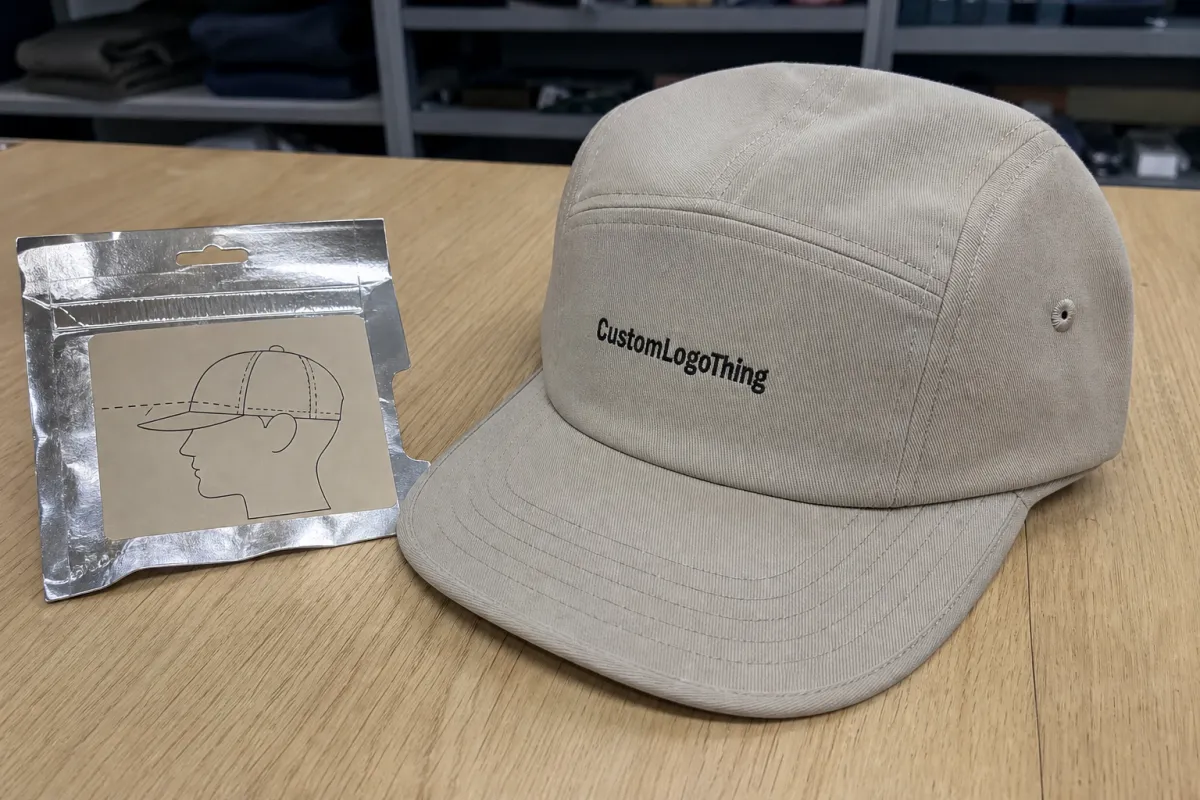
The five-panel structure changes the geometry of the cap. A six-panel crown spreads the front shape across more seams. A five-panel cap gives you one wider front panel, which creates a flatter decoration area and a different drape around the forehead. That is why five-panel caps often read lower-profile and more streetwear-led. The silhouette is simple. The fit behavior is not.
Front panel shape is only part of the story. The actual wearing experience comes from the combination of crown depth, seam placement, internal reinforcement, sweatband thickness, and closure type. A cap made from soft cotton twill can settle into a relaxed profile. The same pattern in firm canvas can feel much more tailored, even if every measurement on the spec sheet stays the same.
That matters because many buyers approve based on appearance alone. The first sample arrives, the logo sits neatly, and the cap photographs well. Then it is tried on by someone with a slightly wider head or a different hair volume, and the result changes immediately. That does not mean the sample is wrong. It means the evaluation was incomplete.
Five-panel caps also tend to feel smaller than their measurements suggest. The flatter front and lower crown reduce perceived volume, especially on heads with more width at the temples or more fullness at the back. A cap can technically cover a 58 cm circumference and still feel snug if the front profile is shallow or the sweatband takes up too much usable room.
The safest way to review a cap is in three layers: measurement, silhouette, and wear test. If one layer is missing, the first sample is doing too much work. Buyers who separate those layers early usually move through sampling faster and with fewer surprises.
How panel shape, crown build, and fabric change the look
The broad front panel is one of the main reasons five-panel caps remain popular for custom branding. It gives you a clean field for embroidery, woven labels, patches, and printed marks. That same uninterrupted surface is also sensitive to structure. If the fabric is too soft, the front can collapse slightly. If the build is too rigid, the cap can look boxy or stiff. The right balance depends on how the product is meant to read in the market.
Cotton twill remains the most familiar starting point. It is breathable, predictable, and easy to source in a range of finishes. Brushed cotton feels softer and more relaxed. Canvas adds body, which is useful if the goal is a crisp front panel and stronger shape retention. Polyester and nylon blends generally feel lighter and more technical, and they dry faster, which suits outdoor or performance-led programs. The tradeoff is visual: some synthetic fabrics look slightly shinier or less casual than buyers expect from a lifestyle cap.
Internal build changes the result just as much as fabric. Buckram or firm interfacing can make the front stand up cleanly, which is useful for embroidery and more structured branding. Remove that support and the cap relaxes. That may suit a softer brand position, but it can also allow the front panel to wrinkle or the logo to lose definition if the fabric is too light.
Sweatband construction matters too. A thicker sweatband can improve comfort and moisture control, but it also reduces the internal room slightly. That is easy to miss until fit testing begins. Small details add up. On paper, a cap may still fall within tolerance. On-head, it can feel noticeably different.
Closures create another layer of tradeoff. A snapback offers a wider adjustment range and is simple to size across more wearers. A strapback usually looks cleaner but may have a narrower comfort window. Velcro is practical and quick to adjust, though some teams dislike the finish. Metal buckle closures often feel more premium, but they can increase cost and add a little weight at the back.
For a quick buying comparison, this is usually where the discussion becomes concrete:
| Material / build | Typical feel | Shape retention | Decoration fit | Typical unit cost impact |
|---|---|---|---|---|
| Cotton twill | Balanced, familiar, breathable | Medium | Very good for embroidery and patches | Baseline |
| Canvas | Heavier, more structured | High | Strong front panel support | +8% to +18% |
| Polyester / nylon blend | Lighter, sportier, smoother | Medium to high | Good for print, labels, and lightweight embroidery | +5% to +15% |
| Brushed cotton | Soft, relaxed, casual | Low to medium | Best when the logo does not need a rigid panel | Baseline to +6% |
| Organic or recycled blend | Varies by yarn and finish | Medium | Good if the front panel is reinforced properly | +10% to +20% |
If sustainability is part of the brief, ask for the actual fiber content and trim breakdown. Some suppliers can offer recycled materials or post-consumer waste content in the fabric, and some can pair that with biodegradable packaging components or recycled kraft inserts. The useful question is not whether the product is “eco-friendly.” It is what specific materials are in the fabric, the trims, and the pack-out.
Five panel caps material and sizing guide: what to measure
A useful Five Panel Caps material and sizing guide starts with more than one number. Head circumference matters, but crown height, front panel width, brim curve, and closure range all influence the final fit. If you only compare head size, you can still approve a cap that wears too shallow, too tall, or too tight around the forehead.
Head circumference is the starting point. Measure where the cap is meant to sit, usually just above the ears and across the mid-forehead line. Then compare that figure to the closure range or fitted size spec. For adjustable caps, the real question is how much usable room remains at both ends of the adjustment range. A cap that technically fits one wearer may still be too narrow for a broader audience.
Crown height shapes the silhouette more than buyers expect. A low crown creates a compact look, but if it is too low, the cap can feel shallow or sit awkwardly. A higher crown gives more room, though it can look oversized on smaller heads. Front panel width matters for logo placement and for how the cap frames the face. A wide logo needs panel space. A small centered mark may look cleaner on a broader front panel, but it still needs to sit in the right visual zone.
Brim curve changes the wear experience as well. A flat brim and a pre-curved brim do not behave the same way, even if the cap measurements are identical. Flat brims often read more modern and retail-ready. Pre-curved brims are easier for first-time wearers because they feel familiar straight out of the box. That choice affects first impression more than many buying teams realize.
Here is a practical workflow that reduces avoidable errors:
- Measure the intended wearer group, or at least a small representative sample.
- Decide whether the cap needs to fit a narrow audience or a broad one.
- Confirm crown depth, panel width, and closure range on the spec sheet.
- Request a physical sample before bulk production.
- Fit-test the sample on multiple head shapes, not just one person.
That last step matters because two heads with the same circumference can wear the same cap very differently if one is rounder and one is more oval. The tape measure does not catch that. The wear test does.
For fitted programs, the tolerance window is tighter and the risk is higher. If the audience is still being defined, adjustable sizing is usually the safer path. It gives you more room to absorb small variations in head shape without forcing a hard decision too early.
Process and lead time: from spec sheet to approved sample
The fastest orders are not the ones with the fewest questions. They are the ones with the clearest brief. A good spec sheet should include material, crown height, panel count, closure type, decoration method, label placement, and fit notes. If those details are spread across separate messages, the sample process slows down and mistakes multiply.
The usual sequence is simple: brief, material selection, size confirmation, mockup, sample, revision, and final approval. The weak point is the handoff between visual approval and wear approval. A sample can be approved for artwork placement and still miss the fit target. A better review checks both. That means looking at how the front panel sits, whether the sweatband pinches, and whether the closure reaches a comfortable range without strain.
Lead time is usually driven by three things: fabric availability, decoration complexity, and the number of revisions after sampling starts. A plain twill cap with a simple embroidered logo can move quickly. A cap with custom woven labels, specialty patches, and a custom closure will take longer. If the fabric needs to be sourced as a low-volume custom run, the schedule stretches again.
Packaging can also affect timing, especially if the caps are meant for retail shelves or distributed kits. A basic pack-out in standard corrugated cardboard cartons with plain kraft paper protection is easier to execute than a program with tissue wrapping, printed inserts, and multiple presentation components. That does not make premium packaging a bad choice. It just means the packaging spec needs to be treated as part of the production plan, not as decoration added at the end.
In practical terms, the first sample should answer three questions: does the silhouette work, does the fit feel right, and does the decoration hold up at normal viewing distance? If it fails one of those checks, fix that issue before asking for more cosmetic changes. Chasing minor details before the structure is right usually wastes time.
Cost, pricing, MOQ, and unit-cost tradeoffs
Material selection shifts price more than many buyers expect. Basic cotton twill usually sits near the lower end of the range. Heavier canvas, specialty performance blends, and more structured builds cost more because the fabric itself costs more and because the cap may need extra handling to keep its shape. Custom trims, upgraded closures, and specialty finishing all move the number again. A cap body can look simple while the bill of materials is not.
MOQ matters because setup costs are spread across fewer units on smaller runs. At 500 pieces, the per-unit cost will often be materially higher than at 2,000 pieces. That is normal. The useful question is whether the extra cost buys something real: better structure, cleaner embroidery, more consistent sizing, or fewer returns later.
Decoration is another major lever. Embroidery is usually durable and visually strong, but dense stitching can increase cost if the logo is large or detailed. Woven labels are efficient for smaller marks. Patches add texture and perceived value, though the patch material, border style, and application method all affect price. Full-panel printing changes the hand feel and often the production time as well.
A practical buying rule: pay a little more for fit and finish if the cap is part of a launch, a retail program, or a client-facing uniform order. A cap that fits poorly creates returns, remakes, and delays that cost more than the unit-price difference. Saving 20 cents per cap and losing two weeks is a poor trade.
Directional pricing often looks like this:
- Basic cotton twill five-panel cap: roughly $2.10-$3.20 per unit at mid-sized quantities
- Structured canvas or premium twill cap: roughly $2.80-$4.20 per unit
- Performance blend with custom trims: roughly $3.00-$5.80 per unit
- Add-ons like woven labels, patches, or special closures: often add $0.20-$0.90 each, depending on quantity and method
Those figures are only directional. Final cost depends on country of origin, labor content, fabric sourcing, and whether packaging is bundled into the quote. If the order includes retail-ready cartons, custom hang tags, or sustainability paperwork, the cost can shift again. Some programs also require presentation details such as FSC certified inserts or recycled pack materials, which may add a modest premium but improve how the product is received.
The best budget choice is not always the cheapest cap. Sometimes it is the one that reduces sampling cycles and keeps the fit consistent across reorders.
Common sizing mistakes that trigger rework or returns
The most expensive sizing mistake is approving a sample after a brief glance instead of a real wear test. A cap can look balanced for a photo and still become irritating after 20 minutes. Pressure at the forehead, a closure that sits too tight, or a crown that rides too high can all pass visual inspection. They fail comfort.
Ignoring crown depth is another common problem. The measurement sounds technical until it affects a real head shape. Too shallow, and the cap sits on top of the head instead of around it. Too deep, and the front panel can collapse or pull down toward the ears. Buyers tend to focus on circumference because it is easy to compare. That is exactly why crown depth gets overlooked.
“One size fits most” also hides more than it reveals. A neat label does not guarantee a useful comfort range. If the audience includes different head shapes, hair volumes, or age groups, the fit range has to reflect that. Adjustable caps help, but adjustment range is not the same as lasting comfort. There is a difference between technically wearable and genuinely easy to wear for hours.
Changing material late in the process creates a different kind of risk. A fabric swap can alter the fit perception even if the measurements stay the same. Moving from brushed cotton to canvas usually makes the cap feel firmer. Moving from canvas to nylon usually makes it feel lighter and more forgiving. The spec sheet may not show that shift. The wearer will.
Packaging can expose fit mistakes as well. Caps packed too tightly can flatten differently from one shipment to another, and that changes the way the brim and crown recover on arrival. If the order is retail-facing, the pack-out method should be part of the approval process. A cap shipped in a clean corrugated carton with proper internal support is more likely to arrive close to spec than one packed loosely with no shape control.
Expert next steps: build a better spec before you order
If there is one habit that improves cap buying more than anything else, it is this: write a better spec before requesting a quote. Not a vague brief. A working document. Include head size range, crown depth, panel shape, fabric, closure type, decoration method, label placement, and fit notes. Then add a sentence that defines what success looks like. Soft and relaxed? Clean and structured? Low-profile and sharp? That sentence helps everyone judge the sample against the same target.
Once the sample arrives, test it on multiple people. Different head sizes. Different hair volumes. Different wear preferences. The goal is not to run a formal lab test. The goal is to see whether the cap behaves properly across the audience it is meant to serve. If it only works on one person, the spec is too narrow.
Then check the details that often get skipped:
- Artwork scale relative to the front panel width
- Panel alignment and seam symmetry
- Label placement on the interior or rear band
- Closure comfort at the tightest and loosest ends of the range
- Brim curve consistency across samples
Keep the approved sample as the reference point for reorders. A five panel caps Material and Sizing guide should work like a live checklist, not a one-time download. That is how you protect consistency when the next run happens months later and the original approval details are no longer fresh in anyone’s memory.
If the program includes presentation packaging, lock that in before release as well. A cap shipped with kraft paper protection, corrugated cardboard outer cartons, and sensible use of biodegradable packaging materials can support the product story without overcomplicating the line. The key is matching the packaging tier to the order tier: premium presentation for premium drops, efficient protection for bulk replenishment.
Used properly, the Five Panel Caps material and sizing guide is not just a reference. It is a production tool. That is what separates a cap that looks right from a cap that actually wears right.
How do I measure five panel caps sizing correctly?
Measure head circumference at the point where the cap will sit, then compare that number to the closure range or fitted size spec. Check crown depth and front panel width too, because those dimensions affect how the cap actually feels on-head.
Which material is best for five-panel caps if I want a structured look?
Cotton twill, canvas, and some blended fabrics usually hold shape better than soft, drapey materials. If the front panel needs to support embroidery or patches, ask for structure details such as buckram or firm interfacing.
What affects five-panel cap pricing the most?
Material, decoration method, and MOQ usually drive the biggest price swings. Sampling, label changes, and closure upgrades can add cost even when the cap body itself looks simple.
How long is the turnaround for custom five-panel caps?
Lead time depends on fabric availability, sample revisions, and the complexity of decoration. The fastest way to shorten turnaround is to approve measurements, artwork placement, and materials before sample production starts.
What should be included in a five-panel cap spec sheet?
Include head size range, crown depth, panel style, fabric, closure, decoration method, and label details. Add notes about desired fit, target audience, and any sample corrections so the factory can match expectations more accurately.


