If you are building a merch program, outfitting a new bakery team, or buying giveaway caps for a grand opening, the foam trucker hats Unit Cost Breakdown for bakery sourcing is the place to start. The blank cap is only one line in the budget. Decoration, packaging, freight, and the number of cartons can move the final landed cost more than buyers expect, especially on shorter runs.
Bakery orders also behave differently from standard promo orders. The hat may need to function as a staff uniform at 5 a.m., a retail item near the register, and a low-cost event giveaway. Those uses do not ask for the same build. A hat meant for a counter display can tolerate a more premium patch and higher packaging cost; a staff hat usually needs simpler decoration, predictable fit, and enough airflow to survive a hot shift.
That is why a useful quote is never just a number. It should show the spec, the decoration method, the minimum order quantity, the sample path, and the shipping method. Without that context, two quotes can look different even when they are not. Or worse, they can look equal and hide very different assumptions.
Why Bakery Sourcing Changes Foam Trucker Hat Costs
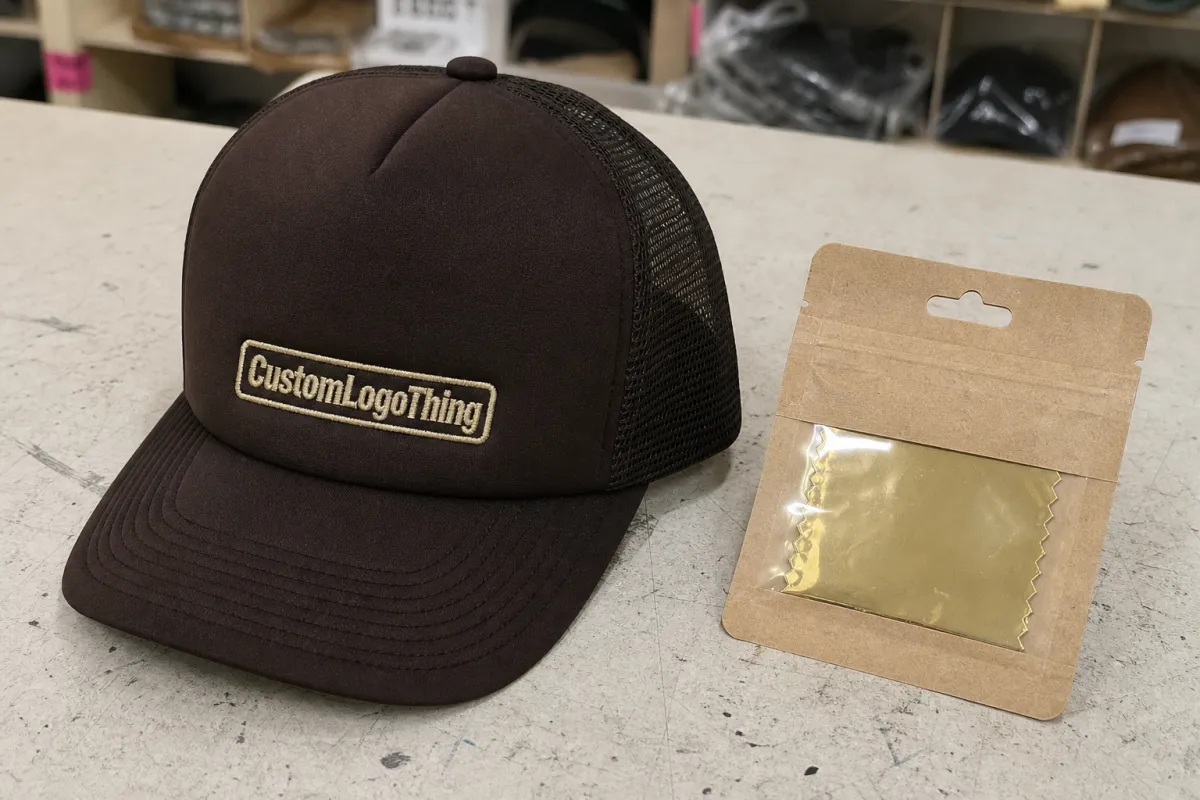
Bakery sourcing changes the math because the cap is often doing three jobs at once. It has to carry brand identity, hold up under kitchen heat, and look clean enough to sit next to pastries, takeaway bags, and seasonal displays. A generic event cap can get away with a rougher finish. A bakery cap usually cannot. Color drift, crooked logos, or a flimsy closure read immediately when the product is worn by front-of-house staff all day.
The biggest surprise in a foam trucker hats Unit Cost Breakdown for bakery sourcing is that the blank cap is not always the expensive part. On a small run, the fixed costs can outweigh the garment itself. A $1.20 cap with a $35 screen setup and $18 in labeling fees is no longer a $1.20 cap. Spread those charges across 100 pieces and the unit price behaves very differently than it does on 1,000 pieces. That is not inflation; it is math.
Bakery buyers also care about visual cohesion in a way that many other buyers do not. A cap that clashes with pastry boxes or menu boards feels disconnected from the brand, even if the logo is correct. If the bakery uses cream, caramel, pink, or espresso tones in its packaging, the hat should sit in that same family. Bright white foam, black mesh, and a neon print can work for a streetwear brand. For a bakery, the result can feel accidental.
Use case should drive the quote request. A launch event, a staff uniform program, and a shelf-ready retail hat all need slightly different specs. A launch order may prioritize fast turnaround. A uniform order should favor durability and reorder consistency. Retail merch needs a more polished finish and stronger packaging. Starting with the use case makes the quote honest from the beginning.
“The cheapest quote is rarely the cheapest order once setup, packing, and freight are included.”
That is especially true when the order crosses a warehouse threshold. Ten cartons can ship differently from thirty. One region may require more detailed carton marks. A split shipment can cut risk but raise landed cost. In bakery sourcing, the right question is not “What is the hat price?” It is “What does the finished carton cost, and what assumptions are hiding inside it?”
Foam Front Construction, Shape, and Decoration Options
Most foam trucker hats use a structured foam front, mesh side and back panels, and a curved or flat visor. A common build is a 5-panel crown with a foam front face and a plastic snapback closure, though 6-panel versions also appear in the market. The foam front gives a smooth print surface and a slightly retro look, while the mesh back keeps the cap light and breathable. In a bakery, that balance matters. Staff need airflow more than they need a heavy, fashion-forward cap.
Material choices affect both cost and comfort. Foam fronts are often made with a thin polyurethane or EVA-style foam layer; the exact blend changes by factory. Thicker foam can hold shape better, but it may feel stiffer and cost more to sew and print cleanly. The mesh is usually polyester. A denser mesh can feel more substantial and survive better under repeat use, but it may add to the price. Even the sweatband matters. A basic sweatband is cheaper, yet a softer band can improve wearability during long shifts and reduce complaints later.
Decoration is where the cost curve starts to move. Screen print is usually the least expensive method for bold logos and simple artwork. It works well when the bakery name is short, the type is thick, and the design can be read from a distance. Patches cost more, but they can change the product from simple promo cap to something that feels retail-ready. Heat transfer sits in the middle on many orders. It helps with small text, detailed marks, or color gradients that would look muddy in a standard print.
There is one caveat buyers often miss: embroidery on foam fronts can be risky unless the factory has a build designed for it. The needle holes can distort the foam, and tiny lettering can disappear. That does not mean embroidery is impossible. It means the cap, the foam thickness, and the logo size all need to be checked before anyone approves it.
Decoration options usually break down like this:
- Screen print - best for simple logos, lowest setup burden, usually the cheapest per unit on larger runs.
- Woven, embroidered, or PVC patch - better for premium retail presentation, but tooling and attachment labor raise the unit cost.
- Heat transfer - useful for detail-heavy art or multi-color logos, with pricing that depends on coverage and artwork complexity.
A bakery team wearing hats behind a counter all day needs a different standard than a bakery selling caps next to branded mugs. A staff cap should hold up to movement, heat, and repeated handling. A retail cap should survive display, folding, and customer inspection. That difference is why the same design can have two sensible production paths and two very different price points.
Spec Sheet Details That Keep Bakery Orders Consistent
A clean spec sheet prevents most quote confusion. Before asking for pricing, lock down the cap style, panel count, crown height, visor shape, closure type, and mesh color. A supplier can only compare prices accurately if every quote uses the same build. If one version uses a 5-panel crown, another uses 6 panels, and a third changes the closure from snapback to velcro, the price spread is meaningless.
For bakery work, fit and comfort should be on the sheet too. A hat worn during a morning rush needs a sweatband that feels acceptable against the forehead, good airflow in the back, and enough adjustability for a mixed team. If the same cap will be worn by staff across multiple shifts, the closure and sweatband deserve more attention than buyers usually give them. A few cents saved on a weaker closure can turn into replacement cost later.
Print area also needs definition. Foam fronts are not infinitely forgiving. The front panel has seams, curvature, and a limited print window. A logo that looks balanced in a digital mockup may sit too high, too low, or too wide on the actual cap. If the artwork reaches too close to the edge, registration problems become more likely. That is why precise panel measurements matter more than a rough “big front logo” note.
For retail-ready orders, ask about packaging before the quote is finalized. A product sold at checkout may need an individual polybag, barcode sticker, warning text, a hangtag, or a carton label that matches the POS system. Those details add labor and materials. They also speed up receiving and resale. Packaging can change unit cost by more than first-time buyers expect, especially on lower volumes where every manual step is visible.
A useful spec sheet separates fixed, variable, and commercial details:
- Fixed: cap style, panel count, front material, mesh color, closure type, and sweatband preference.
- Variable: logo size, decoration method, packaging format, and carton labeling.
- Commercial: quantity, target delivery date, and whether a reorder needs exact continuity.
If those items are clear, the supplier can return a quote that is actually comparable across options. That is where a foam trucker hats Unit Cost Breakdown for bakery sourcing becomes useful: it stops being a vague price and becomes a production plan.
For shipment and carton handling, some buyers use ISTA guidance to understand how packaging should hold up in distribution. Even lightweight hats can arrive crushed if the cartons are overfilled, under-taped, or stacked badly. The cap may be inexpensive; the freight damage is not.
Foam Trucker Hats Unit Cost Breakdown, MOQ, and Quote Drivers
Buyers usually want the number first, so here is the practical version. The final unit cost is usually built from five layers: blank cap cost, decoration, sampling, packaging, and freight. On short runs, setup and packing can outweigh the blank cap. On larger runs, the fixed work spreads out and the cost per piece falls. That is why a 200-piece order and a 2,000-piece order can look like different products even when the hat is identical.
MOQ changes the curve fast. A test run of 100 to 300 hats often costs more per unit than a re-order of 1,000 or more. That does not mean the small run is overpriced. It means the setup fees, artwork preparation, and sample handling are being absorbed by fewer pieces. For a bakery testing a seasonal merch line, that premium can still be the right move. For a recurring staff uniform program, higher volume usually brings better pricing and fewer surprises.
Typical quote drivers include:
- Decoration method - simple screen print usually costs less than patch work or detail-heavy transfer work.
- Artwork complexity - more colors, thin type, and tight registration increase setup and reject risk.
- Packaging - individual polybags, inserts, barcode labels, and custom cartons all add cost.
- Freight mode - air, sea, and split shipping affect landed cost in different ways.
- MOQ - smaller orders carry higher unit costs because fixed charges are spread thin.
| Order Type | Typical Unit Cost Range | Best For | Notes |
|---|---|---|---|
| Small test run, 100-300 pcs | $2.20-$4.10 per unit | New bakery launches, short promotions | Setup charges, sample fees, and packaging carry more weight |
| Mid-size order, 500-1,000 pcs | $1.65-$2.85 per unit | Retail restocks, staff programs | Better spread of printing and prep costs |
| Larger order, 2,000+ pcs | $1.10-$2.10 per unit | Multi-store rollout, recurring merch | Bulk pricing improves if the spec stays stable |
Those ranges are directional, not universal. A special foam color, a premium patch, or rush freight can push the price higher. A simple one-color print with standard packaging can bring it lower. The key is to ask for a quote that separates blank cap price, setup charges, sample cost, packaging, and shipping. If those lines are folded into one number, the buyer cannot tell where the money is going or what will change the next time the order is repeated.
A solid foam trucker hats Unit Cost Breakdown for bakery sourcing should also say whether the MOQ applies to one design, one colorway, or a combined order. Some factories will allow mixed cap colors if the logo stays the same. Others require every color to meet its own minimum. That detail can change a seasonal program by several hundred dollars, which is enough to matter for a small bakery.
If sustainability messaging matters, carton and insert choices should be reviewed alongside the hat spec. FSC-certified paper stock does not change the hat itself, but it can influence the retail presentation and the story the bakery tells about its packaging. That matters more than many buyers admit, especially when the cap is sold near boxed pastries and gift items.
Artwork, Sampling, and Proof Approval for Bakery Brands
Vector artwork is the cleanest starting point. AI, EPS, or PDF files give the factory a usable file without tracing or guesswork. Low-resolution PNGs may work for a quick mockup, but they are weak production files. Foam fronts look smooth from a distance and slightly soft up close, so very thin lines can blur or disappear if the art is not adjusted for the surface. Tiny accent marks, script lettering, and narrow outlines should be checked carefully before anyone approves a run.
Color reference is another place where bakery buyers can save themselves trouble. Pantone targets, brand swatches, or a clear photo of the packaging help the supplier understand the intended finish. Colors also behave differently on foam than they do on paperboard or on a screen. A warm cream can read cooler under warehouse lighting. A soft pink can shift toward coral once it is printed. Proofs should confirm the relationship between the logo and the cap material, not just the digital file.
A pre-production proof should verify three things before bulk production starts: logo size, logo placement, and color contrast. If the print sits too low on the front panel, the cap can look heavy. If it sits too high, the logo may fight the crown seam. If the text is too small, it disappears on the foam. Those mistakes are easy to overlook in a mockup and expensive to correct after production starts.
Sampling is not just a formality. It is a schedule safeguard. If a bakery has a fixed opening date or a seasonal launch tied to pastries, coffee, or holiday packaging, proof review needs to happen early enough to absorb changes. A buyer can usually manage a day or two of sample feedback. A full remake after the production run has started is a different problem entirely. The unit cost breakdown should include a sample line, even if the sample is only a photo proof.
“The fastest approval is the one that answers size, placement, color, and packout the first time.”
That approach matters because the cost of a mistake in headwear is rarely just the cap. It is time, freight, and lost seasonality. By the time a bakery realizes the logo is too small or the mesh color clashes with the brand, the launch window may already be closing.
Production Process, Timeline, and Lead Time Milestones
A predictable production flow usually moves through six steps: inquiry, quote, artwork approval, sample signoff, bulk production, inspection, and shipment. Each gate reduces risk. If the buyer changes the logo size after the proof is approved, the factory may need to reset screens or remake the sample. That adds time, and sometimes money. Clear signoff keeps the schedule from slipping one decision at a time.
Lead time depends on decoration method, raw material availability, packaging requirements, and the shipping lane. A simple screen-printed cap normally moves faster than a patch order that needs extra attachment work. Stock colors are easier than custom foam shades. A standard snapback is easier than a special closure request. A re-order can be faster than a first-time order if the spec is already locked and the factory has the same materials on hand.
Typical planning windows often look like this:
- Proof review: 1-3 business days if artwork is already clean.
- Sampling: 5-10 business days depending on method and corrections.
- Bulk production: often 12-20 business days after sample approval.
- Freight: air is faster, sea is cheaper on larger volumes, and split shipping lands somewhere in between.
Those windows are not fixed. Holiday congestion, carton labeling, and port delays can stretch them. A bakery planning for a grand opening should work backward from the in-hand date, not forward from the day the quote is requested. A two-week delay can ruin a seasonal display, while a slightly higher freight cost may still be cheaper than missing the launch entirely.
If timing is tight, ask whether a partial shipment is possible. That can help hit an opening date or a local event, but it may increase landed cost because the order is no longer moving as one full batch. The tradeoff should be visible before approval. A lower unit cost is not useful if half the order arrives after the promo ends.
What a Direct Cap Supplier Should Handle for Bakery Buyers
A direct cap supplier should keep the quote, proof, and production spec aligned from start to finish. That sounds basic. It is where many orders drift. A buyer sees one version in the initial quote, another in the proof, and a third in the invoice. Once scope drift starts, it becomes hard to tell whether the price changed because of the product or because the details were never consistent. A steady supplier removes that friction.
Direct sourcing is especially useful when the bakery needs repeatability. Staff hats should reorder with the same logo placement, the same closure, the same foam feel, and the same general shape, even if the order happens months later. If the supply chain is stable, the brand stays consistent across stores, events, and seasonal launches. That consistency is not glamorous, but it protects the brand better than a cheaper one-off order that cannot be matched later.
At minimum, a supplier should handle these items clearly:
- Spec control - one approved version of the cap build and decoration.
- Quality checks - visible inspection for print alignment, stitching, closure function, and count accuracy.
- Shipment visibility - clear updates on carton count, dispatch date, and carrier method.
- Reorder continuity - the ability to match previous production without reworking every detail.
That level of discipline matters whether the hats are for staff uniforms, countertop retail, or a seasonal promotion tied to pastries or coffee. A bakery buyer does not need drama; the order needs to arrive clean, counted, and close to the approved sample. That is the real value in a well-managed foam trucker Hats Unit Cost Breakdown for bakery sourcing.
Next Steps for an Accurate Bakery Cap Quote
The cleanest quote packet starts with three inputs: target quantity, logo artwork, and the date the hats must be in hand. Add packaging needs, label placement, and whether the caps are for staff use or retail sale. Those details shape the price more than a vague request for “custom hats.” The clearer the brief, the faster the supplier can return a number that holds up under comparison.
Ask every supplier to separate unit cost, setup charges, sampling, and freight. If one quote looks lower but hides decoration prep or packout fees, it is not the better deal. The fairest comparison is line by line, with the same scope on every offer. That protects the budget and makes internal approval easier because the buyer can explain exactly what is included.
For bakery sourcing, the practical checklist is simple: confirm the cap build, decoration method, MOQ, sample path, and shipping method. Those five decisions do most of the work. Get them right early, and the final order is usually cleaner, cheaper, and easier to repeat. Miss one of them, and the quote can look fine until the cartons arrive.
FAQ
What affects foam trucker hats unit cost for bakery sourcing?
Order quantity, decoration method, and setup charges usually drive the biggest changes in unit cost. Packaging, freight, and color matching can add meaningful cost on small or rush orders. The best quote separates the blank cap from printing, sampling, and shipping so the buyer can see what is actually driving the price.
What MOQ should a bakery expect for custom foam trucker hats?
MOQ varies by factory and decoration method, but smaller runs usually cost more per piece. Simple one-color prints often support lower minimums than premium patch work or complex multi-color designs. Ask whether the minimum applies to one design, one colorway, or a combined order.
Which decoration method lasts best on foam front trucker hats?
Screen print works well for bold logos and simple artwork when the print area is prepared correctly. Patches can improve perceived value and give a more polished retail look for bakery merch. The right choice depends on logo detail, budget, and how the hat will be used.
How long does sampling and production usually take?
Sampling is usually faster than bulk production, but buyer approval can stretch the schedule. Bulk lead time depends on decoration complexity, raw material availability, packaging, and freight method. A realistic plan should include proof review, sample approval, production, inspection, and shipping.
What should I send for a fast foam trucker hat quote?
Send quantity, target delivery date, logo file, cap color, and preferred decoration method. Include packaging needs, retail labeling requirements, and whether you want a sample before bulk production. The more precise the inputs, the faster the supplier can return a usable quote.

