If you are trying to pin down Frosted Zipper Bags unit cost for cosmetics, start with the part that usually gets glossed over: the bag price is only one line in the real landed cost. Size, thickness, zipper style, print coverage, and quantity shift the number more than most buyers expect, and small spec changes can move a quote by several cents per piece. That may sound minor until you multiply it across a few thousand units and realize the packaging budget has quietly changed shape.
Frosted Zipper Bags are popular in cosmetics because they give sample kits, travel sets, refills, and promotional bundles a cleaner presentation without forcing a brand into rigid packaging. The look is softer than clear utility plastic, yet the structure stays light and practical. For many beauty lines, that balance is exactly what the product needs: enough polish to support perceived value, but not so much material that freight and packaging costs start eating margin.
There is also a practical advantage that gets overlooked in early packaging discussions. A frosted pouch can hide minor internal clutter better than a fully clear bag, which matters when the contents are small, mixed, or slightly irregular in shape. That keeps the front-of-house presentation more controlled, and it helps a product feel intentionally packed rather than tossed into secondary packaging at the last minute.
Why frosted zipper bags raise cosmetic shelf value
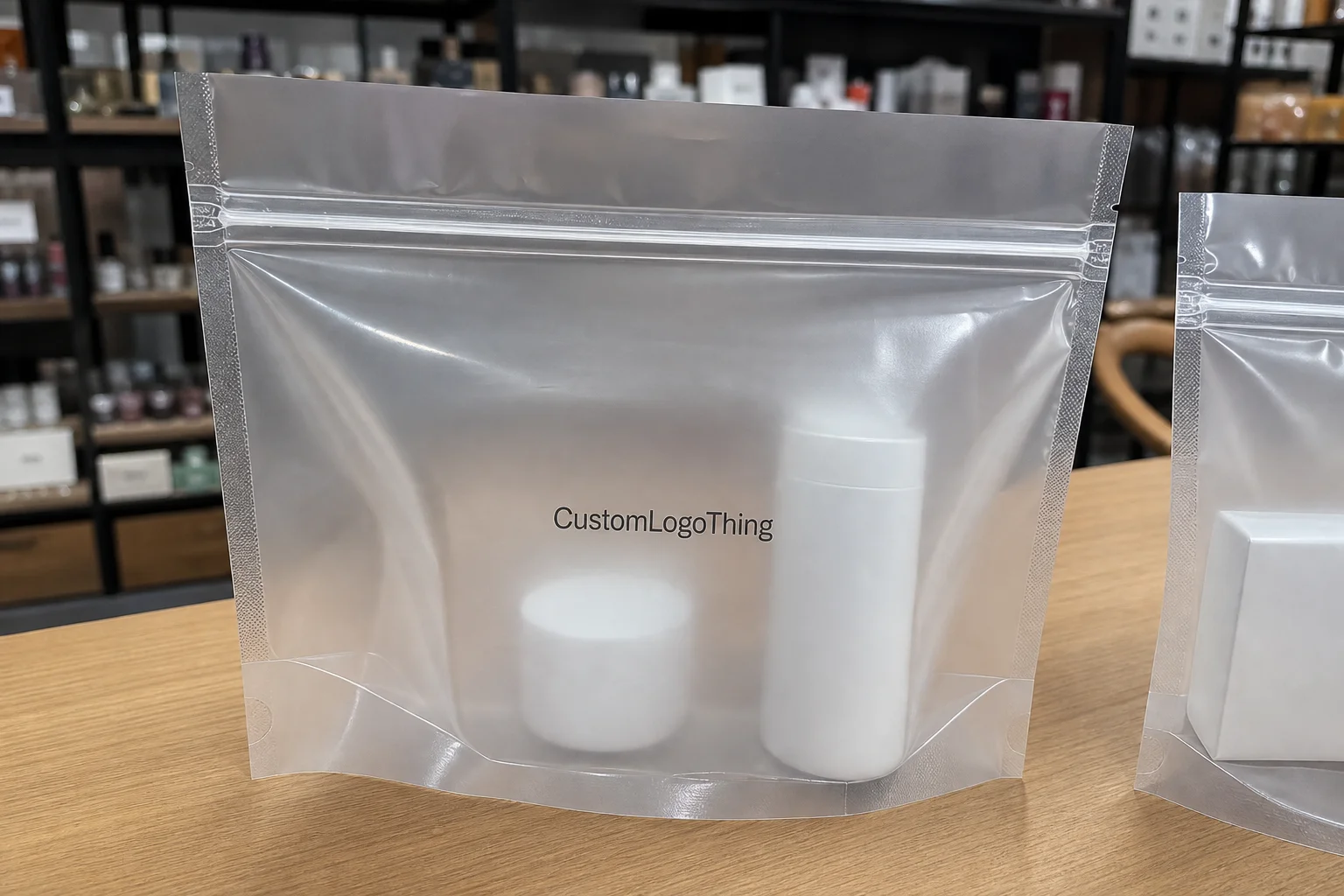
Cosmetic packaging has to do some work before the customer ever touches the formula. It has to signal the right price tier, fit the brand, and survive handling in transit or on a retail shelf. Frosted film helps with that because it cuts visual noise and gives the package a more finished, less industrial look. Even a simple zipper bag can read as promotional, retail-ready, or giftable if the surface finish and closure feel are right.
That is why the Frosted Zipper Bags Unit Cost for cosmetics can still make sense when the bag is not the cheapest option on paper. You are paying for material feel, zipper reliability, print quality, and the way the pouch frames the product inside. A thin, loose bag can make a good formula look inexpensive. A better-built frosted bag does the opposite, and in cosmetics that impression influences conversion faster than many teams expect.
These bags are used for sachets, minis, lip masks, wipes, eye patches, travel kits, and refill packs because the format is flexible and low-fuss. Compared with a rigid carton system, a frosted zipper pouch often delivers a stronger visual upgrade per dollar spent. That tradeoff is especially useful for launches, seasonal sets, and subscription inserts where the packaging has to look elevated without pushing the unit economics out of range.
Still, the right answer depends on the channel. A retail-facing cosmetic pouch has different requirements than an internal sample pack. If the bag is being opened and reused, the zipper feel matters more. If it is mostly for transit, film thickness and seal behavior matter more. The best option is not always the most premium one; it is the one that fits the actual job.
“A decent frosted bag won’t rescue a weak product, but it can stop a good one from looking cheap.”
That is the decision most buyers are really making. Not whether frosted packaging looks better; it usually does. The question is whether the added unit cost is justified by the volume, launch plan, and the way the product is sold.
Frosted zipper bag construction and cosmetic-friendly features
Most Frosted Zipper Bags for Cosmetics are made from LDPE, EVA, or a blended film. LDPE is common because it is economical, flexible, and easy to seal. EVA usually feels softer and more refined, and it can produce a cleaner frosted appearance. Blends sit between those two, often balancing cost, stiffness, and surface quality. If the goal is a softer hand feel and a more polished impression, EVA often has the edge. If the goal is to keep costs tighter while preserving acceptable presentation, LDPE is usually the more practical option.
Zipper style matters more than many first-time buyers expect. A single-track zipper is often adequate for samples and light-use cosmetic packs. A double-track zipper gives a firmer closure and a more substantial feel, which can help with repeat opening and closing. Child-resistant-style closures exist for specific safety or compliance needs, but they usually add cost and make the bag less convenient for end users. Beauty packaging should still be easy to open. A closure that is secure but annoying to use tends to create complaints quickly.
Cosmetic buyers usually focus on a few practical features:
- Leak resistance for creams, cleansers, and mini liquids
- Odor neutrality so the bag does not affect the product inside
- Smooth edges for safer handling and a cleaner look
- Visibility control so the contents show through without looking messy
- Printable surfaces for logos, instructions, or usage notes
Branding can be simple or detailed. A one-color print keeps setup charges lower and usually gives the cleanest pricing. Full-surface branding costs more, but it can turn a plain pouch into a more substantial retail piece. Some brands add matte effects, hang holes for display, or a label panel for ingredient or batch information. That last detail is useful when the pouch does double duty as both a shipping format and a customer-facing package.
There is a limit, though. A heavier frost, thicker film, and more complex print all push the unit price upward. If the bag is expected to do more visual work, the cost has to reflect that. The main mistake is paying for premium features that do not change the customer experience. Clear, intentional specs are cheaper than vague requests followed by revisions.
For broader packaging references, buyers often review structural guidance from Packaging School / packaging.org, and FSC can be helpful if paper components or sustainability claims are part of the packaging brief.
Specifications that change performance, appearance, and unit cost
If you want a realistic quote, lock the specs first. Not “small bag.” Not “medium, maybe.” Exact dimensions, exact thickness, exact zipper style, and exact print area are the difference between a usable quote and a number that changes after every clarification email. The more precise the brief, the less room there is for cost drift later.
The main spec drivers are straightforward:
- Size - sample sachets may be around 3 x 4 in. or 4 x 6 in., while travel kits and bundled sets often run larger.
- Thickness - thinner film lowers price; thicker film feels sturdier and reduces complaints.
- Closure - single-track, double-track, or specialty safety closure.
- Frosting level - a lighter frosted look is often less expensive than a very uniform matte finish.
- Print coverage - small logo printing costs less than full-surface branding.
- Bag style - flat pouch, gusseted pouch, or stand-up style changes material use and labor.
Common cosmetic use cases map neatly to size. Small bags work for sachets, swabs, and single-use samples. Mid-size pouches fit mini bottles, facial wipes, or bundled skincare testers. Larger frosted zipper bags are better for travel sets, promotional kits, and refill packs. The more items inside, the more the bag has to do in terms of seal strength, visual consistency, and handling resistance.
Thickness creates a simple tradeoff. A thinner bag lowers the cost per piece, but it can feel flimsy and crease easily in transit. A thicker bag costs more, yet it often protects the product better and gives a better tactile impression in hand. In cosmetics, tactile impression is not decorative. Customers notice the feel of the packaging almost immediately, and that impression tends to influence whether the line reads as premium, budget, or unfinished.
Finish choices matter too. A matte frost generally looks smoother and more premium. Semi-transparent frosted film keeps more visibility on the contents, which can be useful for color cosmetics or curated sample sets. Custom tinting can align with brand colors, but it usually raises cost and makes color matching harder to control. For a budget-sensitive line, standard frosted tones are usually the safer place to start.
Another practical point: cosmetic packaging should be odor-neutral and visually clean. That sounds obvious, but low-grade plastics can carry a smell that customers notice immediately, especially with fragrance-free skincare or minimalist beauty positioning. Scuffing, clouding, or print distortion can also make a product look poorly handled even when the formula is perfectly fine. Those are small defects on paper and very noticeable defects in the hand.
Frosted zipper bags unit cost, pricing tiers, and MOQ
The cost of frosted zipper bags for cosmetics usually moves first with quantity, then with spec complexity. Size, thickness, and print are the main drivers, but volume changes the math the most. A 3,000-piece order and a 50,000-piece run do not live in the same pricing world, even if the bag looks nearly identical.
For planning purposes, the following pricing bands are a practical benchmark for custom cosmetic frosted zipper bags. These are not universal, because the final unit cost depends on the exact structure, but they are useful for budget modeling:
| Order Size | Typical Unit Cost Range | Best For | Notes |
|---|---|---|---|
| 1,000-3,000 pcs | $0.18-$0.42 | Small launches, samples, pilot runs | Setup charges and freight affect unit cost more here |
| 5,000-10,000 pcs | $0.10-$0.24 | Core retail SKUs, promo kits | Usually the best balance of MOQ and bulk pricing |
| 20,000+ pcs | $0.06-$0.16 | Established cosmetic lines, contract fills | Printing and setup costs spread out more effectively |
If the bag uses multiple colors, heavy coverage, or specialty closure details, expect pricing toward the higher end of those ranges. If the spec stays close to a standard size, uses one-color print, and relies on stock-based construction, the quote can land much lower. A few cents per unit may not sound dramatic, but across tens of thousands of pieces it can be the difference between a workable packaging program and one that needs to be redesigned midstream.
MOQ depends on how the bag is produced. Stock-sized custom printing often allows lower minimums than fully custom dimensions. If the factory is printing on an existing bag, the barrier is lower. If the bag size, zipper, or film structure has to be made from scratch, MOQ climbs. That is normal production economics, not a negotiation trick.
Comparing quotes is where buyers often lose money. Ask whether the price includes printing or only the blank bag. Confirm whether tooling fees or plate charges are included. Check whether setup charges are one-time or recurring. Verify whether shipping cartons, inner packing, and master carton specs are part of the quote. And always ask for thickness in microns or mil, not a vague “standard” description.
Budget surprises tend to show up in freight and packaging handling. Plastic bags are light, but they are bulky relative to their value, which means shipping can feel disproportionately expensive on smaller orders. Color matching can add fees, and sample approvals can add time if artwork is not ready. If the first quote excluded cartons or handling, the invoice can look very different from the initial email. That is not unusual; it is just why the quote has to be read line by line.
For sustainability or disposal questions, some buyers review EPA recycling guidance at EPA recycling resources. It does not replace a packaging spec sheet, but it can help when a brand needs to understand end-of-life messaging or internal sustainability claims.
Process and lead time from artwork to shipment
The order process is usually simple. The trouble starts when measurements are vague or artwork changes arrive late. A clean buying process for cosmetic zipper bags should look like this:
- Confirm size, thickness, zipper style, and finish
- Request a quote with quantity breaks
- Approve artwork and dieline
- Request a sample if the product is retail-facing or needs fit validation
- Move to mass production after proof approval
- Review packing, QC, and shipping method
Most delays happen in three places: bad measurements, artwork revisions after prepress, and slow proof approval. A missing dieline can cost days. A logo change after production files are already prepared can cost more. If someone is still deciding on color while the production slot is waiting, the schedule slips for a reason that has nothing to do with the bag itself.
Typical timelines depend on where the project starts. Stock-based orders are usually faster, especially when the base bag already exists. Fully custom sizes, special frosting, and complex printing take longer. For planning, many buyers should expect about 12-15 business days after proof approval for standard production runs, plus transit time. Larger or more complex jobs take longer. Sampling, when needed, should be added before mass production rather than folded into the production window.
Sampling is especially useful when the bags are going to retail, when the contents are viscous, or when fit is tight. It is less critical for internal promo packs or non-customer-facing inserts. The sample catches zipper stiffness, weak seal behavior, print misalignment, and fit issues before thousands of units are in a warehouse. That is a cheap test compared with reworking finished inventory.
Logistics still matter after production. Packing and QC take time. Then there is ocean or air transit. If the launch date is fixed, the full timeline has to be mapped out, not just the factory’s production estimate. A quote that ignores transit is only part of the picture.
Quality control and order planning that protect margin
Price matters, but repeatability matters just as much. The best packaging arrangement is the one that arrives on spec, holds up in use, and reorders without creating new problems. For frosted zipper bags, useful QC checks are straightforward and worth asking about early:
- Zipper seal testing for closure reliability
- Thickness checks to confirm the film matches the spec
- Print alignment so the logo sits where it should
- Visual inspection for cloudiness, scratches, or contamination
Those checks sound basic because they are basic, and that is exactly why they matter. Cosmetic packaging often gets ordered under time pressure, which is when small defects become expensive. A bag that looks fine on screen but arrives with cloudy film or a weak zipper does more damage than the cents saved by shaving the spec too aggressively.
For repeat programs, consistency becomes part of the product experience. The third reorder should look like the first one. Same frost level. Same zipper feel. Same print placement. If those details drift, the brand starts to look pieced together, even if the formula and marketing are strong. Packaging inconsistency is easy to underestimate because it rarely shows up as a single large failure; it shows up as a slow erosion of quality perception.
There is also a margin issue hiding inside the supply chain. A cheaper unit price is not always cheaper overall if it leads to higher freight, more breakage, more rejects, or extra approvals. Buyers who focus only on the lowest quote sometimes end up paying more through corrections, rush shipping, or reorders. The better approach is to compare landed cost, not just factory cost. That means bag price, printing, tooling, cartons, freight, and the cost of time spent fixing preventable errors.
Next steps to quote frosted zipper bags for your cosmetic line
If you want a useful quote, prepare these five things before sending the inquiry:
- Product size or contents dimensions
- Target order quantity
- Print file or logo artwork
- Closure preference
- Desired finish: matte frost, semi-transparent frosted, or similar
Then ask for 2-3 quote scenarios. That is the most practical way to compare options. For example: one quote with a standard size and one-color print, another with heavier film, and another with more detailed branding. That gives you a real view of how appearance and durability move against unit cost instead of forcing you to guess where the savings or upgrades are coming from.
Also decide the use case early. Is the bag for retail display, sampling, internal storage, or bundle protection? The answer changes the spec. A sample bag can usually stay thinner and simpler. A retail-facing cosmetic pouch should generally feel stronger and look more polished. Same product family, different job.
Check lead time against the launch calendar before artwork is approved. If the launch date is fixed, production and shipping do not compress just because the schedule feels urgent. Reorder planning matters too. If this is a repeat item, the next buy should be mapped before inventory gets tight, not after the last pallet is already spoken for.
If you are comparing suppliers, ask for unit cost quotes with quantity breaks, print options, MOQ, and production timing listed separately. That is the fastest way to see whether the bag is priced for your actual use case or padded with features you do not need.
FAQ
What affects frosted zipper bags unit cost for cosmetics the most?
The biggest drivers are bag size, thickness, order quantity, zipper style, and print coverage. Custom dimensions and full-color printing usually increase unit cost more than basic one-color branding. Freight and setup fees can matter almost as much as the bag price if the order is small.
What is a typical MOQ for frosted cosmetic zipper bags?
MOQ depends on whether the bag is stock-sized or fully custom. Stock-based custom printing usually allows lower MOQs than new-size orders or special structures. If you need a very specific shape, closure, or finish, expect a higher minimum order quantity.
Are frosted zipper bags good for skincare and beauty samples?
Yes, they work well for sachets, minis, travel sets, wipes, and small bundled kits. The frosted look makes samples feel more refined than plain Clear Plastic Bags. They also help keep presentation consistent across retail and promotional use.
How long does production usually take after artwork approval?
Standard runs often take about 12-15 business days after proof approval, but the actual timeline depends on printing complexity, quantity, and whether sampling is required. Transit time should be added separately, especially for international shipping.
Can I lower frosted zipper bag pricing without making the bag look cheap?
Yes. Reduce print coverage, simplify colors, choose a standard size, or adjust thickness only slightly. Ordering a higher quantity usually lowers unit cost more effectively than cutting quality. The key is to keep the zipper seal and film feel strong while trimming nonessential extras.


