Guests notice small things quickly. A bag that feels tidy, closes cleanly, and still looks intentional after handling can shape how an amenity set is perceived long before anyone thinks about the unit price. That is why the Frosted Zipper Bags unit cost for hotel deserves real attention instead of being treated as a minor packaging line item.
For hotel procurement, this is less about buying attractive packaging and more about finding a repeatable format for toiletries, spa items, slippers, laundry kits, welcome sets, and in-room retail items. Frosted Zipper Bags sit in a useful middle ground: they look more polished than a plain clear poly bag, they protect contents better than an open pouch, and they usually stay far below the cost of rigid packaging.
The challenge is that not all frosted bags are built the same. A quote that looks attractive on paper can shift once the actual size, thickness, zipper style, and print requirements are locked in. That is usually where the real procurement work begins.
Why hotel buyers choose frosted zipper bags for daily amenity use
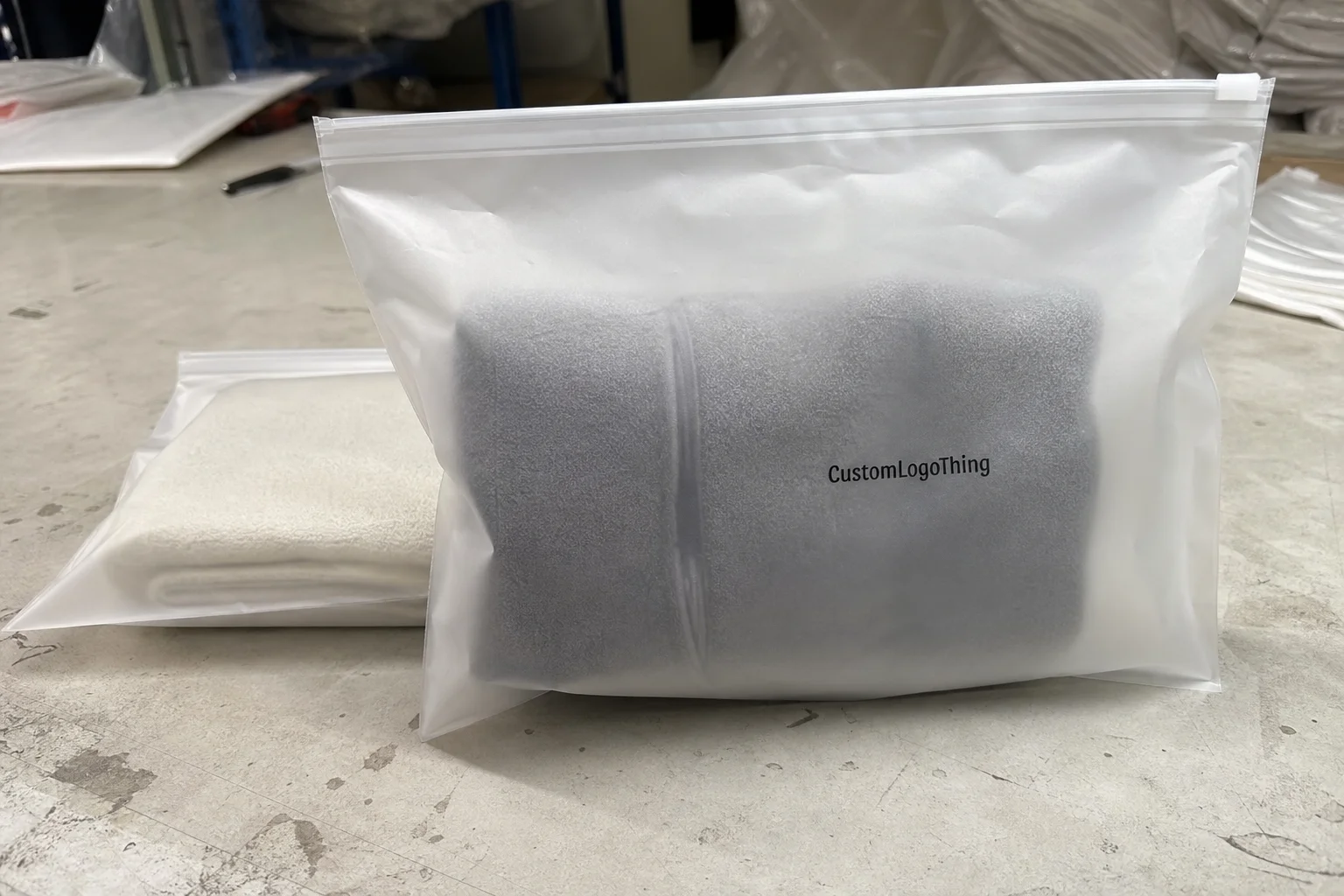
Hotels choose Frosted Zipper Bags because they solve several practical problems at once. They organize small items, protect them during handling, and give the amenity set a finished look instead of something that feels assembled at the last minute. That matters more than many buyers want to admit, especially for guest-facing packaging.
From the guest’s point of view, frosted film reads as cleaner than a fully transparent bag because it softens the view of the contents. The bottle labels, folded towels, and mixed colors inside do not dominate the presentation. The contents remain visible enough to identify, but the overall impression is calmer and more upscale. That muted appearance works well in spa rooms, boutique properties, upgraded room tiers, and welcome kits where the packaging is part of the experience.
The zipper closure is the workhorse here. Housekeeping can pack, move, and restock items without everything slipping out or opening in transit. For properties that reuse the same packaging format across multiple departments, that consistency is useful because it reduces handling issues and keeps the room presentation predictable.
- Toiletries: soap, shampoo, conditioner, dental kits, and grooming items
- Spa sets: bath salts, facial masks, robe accessories, and treatment items
- Slippers and socks: grouped, clean, and easy to hand off
- Laundry kits: forms, bags, and instructions in one place
- Welcome sets: branded inserts, snacks, or small local gift items
Repeat ordering is another practical advantage. Once the size and print are settled, replenishment becomes straightforward. There is no box structure to rebuild, no heavy tooling to maintain, and no complicated assembly process. For properties with steady amenity turnover, that simplicity makes procurement easier to forecast and stock.
Product details that affect appearance, durability, and guest experience
Not every frosted bag feels the same in hand. Some have a soft, cloudy finish that reads as understated and premium. Others are stiffer and more matte. Both can work, but they communicate different things to a guest and behave differently during packing and repeated handling. The difference usually comes down to resin choice, thickness, and surface finish rather than marketing language on a spec sheet.
Common material options include PE, EVA, and recyclable blends. PE is usually the most cost-friendly and widely used option for hotel amenity packaging. EVA tends to feel softer and a little more flexible, which some buyers prefer for higher-end sets. Recyclable blends are increasingly requested, although availability, pricing, and performance depend on the exact structure. If sustainability claims matter to your property, ask for the actual resin content and supporting documentation instead of accepting a generic “eco-friendly” label. Trade references such as packaging.org can help clarify material terminology.
Zipper style changes both the feel and the cost. Single-track zippers are common for light-duty use and basic amenity kits. Double-track zippers provide a firmer closure and can feel more dependable if the bag will be opened and handled repeatedly. Slide zippers are convenient in premium sets, though they usually add cost and are not necessary for every hotel use case.
Printing deserves the same caution. A compact one-color logo often looks cleaner than a crowded two-color layout on frosted film. Because the surface is already soft in appearance, fine details can lose clarity if the artwork is too busy. Simple text, a restrained logo, or a small icon usually prints better than a design with thin lines or heavy gradients. If the artwork has delicate detail, request a proof before production. Tiny elements can disappear faster than a sales sheet suggests.
There are also structural choices that affect performance. Transparent window areas can help guests identify contents, but they reduce the soft frosted effect. Hang holes help with display and storage. Rounded corners feel less industrial and are less likely to snag. A gusseted base can make larger items sit better and can improve the bag’s shape when filled. Heavier gauges generally feel more durable, though they also increase cost and are not always necessary for single-use amenity packaging.
Here is the basic tradeoff many hotel buyers end up making:
| Option | Guest-facing look | Durability | Typical cost impact | Best for |
|---|---|---|---|---|
| PE frosted, single zipper, one-color print | Clean and simple | Good for light use | Lowest | Basic toiletries and welcome sets |
| EVA frosted, double zipper, one- to two-color print | More premium feel | Better for repeat handling | Moderate | Spa kits, slippers, upgraded rooms |
| Recyclable blend, reinforced finish, custom print | Clean and modern | Depends on the blend spec | Higher | Sustainability-focused properties |
That table reflects a simple reality: more features generally mean more cost. Better finish, stronger closure, and more elaborate printing all push the price upward. The trick is matching the bag to the real use case rather than trying to spec in every possible improvement at once.
Specifications hotels should lock in before requesting samples
If you want a quote that actually helps procurement, the specifications need to be defined first. Otherwise, the number you receive may look useful until the real requirements appear, at which point the estimate stops being meaningful. That happens frequently when multiple departments are involved and everyone assumes someone else has already finalized the details.
The core specs are straightforward: size, thickness, closure type, opacity level, print area, and bag color tone. For hotels, size should be based on the actual item load rather than the descriptive name of the kit. A “standard toiletry pouch” can mean very different things depending on whether it is used for a few small items or a full amenity bundle.
Thickness should be stated in a real unit such as microns or mil. Thin bags in the 50-70 micron range can work for light items, but they may feel too delicate if the guest handles them more than once. Around 80-120 microns is a common comfort zone for amenity and spa packaging when a sturdier impression is needed. Going thicker can improve feel and handling, but only if the contents justify it.
Typical size ranges vary by application:
- Small kits: roughly 10 x 14 cm to 15 x 20 cm for toiletries or sample items
- Mid-size bags: roughly 18 x 25 cm to 22 x 30 cm for spa sets and welcome packs
- Larger bags: roughly 25 x 35 cm and above for slippers, laundry, or bundled amenities
Sealing and finishing details matter as well. Heat-sealed edges improve integrity. Reinforced zipper tracks reduce the chance of splitting. Rounded corners improve handling and make the bag look less industrial. For bulkier goods, a gusseted base is usually more practical than trying to force everything into a flat sleeve.
One common mistake is over-specifying the bag because the extra features sound premium. A thicker film, oversized print area, and specialty zipper can all raise the unit cost without making the guest experience noticeably better. In practice, the most efficient spec is often the one that looks clean, holds up to handling, and avoids unnecessary extras.
Frosted zipper bags unit cost for hotel: pricing, MOQ, and quote factors
The Frosted Zipper Bags Unit Cost for hotel depends on a few variables that move quickly: size, material, print, and quantity. Buyers usually want a fixed number right away, but the more useful answer is a realistic range tied to the build. That gives procurement something meaningful to compare rather than a quote that changes once the details are confirmed.
For straightforward custom hotel orders, the following pricing framework is a practical starting point. These are broad ranges, not promises, because artwork complexity, material selection, and bag dimensions can shift the result quickly:
| Order volume | Typical build | Approx. unit cost | Notes |
|---|---|---|---|
| 500-1,000 pcs | Standard size, one-color print, moderate thickness | $0.22-$0.48 per piece | Setup charges are spread across fewer units |
| 2,000-5,000 pcs | Standard or semi-custom size, one- to two-color print | $0.14-$0.32 per piece | Often the best balance for most hotels |
| 10,000+ pcs | Consistent spec, simple branding, repeat program | $0.08-$0.22 per piece | Best unit cost if storage and usage are predictable |
Those figures assume a fairly ordinary hotel specification. A special zipper, heavier gauge material, full-bleed artwork, or a custom size will raise the price. Simplifying the design and staying close to stock dimensions usually brings the quote down. That is why two bags that look similar on the outside can have very different landed costs once the production details are clear.
The main cost drivers are usually these:
- Bag size — larger bags use more material and wider film.
- Material thickness — thicker film costs more and feels sturdier.
- Zipper style — double-track or slide closures add cost.
- Print colors — every additional color increases setup work.
- Artwork complexity — detailed logos, gradients, and small text are harder to print cleanly.
- Order quantity — higher volume spreads tooling and setup costs across more units.
MOQ matters during hotel procurement because it can change the total buy in ways that are not obvious from the per-piece price alone. Stock sizes with light branding may start lower. Fully custom dimensions and printing usually require a higher MOQ because the factory has to reserve material, schedule print setup, and allocate production time. If a supplier says there is “no MOQ,” ask what that means in practice. Often it simply means the order is possible, but the price will reflect the lower volume.
“The cheapest quote is not always the lowest-cost purchase. A bag that tears, prints poorly, or arrives late ends up costing more than a slightly better specification.”
If you need a real comparison, ask for tiered pricing at 1,000, 3,000, and 5,000 units. That shows how the unit price changes with volume and where the best value actually sits. A single number can hide the real structure of the quote, while tiered pricing makes the procurement decision much clearer.
Hotels that care about sustainability or shipping efficiency should also ask whether the material specification aligns with documented recycling guidance and whether the bag can survive transit without scuffing or zipper failure. For shipping performance context, standards references such as ISTA can be useful when packaging needs to hold up through transport, storage, and handling.
Production steps, timeline, and what slows orders down
A good production process should be uneventful. That is usually a positive sign. It means the specification was clear, the artwork was approved, and the factory did not have to guess about what the customer actually wanted.
The normal flow is spec confirmation, artwork setup, sample approval, mass production, quality check, and shipping. If any of those steps are rushed or unclear, the timeline stretches. Hotel buyers often underestimate how much time artwork review can take, especially when procurement, operations, brand, and housekeeping all want to sign off on the same package.
For lead time, simple custom runs can often move in about 12-15 business days after proof approval, depending on capacity and finishing requirements. Fully bespoke sizes, special zippers, or multi-color print jobs can take longer. Shipping time must be added separately, and overseas freight is not interchangeable with domestic rush delivery in either timing or cost.
What slows orders down most often?
- Incomplete logo files or low-resolution artwork
- Late sample approval from procurement or operations
- Changes to dimensions after production has started
- Unclear print placement or missing color references
- Holiday peaks, seasonal openings, or renovation-driven rush orders
If the bags are tied to a hotel opening or reopening, a real buffer should be built into the schedule. Two extra weeks can make the difference between approving a sample calmly and paying rush freight for a compromised spec. That buffer is often cheaper than the delay it prevents.
How to control cost without making the packaging look cheap
Packaging buying works best when the specification is efficient, not stripped down to the point where it feels poor in the guest’s hand. The goal is to match the bag to the actual use case and remove waste, not to cut every possible corner.
There are three practical ways to control cost without hurting presentation. First, choose a thickness that feels sturdy enough for the contents instead of defaulting to the heaviest option. Second, keep the artwork restrained, because a clean one-color logo often looks sharper on frosted film than a crowded design with too much detail. Third, reduce unnecessary SKU variety when several bag formats are being used for similar items.
That last point saves more than many buyers expect. Too many SKUs create small but constant procurement problems: more samples, more reorders, more storage clutter, and more chances to order the wrong size. Fewer well-chosen formats usually improve both control and unit cost.
Sample review is also worth the time. A physical sample or pre-production proof catches issues that a spec sheet will miss, such as zipper feel, opacity level, print clarity, and the visual weight of the bag once it is filled. For guest-facing packaging, skipping that step can create a very expensive surprise later.
Hotels that standardize a clear spec sheet also make replenishment easier. Once the format is locked, repeat ordering becomes more predictable, and that matters for properties with regular amenity turnover or chain-wide brand standards. The savings are not only in the unit price; they also come from fewer mistakes and faster reordering.
The best value is usually the landed cost for the actual use case. That includes the bag, printing, freight, setup charges, and the expense of getting the spec wrong. A low sticker price can look attractive until the packaging arrives too late, tears in use, or looks weaker than the rest of the room presentation.
Next steps to get an accurate hotel quote fast
If you want a quote that procurement can use without follow-up questions, send five items upfront: bag size, thickness target, print artwork, order quantity, and delivery location. That is enough information to build a serious estimate instead of a placeholder.
Ask for at least two or three quantity tiers. Compare the unit cost at each level. If the jump from 3,000 to 5,000 pieces saves only a small amount per bag, storage space and actual consumption may make the lower tier the better choice. If the savings are substantial, a larger order can make sense quickly.
Also ask whether the quote includes printing, packaging, freight, and setup fees. Some suppliers bundle everything, while others separate costs that are easy to miss during comparison. That difference can make a quote look lower than it really is. Tooling fees are usually not large for a bag like this, but they still belong in the total.
If the bags will be part of a premium amenity set, request sample photos or a physical sample before approving production. You want to see how the frosted finish reads next to the actual toiletries, towel set, or welcome kit contents. A bag can look strong in isolation and feel underwhelming in the room. Context changes everything.
The quickest route to a real purchasing decision is simple: send the spec sheet and logo, then ask for a formal breakdown of MOQ, unit price, lead time, and setup charges. Once those pieces are on the table, the frosted zipper Bags Unit Cost for hotel becomes much easier to judge, and the choice is usually clearer than it first appears.
What affects frosted zipper bags unit cost for hotel orders the most?
Size, thickness, zipper style, print colors, and order quantity are the biggest cost drivers. Custom dimensions and multi-color printing usually raise unit cost more than simple logo placement. Higher volume generally lowers the per-bag price because setup costs are spread across more pieces.
What MOQ should a hotel expect for custom frosted zipper bags?
Stock sizes can often start with lower minimums than fully custom bags. Custom size, custom print, and special finishes usually require a higher MOQ. Ask for quantity tiers so you can compare the unit price at different order levels.
Are frosted zipper bags good for guest amenity kits?
Yes. They look clean, hide contents better than clear bags, and feel more polished than basic pouches. They work well for toiletries, spa items, laundry kits, and welcome packs. The zip closure helps keep items organized and protected during housekeeping handling.
How long does production usually take for hotel custom orders?
Simple custom runs move faster than fully bespoke sizes or multi-color print jobs. Artwork approval and sample sign-off can add time if files are incomplete or revisions are needed. Shipping time should be included in the overall timeline rather than treated as an afterthought.
How can a hotel lower the unit price without hurting presentation?
Use a standard size when possible, keep printing to one color, and choose a thickness that matches actual use. Order in larger quantities if storage allows, because unit cost usually drops at higher volumes. Ask for a sample first so you do not pay for features you do not need.


