If you are comparing frosted zipper Poly Bags for Gift shops MOQ planning, the real issue is not whether the bags look nice in a product photo. Nice is easy. The hard part is finding packaging that protects small merchandise, fits the shelf presentation, and does not force you into a pile of dead inventory.
Gift shops live on mixed merchandise and uneven reorder rhythms. One week it is stickers and cards. The next week it is soap sets, candles, and a few “this seemed cute at the time” impulse items that still need packaging. Frosted Zipper Poly Bags work well in that environment because they give you a clean retail look without being fragile, fussy, or expensive enough to make every unit a small crisis.
For buyers planning MOQ, the bag should be treated as a retail tool. Size, film thickness, zipper quality, print method, and closure style affect how the item presents, how long it lasts on the shelf, and how much money you tie up before the bags ever reach the floor.
Why frosted poly bags work so well on retail shelves
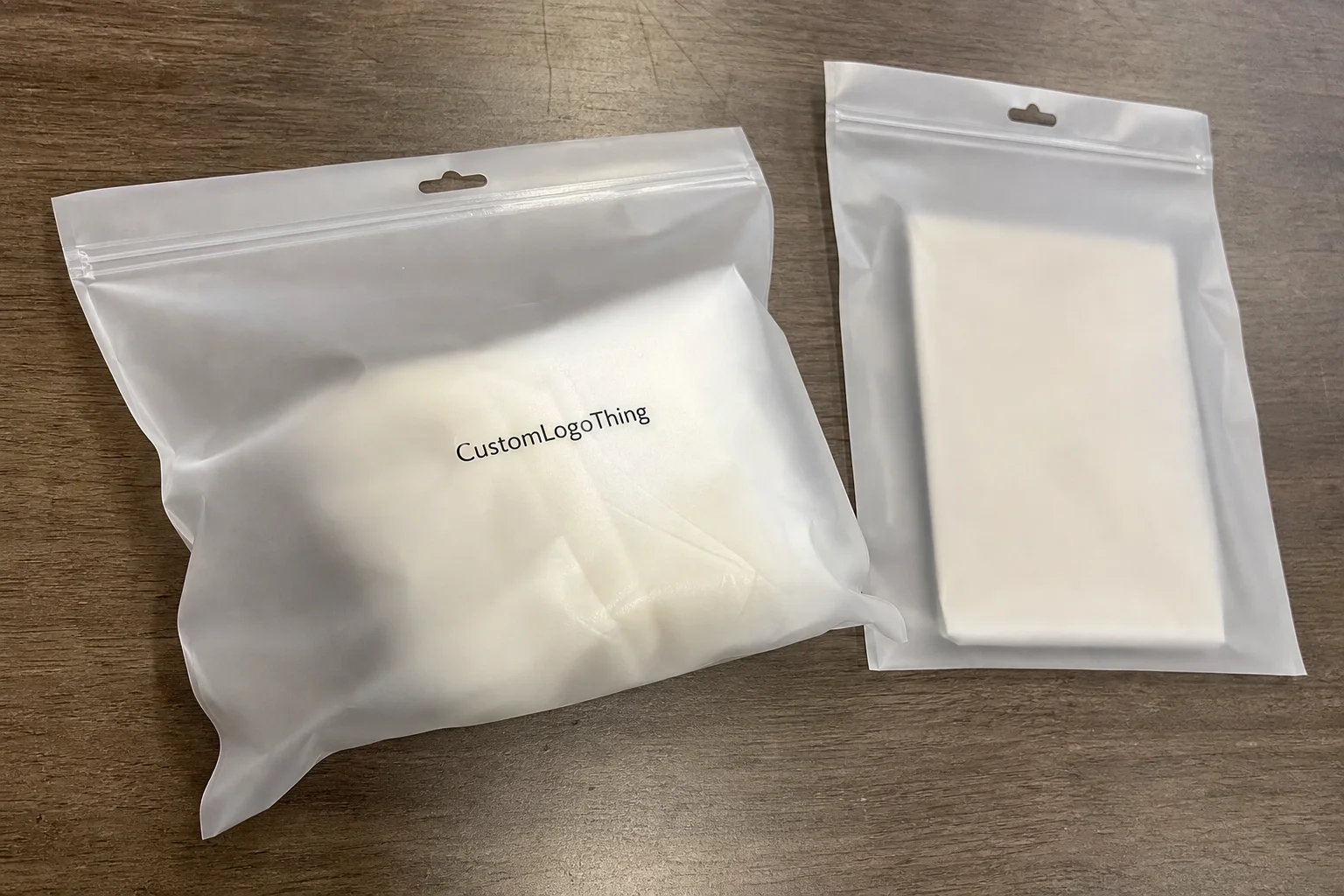
Gift shops need packaging that does more than hold a product. It has to look neat under bright lights, survive repeated handling, and keep the merchandise from looking like a pile of loose inventory. A frosted zipper poly bag does that better than a plain clear economy bag because the frosted finish softens glare and makes the display feel cleaner.
Clear film can reflect overhead lighting in a way that makes the shelf look busy. That problem shows up fast in countertop bins and peg displays. Frosted film cuts the shine, so product colors and logos read more calmly. The item still shows through, but the packaging carries a little more polish. That small visual difference matters in a gift shop, where customers are often buying based on first impression.
The zipper closure adds practical value. Staff can pack, re-pack, and reprice without destroying the bag. Customers can inspect an item and still return it to a tidy state. For bundles, samples, and multi-item sets, the resealable closure keeps everything in place until it leaves the store.
Common gift shop products that fit this format well include:
- Jewelry and small accessories
- Candles and candle add-ons
- Stickers, cards, and stationery sets
- Soap, bath items, and small wellness products
- Gift bundles with tags, ribbon, or samples
Custom sizing is where the packaging starts to earn its keep. A bag that is too large looks lazy. A bag that is too tight presses against the zipper and makes loading slower. The better suppliers will help match the pouch to the merchandise instead of tossing a generic size at you and calling it “flexible.” Flexible usually means someone else gets to deal with the mess later.
There is also a merchandising benefit that buyers sometimes miss. A well-sized frosted bag keeps the product centered, which gives the logo a cleaner placement area and makes the whole package feel intentional. That matters whether the bag is sitting in a tray, hanging on a peg wall, or stacked near the register in a seasonal display.
“Gift shop packaging works best when the product looks organized before anyone touches it.”
For seasonal assortments and impulse gifts, frosted zipper bags solve two problems at once: presentation and protection. That is why they keep showing up in retail packaging programs that need to look polished without becoming expensive or high-maintenance.
Product details that matter before you request a quote
Before asking for pricing, get clear on the actual bag structure. Most Frosted Zipper Poly Bags are made from LDPE or a similar poly film, paired with a zipper seal and sometimes a tear notch or hang hole. The material label matters, but the buyer experience comes from the feel: whether the film sits flat, whether the zipper closes cleanly, and whether the edges are sealed neatly.
That hand feel is not cosmetic. A slightly heavier film usually feels more stable in the hand and holds up better for repeated use. Very light film can be fine for flat items, but it may wrinkle, shift, or feel too soft if the product is heavier. Gift shop packaging is judged quickly, often before the customer even sees the item inside.
The details that change the quote are usually straightforward: size, gusset style, thickness, print colors, and whether the bag is plain or custom printed. Some buyers only need a logo. Others need a small label area, a price tag zone, or a writable panel. A simple layout often works best on frosted film because it keeps the presentation clean rather than overcrowded.
Useful upgrades for store merchandising
Depending on the shelf setup, a bag may need a hang hole, euro slot, writable panel, or a slightly textured surface. If the product lives on a peg wall, the hang feature saves merchandising time. If staff need to add prices or batch notes, a writable area can keep the front of the bag uncluttered.
These are not decorative extras. They affect how well the bag works in daily retail use. A flat pouch is usually enough for cards, stickers, and paper goods. A gusseted version makes more sense for soap sets, boxed items, or small candles because it adds depth without forcing the zipper to do work it was never meant to do. Heavier or sharper-edged products usually call for thicker film and stronger sealing.
Artwork readiness matters too. Vector files, clean spot colors, and simple layouts usually print best on frosted film. Very fine text can work, but it should be checked at actual size in the proof. If the logo sits too close to the zipper or edge seal, the finished bag may look cramped even if the file itself is technically correct. A design can be “right” and still look awkward once it hits plastic.
- Best file format: vector AI, EPS, or editable PDF
- Best print style: one- or two-color layouts for clarity
- Best fit: product-first sizing, not oversized generic bags
For packaging buyers, a spec-driven quote is far more useful than a photo-based guess. It keeps the conversation grounded in actual dimensions, print areas, and material choices. That is especially helpful when you are comparing Frosted Zipper Poly Bags for gift shops MOQ planning against clear bags or other pouch styles.
Specifications gift shop buyers should compare side by side
Gift shop buyers do themselves a favor when they compare specs line by line instead of relying on product photos. Film thickness, width, height, gusset depth, zipper style, print coverage, and carton quantity all change performance and cost. A picture may look clean. It will not tell you whether the bag is 2.5 mil or 4 mil, or whether the zipper is meant for occasional use or regular reopening.
Thickness changes the bag’s feel immediately. Lighter film can work for flat items like stickers and cards. It may be too soft for candle sets, soap bundles, or mixed gift packs. Thicker film usually makes the bag feel more substantial and improves durability, but it also increases cost and sometimes freight weight. There is always a tradeoff. Packaging never lets anyone have everything for free. Tragic, really.
Sizing should follow the product. Flat pouches usually suit stationery, gift cards, and other slim items. Gusseted bags make more sense for candles, bath sets, and bundles with depth. Oversized bags can work for mixed assortments, but they should still look intentional. A bag that swallows the product whole tends to look more like storage than retail presentation.
Print decisions affect both appearance and budget. A small one-color logo is usually the most practical route. Multi-color graphics can look richer, but they increase setup complexity and raise the risk of proof revisions. Front-only printing often keeps the design cleaner, while targeted placement can preserve a premium look without covering too much of the frosted surface.
| Option | Typical use | Relative unit cost | Buyer note |
|---|---|---|---|
| Plain frosted zipper bag | Stock items, quick packing | Lowest | Useful for testing size and zipper feel |
| One-color logo print | Core retail branding | Low to moderate | Often the best balance of cost and shelf presentation |
| Multi-color custom print | Seasonal or premium collections | Moderate to higher | More setup work, more proofing, more chances for revisions |
| Custom size with gusset | Candles, bundles, boxed sets | Higher | Worth it when depth matters more than a flat display profile |
If any of the items touch food-related products, confirm whether the material structure is appropriate for that use. If the bags hang on retail hooks, check hanger compatibility before finalizing the design. If they will sit in storage before merchandising, ask how they should be packed so the film stays clean and does not curl, scratch, or pick up dust.
A spec sheet is the buyer’s best friend here. It gives you a real basis for comparing options and keeps reorder quality consistent. That matters more than glossy marketing language, which tends to collapse the second you ask for a thickness measurement.
MOQ, unit cost, and pricing factors for smaller gift shop runs
MOQ planning is where gift shop buyers either keep control of the budget or get stuck with awkward inventory. Minimum order quantities are usually tied to material setup, print method, and bag size. They are not determined by the fact that the bags are for retail. A standard size with simple printing usually supports lower minimums than a fully custom size with several print colors and special finishing.
Pricing tends to move according to a few predictable variables. The main ones are custom dimensions, number of print colors, film thickness, zipper type, gusseting, and whether the order is based on stock tooling or a new production setup. Tooling fees and plate charges may be small on a larger run, but they can push the effective unit cost up fast on a small order.
For smaller gift shop programs, the rough pattern usually looks like this:
- Plain stock-style bag: lowest cost per piece
- Simple one-color logo: modest increase for printing setup
- Custom size with printed logo: higher cost, but often worth it for a signature retail look
- Multi-color, gusseted, thicker film: higher pricing threshold, better suited to repeat programs
The easiest way to manage cost is to simplify what you can. Fewer colors usually mean lower setup complexity. Standard dimensions often reduce tooling fees. If the bags serve several small store locations or multiple product lines, combining the order can improve pricing even if the total quantity goes up. That kind of consolidation is often smarter than splitting the order into three tiny jobs and pretending that will somehow be cheaper. It usually is not.
Seasonality matters too. A small MOQ may be fine for a test run, a new store, or a limited-edition product. But if the bags will sell steadily all year, a slightly larger quantity may improve economics enough to justify the storage space. The catch is obvious: packaging takes up room before it earns anything back.
Here is a practical way to judge quantity:
- Estimate monthly use by product type.
- Multiply by the months until the next likely reorder.
- Check storage space and cash flow.
- Compare landed cost, not only factory price.
That last point matters. A quote alone does not tell you the whole story. Freight, carton count, packing method, and destination all affect the real delivered cost. For buyers balancing MOQ against cash flow, landed cost is the number that actually matters.
Small-run orders can still make sense when speed matters, when sell-through is uncertain, or when you are testing a seasonal look before scaling up. Just compare the small-run pricing against repeat-order economics so you know exactly what flexibility costs.
Process, proofing, and turnaround for custom orders
The usual workflow is simple enough: inquiry, spec confirmation, artwork review, digital proof, sample approval if needed, production, inspection, packing, and shipment. What slows projects down is usually not the machinery. It is incomplete information or waiting too long to approve the proof.
Start with the basics: bag size, product weight, artwork file, quantity range, and delivery deadline. If the bags need a hang hole, gusset, or writable area, include that up front. The more complete the brief, the less time gets wasted on back-and-forth quoting.
Proofing deserves real attention because frosted film changes how graphics read. Logos can look softer than they do on paper or on clear film. Check placement, zipper orientation, contrast, and legibility at the actual print size. A design that looks fine on a screen can become visually crowded once it is reduced to bag size.
Timeline depends on the order type. Stock sizes with simple decoration usually move faster than fully custom shapes or multi-color jobs. If tooling or revised samples are needed, the schedule stretches. Repeat orders are usually quicker because the specs are already locked in and the production team is not guessing at dimensions.
Seasonal planning helps more than buyers think. Holiday launches, anniversary events, and gift shop refreshes create demand spikes. That is exactly when delays become expensive. Approval speed is one of the easiest ways to protect turnaround, because production often waits on customer sign-off rather than machine capacity.
For broader packaging quality context, organizations such as the International Safe Transit Association and the U.S. Environmental Protection Agency publish useful guidance on packaging performance and materials stewardship. They do not replace a supplier’s spec sheet, but they help buyers think more clearly about transit, handling, and material choice.
How to choose a supplier for retail-ready poly packaging
Pick the supplier that can control production, not the one with the nicest brochure. Film quality, zipper sealing, print registration, and carton packing are the basics. If those are inconsistent, the packaging will show it the moment it hits the shelf.
Ask for the details that actually tell you how the job will go: material spec, sample availability, proofing method, quality control checkpoints, and how defects are handled. A supplier working in retail packaging should be able to talk about shelf presentation, not just transit survival. Gift shop packaging has to look good in the store, not only make it through shipping.
Repeatability matters too. Seasonal packaging only works if the next reorder matches the first one closely. If the film shade shifts too much, or the zipper feel changes, the display looks inconsistent. Reorders should feel like reorders, not mystery boxes.
Communication is a decent predictor of the final result. Clear quoting, quick artwork feedback, realistic lead times, and honest advice about MOQ planning usually mean fewer surprises later. I would rather hear that a small quantity will cost more per piece than get a low quote padded with “extra” charges after approval. A cheap number with hidden surprises is not a bargain. It is a trap in a nicer font.
It also helps to look at the supplier’s broader packaging range. If you are building a retail program that also includes shipping or back-of-house needs, reviewing related items like Custom Packaging Products and other formats such as Custom Poly Mailers can show whether the supplier understands both shelf presentation and operational handling. That combination usually makes future orders easier to manage.
One useful test: ask for sample photos or sample packs that show the zipper working under normal handling. A bag can look beautiful in a staged image and still feel weak at the seal or edge. Real handling tells you a lot more than polished mockups ever will.
Next steps to place a practical first order
Start with the use case. What will the bag hold, how will it be displayed, and does it need to be reusable, hangable, or shelf-ready? Once that is clear, choose a starting size and thickness range, then request a quote with one backup option so you can compare cost and performance without dragging the process out.
Prepare artwork in vector format whenever possible. Confirm logo colors before proofing. Keep the design simple if you want the best balance of appearance and cost. If the packaging is tied to a premium product or seasonal launch, ask for a sample or pre-production proof before full production starts. That tiny step can save a lot of grumbling later.
A practical ordering checklist looks like this:
- Target bag size
- Product type and approximate weight
- Quantity estimate and backup quantity
- Delivery deadline
- Shipping address and carton preferences
- Labeling needs for one or multiple store locations
If you are comparing Frosted Zipper Poly Bags for gift shops MOQ planning, the best next move is to request a spec-based quote built around your actual product. That gives you a clearer view of MOQ, unit cost, lead time, and shelf presentation. For other ordering questions, our FAQ covers the basics in plain language.
FAQs
What MOQ should I expect for frosted zipper poly bags for gift shops?
MOQ depends on bag size, print complexity, and film specification more than the retail category itself. Standard sizes with simple printing usually support lower minimums than fully custom dimensions or multi-color artwork. A good supplier should help you balance MOQ against reorder frequency and storage space so you do not overbuy.
Can frosted zipper poly bags be printed with a small logo only?
Yes. A small logo is often one of the most economical print options for gift shop packaging. Limited artwork can improve clarity on frosted film and reduce setup cost compared with full-coverage designs. It is still smart to confirm the minimum print area and safe margin so the logo does not sit too close to the zipper or edge seals.
Which bag thickness is best for small gift items?
The best thickness depends on item weight, edge sharpness, and how often the bag will be opened or reused. Light accessories may work well in lighter film, while candle sets or multi-item bundles usually need a sturdier build. Ask for a sample comparison so you can feel the stiffness and test zipper action before committing.
How long does custom production usually take after proof approval?
Turnaround depends on order size, print method, and whether the bags are stock dimensions or fully custom. Once proofs are approved, repeat jobs are typically faster than first-time orders because tooling and specs are already established. Freight method also affects delivery timing, so production time and shipping time should be reviewed separately.
What should I prepare before requesting a quote for gift shop packaging?
Prepare target bag size, product type, quantity estimate, logo files, preferred print colors, and delivery deadline. Include whether the bags need gussets, hang holes, or writable areas so the quote reflects the real packaging use. If you are comparing options, ask for pricing at two or three quantity levels to make MOQ planning easier.


