A hotel group opening cartons of pressed uniforms, spa robes, and retail merch does not need a lecture on plastic. It needs a spec that survives real handling and still looks acceptable on arrival. That is why Garment Poly Bags for Hotel groups material comparison matters: the wrong film wrinkles garments, traps moisture, tears in transit, and makes a premium item look like somebody bought the cheapest option and stopped thinking there.
Why hotel groups care about garment poly bags now
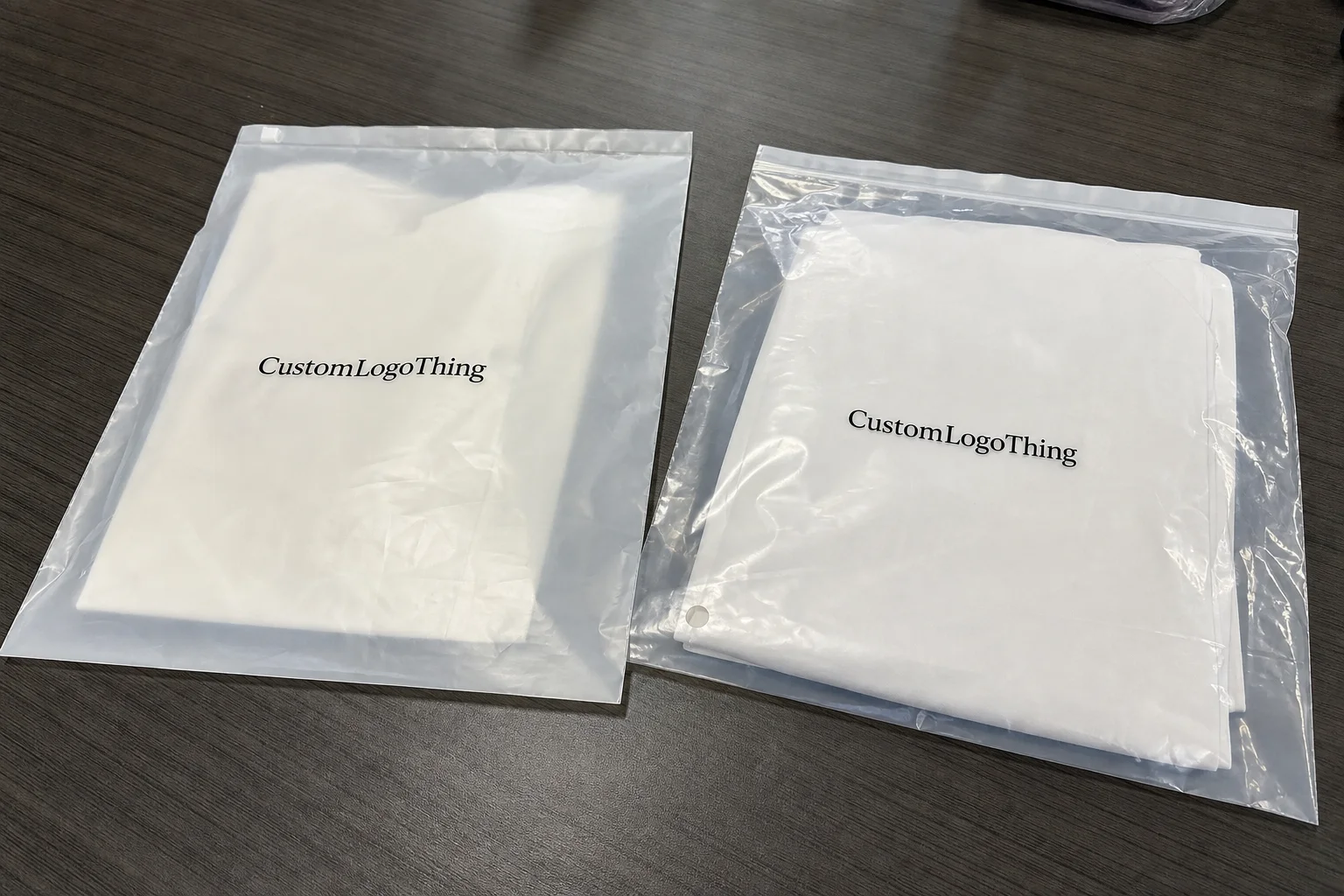
Garment Poly Bags are simple protective sleeves used to keep apparel clean, sorted, and presentable while it moves through storage, laundry, inter-property shipping, or guest-facing delivery. For one property, that is easy. For a hotel group, the same bag may need to work for banquet uniforms, concierge wear, spa robes, retail apparel, and seasonal gift-shop stock across multiple locations. Different use cases. Different handling. Same procurement headache.
That mix changes the buying logic. A bag that is fine for back-of-house laundry carts may look cheap on a folded robe placed in a guest amenity kit. A bag that protects a blazer during transport may be oversized and wasteful for a folded shirt. Centralized procurement has to balance brand feel, handling conditions, storage habits, and the fact that not every property follows the same process discipline.
The real question is not whether to use a poly bag. The question is which film, thickness, clarity, and seal style fit the job without paying for features that nobody will notice. That is the practical side of Garment Poly Bags for Hotel groups material comparison. Once the spec is framed that way, the decision gets easier to defend internally and harder for random local overrides to distort.
There is also a compliance angle. Packaging that looks small on paper can become messy in practice if it creates static, condensation, or excess waste. A hotel group usually cannot afford a bag that saves a fraction of a cent but triggers rework, guest complaints, or repeated replacements. Cheap is only cheap if it stays in one piece.
Garment poly bags for hotel groups material comparison
The main film families are LDPE, LLDPE, recycled-content blends, and co-extruded options. They are not interchangeable, even if a quote sheet makes them look close. Softness, clarity, puncture resistance, seal consistency, and how the film behaves under folding all move around depending on the resin and construction. A proper Garment Poly Bags for Hotel groups material comparison starts with handling, not with unit price.
LDPE is the standard baseline. It is flexible, clear enough for most packaging, and usually easy to spec for basic uniform bags. It works well for folded shirts, light tops, and standard storage where the bag is not being abused. LLDPE is tougher at similar gauge, which helps when bags get dragged across laundry carts, stacked into cartons, or handled by multiple departments. If a bag is likely to see repeated movement, LLDPE often earns its keep.
Recycled-content blends can work well for internal use, but they often bring more haze and more variation in seal behavior. That does not make them bad. It makes them specific. If the bag is going to live in a back-of-house program and the team can accept a less polished appearance, recycled content can be a reasonable choice. If the bag is part of a guest-facing presentation, the visual tradeoff becomes harder to justify.
Co-extruded films combine layers to balance strength and appearance. They are useful when the bag has to protect a garment, stay reasonably clear, and hold up under rougher handling. They also tend to be more forgiving when the package has to look presentable across properties that do not treat packaging as a priority.
The short version: softer films drape better, clearer films show the garment better, and tougher films survive rougher handling. Recycled materials change the picture again because haze, stiffness, and seal behavior can vary depending on the resin mix. If the bag is only moving within one property, a simple film is often enough. If it is shipping between properties or traveling with retail stock, a stronger film usually pays back in fewer tears, fewer rewraps, and less staff time spent fixing something that should have worked the first time.
“If the bag is only for back-of-house movement, do not pay guest-facing money for it. If guests will see it, do not spec it like a trash liner.”
Here is the practical tradeoff buyers usually miss: the best-looking film is not always the best operational film. A crystal-clear bag can look sharp, but if it clings too much or splits at the fold, it fails the job. A slightly less polished film with better toughness may be the smarter choice for a busy program. That is not compromise. That is choosing the right failure mode.
Key spec factors: thickness, clarity, and seal strength
Thickness is usually discussed in mil, and that is the right language for buyers. For light shirts and folded tops, a film around 0.75 to 1.0 mil can be enough if handling is gentle. For robes, jackets, or items that move through more carts and cartons, 1.25 to 2.0 mil is often safer. Heavier is not automatically better. If the bag only sits in a closet or carton for a short time, overbuilding it wastes money and adds plastic that does no work.
Clarity matters more than some teams expect. A highly transparent bag helps staff identify size, department, or property assignment without opening the package. It also makes retail apparel look cleaner and more deliberate. Frosty or recycled films can be fine for internal distribution, especially where brand presentation is not the goal. If the bag is used for guest-facing packaging, though, too much haze can make a well-finished garment look dull and poorly handled.
Seal strength and film strength are not the same thing. A strong seal on weak film still fails when the bag catches on a hanger hook. A tough film with a weak seam still opens during transport. Ask for both. If a supplier cannot speak clearly about seal performance, tear resistance, and gauge tolerance, the quote was probably built around price first and product second.
For hotel programs, sizing matters as much as resin choice. A folded shirt bag should not be so long that it traps air and bunches at the bottom. A robe bag needs room for bulk without swallowing the product. Longer uniforms and jackets usually need a little more width than teams expect, especially if the item is packed with a hanger card or a size label. A bag that fits correctly looks more expensive even when the material is not.
Print and label visibility matter too. If a hotel group wants a logo, property code, department mark, or size marker on the bag, the film has to stay readable after printing. That is easier on clearer LDPE or a well-made co-extruded film than on a haze-heavy recycled blend. For internal sorting, one-color print is often enough. For guest-facing packaging, keep the print restrained. Too much ink on a light bag can make the package look busier than the garment inside.
Quality control should be simple and repeatable. Check bag dimensions against the drawing, confirm the film gauge, inspect the seal edge for consistency, and run a quick fit test with the exact garment, hanger, or insert that will be used in production. A sample that looks fine on a table can fail once it is folded, carted, and stacked. That is not a theoretical risk. It is a routine one.
Process and timeline for sourcing custom bags
The sourcing flow should stay simple: define the garment, choose the film family, set the thickness range, request samples, approve print, confirm dimensions, and then lock the order quantity. That is the backbone of a sane custom bag program. Skip any step and the odds of a wrong fit climb fast.
Lead time depends on artwork readiness, sample approval speed, custom sizing, and the factory schedule. First-time runs usually take longer because the buyer is still deciding whether the bag is for storage, presentation, or shipping. Reorders move faster once the spec sheet is locked and the artwork has already been approved. A lot of delays in hotel group programs come from split ownership: marketing wants the logo one way, operations wants the bag another way, and procurement is left stitching it together after the fact.
Centralized approval matters because hotel groups can generate chaos without trying very hard. Get one internal spec signed off first, then distribute property-level rules for usage and replenishment. Otherwise each hotel starts tweaking the bag to fit local preferences, and suddenly the same item has five versions. That is how a simple order turns into a paperwork hobby.
Timelines also depend on what the supplier is being asked to do. A plain stock bag with no print is faster than a custom size with multiple ink colors. A recycled-content blend may add extra validation if your team wants consistency across lots. If the bag needs matching hang tags, inserts, or carton labeling, those elements should be approved together. Chasing each one separately is how schedules slip by a week at a time.
If your team is standardizing other packaging at the same time, keep the broader spec library in one place. Many buyers use a common approval process for Custom Packaging Products so uniform bags, inserts, and shipping cartons are easier to compare. For non-garment shipments, Custom Poly Mailers can follow the same logic, which keeps purchasing cleaner across the group.
For shipment performance, transport tests are worth the time. The test methods from ISTA are a better reference than guessing how a package will behave in real handling. If the bag is part of a broader packaging reduction effort, the EPA guidance on source reduction and material use is a reasonable place to check whether the program is actually reducing waste or just changing the label on it.
The useful distinction is first run versus repeat order. First runs carry the most risk because the buyer is still learning. Reorders are where the efficiency shows up. Once dimensions, film, print, and carton pack count are stable, the process becomes a lot less annoying.
Cost and pricing: what really changes unit cost
The biggest pricing levers are film type, thickness, dimensions, print coverage, seal style, recycled content, and quantity. Size alone can move the quote more than buyers expect because material usage climbs quickly once the bag gets longer or wider. Print coverage also matters. A small logo is not priced like a full-panel graphic or repeated mark pattern.
| Material | Best fit | Clarity and feel | Typical thickness band | Cost pressure |
|---|---|---|---|---|
| LDPE | Standard uniforms, folded shirts, basic storage | Soft, clear, easy to handle | 0.75 to 1.5 mil | Lowest |
| LLDPE | Busier handling, shipping between properties, heavier garments | Tougher, slightly firmer | 0.75 to 1.25 mil | Low to moderate |
| Recycled-content blend | Back-of-house programs, sustainability-led purchasing | Often a little hazier, feel varies | 1.0 to 1.5 mil | Moderate |
| Co-extruded film | Guest-facing packaging, mixed handling, better puncture resistance | Balanced look and strength | 1.25 to 2.0 mil | Moderate to higher |
For plain, unprinted bags, the spread between a basic LDPE option and a heavier co-extruded bag is often only a few cents per piece at volume, but the exact number depends on size, quantity, and print. Small orders can look much more expensive because setup and packaging overhead get spread across fewer units. That is why a quote without a full spec is almost useless. Two quotes can look close while hiding different gauge, different resin, different seal design, and different carton pack counts.
The usual buyer mistake is chasing the lowest number without checking whether the product is actually comparable. A cheap quote with thinner film or looser tolerance is not a win if the bags tear in laundry handling or arrive with inconsistent seams. Watch MOQ too. Hotel groups sometimes split volume across properties to stay flexible, but too much fragmentation can raise the per-unit cost and make reordering a hassle. The back office ends up paying for that fragmentation long after the meeting that caused it has been forgotten.
There are three straightforward ways to save money Without Cutting Quality: consolidate SKUs, standardize one or two bag sizes, and use the same base film across departments where the function is similar. If the procurement team is already buying corrugated cartons, kraft inserts, or FSC certified paper components, the packaging strategy should follow the same discipline. Separate what truly needs to be different. Do not create ten special items because nobody wanted to say no.
If sustainability is part of the brief, compare recycled materials, downgauged film, and right-sized packaging before jumping straight to biodegradable packaging. Poly bags are not automatically the right place to solve every environmental goal. In many cases, reducing excess film and improving carton efficiency does more than switching to a material that looks greener on paper but fails the job in practice. If the bag needs to be lighter, prove that the lighter version still survives the handling path.
One more procurement reality: freight and carton configuration can move the landed cost more than the resin choice on a per-piece basis. A bag that ships efficiently in a tight carton pack count may beat a slightly cheaper film that requires more cube. Most quotes do not make that obvious, so buyers need to ask for landed cost, not just ex-factory price.
Common mistakes hotel buyers make with poly bags
The first mistake is using one bag spec for every garment type. That sounds efficient until the thin bag on a jacket tears and the oversized bag on a shirt wastes material and looks sloppy. Uniform shirts, spa robes, and retail sweaters are not the same problem, so they should not be forced into the same packaging geometry.
The second mistake is choosing overly thin film just to save pennies. That usually backfires. Bags split, garments wrinkle, and someone at the property rewraps the item or complains that the presentation looks cheap. Small savings disappear fast once replacements, labor, and guest-facing damage show up.
The third mistake is ignoring fit. A bag that is too long, too narrow, or too loose is almost always a weak spec. Fit affects appearance, protection, trapped air, and how neatly the package stacks in storage. It matters even more when the garment travels with a hanger or a folded insert card.
Fourth, many buyers underestimate back-of-house handling. Laundry carts, hanger hooks, carton stacking, and repeated sorting punish weak seams. If the program runs through multiple departments, sample testing is not optional. A five-minute fit check often saves a week of avoidable frustration and a pile of complaints nobody planned for.
Fifth, some teams approve artwork before they approve the film. That sounds harmless until print looks fine on paper but hazes out on a recycled blend or distorts on a thinner gauge. Material first, print second. That sequence avoids a lot of avoidable rework.
Expert tips for smarter material selection
Match the material to the job. Guest-facing packaging should usually get clearer film, cleaner printing, and a better surface finish. Internal transport can use a less expensive, tougher film that prioritizes tear resistance over showroom appearance. That split alone can keep a whole program from drifting toward over-spec.
Standardize by garment category, not by property. A shirt bag should be the same across the group unless there is a real operational reason to change it. That keeps procurement simple and makes replenishment easier. The fewer moving parts, the less likely someone is to approve a local variation that costs more and solves nothing.
If the sustainability brief is real, ask what the supplier can prove. Recycled-content percentage, seal quality, haze, and puncture resistance are all testable. So is fit. A claim is cheap. Sample validation is not. If a supplier cannot give clear information, assume the spec is still fuzzy.
One practical point most teams miss: the outer packaging often matters more than the inner bag in terms of waste perception. If garments ship in corrugated cartons with kraft paper inserts, or if the broader packaging program uses recycled materials and post-consumer waste content where it makes sense, the bag does not need to carry the whole sustainability story. If policy requires biodegradable packaging, make sure it still meets handling requirements. Good intentions do not stop a seam from splitting.
For seasonal spikes, build a replenishment plan before the panic order starts. Property openings, banquet seasons, and spa promotions all change demand. If the bag spec is already approved, the team can reorder faster and avoid paying for rushed changes. That is the unglamorous part of procurement, and it usually saves more money than a clever presentation ever will.
My rule is simple: if a bag will be handled more than twice before it reaches the guest, test it like a working package, not like a sample on a desk. Fold it, stack it, drag it, label it, and see what breaks first. That tells you more than a polished quote sheet ever will.
Next steps for hotel groups choosing garment bags
Start with a short internal spec sheet: garment type, target dimensions, film family, thickness range, print needs, and acceptable MOQ. Keep it to one page. If the spec needs a paragraph to explain itself, it is probably too complicated.
Then request side-by-side samples from at least two material options and test them on the exact garments your properties use. A robe, a pressed shirt, and a jacket all tell different stories. A sample that looks fine on a table may behave badly once it is folded, carted, stacked, or dropped into a bin with the rest of the day’s work.
Compare quotes using the same spec, then check total landed cost, not just unit price. That means material, print, carton pack count, and shipping terms all have to be visible. Once the primary bag is locked, keep one backup option for busy periods so procurement can move without reopening the whole sourcing process. That backup should be boring. Boring is useful here.
For a hotel group, the best Garment Poly Bags for Hotel groups material comparison is the one that matches handling, presentation, and budget without forcing compromises everywhere else. Finalize the spec, test the samples, and let the film prove itself in the workflow before anyone orders a thousand units and hopes for the best.
What material is best for garment poly bags for hotel groups?
LDPE and LLDPE are the most common choices because they balance flexibility, clarity, and cost. Clearer film works better for guest-facing presentation, while tougher film is usually better for internal transport or heavier garments. The best option depends on garment weight, handling conditions, and whether appearance or durability matters more.
How thick should garment poly bags be for hotel uniforms?
A practical thickness range depends on garment weight and how rough the handling is. Light shirts may only need a lighter film, while robes, jackets, and folded sets usually need more material. Use the lightest thickness that still resists tearing in your real workflow, not the thickest one available.
How do I compare quotes for garment poly bags accurately?
Match size, film type, thickness, print method, and carton pack count before comparing price. Check MOQ, tooling or plate charges, and shipping terms so the lowest quote is not misleading. Ask for samples or spec sheets so you can verify that each quote is actually the same product.
What is a realistic lead time for custom garment poly bags?
Lead time depends on artwork approval, sampling, production queue, and shipping distance. Simple repeat orders usually move faster than first-time custom runs. If your hotel group has seasonal demand, build in extra time for approvals and property-level coordination.
Can recycled-content film work for hotel garment packaging?
Yes, if the film still meets your clarity, seal, and tear-resistance requirements. It is often a good fit for back-of-house use or standardized internal packaging. Always test recycled-content samples on the exact garments before rolling them out across properties.


