For hotel groups, Garment Poly Bags for hotel groups moq planning affects housekeeping speed, storage space, brand consistency, and the actual cost per piece. If the bag spec is vague, the quote is vague too. Then the wrong size gets ordered, cartons arrive awkwardly packed, and somebody has to explain why the packaging program is now eating budget.
Hotels rarely buy garment packaging for one reason only. Uniforms need clean presentation. Laundry returns need dust and moisture protection. Spa apparel often needs a softer, more polished look. Back-of-house storage wants something that stacks neatly and survives handling. Once you put those use cases together, “just use a plastic bag” stops sounding like a plan.
Why hotel groups need poly bag specs locked before quoting
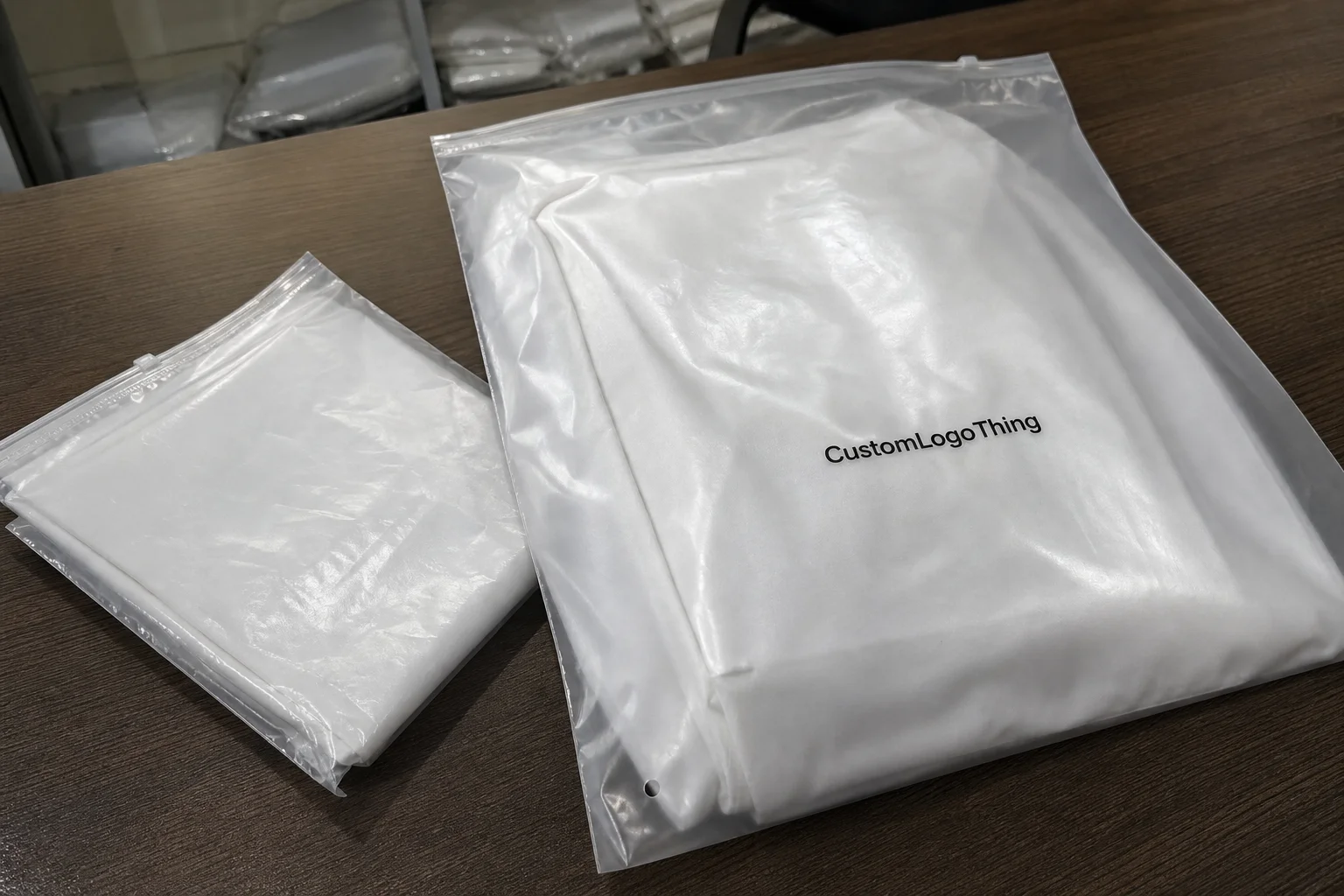
A hotel chain usually needs garment packaging for a mix of workflows. Housekeeping may need fast access and easy tearing. Laundry teams may need stronger film and cleaner carton packing. Guest-facing programs care more about appearance. The same bag rarely serves all of those needs well, which is why Garment Poly Bags for hotel groups moq planning should start with the use case, not the price request.
When buyers leave the spec open, three mistakes show up again and again. First, the bag is too small and garments crease badly or won’t sit flat. Second, the film is too thin for repeated handling, so the seams split or the hanger hole tears. Third, the order gets overprinted with a logo treatment that looks fine in proofing but drives up setup charges for a rollout that is still being tested.
From a packaging buyer’s perspective, the best order is not the cheapest quote. It is the one that balances presentation, durability, and MOQ without filling a storeroom with dead stock. That is the whole game.
“A vague bag spec usually costs more than a better bag spec. You just pay for the mistake later, in freight, rework, or surplus inventory.”
Chain programs make this even more sensitive because every property expects the same result. One hotel should not receive a glossy clear bag while another gets a frosted version with a different opening and a slightly off logo color. That looks sloppy.
Product details that matter for hotel garment packaging
Most hotel garment packaging falls into a few standard structures. Flat poly bags are the simplest and most common. They work well for folded uniforms, spa apparel, and guest laundry returns. Side gusset bags add capacity, which helps for bulkier garments or sets. Resealable styles can make sense when bags are reused internally or when the hotel wants a cleaner guest-facing experience. Hanger holes and vent holes also matter because they affect fit, airflow, and how the bag behaves on a rail.
In practice, hotel groups use these bags in a few predictable ways:
- Housekeeping uniform packing for folded shirts, pants, aprons, and jackets
- Dry-cleaning returns where the bag protects the garment after pressing
- Spa and wellness apparel that benefits from a neat presentation
- Guest laundry returns that need moisture and dust protection
- Back-of-house inventory for seasonal or spare uniform storage
Print is another decision point. Some hotel groups want a single-color logo. Others need handling text in multiple languages. Some add size labels or barcode stickers for inventory control. A few use plain transparent bags with insert cards because that keeps costs down and still looks tidy. If you are planning Garment Poly Bags for hotel groups moq planning across multiple properties, simpler is usually easier to control.
Finish matters too. Clear bags show the garment immediately and work well for uniform management. Frosted film looks more premium but can raise the cost slightly. Glossy bags tend to look cleaner under bright light. Matte is less common but can reduce glare. If anti-static treatment, recycled content, or a specific resin blend is required, say that before proof approval.
For buyers who need a broader packaging view, our Custom Packaging Products page is a useful starting point. If the hotel group also needs mailers for amenities, retail items, or uniform distribution, the same planning logic applies to Custom Poly Mailers.
Specifications to confirm before you request a quote
If you want a useful quote, send usable information. For Garment Poly Bags, confirm the width, gusset, height, opening style, and whether the garment is folded or hung. A folded shirt in a flat bag needs a different footprint than a jacket on a hanger. A bag that is 2 inches too short can make the whole run annoying to use.
Thickness is the next big decision. For light-duty protection and one-time handling, thinner film can work. For repeated movement by housekeeping or laundry teams, a heavier gauge makes more sense. In many hotel programs, a practical range is 1.2 to 2.0 mil depending on how often the bag is handled.
Print details need the same discipline. Confirm artwork file format, ink colors, print area, and whether Pantone matching is required. Ask for registration tolerance too. Multi-color logos are where small shifts show up and make the final bag look cheap even when the unit price looked fine.
Operational features are easy to forget and annoying to fix later:
- Perforation for easy tear-off in housekeeping workflows
- Tear notch for fast opening
- Adhesive flap for return or storage use
- Zipper seal for reusable applications
- Hanger hole size if bags sit on rails
Also confirm whether the bag is meant to be stacked flat in cartons or used directly on-site in dispensers. That affects carton count, carton dimensions, and shipping efficiency. In procurement, those small decisions decide whether a quote looks reasonable or quietly becomes expensive after freight and handling are added.
| Spec choice | Best use | Cost impact | Risk if chosen wrong |
|---|---|---|---|
| Flat bag | Folded uniforms and guest laundry | Lowest | Poor fit for bulkier garments |
| Side gusset | Thicker items, jacket sets, spa apparel | Moderate | Higher unit cost and larger cartons |
| Resealable flap | Reusable or guest-facing packaging | Higher | More setup charges and slower production |
| Plain clear bag | Inventory control and low-cost rollout | Lowest | Less brand presence |
Pricing and MOQ for hotel group orders
MOQ and pricing move together. Bigger runs lower the unit cost, but storage risk rises fast if the program is still changing. For Garment Poly Bags for hotel groups moq planning, compare MOQ against real usage, not against an abstract “best price.”
The main cost drivers are straightforward: film type, thickness, bag size, print colors, special features, and whether you need mixed sizes. Add labels, hanger holes, or resealable flaps, and the cost per piece climbs.
Typical hotel-group planning usually falls into three buckets:
- Pilot run: 2,000 to 5,000 pieces for one or two properties. Best when the design is new or the workflow is not fully settled.
- Regional rollout: 10,000 to 30,000 pieces. Better for a hotel group that has one standard spec but wants to test distribution by market.
- Full-property program: 50,000+ pieces. Lowest unit cost, but only sensible when the size, film, and print are locked.
A pilot can cost more per bag. That is normal. A buyer who chases the lowest MOQ and ignores implementation risk often ends up paying more overall. Too much inventory is not savings. It is just money sitting in cartons while storage space disappears.
Use this as a realistic framing, not a promise:
- Plain clear poly bags: often lower cost, especially at larger volumes
- Single-color printed bags: moderate price increase, mostly driven by setup charges and print prep
- Multi-color or specialty bags: higher cost due to tooling fees, longer production, and stricter QC
Watch the hidden costs too. Freight can make a decent quote look bad. Split shipments add handling. Carton labeling changes may require extra prep. Rush production premiums are rarely worth it unless a property opening is already at risk. Buyers often focus on bulk pricing and forget landed cost.
For hotels comparing options, ask for three quote scenarios: lowest unit cost, balanced MOQ, and pilot volume. That makes tradeoffs visible.
Production steps, lead time, and approval flow
The production flow is simple. First comes spec confirmation. Then artwork proof. Then material approval. Then sample or pre-production review. After that, bulk production begins. If the order is printed, a clean approval chain matters more than people like to admit.
Lead time changes with complexity. Simple plain bags can move faster than printed bags with special features. If the supplier needs to source a particular film grade or match a strict logo color, timing stretches. For custom hotel packaging, a normal range is often 12 to 20 business days after proof approval, but that depends on production load and whether samples are required first.
Common delay points are boring and predictable:
- Missing dielines or incorrect artwork dimensions
- Low-resolution logos that need rework
- Late color approval from brand teams
- Last-minute size changes after pricing is quoted
- Property-by-property changes that break the original production plan
If the hotel group wants the fastest path, do three things. Finalize the specs first. Approve one master proof. Release production by phase or property, not by random emergency. That is especially useful when multiple procurement managers are involved and everybody has a slightly different opinion about “just one small change.”
For the procurement team, a clean approval flow also protects quality. Standards like ISTA testing principles matter when packaging is moving through distribution.
How to choose a supplier for chain-wide packaging consistency
For hotel groups, the supplier question is not just “who is cheapest.” It is “who can repeat the same result next quarter and next property.” That means stable thickness, repeatable color, accurate sizing, and decent reorder records.
Factory-direct buying usually gives better control over MOQ and pricing. You can often negotiate the exact specs and avoid some distributor markup. Distributors can still be useful if the hotel group needs smaller split orders, faster local replenishment, or help coordinating multiple delivery points.
Before choosing a supplier, check these basics:
- Sample availability before bulk release
- Artwork support for logo placement and print prep
- Production traceability across reorders
- Carton labeling that works for procurement and warehouse teams
- Shipping documents prepared cleanly for multi-property deliveries
Compliance still matters. If recycled content is part of the program, ask for documentation. If the hotel group has sustainability targets, look at EPA recycling guidance and verify what claims the supplier can support. If FSC-certified paper insert cards are involved, check the documentation through FSC.
Also ask about setup charges and reorder policy. Some suppliers quote nicely on the first order and then attach new fees every time the hotel group wants a size tweak or a repeat run.
Next steps to lock your order without overbuying
If you are planning garment poly bags for hotel groups moq planning, start with the numbers you actually control. Gather the exact bag size, film thickness, print requirement, and estimated consumption by property. If you do not know monthly usage, estimate it from room count, laundry cycles, and uniform turnover.
Then decide whether the rollout should be pilot, phased, or full. If the hotel group is changing vendors, changing uniform styles, or changing bag design, a phased release is usually smarter. A smaller MOQ can cost more per unit, but that can still be cheaper than overbuying the wrong spec and living with it for a year.
Ask for three quotes side by side:
- Lowest unit cost for a larger MOQ
- Balanced MOQ for a controlled rollout
- Pilot volume for lower inventory risk
That comparison gives procurement a clean way to make the call. It also makes the cost per piece, freight, and setup charges visible instead of buried in the fine print. If you need help organizing the request package, our FAQ can answer common ordering questions before you send specs out for quotes.
Final checklist: send artwork, confirm specs, request a sample, compare landed cost, and approve the release quantity only after storage and usage are checked. That is how hotel groups keep a packaging program under control.
What MOQ should hotel groups expect for garment poly bags?
MOQ depends on bag size, print colors, and film type. Custom-printed orders usually need a higher minimum than plain bags. For chain programs, compare pilot MOQ, regional MOQ, and full rollout MOQ instead of chasing the absolute lowest number. If storage is limited, a slightly higher unit cost on a smaller MOQ can be cheaper than overbuying cartons of unused bags.
How do garment poly bag specs change for hotel laundry and uniform use?
Uniform bags usually need tighter sizing and cleaner presentation, while laundry return bags may need stronger film and easy-open features. If the bags are handled repeatedly, thickness matters more than fancy print. Hanger holes, tear notches, and adhesive flaps should match the actual workflow, not the sample sitting on your desk.
What affects the unit cost most on hotel group poly bag orders?
Film thickness, bag size, print coverage, and color count are the biggest price drivers. Special features like resealable flaps, vent holes, or custom labels raise cost fast. Freight and setup charges can distort the quote, so always check landed cost, not just bag price.
How long does production usually take after artwork approval?
Simple custom bags typically move faster than complex printed or feature-heavy designs. Lead time depends on proof approval speed, material availability, and whether samples are required first. If the hotel group wants phased delivery, build shipping time into the schedule so each property gets product on time.
Can hotel groups order different sizes under one MOQ plan?
Yes, but it depends on whether the supplier allows shared material runs or mixed-SKU production planning. A smart MOQ plan often bundles a few sizes into one program instead of treating every property as a separate project. Ask for a split-order quote so procurement can compare inventory risk against savings.


