Garment Poly Bags for Apparel Brands: Rush Reorder Planning
Garment Poly Bags for apparel brands rush reorder planning starts with one awkward fact: the clothing can be ready while the packaging is not. A best-selling tee clears production, passes final QC, and still sits in staging because nobody can find the last approved bag spec. Or worse, the spec exists, but it does not match the current SKU mix. That is not a supply chain mystery. It is a paperwork problem with a deadline.
The film itself is usually not the expensive part. The expensive part is the delay that follows when someone has to rebuild an order from memory. Dimensions get guessed. Thickness gets debated. Print files go missing. Then the team discovers the old bag fit was fine for the first run and wrong for the current fold size. Speed matters, but speed without a locked spec just creates fast mistakes.
If you are comparing packaging formats beyond this one article, it can help to review Custom Packaging Products for broader options and Case Studies for examples of how brands handle repeat orders and replenishment cycles.
“If the bag spec is fuzzy, the reorder is already late.” That is the reality. A rush order does not forgive missing information. It punishes it.
Why Rush Reorders Fail When Packaging Is an Afterthought
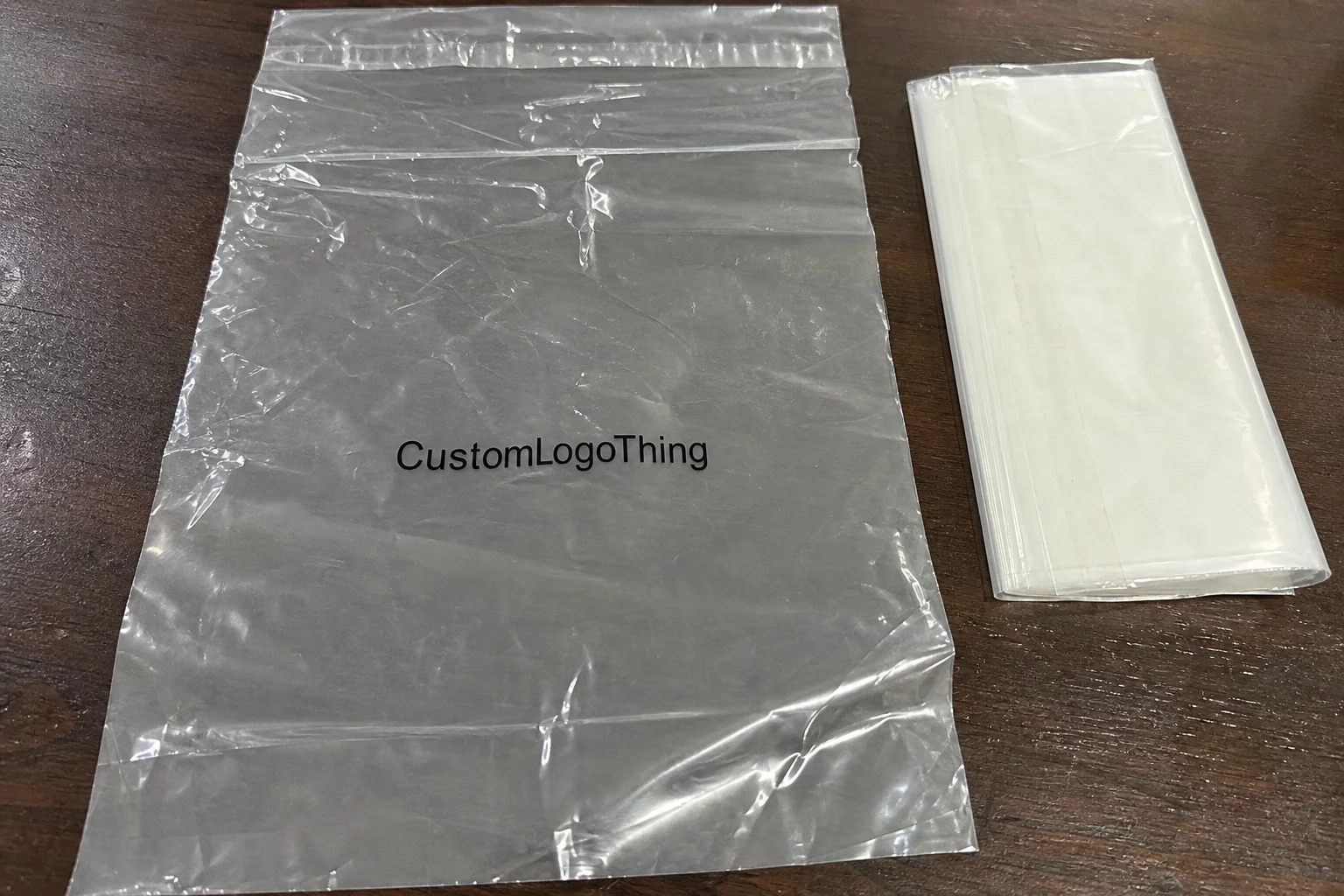
Rush reorders usually fail for the same boring reasons. The original order looked simple, so nobody saved the full spec set. Then a replenishment comes in with a different size breakdown, a new hangtag, or a revised retail channel, and the “same bag” is no longer the same bag. Packaging becomes the bottleneck in a shipment that was otherwise ready to move.
The hidden cost is not always obvious on a quote. It is the chain reaction: one email to confirm dimensions, another to check seal type, another to approve warning text, another to verify carton counts. Every one of those steps takes time. Apparel inventory windows are usually short, so a missing bag detail can push a replenishment past a launch date or a store receipt window. That is how a small packaging miss turns into a real operational problem.
Consider a standard tee restock. The product is finished. Freight is waiting. The fulfillment team wants cartons labeled. But the packaging team cannot pack until the folded dimensions are confirmed, and the buyer will not release the order until the warning copy matches the retailer file. None of this sounds dramatic. It still stops the shipment.
- Lock dimensions early: width, length, and gusset determine fit and carton pack-out.
- Confirm thickness: a change from 1.5 mil to 2.0 mil affects durability, feel, and cost.
- Define print status: unprinted, printed, or warning-only bags each carry different setup time.
- Fix pack counts: inner packs, master carton counts, and acceptable overage should not be guessed on a rush order.
That is the practical value of Garment Poly Bags for Apparel brands rush reorder planning. It does not just speed production. It removes the friction that usually shows up after the order is already late.
Poly Bag Formats Apparel Buyers Actually Reorder
Most apparel buyers do not need twenty packaging options. They need the right one repeated accurately. The actual reorder list is pretty ordinary: folded tees, hoodies, socks, intimates, multipacks, and hanger-ready presentation bags. Each category has a slightly different packing logic. A slim tee needs less space. A heavy hoodie needs room for bulk and often a gusset. Socks and intimates care more about consistency and barcode visibility than display drama.
Clear bags remain the default for basic ecommerce and wholesale packing because inspection is easy and the material is inexpensive. Frosted bags look cleaner on shelf and take the edge off a warehouse feel without adding much complexity. Printed bags are the most brand-forward choice, but they add approval steps, and that matters a lot more on a rushed reorder than it does on a long-planned launch.
Closure style changes the workflow too. Resealable adhesive strips work well for high-volume fulfillment. Flap closures can fit certain retail programs. Hang holes help display programs but need to be positioned correctly or the line slows down. Suffocation warnings, recycling marks, and venting requirements all belong in the same conversation. If those details are still open when the order is supposed to move, the clock starts slipping.
Some details should stay fixed from one order to the next. Bag width, gusset depth, film gauge, seal type, and warning text placement belong in a master spec, not in someone’s inbox thread. Other details can stay flexible. If a standard unprinted bag gets the job done and shaves days off the schedule, that is usually a smarter rush decision than forcing a custom print setup for a short delivery window.
For teams building a repeatable line, it is usually better to standardize a small set of sizes and film weights rather than redesign every SKU from scratch. Common apparel ranges often land around 1.5 mil to 2.0 mil for general folding and inner packing, while heavier garments or higher handling risk may call for thicker film or a wider gusset. The exact choice depends on the garment weight, folding method, and how much abrasion the package will see in transit.
Specifications That Prevent Reorder Delays
Good reorder specs remove guesswork. Bad ones create it. A useful spec sheet needs bag dimensions, material type, thickness or gauge, closure style, print requirements, carton pack-out, and the final ship-to destination. If any of those fields are missing, the quote process slows because the supplier has to assume something. On a rush job, assumptions are how people lose days.
Size changes matter more than many buyers expect. A one-inch shift can affect whether a folded garment lies flat, whether the barcode stays visible, and whether the carton count still works. It can also change freight efficiency if the pack pattern no longer matches the case size. That is why Garment Poly Bags for apparel brands rush reorder planning works best when the master spec reflects the current SKU, not the version from two seasons ago that happens to be sitting in a folder.
Compliance details deserve the same attention. Many retailers expect suffocation warning text in a specific size and location. Some want recycling marks. Others require vent holes or label placement tied to product type. If the brand also uses paper cartons or inserts, procurement may have sustainability rules that affect the secondary packaging mix. Packaging standards vary by retailer and channel, so the exact requirement always outranks the generic version.
A solid reorder file usually includes:
- Approved sample reference or previous PO number.
- Final bag dimensions and thickness.
- Print file status with version control.
- Carton count, inner pack count, and overage allowance.
- Shipping address, in-hand date, and any special handling notes.
If that information is current, future rush orders move much faster. If it is not, the buyer spends the first day reconstructing a file that should already exist.
It also helps to define acceptable tolerance ranges in advance. For example, many buyers are comfortable with minor dimensional variation if the bag still fits the folded garment and the carton configuration stays unchanged. The key is to agree on those limits before the rush happens, not during it.
Cost, Pricing, and MOQ for Rush Reorders
Price is driven by a small set of variables: material thickness, bag size, print complexity, style, and quantity. That is the easy part. Rush orders change the economics because they compress the schedule. A supplier may need to prioritize shop time, split production windows, or pull from stock material instead of waiting for a standard run. All of that can raise the unit cost.
In practice, the gap is not always dramatic, but it is real. A clean repeat order for 5,000 clear bags often lands lower than a fully custom printed rush run of the same quantity. The more colors in the art, the more likely the price climbs. If the bag is an exact repeat and the material is already in stock, the premium can stay modest. If the supplier has to rebuild the spec or locate material, the premium usually grows.
| Bag Option | Typical MOQ | Typical Unit Price at 5,000 | Lead Time Profile | Best Use |
|---|---|---|---|---|
| Clear unprinted LDPE bag, 1.5 mil | 3,000 to 5,000 | $0.05 to $0.10 | Fastest if stock material is available | Basic tees, inner packing, replenishment |
| Frosted bag, unprinted | 5,000 | $0.07 to $0.14 | Usually short if dimensions are standard | Retail presentation with a cleaner look |
| Printed apparel bag, single-color | 5,000 to 10,000 | $0.11 to $0.20 | Proof approval adds time | Brand visibility, ecommerce unboxing |
| Printed bag with special closure or warning copy | 10,000 preferred | $0.15 to $0.28 | Longest setup window | Retail programs with compliance or display requirements |
A clean quote should show more than unit price. Ask for setup charges, artwork fees, carton details, freight assumptions, and the exact bag spec. Otherwise the low number on page one turns into a higher landed cost once extras appear. That is not a surprise. It is a bad comparison.
Minimum order quantity matters, but it is not the whole decision. A lower MOQ can help protect cash flow on a seasonal test. A tiny rush order can also carry a higher unit cost. The practical tradeoff is simple: buy enough to cover the immediate replenishment without creating dead stock that outlives the SKU.
Process and Timeline for a Fast Reorder
A fast reorder follows a predictable sequence: request, spec confirmation, quote approval, artwork or sample sign-off, production, inspection, and freight booking. The order moves quickly only if the first two steps are clean. If the buyer cannot confirm the old spec, the supplier has to stop and reconstruct it. That is the point where “rush” starts meaning “expedited paperwork.”
For a standard repeat order, many apparel teams should expect roughly 10 to 15 business days from proof approval to production completion if the material is available and the spec is unchanged. For an expedited repeat, 5 to 10 business days is possible on some runs, though that depends heavily on inventory, print setup, and factory schedule. Freight time is separate. Air or premium courier can save days; ocean or ground can add them. Lead time is never just manufacturing.
Delays usually show up in the same places. Artwork is missing. The dieline is outdated. The buyer is waiting on a current carton count. A ship-to address changed, but nobody updated the file. These are ordinary failures, which is exactly why they happen so often. Garment Poly Bags for apparel brands rush reorder planning works best when the packaging request is built into the replenishment calendar instead of being treated like a last-minute rescue.
The supplier needs a few things on day one:
- Approved reference sample or previous PO.
- Target in-hand date, not just order date.
- Final quantity and any acceptable overrun.
- Ship-to details, including receiving hours if applicable.
- Any test or transit requirement. For rough freight routes, many teams use ISTA testing standards to sanity-check packaging load and handling.
If those inputs are ready, the reorder moves like a controlled production task instead of a fire drill.
When a team has a recurring replenishment pattern, a practical workflow is to maintain a single packaging file per SKU family. That file should include the latest approved spec, the last production quantity, any deviations from standard, and the contact path for approvals. The result is a shorter quote cycle and fewer preventable revisions.
What a Repeatable Packaging Partner Should Already Know
The advantage of a repeatable packaging partner is not the pitch. It is memory. A supplier that stores spec history, carton preferences, routing notes, and approved print files can quote faster and make fewer mistakes. That matters across seasonal drops, replenishment waves, and channel changes, because packaging never lives alone. It has to work with buying, fulfillment, and freight.
Compare that with a supplier that starts from scratch every time. Even if the team is capable, buyers spend more time rediscovering details that should already be documented. The result is slower decisions and a higher chance of mismatch between the current SKU and the old packaging file. That shows up later as missed dates and preventable revisions.
Quality control also gets easier with a repeat partner. Dimensional tolerance should stay within the agreed range. Seal integrity should be consistent. Print should match the approved proof. Carton labels should reflect the correct SKU family. Those are basic controls, but in a rush run they are the controls that matter most.
There is also a practical reason buyers keep coming back to the same packaging setup. If a supplier already knows the bag style, the run can start from an approved baseline instead of a guess. No one needs a design meeting for a plain clear poly bag. What they need is a clean record, a fast response, and a file that does not require detective work.
For broader packaging programs, the same documentation habits apply to mailers, cartons, and insert materials. The point is not to chase more vendors. The point is to make each reorder predictable enough that a rush does not become chaos.
If your team is comparing vendors, ask whether they can support repeat ordering with stored specifications, sample references, and proof history. That is often a better indicator of rush performance than a simple price quote.
Next Steps to Place a Rush Apparel Reorder
If the next replenishment is already on the calendar, pull together the last approved spec sheet, a reference bag, the current quantity target, and the required delivery window before asking for a quote. That short list removes most of the friction. The best apparel buyers do not send a vague request and wait for interpretation. They send enough detail to get a real answer on the first pass.
Confirm whether the job is an exact repeat or a revised order. Even a small change in size, thickness, print, or warning copy can change cost and lead time. If the order is modified, say so clearly. If the bag is unchanged, say that too. The distinction matters because it determines whether the supplier can move straight into production review or has to restart approval.
Send this first:
- Dimensions and bag style.
- Film thickness and material type.
- Closure style, warning text, and print status.
- Carton count, ship-to address, and required arrival date.
Ask for a written production calendar, not a verbal promise. Ask which details are already approved and which still need review. If the supplier stores repeat specs cleanly, the next order can move fast. If your internal team stores them cleanly too, the second reorder is usually easier than the first. That is the quiet advantage of handling packaging like part of replenishment planning instead of treating it like a side quest.
For teams still building out internal process, a dedicated packaging reference page such as FAQ can help answer common approval and reorder questions before the request goes out.
Frequently Asked Questions
These are the questions that usually come up when a rush apparel reorder is already in motion. The practical answer is usually about file quality, stock material availability, and whether the bag is a true repeat.
How fast can garment poly bags for apparel brands be reordered in a rush?
It depends on three things: whether the order is an exact repeat, whether the material is already in stock, and whether the artwork is approved. A standard repeat can move much faster than a first-time custom order because the supplier can skip spec discovery. Freight method also affects the final timeline, especially when the delivery window is tight.
What information should I send for a fast apparel poly bag quote?
Send the bag dimensions, material or thickness, closure style, print requirements, quantity, and delivery destination. If you have a reference sample or the last approved order number, include that too. If the order is urgent, state the in-hand date up front so the supplier can confirm feasibility before the quote is built.
Do rush reorders usually have a higher unit cost?
Often yes. Expedited scheduling reduces production flexibility and can add handling costs. The actual increase depends on quantity, material availability, and whether the order can run as a true repeat. A clean spec and a larger quantity usually keep unit cost lower than a fragmented emergency order.
Can I reorder the same poly bag without reapproving everything?
Usually only if the spec, artwork, and carton details match the prior approved order. Any change in size, thickness, print, or compliance text can trigger a new review. The fastest reorders are the ones with a master spec file that already captures the final approved version.
What is the best way to avoid delays on future packaging reorders?
Store the approved spec sheet, final artwork, and sample reference in one place. Record carton counts, packaging notes, and ship-to requirements for each SKU family. Treat packaging as part of replenishment planning, not an afterthought, and garment poly Bags for Apparel brands rush reorder planning stops being an emergency and starts acting like a routine process.
Should I choose printed or unprinted bags for a rush order?
If the goal is speed, unprinted bags are usually the safer choice because they avoid proofing and print setup time. Printed bags make more sense when branding or retail presentation is the priority and the timeline allows for approval. For urgent replenishment, many teams use a standard unprinted bag now and reserve printed packaging for a later run.
What thickness is common for apparel poly bags?
Many apparel programs use film in the 1.5 mil to 2.0 mil range for standard garments, with thicker options sometimes used for heavier pieces or more handling. The right choice depends on fold size, product weight, and how much protection the bag needs during shipping and storage. A bag that is too thin can tear easily, while one that is unnecessarily heavy may add cost without much benefit.
Where can I find related packaging options or broader guidance?
The most relevant starting points are Custom Packaging Products for packaging format options, Case Studies for reorder examples, and FAQ for common ordering questions.


