Garment Poly Bags for streetwear labels rush reorder planning usually fails at the packaging stage, not at the garment stage. One wrong dimension, and the pack line starts fighting extra fold time, wrinkling, and rework while the launch clock keeps moving.
Streetwear drops compress decisions fast. A tee can be finished, folded, and boxed in an afternoon, but if the bag is off by even a little, the line slows down and the delay spreads into freight, labor, and retail timing. That is why Garment Poly Bags for streetwear labels rush reorder planning needs to start with the last approved spec, not a fresh guess.
Why rush reorder planning breaks down when packaging is treated like a commodity
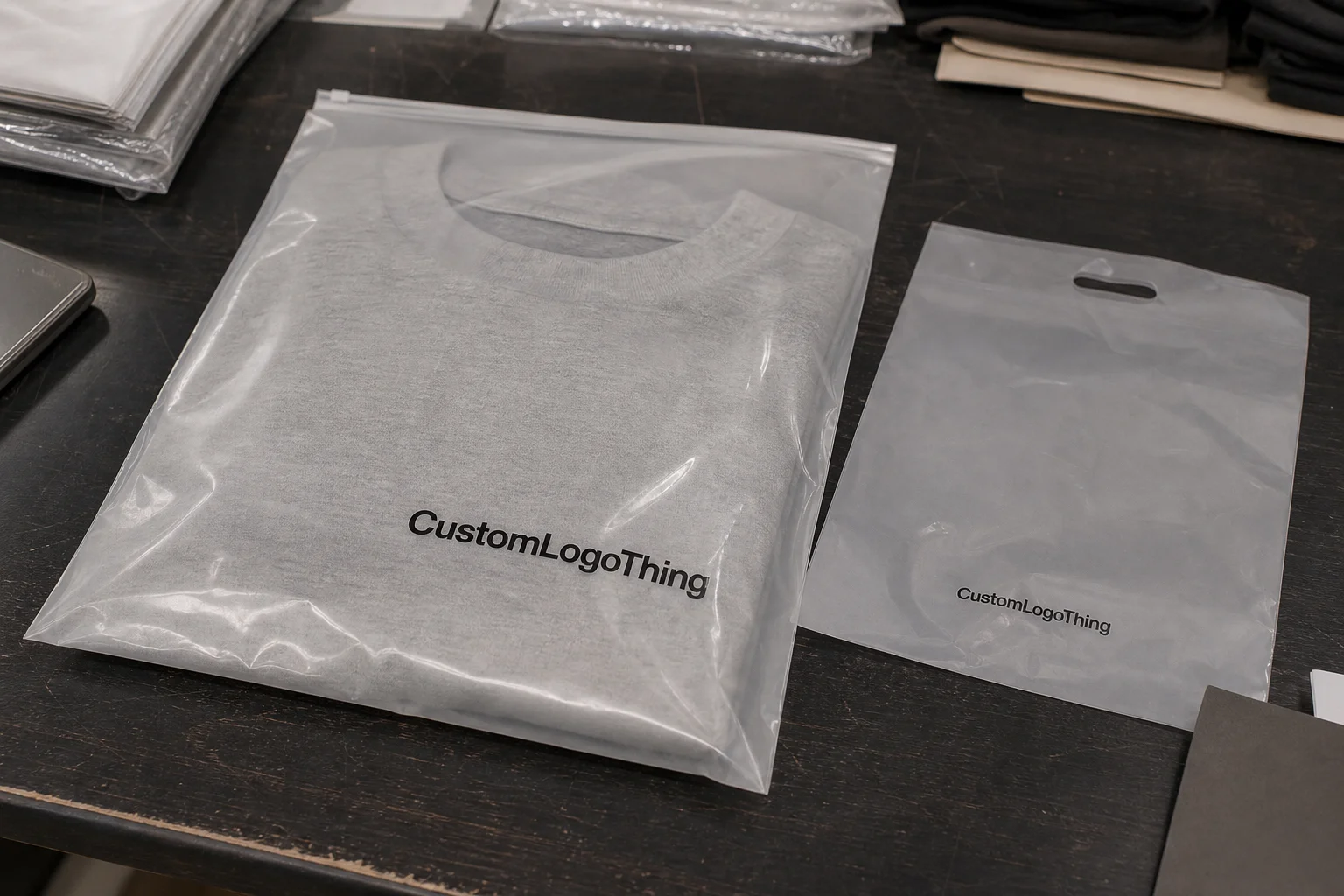
Poly bags look simple, so they get treated like a background item. That is the mistake. Packaging sits inside the production system. A bag that is too short forces overfolding. A bag that is too tight adds static and creasing. A bag that is too loose makes the presentation sloppy and can slow insertion at the packing table. In a rush order, those small problems compound.
Streetwear is especially sensitive to that because the product cycle is short and the margin for error is thin. A clean reorder usually depends on a known bag code, the same artwork, and the same film gauge. The moment someone says, “We can sort it out later,” later turns into extra freight, more handling, and a missed ship window. The safest move is usually to repeat the last approved configuration unless there is a clear reason to change it.
There is also a timing issue that gets ignored too often. Drop schedules push packaging into the last mile, where every upstream delay gets magnified. If the garment is ready but the packaging is not, the brand still misses the launch. That is why Garment Poly Bags for Streetwear labels rush reorder planning should be treated like deadline management, not a commodity quote.
A reorder only looks simple after the supplier has the last approved sample, exact dimensions, and ship-to details. Without that packet, every date is a guess.
For teams that want a broader packaging stack, related items belong in one buying system instead of scattered across vendors. That is where Custom Labels & Tags and Custom Packaging Products help. Fewer disconnected suppliers means fewer handoff errors when the schedule is already tight.
Bag styles and film choices that fit streetwear packaging
Streetwear teams usually reorder from a few common bag types, and the right choice depends on garment weight, retail presentation, and how the packout line operates. Flat poly bags are the default for tees and lighter tops. Resealable flap bags work well if the product may be opened and resealed at retail or by fulfillment staff. Hanger-hole bags make sense for items that move through a hanging retail fixture. Gusseted bags give extra depth for hoodies, sweatpants, and denim. Perforated retail packs help with speed when crews are bagging by hand and need a cleaner tear-off or access pattern.
Film choice matters just as much as bag style. Clear LDPE is usually the practical option when product visibility matters more than the finish. Frosted film creates a more premium visual signal, though it can add cost and sometimes adds lead time. For heavier pieces, a stronger gauge is worth paying for. A 1.5 to 2 mil film may be enough for lightweight tees, but heavyweight fleece often does better at 2.5 to 3 mil, sometimes higher if the garment has sharp hardware or bulky seams. That extra strength is not decoration. It protects the product and the labor spent handling it.
Closure type changes line speed. A tuck flap is quick. A peel-and-seal strip is cleaner for some retail applications. Heat seal can be efficient in higher-volume runs, but it adds equipment dependence. Venting matters too, especially for bulkier garments that trap air and fight the bag during insertion. A small vent or a perforation pattern can save real time when a crew is working through thousands of units.
Print should be used deliberately. Brand marks are obvious. Size callouts reduce sorting errors. Warning copy protects compliance. Barcode windows can reduce handling mistakes if the bag is used in a retail or warehouse workflow. If the reorder is urgent, staying close to the last approved style code is usually the safest path in Garment Poly Bags for Streetwear labels rush reorder planning. Every new feature becomes another variable.
If the order also needs shipping protection, pairing the inner bag with Custom Poly Mailers can simplify the final packout. The point is to keep the packaging stack consistent, not to add more moving parts.
Critical specifications to confirm before you approve the quote
The fastest quote is the one with the fewest unknowns. In garment poly Bags for Streetwear labels rush reorder planning, the supplier should not have to infer the product from a blurry photo and a size guess. Confirm the width, length, and gusset, then check how the folded garment actually sits inside the bag. A tightly folded tee in a 10 x 13 inch bag does not behave the same way as a heavyweight hoodie in the same footprint.
- Exact finished dimensions in inches, millimeters, or both.
- Film thickness in mil or microns.
- Print detail: number of colors, PMS matches, front, back, or full coverage.
- Functional features: hang hole, perforation, resealable flap, or heat seal.
- Compliance copy: suffocation warning placement and any retail wording.
- Packout reference: photo or physical sample of the last approved bag.
That last item matters more than most buyers expect. A photo helps, but a sample catches things photos miss: gloss level, seal strength, flap length, and whether the artwork sits where the fold line actually falls. If the vendor has to recreate the bag from memory, the order is no longer a reorder. It is a redesign under deadline.
Artwork control is another common failure point. Confirm whether the printer can reuse old files or whether the art needs a new proof because the logo, warning text, or barcode placement changed. Even a small shift in the warning panel can affect production setup. Buyers often try to save time by skipping the proof cycle, but that only works if the prior approval is clean and the vendor can document it.
For teams that care about transit durability, it is worth asking how the supplier thinks about distribution testing. The logic behind ISTA methods is straightforward: if the packout has to survive handling, vibration, and stacking, the bag spec should be checked against the actual shipping path, not just the drawing. That is a practical standard, not theory.
Pricing, MOQ, and unit cost for rush reorders
MOQ is usually driven by size, film type, print complexity, and whether the order uses stock tooling or a fully custom build. Simpler clear bags tend to have lower minimums. Printed bags, frosted finishes, gussets, and specialty closure features usually push the minimum up. In garment poly bags for streetwear labels rush reorder planning, the right question is not just “What is the unit price?” It is “What does the full landed cost look like at the quantity I actually need?”
That means asking for base film, print setup, proofing, carton packout, and freight. Those line items explain why two quotes that look close can end up far apart. A bag may be cheap on paper and expensive once rush freight, split shipment fees, and rework risk are added. Speed costs money because scheduling capacity is real.
| Bag option | Typical use | Common MOQ | Typical lead time after proof approval | Indicative unit cost |
|---|---|---|---|---|
| Clear flat poly bag | Tees, lightweight tops, basic packout | 5,000 to 10,000 | 7 to 12 business days | $0.08 to $0.16 |
| Resealable flap bag | Retail-friendly presentation, returns, storage | 5,000 to 10,000 | 10 to 15 business days | $0.12 to $0.22 |
| Gusseted heavy-garment bag | Hoodies, fleece, denim, bulkier folds | 3,000 to 5,000 | 10 to 16 business days | $0.14 to $0.28 |
| Perforated retail pack | Hand-bagging speed, display packs, multi-step handling | 10,000+ | 12 to 18 business days | $0.15 to $0.30 |
Those figures move with print coverage and quantity. A one-color brand mark is cheaper than full-coverage artwork. A larger run usually drops the unit cost, but it can also lock up cash in inventory that may not turn fast enough for a short streetwear release. That is why some labels quote both a standard and a rush option before they choose. A slightly longer lead time can protect margin if the drop can absorb it.
For sourcing decisions that include material reduction goals, the EPA source reduction guidance is a sensible reference point. Less material is not automatically better, but unnecessary over-specification is a real cost, and it often shows up in freight as much as in film.
For teams that need to compare packaging costs across a wider assortment, Wholesale Programs can help frame the numbers in context. The goal is not the lowest price in isolation. The goal is the lowest landed cost that still makes the launch date.
Process and turnaround for a streetwear reorder
The reorder path should be short, structured, and visible. The best vendors move through intake, spec verification, artwork check, proof approval, production, QC, and dispatch without losing the thread. In garment poly bags for streetwear labels rush reorder planning, the schedule is often won or lost before production starts. A bad intake packet creates a bad timeline.
Some steps can be compressed. Others cannot. If the artwork is unchanged and the bag dimensions match the prior order, proof time can move fast. If the size changed, if the film changed, or if the warning panel moved, the vendor has to revalidate setup. That takes time, even in a rush. There is no honest shortcut around it.
One thing buyers should separate is production time from in-hands time. A quote that says “ship in 10 business days” is incomplete if freight adds another 4 or 5. The launch does not care when the bags leave the plant. It cares when they hit the dock, the DC, or the finishing table. For that reason, in-hands date and ship date should always be treated as different commitments.
Split shipments can help if a drop is divided across regions or channels. A brand may need part of the order for a launch kit while the rest is still in transit. That can keep the campaign moving, but it needs planning. It also needs clear carton counts, lot tracking, and a written agreement on what ships first.
The most reliable turnaround improvement is a clean order record. If the supplier can pull the prior proof, the exact spec, the approved quantities, and the packing instructions, the reorder becomes an execution task instead of a detective job. That is the real advantage of disciplined garment poly bags for streetwear labels rush reorder planning.
What a reliable packaging partner should do during a rush order
Not every supplier is built for urgency. Some only price the bag and wait. A better partner checks the spec, asks where the timeline is vulnerable, and flags problems before production starts. That behavior matters more than a polished quote PDF. In a rush order, the real product is judgment.
The supplier should be able to say, plainly, whether the current spec is reusable, whether the print file needs a fresh proof, and whether the material is available without substitution. If the original gauge is unavailable, there should be a compatible alternative with a clear explanation of how it changes handling or appearance. Silence is expensive in a packaging schedule.
Communication cadence matters too. Daily updates may be excessive for a simple reorder, but the buyer should know when proof approval is due, when production starts, and when QC is complete. That kind of visibility protects the launch team, the warehouse, and the merch planner. It also reduces the tendency to chase status from five different people.
Reliable support is operational. It sounds basic, but it is not common enough. The partner should think in counts, carton flow, warning copy, and freight deadlines. If the order has to move through a compliance review or a retail distribution check, the vendor should know that too. Brands running multiple drops can keep art and packaging aligned through repeatable specs instead of rebuilding the order every time.
Streetwear buyers do not need hype. They need a supplier who understands that a bag is part of the schedule, not separate from it. That is especially true for garment poly bags for streetwear labels rush reorder planning, where one missed approval can cost a launch window.
Next steps: assemble the reorder packet before you request pricing
Before asking for a quote, put the reorder packet together. Include the current bag sample or a sharp photo, exact dimensions, thickness, quantity, artwork file, ship-to address, and the deadline. If there is retail compliance copy, include that too. The cleaner the packet, the faster the response.
Decide whether the reorder should match the last version exactly or whether the brand update is worth the added proof cycle. A logo tweak, a size change, or a new warning panel is not a minor detail if the drop is close. It is a schedule decision. Ask for tiered quotes with and without rush freight so the team can see the cost of speed instead of guessing at it.
Confirm the proof approval cutoff in writing. Confirm the production start date in writing. Those two timestamps control the rest of the job. If the supplier cannot commit to them, the date is not real enough to plan around. Packaging buyers lose time most often by trusting vague language instead of timestamped milestones.
That is the practical shape of garment poly bags for streetwear labels rush reorder planning: send the sample, lock the details, compare landed cost, and move immediately to proof approval. If the launch matters, the packaging needs to move with it.
What do I need to send for garment poly bags for streetwear labels rush reorder planning?
Send the last approved sample or a clear photo, plus exact dimensions, film thickness, quantity, artwork, and ship date. Include any changes since the last order so the vendor can catch spec drift before quoting or proofing. If the deadline is tight, state the in-hands date and the ship-to ZIP so freight timing is accurate.
How fast can a rush reorder move if the bag spec is already approved?
Repeat orders move fastest when the supplier can reuse tooling, artwork, and a known spec without a new design cycle. The production clock still depends on proof approval, payment terms, and material availability, so speed is not automatic. Ask the vendor to separate proof time, production time, and freight time so the real timeline is clear.
What MOQ should I expect for custom streetwear poly bags?
MOQ varies by size, film type, print count, and whether the bag uses standard or custom features. Simpler bags usually have lower MOQs than printed or specialty-finish bags, especially when rush scheduling is involved. Request tiered pricing so you can see where the MOQ starts to improve unit cost.
Can I change the size on a reorder without delaying delivery?
Usually no, because even a small size change can affect tooling, print placement, and carton packing. Minor changes may be possible only if the supplier has a compatible stock spec or a ready alternate size. If the size must change, ask for a separate schedule so the reorder does not silently slip.
What should I compare in a rush reorder quote besides unit price?
Compare setup charges, proof fees, freight, split shipment costs, and any premium for expedited scheduling. Check whether the quote includes QC, carton packout, and warning-copy compliance so there are no hidden additions later. Look at landed cost and delivery date together, because the cheapest quote can be the most expensive if it misses the drop.


