Buyer Fit Snapshot
| Best fit | Gloss Lamination Retail Cartons projects where brand print, material claims, artwork control, MOQ, and repeat-order consistency need to be specified before quoting. |
|---|---|
| Quote inputs | Share finished size, material target, print colors, finish, packing count, annual reorder estimate, ship-to region, and any compliance wording. |
| Proofing check | Approve dieline scale, logo placement, barcode or warning zones, color tolerance, closure strength, and carton packing before bulk production. |
| Main risk | Vague material claims, crowded artwork, missing packing details, or unclear freight terms can make a low unit price expensive after revisions. |
Fast answer: Gloss Lamination Retail Cartons: Board, Finish, Dieline, and Unit Cost should be specified like a repeatable production item. The safest quote records material, print method, finish, artwork proof, packing count, and reorder notes in one written spec.
Production checks before approval
Compare the actual filled-product size with the drawing, then confirm tolerance on folds, seals, hang holes, label areas, and retail display edges. Reserve space for logos, QR codes, warning copy, and material claims before decorative graphics fill the panel.
Quote comparison points
Review material grade, print process, finish, sampling route, tooling charges, carton quantity, and freight assumptions side by side. A quote is only useful when the supplier can repeat the same color, closure quality, and packing count on the next order.
Gloss Lamination Retail Cartons: What Buyers Need to Know starts with a shelf test that has nothing to do with theory. Pick up the box, turn it under the light, and ask whether it earns the price printed on the product inside. That single motion tells you more than a spec sheet ever will. Gloss lamination retail cartons can make a carton look sharper, cleaner, and more expensive, but only when the board, artwork, and structure are all built to carry the effect. If any one of those pieces is weak, the shine is gonna expose it pretty fast.
Packaging buyers usually care about two jobs at once. The carton has to help sell the product, and it has to survive the trip from press to shelf to customer hands. That overlap explains why gloss lamination retail cartons show up in beauty, personal care, vitamins, holiday kits, and other categories where the package carries part of the brand story. A carton that disappears is a missed opportunity. A carton that cracks, scuffs, or dulls too fast is worse.
There is a practical side that often gets missed in mood-board conversations. A glossy film can shield print from rubbing, light moisture, and repeated handling. It can also expose weak contrast, fuzzy typography, and poor file prep with brutal clarity. I have watched a beautiful launch fall apart at the proof table because the artwork looked fine on screen but went muddy once the gloss hit it. Packaging has a funny habit of rewarding precision and punishing shortcuts in the same stroke.
What Are Gloss Lamination Retail Cartons?
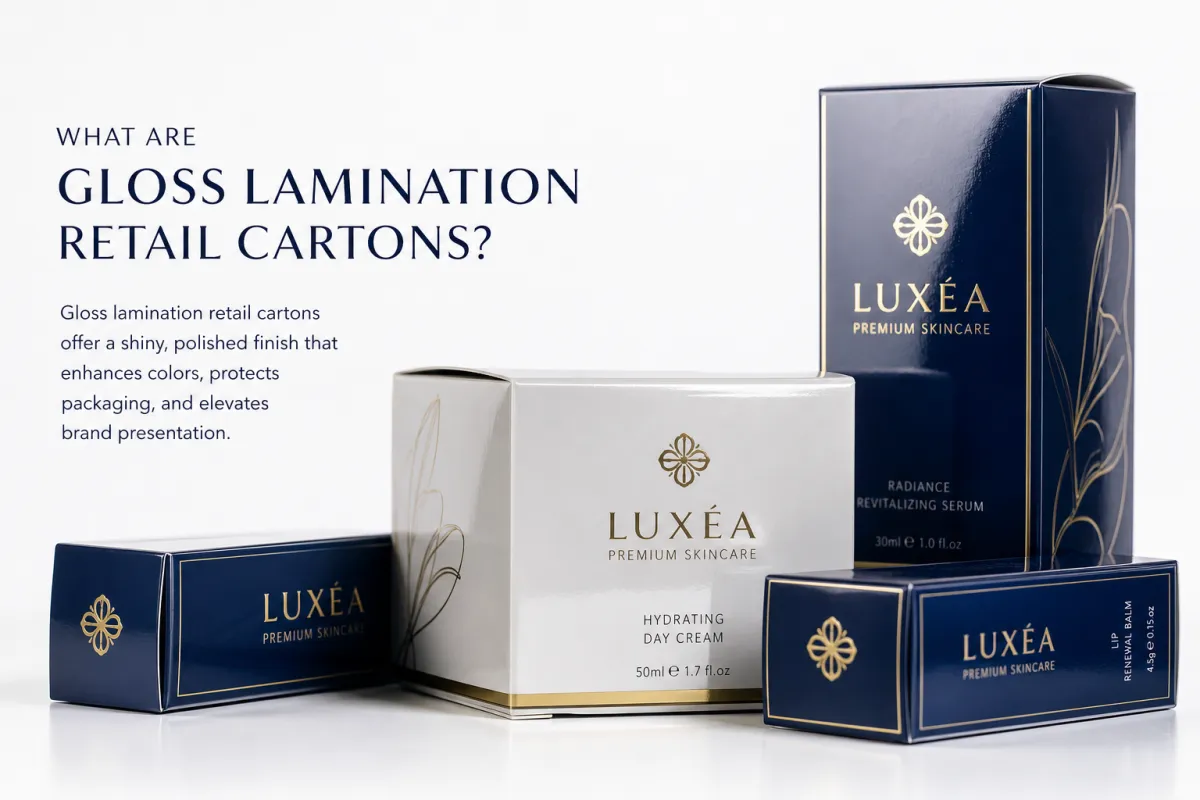
Gloss lamination retail cartons are printed paperboard cartons finished with a clear film that adds shine and creates a smoother face. The printed sheet gets a thin plastic layer after printing, then it is cut, folded, and glued into the final carton. The result is a surface with more reflection, deeper color read, and stronger resistance to scuffing than many bare or lightly coated cartons.
The visual shift is immediate. A carton that felt ordinary on press can look far more premium once the light hits the laminated side. Colors usually land with more force. Black looks denser. Reds, blues, and other saturated tones tend to feel louder in a good way. Logos can pop harder too, especially when the design uses clean spacing and strong contrast. That is one reason gloss lamination retail cartons are so common for products that have to earn attention in a few seconds.
Gloss is still just a finish, not a rescue plan. Weak artwork stays weak. Poor print registration stays poor. Flimsy board still feels flimsy. The shine can even make flaws easier to spot. Tiny scratches, dust specks, fingerprint marks, and creases near the fold line often stand out more on gloss lamination retail cartons than on matte cartons.
That matters because retail packaging gets handled constantly. Store staff stack it. Shoppers pick it up and put it back. Cases slide across warehouse floors. Displays sit under aggressive lighting for weeks at a time. Gloss can help the carton hold its appearance through that abuse, but it also reflects every nick and smear. So the real question is not whether gloss looks attractive. It is whether gloss lamination retail cartons fit the product, the shelf environment, and the level of handling the box will face.
- Best for: bold branding, high-saturation graphics, photography, and shelf-facing products.
- Less ideal for: quiet luxury cues, ultra-minimal layouts, or designs built around a soft tactile feel.
- Practical benefit: stronger resistance to scuffing than bare print on many retail runs.
- Main caution: glare and fingerprints can show up quickly under bright retail lighting.
The short version is simple. This finish is usually chosen to help a package sell harder and hold up longer. That is the core appeal of gloss lamination retail cartons.
How Gloss Lamination Retail Cartons Are Made
The production path looks straightforward on paper, yet the details decide whether the final carton works. First, the artwork is printed on the selected board, often paperboard in the 300gsm to 400gsm range depending on the product, size, and structural demands. Next, the clear laminate film is applied over the printed sheet. The sheet then moves through die cutting, scoring, folding, and gluing before it becomes a finished carton.
That sequence means the finish is not decorative add-on work. It is part of the structural plan. For gloss lamination retail cartons, the score lines need to be set so the film does not crack on a hard fold. Glue zones must remain bondable after lamination. Tight panels, lock tabs, and side seams all need to be planned with the film behavior in mind.
Why scoring and glue zones matter
The laminate changes the way the board behaves. A low-cost structure can fail at the folds if the score is too shallow or the board is not suited to the finish. Dense solids and heavy ink coverage make the issue more obvious, because the film adds stiffness and magnifies bad folding geometry. On gloss lamination retail cartons, a fold that looks fine on screen can become a cracked edge in real life.
Good converters test the fold, inspect for cracking near creases, check adhesive performance, and confirm that the panels stay square after conversion. Skip that step and the buyer ends up finding the problem later, usually after the cartons have already been approved, packed, and booked for shipment. Packaging likes to keep its worst surprises for the least convenient moment.
Gloss versus other coatings
Gloss lamination is not the same as UV coating or aqueous coating. Aqueous coating is lighter, quicker, and usually less expensive, though it gives less film build and less protection. UV coating can deliver a strong shine too, but it behaves differently under abrasion and fold stress. Lamination generally adds more protection than a simple coating on many retail carton jobs, which is one reason gloss lamination retail cartons are selected for products that need more shelf durability.
Designers also use gloss as part of a wider visual system. It can amplify solid color blocks, photography, metallic inks, and sharp logos. It can pair with spot UV when selective shine is part of the plan. Add foil stamping or embossing, and the carton can gain depth fast, though every extra finish adds setup time and more opportunities for error.
Film choice matters too. Most gloss laminates in retail packaging use BOPP or PET films, and each brings a slightly different balance of clarity, stiffness, and cost. A good converter will talk through that early instead of treating the laminate as a one-size-fits-all add-on. That discussion sounds technical, but it saves headaches later. Nobody wants to discover too late that the chosen film was right for the image but wrong for the fold.
The best gloss work is rarely the loudest. It is the work that supports the design instead of fighting it. The surface should make the artwork feel crisper, not busier. That difference separates a carton that feels considered from one that looks like shine was added because the budget had room for it.
Are Gloss Lamination Retail Cartons Worth It?
For many brands, yes, but only when the visual job and the physical job line up. Gloss lamination retail cartons tend to be worth the extra spend when the product needs sharper shelf presence, better scuff resistance, and a finish that can survive frequent handling. If the packaging has to do the selling in three seconds or less, a glossy surface often earns its place.
The return is easiest to see in categories where color, photography, and fast recognition matter. Beauty launches, supplements, seasonal kits, and mass retail promotions often benefit because gloss makes the carton read faster from a distance. That said, glossy shine can work against softer brand cues. If the design depends on restraint, texture, or a muted luxury feel, the same cartons may feel too bright and too literal.
So the answer is not universal. It depends on the product, the shelf, and the message. A strong carton finish should support the brand story, not overwrite it. When the choice is right, gloss lamination retail cartons can do more than look polished. They can help a product stand out without needing a larger format, louder copy, or a second round of redesign.
There is also a hidden advantage that teams sometimes overlook: consistency. A glossy finish can help a printed carton look more even across a production run, especially if the design uses large solid panels. That does not erase print variation, but it can reduce the visual noise that makes small shifts look worse than they are. In a high-volume retail setting, that kind of stability matters more than people admit.
Key Factors That Decide Whether Gloss Lamination Is Worth It
Not every carton deserves a glossy finish. Some do. Some absolutely do not. The right answer depends on a few concrete factors, and they matter more than brand mood boards usually admit.
Board stock and thickness come first. A thin board with a glossy film still feels thin. It may look a little better, but it will not suddenly read as premium in the hand. Overspecifying the board can push freight and converting costs higher without adding much value. For gloss lamination retail cartons, the useful range is usually a board that supports the product weight, folds cleanly, and feels stable without turning into a shipping cost you resent later.
Artwork style matters just as much. Gloss tends to reward photography, saturated color, high contrast, and bold typography. If the carton is mostly text, line art, or a restrained minimalist layout, the shine may add reflection without adding real value. That is why gloss lamination retail cartons often outperform matte on cosmetics, supplements, and consumer goods fighting for attention, while softer luxury brands may prefer a less reflective finish.
Retail environment changes the decision too. Busy drugstore aisles, mass-market shelves, and display tables that invite constant handling put more stress on packaging than a boutique shelf does. Humidity, transit abrasion, and stacking all increase the need for a finish that can take abuse. If the carton will be touched twenty times a day, gloss lamination retail cartons start to make much more sense.
Brand positioning also steers the choice. Promotional packaging, seasonal runs, and high-volume consumer goods often benefit from a more forceful visual finish. Matte or soft-touch can feel richer in certain categories, but gloss often wins where fast recognition matters more than quiet elegance. A carton on a crowded shelf has a tiny window to make a decision for the shopper. A glossy surface can help or hurt depending on the rest of the design.
A finish can rescue a crowded shelf, but it cannot rescue weak artwork. If the hierarchy is messy, gloss just makes the mess shinier.
Sustainability and compliance still need a direct answer. Buyers often want to know whether the carton is recyclable, FSC-certified, or compatible with certain environmental claims. The answer depends on the board, the film, local recycling rules, and the exact structure. For general recycling guidance, the EPA page at epa.gov/recycle is a useful starting point, but local rules still decide what actually gets accepted. Do not guess. A brand claim that sounds confident but does not match the material is worse than saying less.
For buyers, the real question is not whether gloss looks nice. Of course it does. The question is whether gloss lamination retail cartons help the product sell, survive handling, and stay inside the budget and compliance rules that apply to the job.
Gloss Lamination Retail Cartons: Cost, Pricing, and Tradeoffs
Cost is where the decision becomes concrete. Many buyers like the look of gloss lamination retail cartons until the quote arrives, and then every team suddenly wants to discuss alternatives, exceptions, and creative compromises.
The price depends on board grade, carton size, quantity, print coverage, laminate type, and the amount of finishing involved. A simple one-color carton on standard paperboard costs far less than a full-bleed photo carton with foil stamping, spot UV, and tight structural die cutting. Packaging budgets usually do not blow up because of one obvious line item. They unravel because several small choices stack together and no one notices until the invoice lands.
Short runs usually carry a higher per-unit cost because the setup is spread across fewer cartons. A 1,000-unit order can look manageable until you compare it with a 5,000-unit run and see how sharply the unit price drops. For gloss lamination retail cartons, quantity has a real effect because the print setup, lamination setup, cutting dies, and finishing labor all have to be absorbed somewhere.
There is another wrinkle: a glossy finish can raise expectations. That is not a line item, but it behaves like one. If the carton looks more premium, the print quality, cutting accuracy, and assembly consistency need to keep pace. Otherwise the finish feels like window dressing. Buyers often discover this after the first sample run, and then the conversation gets a lot less theoretical.
Here is a practical comparison. These figures are broad add-on ranges for a typical folding carton run in the 5,000-piece range, before freight and any unusual artwork complexity. Exact pricing shifts with size, coverage, and the converter's equipment.
| Finish | Typical Added Cost Per Unit | Look | Best Use | Main Tradeoff |
|---|---|---|---|---|
| Gloss lamination | $0.04-$0.12 | Bright, reflective, color-forward | Shelf impact, handling resistance | Glare, fingerprints, visible scuffs |
| Matte lamination | $0.05-$0.14 | Soft, muted, premium | Luxury positioning, low-glare display | Less color pop, can show oils differently |
| Aqueous coating | $0.02-$0.05 | Light sheen or satin | Budget-sensitive retail cartons | Less protective than laminate |
| UV coating | $0.03-$0.08 | Very glossy, crisp | High-impact graphics, selective shine | Can be less forgiving in folding and scuff zones |
The table is not a quote. It is a reality check. If one supplier quotes gloss lamination retail cartons at a much lower number than the rest, ask what is included. Is the quote board only? Does it include die cutting, folding, and glue? Is proofing charged separately? Is the laminate a standard film or a specialty stock? The cheapest number on the page is often only cheap because it is incomplete.
Hidden costs tend to show up in a few predictable places:
- Reproofs: artwork that is not press-ready adds time and money with every correction.
- Color matching: high-coverage graphics may need more adjustment before approval.
- Testing: fold checks, glue checks, and assembly checks are worth paying for.
- Artwork issues: low-resolution files can trigger reruns or delay sign-off.
- Shipping inefficiency: heavier board and larger cartons can push freight higher.
The cleanest way to compare gloss lamination retail cartons is to request quotes with identical specs. Same dimensions. Same board. Same quantity. Same finish. Same shipping destination. Anything less turns the comparison into apples versus oranges, and one of those fruits probably has a hidden surcharge attached.
Process and Timeline
The timeline for gloss lamination retail cartons starts before printing and ends after packing, but the buyer feels it most when the launch date gets close. That is why the schedule should be built backward from shelf date, not forward from the purchase order. Retail calendars do not soften because an approval was late. They just keep moving.
A standard production sequence usually looks like this:
- Dieline approval: confirm dimensions, folds, glue tabs, and product fit.
- Artwork proofing: check colors, copy, bleeds, and finish callouts.
- Printing: produce the carton sheets on the approved board.
- Lamination: apply the gloss film after the ink is cured or ready for finishing.
- Die cutting: cut the carton shape and score the fold lines.
- Folding and gluing: convert the flat sheets into cartons.
- Inspection and packing: verify seams, surface quality, and carton count.
- Shipment: send the finished cartons to the next step or direct to the brand.
A domestic converter may need around 12-18 business days from final proof approval to ship, depending on quantity and finishing complexity. Offshore timelines often run longer, and freight time can add more than teams expect. If the carton includes extra effects like foil stamping, embossing, or a mixed-finish build, the calendar usually stretches further. Gloss lamination retail cartons are not inherently slow, but the process only moves as fast as the artwork and approvals allow.
The delay points are predictable. Late artwork remains the most common culprit. Color changes follow close behind. Laminate sourcing can also slow things down if the converter needs a specific film grade or width. Quality checks are another time cost, though they are usually worth it. Buyers often want speed and perfection together, which sounds reasonable until the freight window closes.
Buffer time is not a luxury. Retail launches usually need sample review, internal sign-off, and a safety cushion in case the first proof misses the mark. Seasonal promotions need even more room. Gloss lamination retail cartons only matter if they arrive before the product needs them.
Suppliers can accelerate some steps, but not all of them. A converter may be able to push printing or adjust the order of jobs, yet rushing lamination or folding can create defects, weak seams, or surface issues that are hard to repair. Fast is useful. Rushed is expensive.
For buyers who want to keep the process orderly, a simple checkpoint list helps before approving gloss lamination retail cartons:
- Final dieline approved and dimensions checked.
- Artwork flattened, press-ready, and correctly sized.
- Finish confirmed in writing.
- Ship date worked backward from retail launch.
- Sample or press proof reviewed under actual store lighting.
Common Mistakes with Gloss Lamination Retail Cartons
The most common mistake is choosing gloss because it looks expensive in a sample image, then discovering the actual product needs something quieter. Gloss lamination retail cartons are a visual choice first, but they are also a positioning choice. If the brand wants a soft-touch luxury feel, or if the product is meant to signal calm and restraint, gloss may send the wrong message.
Another mistake is ignoring fingerprints, edge wear, and glare in the real store environment. A glossy carton under bright retail lighting can reflect more than people expect. That is not a defect. It is physics. Still, if the package will sit on a shelf where shoppers grab it often, gloss lamination retail cartons need to be checked under the same lighting the customer will see.
Skipping fold-line and glue testing is another common miss. The laminate changes how the carton bends, especially on tight scores or more complex structures. A carton that looks flawless while flat can crack at the fold, open at the seam, or fight the gluing process once the line starts running. It is usually easier to prevent that problem than fix it, which is a polite way of saying test early and save money.
Low-resolution artwork is a trap too. Gloss is unforgiving. It throws light in a way that can make weak contrast or blurry imagery painfully obvious. If the file is marginal, the shiny surface will not hide it. It will spotlight the flaw. That is why gloss lamination retail cartons should be paired with clean files and strong contrast that can survive a shelf scan from a few feet away.
I have also seen teams approve a carton in a quiet conference room and then hate it on the sales floor. The office lighting was warm and forgiving; the store LEDs were not. That is a small detail with big consequences. A sample that looks elegant in the hand can feel a little harsh once it sits under retail lights for a week, and that difference is easy to miss if nobody checks both environments.
Here are a few mistakes buyers repeat:
- Choosing shine first: selecting gloss before deciding whether the brand needs high reflectivity.
- Ignoring handling: not accounting for shipping abrasion, shelf picking, and case packing.
- Skipping sample review: approving only on a monitor instead of under real lighting.
- Overcomplicating the structure: stacking too many finishes without checking whether the carton still folds cleanly.
- Weak compliance language: making recycling or sustainability claims that do not match the final material.
The last point carries more weight than many teams admit. If the carton uses a laminate layer, the environmental message should match the structure and the local recycling rules. Gloss lamination retail cartons can still fit a responsible packaging strategy, but the claim has to be accurate. "Recyclable" is not a mood. It is a statement that needs evidence.
Brands also get tempted to pile on foil stamping, embossing, and spot effects all at once. Done well, that can look striking. Done badly, it turns into expensive clutter. Every effect should justify its place by improving recognition, perceived value, or usability. If it is decoration for its own sake, it probably belongs on the cutting-room floor.
What to Do Next Before Ordering Gloss Lamination Retail Cartons
Before ordering gloss lamination retail cartons, lock down the basics. The fastest way to get a useful quote is to send a clear spec sheet instead of a vague "how much for boxes?" message. Suppliers can work fast, but they still need something concrete to price. Minds are not part of the package.
- Request a physical sample or press proof. Review it under the same light your customer will see in store.
- Compare at least two finish options. Keep board, size, and print specs identical so the difference is meaningful.
- Confirm laminate type in writing. Ask whether it is standard gloss film, a specialty film, or another finish route.
- Ask about turnaround time and minimum quantity. For gloss lamination retail cartons, schedule matters almost as much as price.
- Check score, fold, and glue requirements. The finish should not create assembly problems.
- List the exact use case. Shelf display, shipper insert, seasonal promo, or direct retail display all call for different thinking.
A one-page approval checklist also helps. Keep it plain: dimensions, board thickness, quantity, finish choice, ship date, artwork version, and product category. If the cartons are tied to a launch, add the retail date too. That single field has saved more budgets than a stack of software subscriptions ever has.
If the carton needs more than shine, say so early. Maybe the brand wants a tactile contrast between gloss and a matte panel. Maybe there is a logo in spot UV. Maybe the front flap carries a foil accent. The clearer the goal, the easier it is to quote gloss lamination retail cartons without missing a hidden cost driver.
Good packaging briefs are boring in the best way. They are specific, measurable, and impossible to misread.
For most brands, the safest path is simple. Define the shelf job first, then choose the finish that supports it. If gloss lamination retail cartons are the right answer, the carton will read better, hold up better, and fit the budget instead of fighting it.
Frequently Asked Questions
Are gloss lamination retail cartons better than matte cartons?
Usually they are better for color pop and shelf visibility, while matte is better for a softer, lower-glare look. Gloss lamination retail cartons make more sense when the product needs to stand out quickly and survive handling. Matte tends to win when the brand wants a calmer premium feel. If fingerprints and glare are concerns, compare both finishes under actual store lighting before you commit.
How much do gloss lamination retail cartons usually cost?
The cost depends on board grade, carton size, print coverage, finish type, quantity, and any extra work like die cutting or folding tests. On a typical 5,000-unit run, the gloss lamination step alone might add roughly $0.04-$0.12 per carton, though that range can move around. Gloss lamination retail cartons should always be quoted with identical specs so you can compare them fairly against matte, aqueous, or UV coating options.
How long do gloss laminated retail cartons take to produce?
Standard production usually includes dieline approval, proofing, printing, lamination, die cutting, folding, gluing, inspection, and shipping. A domestic run may land around 12-18 business days after final proof approval, while larger or more complex jobs can take longer. Delays usually come from late artwork, color corrections, or extra sample approvals. If the cartons are tied to a launch, build buffer time into the schedule.
Can gloss lamination retail cartons still be recycled?
Sometimes, but not always in the same way as unlaminated paperboard. It depends on the laminate type, the carton structure, and local recycling guidance. Some programs accept laminated paperboard, while others treat it differently because of the film layer. Do not overstate the environmental claim. Match the message to the actual material structure of the gloss lamination retail cartons and the rules in the market where they will be used.
What specs do I need to quote gloss lamination retail cartons accurately?
Send the carton dimensions, board thickness, quantity, print coverage, finish preference, and ship-to location. Include the dieline, artwork files, and any compliance notes or product constraints. The more specific the brief, the better the quote. For most brands, gloss lamination retail cartons are easy to price once the structure, finish, and production path are locked down.
Related packaging resources
Use these related guides to compare specs, costs, quality checks, and buyer decisions before making the final call.