Hotel retail Frosted Zipper Plastic Bags wholesale order planning starts with a simple buyer question: does the package help the product sell, and does it still work after dozens of hands touch it? A frosted bag does more than cover an item. It softens the look, controls what the shopper can see, and gives even a small amenity or souvenir a cleaner retail presence. In hotel gift shops, spa counters, and bundled travel assortments, that first impression can carry more weight than the item itself.
“The bag has to do two jobs at once: look polished on the shelf and survive real handling without losing shape, clarity, or zipper function.”
The practical work begins before artwork is sent. Buyers need to know how the bag will be filled, how often it will be opened, how it will be stacked, and whether it is being used as retail packaging, back-of-house storage, or both. Those uses push the spec in different directions. A bag that looks perfect in a mockup can turn awkward once products, inserts, and shipping cartons are all part of the equation.
That is why a strong spec sheet usually saves more money than a clever sample photo. The right dimensions, film thickness, zipper style, and print coverage make the order easier to quote and much easier to repeat. Skip one of those details and the supplier ends up guessing where the bag should sit on the line, which is how delays and rework usually begin.
Hotel Retail Frosted Zipper Plastic Bags Wholesale Order Planning: What Buyers Notice First
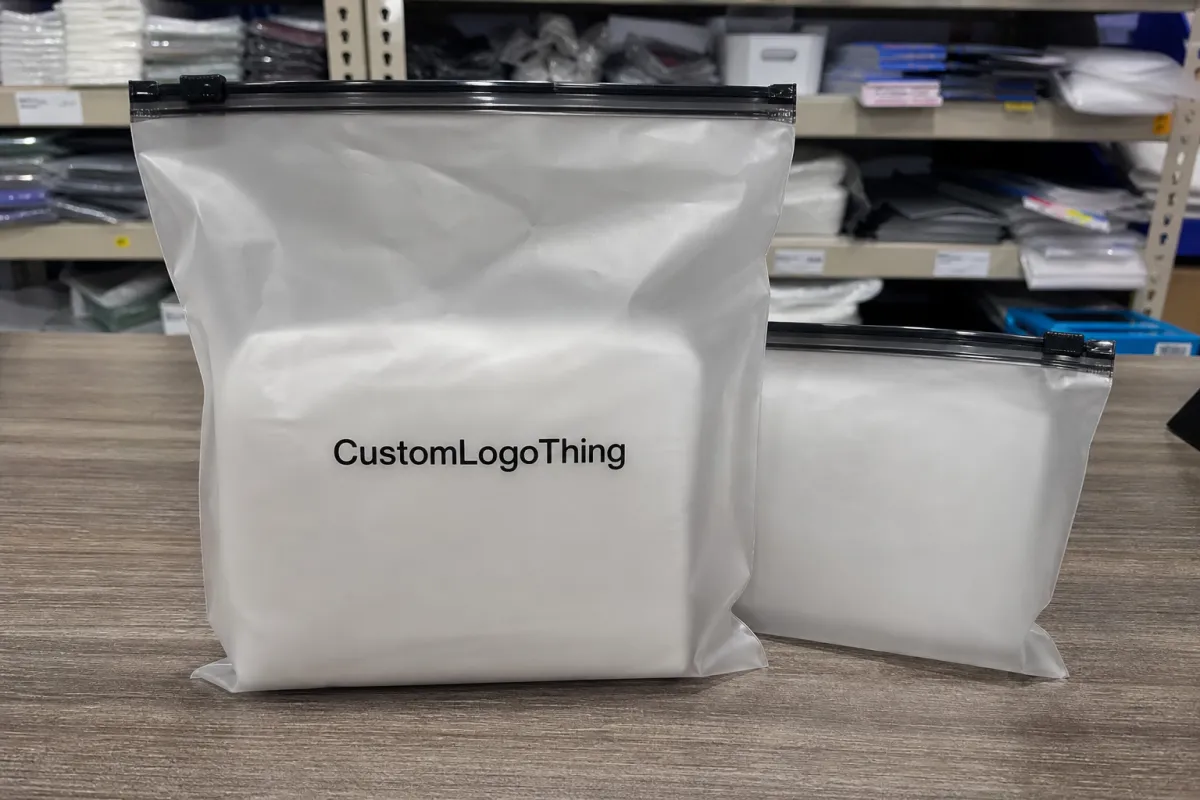
Buyers usually see the surface first. Frosted film has a softer, more controlled look than a fully clear sleeve, and it hides minor scuffs, fingerprints, and handling marks better during display. For hotel retail programs, that matters because the package often sits beside toiletries, slippers, travel sets, and spa add-ons that need to look considered, not improvised.
The zipper changes the use case immediately. A bag with a closure feels more complete than an open-top pouch, and it is easier for staff to store, refill, and reseal. Guests notice that too. Reusable packaging generally reads as more intentional than throwaway packaging, which can support a higher shelf price without changing the product inside.
Still, not every item belongs in this format. Frosted Zipper Bags work best with products that are compact, flat, and easy to stack: travel kits, grooming sets, hotel room accessories, seasonal souvenirs, and lightweight multipacks. Sharp corners, oversized bottles, or irregular shapes can stretch the film in a way that makes the bag look strained instead of premium. The bag should frame the contents, not fight them.
There is also a margin issue that is easy to miss. Two bags can appear almost identical in a photo and still price differently once film gauge, zipper track, seal width, and print coverage are finalized. A slightly heavier film or wider zipper track can raise the unit cost, but it may also reduce damage, improve shelf presentation, and lower the rejection rate at receiving. Buyers who quote by appearance alone often underestimate that tradeoff.
Film, Zipper, and Seal Choices That Affect Daily Use
Film choice is the foundation. Frosted PE is common because it gives a low-gloss finish and can handle regular handling without looking brittle. For retail and hospitality use, film thickness is usually discussed in microns or mil. A 60- to 100-micron range is common, with lighter gauges suited to simple accessories and heavier gauges better for repeated handling, denser contents, or programs that want a more substantial hand feel.
That range is only a starting point. A lightweight room key set does not need the same build as a spa retail kit with multiple components. If the filled bag must sit upright or hang on display, film stiffness matters as much as thickness. Too soft and the package collapses; too stiff and it can look bulky or resist closure. The best choice is the one that matches the actual product weight and retail use, not the one that sounds strongest on paper.
The zipper is just as important. Some tracks open with very little resistance and suit staff use, while others close more firmly and stay shut better in transit. If the end customer will reuse the bag, a smoother, clean-running zipper usually feels better in hand. If the bag is mostly for internal packing or controlled retail display, a tighter closure can be the safer choice. The goal is not the strongest zipper in the abstract. The goal is the zipper that behaves correctly after repeated use.
Seal quality should not be treated as a minor detail. Straight, even seals make the bag look sharp and reduce weak points that can fail under load. If the product has corners, edges, or a little weight, a wider seal area often helps. A custom shape may also need a slightly larger footprint so the zipper is not carrying more stress than it should. Most production problems show up at the edges first, not in the middle of the bag.
Sizes, Print Coverage, and Finish Specs to Lock Before Ordering
Bag size should be set around the packed product, not the product alone. That sounds obvious until inserts, instruction cards, tissue, tags, or multipacks are added and the original spec turns too tight. A bag that looks roomy on a drawing can become hard to load on the packing table. Leave enough width and height for easy filling, then build in a little tolerance so the zipper closes without forcing the contents upward.
Print layout should be approved before production starts. For many hotel retail programs, a clean one-color logo on frosted film is the most efficient solution. It keeps the branding visible while avoiding the cost and risk that come with heavy coverage. If the pack needs a barcode, SKU panel, care note, or regulatory line, that space should be reserved early. Frosted film can print well, but the texture changes how fine detail reads, so the artwork should be built for the material rather than copied from a glossy sleeve.
Finish details can make the difference between a bag that works and one that feels merely acceptable. Hang holes help with peg display. Tear notches help with quick opening. Gussets add room for depth and can keep a bundle from distorting the front panel. Partial windows may be useful if the contents need to be seen, but a large clear area can dilute the frosted look that many hotel retail buyers are paying for. Every extra feature should earn its place.
- Confirm packed dimensions with inserts, cards, and closures included.
- Lock artwork placement early so print setup and proofing are accurate.
- Choose extras deliberately such as hang holes, tear notches, or gussets.
- Share a reference sample if the bag must match an existing retail presentation.
That level of detail is also what shortens the quoting cycle. A supplier can move faster when the spec is concrete instead of implied, and a concrete spec usually prevents the awkward second quote that appears after the first sample misses the mark.
Pricing, MOQ, and Quote Drivers for Wholesale Buys
Price is driven by the full build, not by the category name. Size, film thickness, zipper type, print coverage, and order volume all push the number. Two Frosted Zipper Bags can look similar on a screen and still have very different costs if one uses heavier film, wider seals, and a full-panel print while the other is a simple one-logo bag with minimal finishing.
MOQ tends to follow setup cost and line efficiency. Film conversion, zipper attachment, printing setup, and packing all require time before the first usable bag is boxed. That means smaller runs carry more overhead per piece. A repeat order often looks better because the setup work has already been absorbed once, and reorders usually move more predictably if the approved spec stays unchanged.
| Spec Level | Typical Use | MOQ Pressure | Indicative Unit Cost at 5,000 pcs |
|---|---|---|---|
| Basic frosted PE, standard zipper, one-color logo | Amenities, simple retail kits | Lower | $0.18-$0.28 |
| Heavier film, tighter seal, one- to two-color print | Spa sets, premium gift shop items | Medium | $0.24-$0.38 |
| Custom size, wider zipper, larger print coverage, extras | Seasonal retail programs, multi-piece bundles | Higher | $0.32-$0.55 |
Those numbers are directional, not fixed. Resin pricing, freight, print complexity, and seasonal capacity can move them quickly. A quote that looks low at first can become expensive if it excludes setup, carton packing, freight, or a more durable zipper track. A fair comparison checks the same details line by line.
That is the part many buyers learn the hard way. One supplier may quote a thinner film with loose packing and no printed details. Another may include a heavier gauge, cleaner sealing, and better carton configuration. The second quote can look higher, but it may be the better buy if the bag is going straight into retail use and not just into storage.
Order Process, Lead Time, and Production Steps
A clean order process usually follows the same sequence: inquiry, spec review, artwork check, proof approval, sample review if needed, and then production scheduling. The speed of the order depends on how much is known at each step. If the buyer is still adjusting size or logo placement after the proof arrives, the job slows down immediately.
Artwork is one of the most common friction points. Thin lines can disappear on frosted film, small text can fill in, and barcode placement can become unreadable if it lands too close to texture or zipper hardware. Size changes create another delay because they affect both film layout and closure position. Even zipper substitutions can cause trouble, since a closure that looks similar in a photo may behave differently once it is mounted and tested on the line.
Sampling is useful, but only if the sample reflects the real build. A sample that uses a different film gauge or a different zipper type can mislead the buyer into approving the wrong direction. That is why the sample should always be checked against the final spec, not just against the visual goal. If the use case is seasonal, time-sensitive, or tied to store resets, the first proof should be treated as a production control tool, not just a picture.
For planning, 12 to 15 business days after proof approval is a reasonable window for many custom wholesale orders. Simple runs can be faster, and more complex builds can take longer. Shipping method adds another layer. Ocean, air, and domestic truck transit all change the calendar, so the buyer should work backward from the actual receipt date rather than the production completion date alone.
Before release, confirm these five items:
- Final dimensions and material thickness
- Approved artwork and print placement
- Quantity split by carton or destination
- Ship-to address and delivery contact
- Target receipt date and dock requirements
For larger or more sensitive shipments, organizations such as ISTA publish widely used distribution test methods, and Packaging.org offers broader packaging and supply-chain guidance. Not every order needs formal lab testing, but those references are useful when the shipment is heavy, mixed, or likely to be handled several times before it reaches the shelf.
Quality Checks That Catch Problems Before Shipping
Good packaging programs are usually won before shipment, not after arrival. The checks that matter most are straightforward: film clarity and haze, zipper alignment, seal straightness, print registration, and carton count accuracy. If the bag is going to retail, the eye test matters almost as much as the technical one. A slight warp in the seal or a misaligned logo can make the whole run look inconsistent on a shelf.
Zipper performance deserves special attention. The track should close cleanly without gaps, bind points, or sudden changes in resistance. If the zipper is too loose, the bag may open during handling. If it is too tight, staff may avoid using it the way they are supposed to. Neither outcome is ideal. A good zipper feels predictable, not difficult.
Printing should be checked under the same light the customer will use if possible. Frosted film can soften color density and make thin fonts harder to read. Registration problems are easier to catch before carton packing than after the pallets are wrapped. Buyers should ask for a random-run check, not just a single first-off approval, because the first piece often looks better than the middle of the lot.
Other problems are quieter but just as costly: edge curling, dust contamination, seal wrinkles, and inconsistent pack counts. Those issues do not always stop a bag from being usable, but they do weaken presentation and create extra labor during receiving. A useful supplier will check these items before the product leaves the line, especially on orders meant for hotel retail or branded guest-facing use.
Carton Packs, Freight Terms, and Receiving at Hotels or Stores
Carton configuration affects the back end more than many buyers expect. Inner packs, master cartons, and pallet layout all influence storage space, receiving speed, and damage risk. A hotel storeroom with limited shelving needs a different pack plan from a retail distribution center that can handle full pallets. If the cartons are oversized or the bundles are loose, the bags can arrive looking tired even when the product itself is fine.
Carton count matters because it controls distribution. Hotel groups often split inventory across properties, floors, or departments, while retail chains may need allocation by store or seasonal drop. If one carton holds 500 pieces and another holds 1,000, the receiving team should know that before the truck arrives. Otherwise, unpacking becomes a sorting exercise that wastes time and invites mistakes.
Freight terms should be clear from the first quote. Ask who books the shipment, whether the price is prepaid or collect, and what label details the dock requires. Some receiving areas need appointment windows, pallet labels, carton marks, or purchase-order references printed in a specific format. Those are minor details only until a shipment sits at the curb because the paperwork and the receiving rules do not match.
It also helps to ask how the bags are packed inside the carton. Flat bundles with clean compression are easier to store and count than loose bulk fill. That matters for shelf replenishment, backroom organization, and reorder timing. A well-packed carton saves labor every time it is opened.
- Use consistent carton marks for SKU, quantity, and destination.
- Match pallet height to the receiving dock or storage limit.
- Keep inner packs easy to count for partial distribution.
- Confirm whether cartons need moisture protection for long transit.
What a Reliable Supplier Should Document
Consistency is usually where a supplier proves itself. A low quote matters less if the next shipment varies in film feel, zipper action, or print placement. Buyers tend to stick with a partner who can repeat the same bag without forcing them to rebuild the order from scratch every time. That includes keeping the approved sample, the final spec, and any special packing notes on file.
Good documentation prevents quiet drift. One order may have used a slightly tighter zipper, a 90-micron film, or a specific carton count that worked better in the receiving room. If those details are not recorded, the next run can change without anyone realizing it until the boxes are opened. In hotel and retail programs, that kind of small drift can create a real problem because staff expect the packaging to behave the same way every time.
Repeatability also matters across locations. A chain with multiple hotels or stores needs the same package to feel and look the same from one reorder to the next. Color shifts, print placement changes, or carton inconsistencies become visible when the product is spread across different sites. That is why buyers often value the supplier who communicates clearly and documents well more than the one who only offers the lowest line item.
What to Send Before You Request a Final Quote
The fastest quotes come from complete inputs. Send the exact dimensions, estimated quantity, print artwork, target ship date, and destination up front. If the bag has a special use, add a product photo or a reference sample so the supplier can see how the finished piece needs to function in real conditions. That shortens back-and-forth and reduces the chance of a mismatched first proof.
It also helps to say whether the order needs samples, production proofs, or a reorder reserve. Some buyers want a pre-production sample before release, while others already have an approved reference and only need a repeat run. Either approach works, but the supplier needs to know the expectation early so the job is planned correctly.
A useful checklist keeps hotel retail Frosted Zipper Plastic Bags Wholesale Order Planning aligned across purchasing, operations, and receiving:
- Bag size and film thickness
- Zipper style and seal preference
- Print file and color count
- Quantity by location or program
- Packing, carton count, and freight details
- Approval path and target receipt date
If you need a quick check on common ordering requirements, the FAQ page is a practical place to verify details before sending a request. The better the input, the fewer assumptions the supplier has to make.
How do I choose the right size for hotel retail frosted zipper bags?
Measure the packed product, not just the item itself, and include inserts, cards, or multipacks that change the final footprint. Leave enough room for easy loading and resealing so staff and customers are not fighting the closure during use.
What MOQ should I expect for wholesale frosted zipper plastic bags?
MOQ usually depends on film setup, zipper type, and print complexity, so the spec matters as much as the quantity. A common planning range is often a few thousand pieces and up, with smaller runs carrying more overhead per bag.
How does printing change the price of hotel retail zipper bags?
More print colors, larger coverage, and tighter registration usually increase the quote because they add setup and production steps. A clean one-color logo on frosted film is often the most efficient way to keep branding visible without pushing the budget too high.
What lead time is normal for custom frosted zipper plastic bags?
Lead time depends on proof approval, sample review, production load, and shipping method, so a clear spec speeds everything up. Many custom wholesale orders fall around 12 to 15 business days after approval, but complex jobs and busy seasons can run longer.
What should I confirm before reordering wholesale frosted zipper bags?
Confirm the approved sample, final dimensions, print file, carton count, and ship-to details so the reorder matches the last good run. Check whether the previous order had any special notes about zipper feel, film thickness, or packing that should carry forward.
For buyers who need packaging that looks polished, ships cleanly, and repeats without drama, hotel retail frosted zipper plastic bags wholesale order planning works best when the spec is concrete, the checks are disciplined, and the packaging is built for the way it will actually be handled rather than the way it looks in a mockup.


