Hotel trucker caps bulk order: Specs, Pricing, Timing
A hotel Trucker Caps Bulk order works best when the cap is treated like a working brand asset, not a disposable promo item. That distinction sounds small until the hats are on staff heads, in guest photos, and on a retail shelf that needs to look deliberate rather than left over from another campaign.
The economics are attractive for a reason. A cap is one of the few low-cost items that can do three jobs at once: unify a team, move a logo through public spaces, and leave the property with a guest who may wear it again. If the cap is built well, that one purchase keeps generating impressions long after the initial handoff. If it is built badly, the whole batch becomes closet inventory.
Most buying mistakes happen before production begins. The wrong front panel, a vague logo size, or an unclear closure spec can turn a simple order into a round of samples, revisions, and apologies. That is why the smartest hotel buyers talk about trucker caps the way they talk about linens or signage: as a repeatable operational item with brand value attached.
Why hotel trucker caps bulk orders work on-property
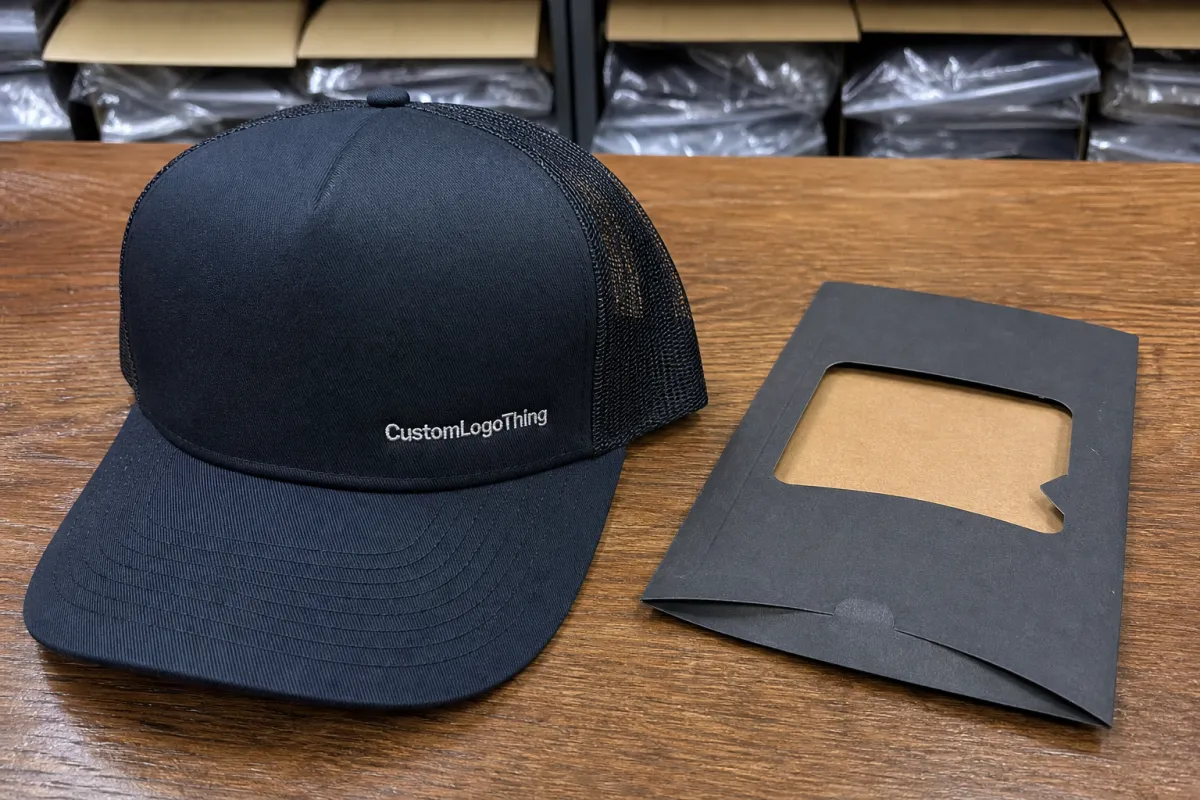
Trucker caps fit hospitality because they stay visible. A valet wears one at the curb, a pool attendant wears one in full sun, and a concierge may hand one to a guest as part of a welcome set. The cap is not subtle, which is the point. It gives a logo room to move without asking the rest of the uniform to do all the work.
There is also a cost-per-use argument that procurement teams understand quickly. A cap landed at $4.50 and worn 75 times costs pennies per wear. Even a landed cost closer to $7.25 can still make sense if the item is actually used on property and not just handed out once. Compare that with paper collateral or a one-time amenity: the cap keeps paying for itself through repetition, not novelty.
Practical rule: if the cap looks right on a staff member at 3 p.m. and still looks right on a guest at checkout, the style is probably doing its job.
Mesh-backed caps work especially well in warm climates, pool areas, golf programs, beach properties, and any operation where staff spend long stretches outside. They breathe better than closed-front caps and tend to hide minor wear more gracefully than a plain flat-front style. For guest gifting, the look has to be casual but controlled. A cap that feels too promotional can cheapen the brand; one that is too formal feels like an afterthought.
- Valet teams: strong first-impression value and easy visibility.
- Pool and beach staff: better airflow than closed-front caps.
- Concierge kits: clean enough for guest gifting when the decoration is restrained.
- Golf and event programs: practical for seasonal launches, tournaments, and sponsor merchandise.
- Retail shelves: works as an impulse item if color choices are limited and the logo is tidy.
Procurement usually gets easier once the cap is framed as a functional uniform piece rather than a souvenir. Operations cares about comfort, fit range, and consistency. Marketing cares about visibility. A good spec balances both, which is why Hotel Trucker Caps bulk order programs often outlast trend-driven merchandise.
Mesh build, front panel, and branding choices that hold up
Not all trucker caps behave the same way. The front panel changes the tone, the mesh affects comfort, and the decoration method determines whether the logo reads clearly from across a lobby or turns into a blur. For hotel programs, those decisions matter more than the mockup language suggests.
| Front build | Best use case | Branding behavior | Relative cost |
|---|---|---|---|
| Foam front | Bold retail look, casual promotions, large logos | High contrast works well; fine text does not | Low to moderate |
| Cotton twill front | Staff wear, guest gifting, cleaner visual finish | Embroidery sits cleanly and holds shape | Moderate |
| Structured polyester front | Programs that need crisper form and color consistency | Good for repeat orders and sharper logo edges | Moderate to higher |
Mesh density deserves a real conversation. A lighter mesh helps in hot weather and around active outdoor teams. A tighter mesh makes the cap feel more polished and less athletic. Neither is automatically better. The right choice depends on whether the cap is being worn for eight-hour shifts, handed to guests, or sold as retail merchandise. The property use case should drive the build, not the other way around.
Decoration changes the look more than many buyers expect. Embroidery remains the default because it feels durable and is easy to trust on staff wear. It also holds up well through repeated use. But patches solve different problems. A woven patch can rescue a logo with thin strokes, a small wordmark, or a shape that would get lost in thread. For bolder graphics, a clean patch often looks sharper than direct stitching.
The front panel should stay visually calm. Trucker caps do not offer much real estate, and crowded branding usually reads smaller than it looked in the proof. If the logo includes a wordmark, icon, and tagline, something has to be reduced or removed. The cleanest caps usually center one mark and let the panel breathe.
Three details usually separate a strong result from a weak one: Logo Placement That is centered with intention, contrast that still reads in daylight, and a front panel that stays flat instead of puckering around the stitch line. That matters even more on hotel Trucker Caps Bulk Order runs, where the same style may need to satisfy housekeeping leads, front-of-house staff, and guest-facing retail at the same time.
Specs that prevent rework at approval
The fastest way to slow a cap order is to approve a vague spec sheet. Factories build from instructions, not assumptions. If crown height, panel count, visor curve, closure type, and mesh color are left open, someone will fill in the blanks. That guess may be reasonable. It may also be expensive to reverse.
- Crown height: low-profile, mid-profile, or taller crown shape.
- Panel count: usually 5-panel or 6-panel construction.
- Visor shape: flat or gently curved.
- Closure: snapback, strap, or another adjustable finish.
- Mesh color: match or contrast intentionally.
- Logo size: specify exact width and height in inches or millimeters.
One-size-fits-most still hides a lot of variation. If the cap will be worn by staff across departments or distributed to guests without fitting, ask for a wider adjustment range and confirm the closure is easy to operate with one hand. That matters more than buyers expect. In real use, people adjust caps quickly, often while carrying something else. A closure that looks fine in a photo but feels awkward in practice becomes a small daily annoyance.
It helps to define whether the hat should feel retail-ready or staff-use durable. Those are not the same brief. Retail-ready caps usually get cleaner finishing, more careful folding, and better presentation in cartons or polybags. Staff-use caps may need a heavier sweatband, sturdier stitching, and packaging that survives being opened, worn, tossed in a locker, and worn again.
Ask for exact logo dimensions rather than scale percentages. “Make it 80% of the proof” creates room for drift on repeat runs. A logo width of 3.25 inches may sound minor, but it is the difference between a mark that reads cleanly and one that sinks into the seam line or sits too low on the panel.
If the artwork includes gradients, metallic effects, or hairline text, flag that before sampling. The factory can then steer the decoration method toward embroidery, woven patch, or print-based decoration before the design is locked. That saves time and avoids one of the most common hospitality problems: approving a design on a screen that cannot be reproduced cleanly on a curved front panel.
For teams that want fewer surprises, ask for a pre-production checklist that covers thread color, patch backing, mesh shade, and carton label format. The better the order is documented, the less likely it is to wobble after approval.
Pricing, MOQ, and unit cost drivers for hotel headwear
Pricing on a hotel trucker caps bulk order is driven by more than quantity. Volume still matters because setup gets spread across more pieces, but decoration method, cap structure, color count, and packaging can move the number just as much. Buyers sometimes focus on the unit price and miss the real cost drivers sitting around it.
For a simple embroidered cap, rough landed pricing often falls in these bands:
- 100-300 pieces: about $5.50-$8.50 per unit, depending on setup and freight.
- 500-1,000 pieces: about $3.50-$6.00 per unit for standard builds.
- 2,500-5,000 pieces: about $2.40-$4.25 per unit if the spec stays consistent.
Those numbers move quickly if you add custom labels, specialty patches, multiple decoration locations, or rush delivery. Digitizing is often a one-time setup charge, but patch tooling, custom inner taping, and premium packaging all add cost. Sampling also matters. A sample may look like a small expense, yet it is usually the cheapest way to avoid a full run with the wrong crown shape or a logo that sits too low.
MOQ is not arbitrary. It usually follows component sourcing and decoration complexity. A one-color embroidered cap with a standard snapback closure is easier to quote at a lower minimum than a cap with a custom woven patch, special mesh color, and nonstandard front structure. If you are working across multiple properties or departments, ask whether the factory can combine SKUs under one production plan. That may help you reach a better price tier without changing the look of the cap.
Compare total landed cost, not just the unit line. A quote that looks cheaper on paper can become more expensive after sample charges, freight, carton fees, and remake risk are added back in. For procurement, the useful number is the one that arrives at the hotel dock with no surprises.
There is a reason experienced buyers ask about shipping method early. Air freight shortens the calendar and raises the price. Ocean freight lowers the cost but adds time and requires more discipline around forecast and inventory. If the caps are tied to a seasonal launch or a scheduled event, the cheapest freight option can become the most expensive decision in the room.
For teams that also manage broader merchandise or supply programs, the logic is familiar: handling and transit matter just as much as the product itself. References from groups such as Packaging Coalition and ISTA are useful because they remind buyers to think about compression, drop risk, and carton integrity, not just decoration.
Common mistakes that bloat cost or delay shipment
A lot of budget pain comes from small omissions. The logo itself may be approved, but the order fails because the buyer did not specify the back closure, forgot to confirm mesh color, or changed the thread shade after the proof was already signed off. That is where simple orders start to act expensive.
One common mistake is overdesigning the front panel. A trucker cap has limited space, so trying to include a long slogan, a thin icon, and a detailed wordmark usually creates one of two outcomes: the decoration gets shrunk until it loses impact, or the panel is crowded enough to look rushed. In hospitality, restraint tends to age better than ambition.
Another problem is approving a sample without testing it on real staff. A cap can look fine in a mockup and still fail in use if the crown sits too high, the closure catches hair, or the front panel wrinkles when worn. Those issues are not dramatic, but they matter when the cap is worn daily. A one-hour fit check with a few people from different departments catches more problems than a second round of email comments.
Color drift is another quiet expense. Mesh, twill, and embroidery thread do not always reflect light the same way, especially under hotel interior lighting. A shade that looks matched in daylight can separate indoors. If brand color discipline matters, confirm a Pantone target or physical swatch and ask the supplier to call out any material-based variation in advance.
Packaging can also create friction. Bulk cartons are efficient, but they are not always ideal if the caps are going to multiple properties or need shelf-ready presentation. Individual polybags, size stickers, hangtags, or carton labels add cost, yet they may save time on the receiving end. The right decision depends on where the caps are going after they ship, not just how they leave the factory.
Finally, reorders can become messy if the spec history is not preserved. If the vendor cannot tell you which thread color was used, how the logo was sized, or how the cartons were packed, the next run turns into a new project instead of a repeat order. That is where the hidden cost lives.
Process and turnaround from artwork to delivery
The cleanest workflow starts with artwork review, material selection, digital proofing, one approval checkpoint, and production scheduling. If any of those pieces are missing, the order drifts. Drift is what pushes a straightforward cap program into the awkward stage where everyone says it is “almost ready” and nobody trusts the timeline.
A practical timeline for a hotel trucker caps bulk order usually looks like this:
- Day 1-2: artwork review and spec confirmation.
- Day 2-4: digital proof and corrections.
- Day 5-7: sample or pre-production approval if needed.
- Day 8-15: production for simple embroidered builds.
- Day 15+: freight booking and final delivery timing.
More detailed patches, color matching, or mixed-color runs add time. So does a brand team that wants to review every variation separately. In practice, approval is usually the bottleneck, not sewing. A cap cannot move until the proof is signed off, and freight cannot be finalized until the production queue is stable.
If the caps are tied to a seasonal event, room rollout, or guest welcome program, build the schedule backward from the in-hand date rather than forward from the approval date. That sounds basic, but it is where many hospitality programs lose margin. A launch that looks complete on paper is not useful if the cartons show up after the window closes.
For shipping and carton handling, ask how the supplier packs inner units, how many caps fit per carton, and whether the outer packaging has been tested for transport stress. The exact test depends on route and carton weight, but the logic is constant: if the caps are stacked, compressed, or moved through multiple handoffs, shipping quality matters. If your program uses paper inserts or hangtags, check whether the paper stock should be FSC-certified under your brand rules.
One sign of a disciplined supplier is simple: they can explain the job in three steps without hand-waving. If the workflow is clear, the delivery date is more believable. If the workflow is fuzzy, the schedule is usually fuzzy too.
Buyer rule of thumb: if the vendor cannot explain the order in three steps, the reorder will probably be harder than it should be.
Quality control and reorder discipline
The first run is about getting the look right. The second run is about keeping that look intact. Hospitality buyers care about shape consistency, logo placement, color repeatability, and packaging presentation from one batch to the next. If those details shift, the program starts to feel unfinished even if the caps are technically acceptable.
Good quality control on a cap order usually starts before shipment, not after arrival. Ask for photo checks of the logo placement, crown shape, mesh color, and finished cartons. For larger runs, a pre-shipment inspection is worth the time because it catches problems while the factory still has a chance to fix them. If the order is large enough to justify it, a third-party check can be money well spent.
- Photo-based quality control: useful for verifying placement and color before shipment.
- Pre-shipment inspection: valuable when the run is large or the deadline is tight.
- Clear remake terms: important if the logo placement or materials miss the approved proof.
- Stored spec history: keeps repeat orders aligned with prior runs.
Brand color discipline matters more on repeat orders than on the first sample. If you have a Pantone target, the supplier should know it. If the cap body and embroidered thread need to sit within a narrow range, that needs to be written down. Otherwise, a “close enough” reorder can look noticeably different under hotel lighting, which tends to expose color mismatch fast.
Reorder discipline also depends on packaging records. If the caps were packed 24 per carton last time, that detail should be documented. If one property needs small-batch carton labels and another needs bulk-packed units, the supplier should be able to keep those differences organized. That is the difference between a one-off purchase and a repeatable merchandise program.
For buyers managing broader wholesale or merchandise programs, it helps to work with a vendor that keeps boring details on file: the last approved thread color, the preferred carton count, the logo file that worked, and the issue that caused a delay the first time. Those notes save time, but they also save face when the same cap has to be reordered six months later.
For order basics, approvals, and common questions, the FAQ page can clear up routine issues before sampling begins. If you need a repeatable buying lane rather than a one-off quote chain, the Wholesale Programs page is the natural starting point.
Next steps to launch your order without delays
If you are planning a hotel trucker caps bulk order, the fastest path is to send one clean message with the core inputs already assembled. The fewer assumptions the supplier has to make, the faster the quote comes back and the less likely the order is to wobble later.
Gather these items first:
- Logo file: vector preferred, such as AI, EPS, or editable SVG.
- Target quantity: a real count, not a guess.
- Color direction: cap body, mesh, and thread or patch colors.
- Use case: staff, guest gifting, resale, or event merchandise.
- Deadline: the date the caps must be in hand, not the date you want to approve them.
- Packaging needs: bulk cartons, individual bags, or retail-ready presentation.
Then ask for three things together: a mockup, MOQ confirmation, and a landed-cost estimate. Separate answers slow the process down and make comparison shopping messy. One combined response gives procurement something real to evaluate against budget and timing.
If the order will be split across departments or properties, confirm how each SKU will be labeled and packed. Small distribution errors turn into large headaches once cartons arrive at multiple hotel sites. That is especially true when one team expects staff caps and another expects guest merchandise from the same shipment.
For a straightforward build, hotel trucker caps bulk order projects can move quickly once the proof is approved. For more detailed programs, the right answer is not speed at any price. It is clean specs, honest pricing, and a timeline that actually holds. That combination keeps the cap useful after delivery and makes the next reorder easier than the first.
What is the usual MOQ for hotel trucker cap bulk orders?
MOQ depends on the decoration method, cap color, and whether the design uses embroidery, a patch, or a special finish. Simple one-color builds are usually easier to quote at lower minimums than highly customized caps. If you need several properties or colors, ask whether the factory can combine them in one production run.
How long does a hotel trucker caps bulk order typically take?
Timing usually depends on proof approval, sample requirements, and how quickly the production slot opens. Simple specs move faster than detailed patches or custom labeling. Freight method also matters: air shortens lead time, while ocean shipping lowers cost but adds calendar days.
Can you match a hotel brand color on trucker caps?
Yes, but exact matching works best when you provide Pantone references or a physical brand swatch. Material type changes how color appears, especially on mesh, foam fronts, and stitched logos. A proof should show both the cap body color and the decoration color before production starts.
Which decoration method is best for hospitality trucker caps?
Embroidery is the most common choice because it is durable and looks clean on staff wear. Patches can improve readability when the logo has thin details or needs stronger contrast. Printed or heat-applied methods may work for certain graphics, but they should be checked against wash and wear expectations.
Can one hotel trucker cap order include multiple sizes or colors?
Yes, but each variation can affect MOQ, pricing, and production scheduling. Mixing colors is easiest when the base model stays the same and only the shell color changes. If you need mixed sizes, confirm how the factory labels and packs each carton so distribution stays simple.