Buyer Fit Snapshot
| Best fit | Lower Box Tooling Costs Without Cutting Quality projects where brand print, material claims, artwork control, MOQ, and repeat-order consistency need to be specified before quoting. |
|---|---|
| Quote inputs | Share finished size, material target, print colors, finish, packing count, annual reorder estimate, ship-to region, and any compliance wording. |
| Proofing check | Approve dieline scale, logo placement, barcode or warning zones, color tolerance, closure strength, and carton packing before bulk production. |
| Main risk | Vague material claims, crowded artwork, missing packing details, or unclear freight terms can make a low unit price expensive after revisions. |
Fast answer: Lower Box Tooling Costs Without Cutting Quality: Board, Finish, Dieline, and Unit Cost should be specified like a repeatable production item. The safest quote records material, print method, finish, artwork proof, packing count, and reorder notes in one written spec.
Production checks before approval
Compare the actual filled-product size with the drawing, then confirm tolerance on folds, seals, hang holes, label areas, and retail display edges. Reserve space for logos, QR codes, warning copy, and material claims before decorative graphics fill the panel.
Quote comparison points
Review material grade, print process, finish, sampling route, tooling charges, carton quantity, and freight assumptions side by side. A quote is only useful when the supplier can repeat the same color, closure quality, and packing count on the next order.
How to Lower Box Tooling Costs Without Cutting Quality
If you are trying to how to lower box tooling costs without ending up with a flimsy carton or a box that fights you on the line, the first thing to understand is that tooling usually gets expensive because the project keeps moving. Dimensions shift after the quote, artwork grows across more panels, or a nice-looking detail gets added late in the process because someone wants the pack to feel more premium. I have seen that happen more than once, and it almost always costs more than the original idea by the time the second sample shows up.
The practical answer is not to strip the package down until it feels cheap. It is to decide early which features are doing real work and which ones are just adding setup time. A box planned around the right geometry, the right board, and the right closure can still look sharp, print cleanly, and protect the product properly. That is the real discipline behind how to lower box tooling costs: cut the unnecessary custom work before steel is cut, and keep the complexity only where it actually earns its keep.
How to Lower Box Tooling Costs: The First Decisions That Matter
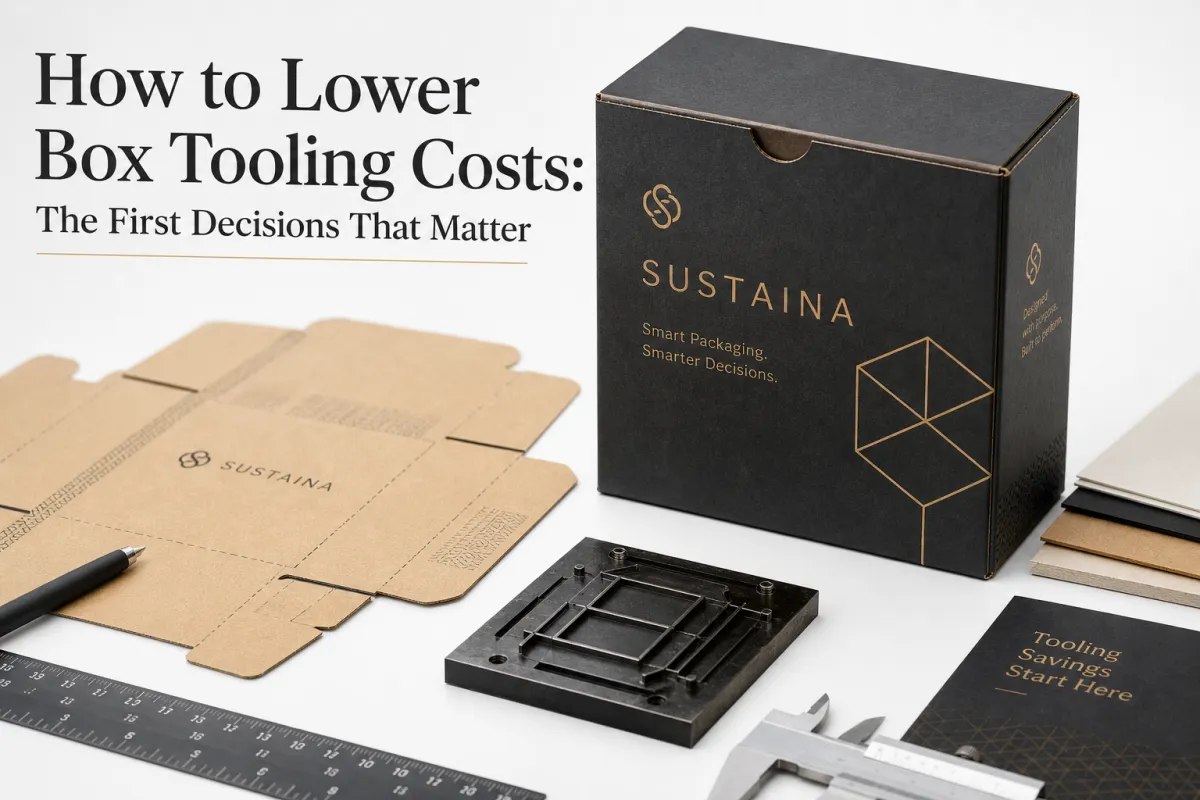
Most buyers assume the price rises simply because the box is custom. That is only part of the picture. In practice, how to lower box tooling costs starts with a better question: which parts of the design truly need to be custom, and which parts can follow a standard path? A straight-sided mailer, a regular slotted carton, and a tuck-end box all ask for different tooling decisions, yet the biggest jumps in cost usually come from special cutouts, unusual folds, or repeated redesigns after the first proof.
A simple tool is not the same as a plain-looking package. A simple tool follows clean geometry, standard panel relationships, and limited special features. A custom tool path may need extra cut lines, precise registration for a window, or tighter positioning for a locking flap. That does not automatically make the box better. It only means the tool has to do more work. If the goal is how to lower box tooling costs, the smartest move is often to simplify the structure before steel is committed.
From a packaging buyer's point of view, the real value is not a cheaper-looking box. The value is a box that still fits, still protects, and still prints cleanly while avoiding unnecessary custom labor. I often see teams focus on the final tooling number and ignore the small design changes that pushed the number higher. A half-inch shift in width, an added thumb notch, or a new insert can matter more than a negotiation over the quote itself. That is why how to lower box tooling costs is really a design discipline, not a discount request.
The earlier you settle the structure, the more money you usually save. A buyer who approves one stable dieline, locks artwork placement, and confirms substrate choice before release generally gets a better result than a buyer who keeps moving dimensions after sampling has already started. In that sense, how to lower box tooling costs is not about making the box less capable. It is about removing avoidable custom work so the tool only does what the package actually needs.
One more thing I say to teams all the time: do not let the box become a moving target. A moving target is where budgets go to die, kinda quietly, and everybody acts surprised later.
The cheapest quote is not always the cheapest package. A cleaner structure with fewer revisions usually wins once the order reaches production.
Product Details That Help Lower Box Tooling Costs
The product itself drives a large share of the tooling decision, and this is where good buyers save real money. A small rigid accessory, a folded garment, a bottle with a cap, and a fragile electronics part do not need the same box logic. If you are serious about how to lower box tooling costs, start by matching the box style to the product instead of forcing the product into a decorative structure that looks good in a mockup but creates extra work in production.
Regular slotted cartons are usually the least complicated route for shipping, especially when the product can tolerate a practical shipper with minimal internal fit. Tuck boxes often work well for retail presentation, but they may require more precise panel control and a cleaner score pattern to close consistently. Mailer boxes can deliver strong brand impact while staying efficient, yet once you add magnetic closures, internal locks, or multiple display flaps, the tool complexity rises fast. Display cartons bring their own balance of visibility and strength, but the more visible the structure, the more exact the cut and fold relationships must be. That is why how to lower box tooling costs often begins with choosing the least complex box style that still protects the product and supports the brand.
Feature count matters too. Every insert, thumb cut, window opening, locking tab, or special fold adds precision work. A single window may be simple; a window that must align with a printed graphic and hold a clear PET sheet in place is not simple anymore. Two locking tabs can be fine. Four tabs, each with a different size and fold direction, create more setup and a higher chance of revision. The more features you stack together, the more time it takes to approve tooling, and the harder how to lower box tooling costs becomes.
Board selection is another quiet cost driver. A thin SBS or C1S paperboard can often be die-cut with less stress than a thick corrugated or very stiff specialty board, though the final choice depends on the product and the shipping channel. A heavier board may be the right answer for strength, but it can also require a more durable die, more careful pressure adjustment, and sometimes an extra sample cycle to get clean cuts without fiber tear. In practice, asking for a board that is stronger than needed can make how to lower box tooling costs harder than it should be.
Here is the kind of comparison that helps buyers see where the money goes:
| Box Style | Tooling Complexity | Typical Cost Pressure | Best Use Case |
|---|---|---|---|
| Regular slotted carton | Low to moderate | Usually lower because the geometry is standard | Shipping, bulk packing, simple protection |
| Tuck end box | Moderate | Rises with closure precision and panel alignment | Retail packaging, lightweight product presentation |
| Mailer box | Moderate | Increases with custom locks, inserts, and print coverage | E-commerce, branded unboxing, repeat shipments |
| Display carton | Moderate to high | Higher because visibility and strength both matter | Counter display, retail promotion, shelf-ready packs |
| Highly customized structure | High | Highest because every special feature needs setup and testing | Niche launches, premium presentation, unusual product shapes |
That table does not mean standard is always best. Sometimes a custom insert or a more specific closure saves product damage, which is far more expensive than the tooling itself. The point is balance. If you want how to lower box tooling costs to work in the real world, you need to know which details are functional and which details are ornamental. A packaging spec that protects the product with the fewest possible moving parts usually wins over a design that looks ambitious but creates avoidable setup work.
For transport performance, the industry still relies on testing and standards for a reason. A package built around real shipping conditions, not just a presentation idea, tends to cost less over the full run. References from organizations like ISTA and the broader packaging community at packaging.org can help teams think about fit, durability, and test discipline before they approve a structure. That kind of discipline is part of how to lower box tooling costs without paying for rework later.
Box Specifications That Reduce Tooling Spend
Specifications are where a lot of tooling waste hides in plain sight. A buyer may ask for "a custom box," but the quote changes depending on whether the dimensions are final, whether the product has buffer space, and whether the print needs to wrap every panel. If you want how to lower box tooling costs to become a repeatable habit, tighten the spec before you ask for the quote. Final dimensions, final board preference, final closure style, and final artwork scope make the job easier to estimate and easier to build.
Practical dimensions matter more than decorative proportions. A box that matches the product and includes only the clearance it needs usually takes less structural adjustment than a box built around an idealized visual ratio. For a folding carton, even a few millimeters can change how the tuck locks or how the end panels align. For a corrugated mailer, the fit can affect not only the tool but also the shipping performance. In other words, how to lower box tooling costs is often about choosing the smallest useful footprint rather than the most attractive drawing.
Artwork affects tooling more than many buyers expect. Heavy ink coverage, full-bleed graphics, metallic effects, and panel-to-panel image wraps do not always change the tool directly, but they can change the production setup that surrounds it. A simple black logo on one panel is easier to manage than a multi-panel print that must register across folds and openings. If you are trying to figure out how to lower box tooling costs, keep the print plan realistic and confirm whether the design needs full coverage or can use strategic blank space without hurting the brand.
Tolerances deserve a plain-language explanation. Tight tolerances mean the product must fit within a narrow range, which increases the chance of revisions if the product supplier changes even slightly. Wider tolerances can reduce tooling pressure because the box has a little more room to accept variation, but that only works if the product can safely move within that range. The best packaging teams do not ask for "as tight as possible" by default. They ask where the fit truly matters and where a little extra room will not affect protection. That mindset is one of the cleanest ways of how to lower box tooling costs.
Reducing SKU variation helps too. A family of sizes that shares a common board caliper, a similar closure, and one tool platform often costs less than three unrelated designs. If the product line includes multiple sizes, ask whether one dieline can cover more than one item with only shallow dimensional changes. Shared tooling is not always possible, but when it is, it can save material waste, revision time, and the expense of building separate custom structures. That is a practical path for how to lower box tooling costs across a product family rather than just on a single order.
Here is a short checklist I give buyers who want fewer surprises:
- Confirm final product dimensions, including any fragile protrusions or closures.
- State the board or substrate preference before the quote is issued.
- Identify whether the box is for retail, shipping, or both.
- List inserts, windows, thumb cuts, or special folds up front.
- Approve artwork panel coverage before tool release.
That list sounds basic, but basic is powerful. More than once, I have seen a project save real money simply because the buyer locked the fit and stopped treating the structure like a moving target. If your goal is how to lower box tooling costs, those early decisions are where the savings begin.
How to Lower Box Tooling Costs with Pricing and MOQ
Tooling pricing makes more sense once you split it into two pieces: the one-time setup cost and the per-unit packaging cost. Buyers often focus on the tool number because it is visible on the quote, but the larger financial picture includes how efficiently that tool runs over the life of the order. If you are serious about how to lower box tooling costs, think in terms of total landed value, not just the first invoice.
Minimum order quantity changes the math immediately. A $300 tool spread across 500 boxes is a very different number than the same tool spread across 10,000 boxes. That does not mean small orders are a bad idea; sometimes they are the right move for a launch, a pilot, or a product test. It does mean the apparent tooling cost per unit looks high when the MOQ is low. A smart buyer asks for more than one quantity so they can see where the break-even point lands. That is one of the cleanest ways to understand how to lower box tooling costs without guessing.
There is also a point where paying a little more up front saves money later. A better-made die, a cleaner score line, or a tool designed with fewer adjustment problems can reduce waste, scrap, and press downtime. If the packaging line is fast or the product is sensitive, a low-cost but fussy tool can become expensive very quickly. The cheapest quote is not always the cheapest outcome. This is a central lesson in how to lower box tooling costs: spend where the tool improves repeatability, and cut where the feature adds nothing to function.
For buyers who want a practical reference, the most useful price drivers usually look like this:
- Dimensions: larger boxes typically need more board and sometimes a larger die layout.
- Structure: standard tuck and mailer styles often cost less than highly specialized folds.
- Decorative features: windows, inserts, and complex cutouts add setup and verification time.
- Print method: basic one- or two-color work is easier to manage than full-coverage specialty effects.
- Volume: higher volume spreads fixed tooling cost over more units.
That list helps buyers ask better questions. Instead of saying, "Why is the tooling so high?" a better question is, "Which part of the design is creating the extra cost?" That shift usually leads to a better quote and a better package. In practical terms, how to lower box tooling costs often comes down to choosing a stronger structure with fewer features instead of a prettier structure with more moving parts.
Buyers also need to watch the hidden cost of revisions. A tool that has to be reworked because the artwork changed after approval, or because the product size was not final, is no longer a simple tooling story. It becomes a scheduling story, a scrap story, and sometimes a quality story. If you want to lower box tooling costs, ask for pricing only after these items are settled: final dimensions, substrate, print method, accessory count, forecasted quantity, and whether the order is a first run or a repeat run. That is not bureaucracy. That is how you keep how to lower box tooling costs from turning into a moving target.
Packaging buyers who work with products that require transit testing should also think about performance standards. Depending on the shipment method and product sensitivity, teams may use guidance from ISTA or material sourcing standards from FSC. Those references do not replace good package design, but they do help teams justify a structure that performs in the real world. That is useful context for how to lower box tooling costs because a box that passes the right test the first time is less expensive than a box that needs rework after failure.
Process and Timeline for Box Tooling Approval
The approval process is where good planning saves time, and time is money in packaging. A normal sequence starts with inquiry, moves into dieline review, then sample approval, and finally tooling release. If you are trying to master how to lower box tooling costs, you need to know where delays usually happen. Missing specs, late artwork changes, and unclear approval ownership are the most common causes. The tool itself is rarely the delay; the waiting is.
Quick feedback shortens the path. If the structural team sends a dieline and the buyer waits a week to answer a question about fit, the schedule slips. If the artwork team is still adjusting a logo while the structural sample is being reviewed, the process slows again. Clear ownership helps a lot. One person should be responsible for the final sign-off on structure, and one person should be responsible for print approval. That kind of discipline is part of how to lower box tooling costs because every extra round of review adds labor and risk.
Some steps can run in parallel. Structural review and artwork preparation can happen at the same time, as long as the team knows the target dimensions are fixed. Product fit checks and material selection can also overlap. But certain steps must stay in order. The dieline should not be released until the structure is approved. The tool should not be finalized until the sample is approved. And production should not begin until the buyer has confirmed that the sample matches the product and the branding. That orderly sequence is another reliable part of how to lower box tooling costs because it reduces the chance of rework.
Timing depends on complexity, but a simple structure with final specs can move quickly, while a box with custom inserts, windows, or unusual closure geometry may need more back-and-forth. A good planning assumption is that straightforward tooling may be ready in roughly 12 to 15 business days from proof approval, while more complicated work can take longer if samples need to be tested with the actual product inside the box. That is not a delay by default; it is due diligence. The real mistake is rushing a design that was never settled. If you want how to lower box tooling costs to work consistently, give the tool a stable target.
Here is the sequence that usually keeps a project moving:
- Send complete dimensions, board preference, and quantity.
- Review the dieline and confirm fold direction, cut positions, and closure style.
- Approve artwork placement with bleed and safe areas.
- Check a physical sample or digital proof against the actual product.
- Release tooling only after the fit and print are both signed off.
That process may sound strict, but it is actually the fastest way to keep costs under control. The more stable the approval trail, the less likely you are to pay for a second die or a corrected sample. That is the practical answer to how to lower box tooling costs without sacrificing the packaging result.
Why Choose Custom Logo Things for Tooling Support
Custom Logo Things is a useful partner for buyers who want practical packaging guidance instead of vague promises. For anyone asking how to lower box tooling costs, the value is in the review process: comparing structures, spotting avoidable custom features, and choosing a box path that fits the product without adding unnecessary tooling work. That kind of support matters because the best packaging decision is rarely the flashiest one. It is the one that holds up in production and still makes financial sense.
Technical guidance should be direct. A strong packaging team looks at dielines, board choice, closure style, and print coverage with the same attention that a press operator or converter would use. That means talking plainly about cut complexity, fold behavior, material stiffness, and any feature that could affect setup. If a window cut, insert, or special flap is not doing enough work for the money, it should be questioned. That is how how to lower box tooling costs turns into a smarter specification process instead of a guessing game.
Packaging experience also helps spot small details that have cost impact. Fold direction can affect how a carton closes. Panel strength can affect whether the box needs reinforcement. Cut precision can affect whether a shipper runs cleanly or starts producing scrap. These are not glamorous topics, but they are the places where real budget leaks happen. A supplier who understands that reality can help customers avoid paying for unnecessary complexity. That is especially valuable if you are trying to balance brand presentation with how to lower box tooling costs on a real schedule.
There is also a trust factor. Buyers need honest answers about where the money goes, including when a feature is worth the premium and when it is not. A good packaging partner does not push every customer toward the most custom option. Sometimes the right answer is a standard structure with a clean print application and a modest insert. Sometimes a custom die is justified because the product needs a very specific fit. The key is choosing based on function, not ego. That is the kind of support that makes how to lower box tooling costs sustainable over repeat orders.
And, honestly, the best partners save you from your own late-stage ideas. Everyone gets tempted to add one more cutout or a fancier closure right before approval. That is usually where the budget gets a little weird.
A box should ship well, print cleanly, and protect the product first. If the structure does those jobs without unnecessary custom tooling, the budget usually follows.
Next Steps to Lower Box Tooling Costs Before You Order
If you want to move from theory to action, start with the basics and do not split the information across five emails. A complete brief is the fastest route to a real estimate. Final dimensions, product weight, board preference, print method, inserts, windows, and special folds should all be in one place. That alone helps a quoting team identify the cost drivers and gives you a better shot at how to lower box tooling costs before the tool is even discussed.
Choose the simplest box style that still protects the product. A fancy structure is only worth the extra expense if it creates measurable value, such as better product retention, stronger shelf appeal, or lower damage rates in transit. If the product ships well in a simpler mailer or a cleaner tuck box, do not force it into a more elaborate design. That kind of restraint is often the core of how to lower box tooling costs: use the least complicated path that still does the job.
Ask for two options when the project allows it. One can be the direct-cost version, built around the exact fit and preferred presentation. The other can be a cost-saving version, using a shared dieline, fewer cutouts, or a slightly wider tolerance. Comparing those options side by side helps buyers understand the tradeoff in plain terms. It also prevents a common mistake: agreeing to the first concept without seeing how much cost sits in the extra features. For how to lower box tooling costs, that comparison is often worth more than another round of casual negotiation.
There is a simple order of operations that usually gives the best result:
- Confirm the product size and shipping requirement.
- Pick the box style with the fewest necessary features.
- Lock the artwork panel plan and print coverage.
- Review the dieline once, carefully, with the actual product in mind.
- Approve the sample only after fit and finish are both checked.
The fastest way to lower box tooling costs is to lock the structure early, approve the dieline once, and move forward with complete information. That may sound simple, but simple is often what keeps packaging budgets healthy. For brands that care about both value and presentation, how to lower box tooling costs is not a trick. It is a disciplined process of Choosing the Right structure, finalizing it early, and avoiding expensive changes after the tool is already underway. If you keep one takeaway from this article, make it this: final decisions made early save more money than any last-minute negotiation ever will.
Frequently Asked Questions
How can I lower box tooling costs on a small order?
Use the simplest box style that still protects the product and skip nonessential cutouts, inserts, or decorative features. Ask whether a shared or standard dieline can work for your dimensions before committing to a fully custom setup. Keep artwork and structural specs final before approval so you do not pay for repeated revisions. For a small launch, how to lower box tooling costs is usually about reducing complexity, not chasing the lowest possible quote.
What box details usually increase tooling costs the most?
Complex cut lines, windows, special folds, and multiple locking tabs usually add the most setup and adjustment work. Very tight fit requirements can increase testing and revision time, especially when the product has fragile edges or uneven dimensions. Changing materials after the dieline is approved can also force tooling changes or rework. If you are focused on how to lower box tooling costs, those are the details to question first.
Does a standard box size always mean lower tooling costs?
Often yes, but only if the standard size still fits the product without adding fillers or redesign work. A standard structure with heavy inserts or unusual print requirements can still cost more than a simpler custom option. The best choice is the one that minimizes both tool complexity and follow-up adjustments. That is why how to lower box tooling costs is really about fit, not just picking a catalog size.
How does MOQ affect box tooling pricing?
A higher MOQ can spread the fixed tooling cost across more boxes, which lowers the cost per unit. A low MOQ may still make sense for testing or launch orders, but the unit economics will usually look higher. Ask for pricing at more than one quantity so you can compare the break-even point clearly. In many projects, how to lower box tooling costs becomes much easier to judge once MOQ is shown beside the tooling line item.
What should I send to get an accurate tooling quote?
Send final dimensions, product weight, board preference, print method, and any inserts, windows, or special folds. Include target quantity and whether the order is a first run or a repeat run, since that affects tooling planning. Share artwork or a rough layout if available so the estimator can spot cost drivers before quoting. A complete brief is the easiest way to improve how to lower box tooling costs before the order gets built.
Related packaging resources
Use these related guides to compare specs, costs, quality checks, and buyer decisions before making the final call.


