Order Custom Clothing Store Paper Bags in Small Batches
Retail buyers tend to notice the bag before they remember the receipt. That makes Custom Clothing Store Paper Bags Small Batch Custom Order decisions more than a packaging line item. The bag is the first physical sign that the purchase was handled with care, and for apparel, that matters more than many stores realize.
A well-sized paper bag keeps folded garments flat, protects smaller add-ons, and gives the checkout handoff a finished look. A bag that is too large feels loose and improvised. One that is too light or too shallow can fail at the exact moment a customer is carrying it through a parking lot, onto a train, or into a rainstorm.
Why custom clothing store paper bags small batch custom order works at retail
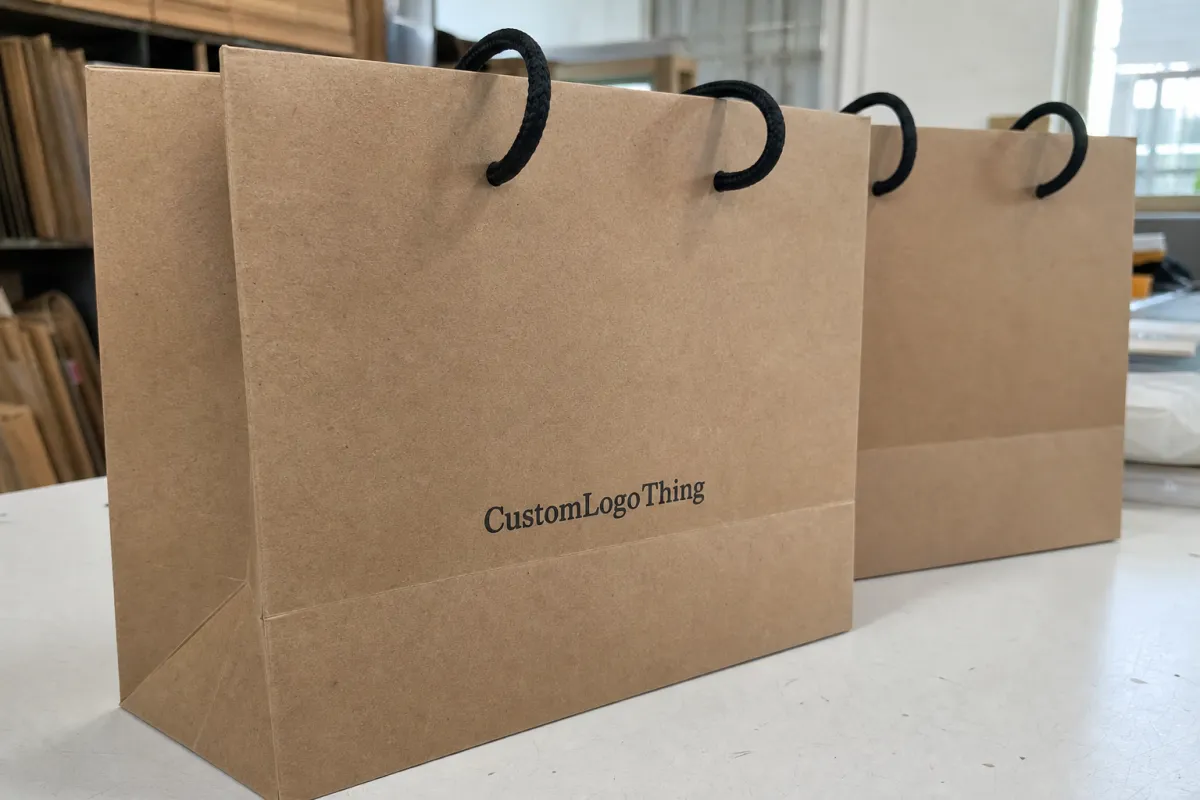
A clothing store bag has two jobs: carry the purchase safely and reinforce the store’s positioning. Those jobs are practical, not decorative. If the bag bends at the bottom, stains easily, or looks unrelated to the rest of the brand, the customer notices that mismatch even if the garment itself is strong.
Small-batch ordering is useful because apparel assortments change fast. A boutique may need one bag for folded tees, another for premium denim, and a third for gift purchases around a holiday drop. Buying one generic stock bag and forcing it to do every job usually creates waste somewhere: wasted space, wasted paper weight, or wasted brand consistency.
A clean bag does not need a loud design. It needs to fit the product, hold its shape, and arrive at the register looking intentional.
For that reason, small-batch custom bags fit apparel retail especially well. The order can be matched to a season, a capsule collection, a pop-up event, or a single store format. The store gets enough control to make the packaging feel considered, without locking into a large inventory that may be the wrong size six months later.
The bag also affects how the sale feels. A modest logo on a solid paper surface often reads more refined than a crowded print treatment. In practical terms, the packaging should support the merchandise, not compete with it. That is the same principle used in strong custom printed boxes: the structure and surface should make the product look organized before the customer even opens it.
Bag styles, paper weights, and handles that fit apparel stores
Most apparel paper bags fall into a few dependable constructions: flat-handle, twisted-handle, rope-handle, and no-handle gift styles. Each one has a different balance of cost, appearance, and carry comfort. Flat handles are efficient for fast checkout lines. Twisted handles look a little tidier. Rope handles usually feel more premium. No-handle styles work well for accessories, boxed items, or gift-with-purchase sets.
Paper weight matters just as much as handle style. A lighter stock lowers the unit price, but it can feel soft or unstable if the order needs to carry heavier folded items. Heavier paper improves stiffness and helps the bag stand square on the counter. For clothing stores, buyers often start around 120-150 gsm for light use, 150-200 gsm for standard retail, and 200 gsm or higher when the bag needs more body.
Bag dimensions should follow the merchandise, not the broadest possible use case. A tee, scarf, or small accessory box can fit a compact bag. Hoodies, denim, and gift sets need more height and gusset width. If the bag is too deep, the product slides around. If it is too shallow, the top opens under stress and the bag loses its clean shape.
- Flat handles: practical for high-turn counters and tighter budgets.
- Twisted handles: a balanced option for boutiques and seasonal promotions.
- Rope handles: better suited to premium apparel and higher-ticket purchases.
- Reinforced tops and gussets: help the bag stay square and carry more cleanly.
There is also a customer comfort issue that rarely shows up in a spec sheet. A bag may look fine on the counter and still feel awkward in hand if the handle is too narrow, the top board is weak, or the gusset collapses under a heavier garment. Buyers who think through that part of the experience usually end up with fewer complaints and fewer returns to the counter for a replacement bag.
Print specs, sizing, and finishing choices to confirm before you order
Size is the first decision worth getting right. Start with width, gusset, and height based on the item you ship most often out of the store. If your checkout mix is mostly folded shirts, build around that. If larger garments dominate, do not undersize the bag just to save a few cents. A good rule is to leave room for tissue, a receipt insert, and a small second item so the top closes without bulging.
Artwork placement deserves the same attention. Small runs do not give a weak layout much room to hide. Ask for the dieline before approving anything and keep the logo safely inside the trim and fold zones. A vector logo is still the cleanest file type for print. If the design uses a photo, gradient, or fine text, have the final size checked carefully so detail does not break down on press.
For most clothing stores, one-color print is the most disciplined option. Two colors can add contrast without making the bag feel crowded. Full-color work makes sense for brands that already use complex graphics, but more ink is not automatically better. In many cases, a simpler imprint and stronger paper stock create a better result than a busy surface treatment.
Finish changes the bag’s tone under store lighting. Uncoated paper feels natural and is easy to write on. Matte coating softens reflection. Gloss brings more shine but can show handling marks sooner. Soft-touch can feel refined, though it is not always the right choice for every apparel store because it costs more and can be more sensitive to scuffing during shipping.
If you want a more sustainable paper source, ask specifically about FSC-certified paper and whether the certification applies to the actual board being used. Independent references such as FSC and packaging.org can help keep those conversations grounded in verifiable standards instead of vague marketing claims.
Before approving production, check the following details in writing:
- Exact bag dimensions, including width, gusset, and height.
- Paper weight and whether the stock is coated or uncoated.
- Handle style, handle color, and reinforcement method.
- Print colors, logo placement, and any white-space requirements.
- Finish, special effects, and whether they affect lead time.
- Carton pack count, freight method, and the in-hand date.
That list sounds basic, but it prevents most of the avoidable mistakes. A quote with missing dimensions or loose artwork notes is not really a quote; it is a starting point for more questions.
Cost, MOQ, and quote factors for small-batch paper bags
Custom Clothing Store Paper Bags small batch custom order pricing becomes much easier to understand once the buyer treats it as a bundle of variables. Bag size, paper weight, handle type, print complexity, finish, proofing, and tooling all affect the total. The hidden cost in smaller runs is usually setup, not the paper itself. That is why one order can look reasonable at 5,000 units and unexpectedly expensive at 500 units.
| Bag style | Best use | Typical small-run unit range | Trade-off |
|---|---|---|---|
| Flat-handle, one-color print | High-volume basics and everyday apparel sales | $0.38-$0.65 | Lowest cost, least premium feel |
| Twisted-handle, one- or two-color print | Boutiques and seasonal promotions | $0.52-$0.88 | Good balance of look and cost |
| Rope-handle, heavier stock | Premium apparel and gift purchases | $0.90-$1.60 | Higher unit price, stronger presentation |
| No-handle gift style | Accessories and event handouts | $0.45-$0.95 | Less carrying convenience |
Minimum order quantities matter because setup costs are spread across fewer pieces. A 500-piece run can feel expensive next to a larger reprint, even if the paper and handle costs are similar. The difference is in prepress work, cutting dies, gluing, proofing, and the amount of manual handling the factory has to absorb.
There are practical ways to bring the number down. Standard dimensions usually help. One or two ink colors cost less than a dense full-coverage print. A standard twisted handle is often easier on the budget than a rope handle. A simple matte finish usually adds less cost than specialty coating. None of those choices remove the brand; they just stop the order from paying for features the store does not need.
Buyers should also ask for landed cost, not just the factory unit price. Freight, samples, artwork revisions, and any duty or tax charges can change the real number meaningfully. A complete quote should spell out the sample charge, proofing cost if any, production quantity, packaging method, shipping method, and delivery window. If those items are missing, the order is not fully defined yet.
Production steps, lead time, and proof approval for small runs
A clean paper bag order follows a predictable path: inquiry, dieline review, artwork setup, proof approval, production, carton packing, and shipping. If one of those steps is skipped, the error usually shows up later as a misplaced logo, a wrong gusset, or a handle that does not sit properly against the top fold. Small runs do not leave much room for correction after the fact.
Most delays happen before production starts. Missing vector files, late artwork changes, and specialty finishes are the usual culprits. Foil stamping, soft-touch lamination, rope-handle attachment, and unusual stock weights all add time. Shipping can add another layer if the cartons cross multiple regions or ports before reaching the store.
The fastest way to keep the order moving is to send four things at once: quantity, exact dimensions, logo files, and the date the bags need to be in hand. If the bag will hold folded tees, denim, or gift sets, say that clearly. That context helps the supplier decide whether a standard build is enough or whether the bag needs more board strength and gusset support.
The best paper bag approvals usually happen when the buyer checks the proof against the actual folded product, not just against the screen.
Quality control should not be vague. A proper check looks at print registration, handle attachment, glue integrity, fold consistency, and the way the bag stands when empty. For apparel orders, I would also check whether the top edge sits level and whether the gusset opens evenly; those small issues affect how the bag feels at checkout. A bag that seems fine in a flat proof can still look tired if the fold lines are inconsistent.
Typical lead times after proof approval often land around 10-18 business days for straightforward runs. Larger quantities, specialty finishes, or nonstandard handles can extend that timeline. Freight then adds its own clock. That is why an exact in-hand date is more useful than a general rush request. If the bags are needed for a seasonal launch, the schedule should be built backward from that date instead of guessed at the end.
Why apparel retailers keep choosing small-batch paper bag programs
Apparel retailers keep returning to small-batch bag programs because the format stays predictable while the product mix keeps changing. That predictability is operationally useful. Staff can learn one or two bag sizes quickly. Reorders are easier to manage. The store does not have to use a bag that is technically available but visually wrong for the season.
Smaller runs also reduce the risk of sitting on the wrong packaging inventory. Fashion changes. A boutique may move from lightweight knits to heavier denim, then back again. A paper bag that made sense in one quarter may feel off by the next. Small-batch ordering keeps the packaging closer to the current assortment instead of locking the store into months of old stock.
There is also a presentation benefit. Bags, tissue, tags, receipt inserts, and custom printed boxes can all work together as part of one packaging system. When those elements share the same color family, typography, or print tone, the store looks organized without seeming overworked. The customer may not name the packaging system, but they will feel the difference.
What usually earns repeat business from retailers is not a flashy promise. It is consistency in the practical parts: clear proofs, honest lead times, stable dimensions, and a willingness to say when a requested spec will push the price or timeline too far. That kind of straight answer is useful for boutiques, pop-ups, and multi-location apparel stores that need packaging to stay aligned across seasons.
If a store needs matching formats for other product types, the broader Custom Packaging Products page can help compare options, and Wholesale Programs may make more sense for planned replenishment. Packaging usually works best as a system, not a one-off purchase made in isolation.
Next steps to place a custom clothing store paper bag order
A Custom Clothing Store Paper Bags small batch custom order should begin with the merchandise, not the logo file. Gather the basics first: the product type, target dimensions, preferred handle, print colors, quantity, and required delivery date. If you already know your reorder threshold, include that too. It helps shape a run that supports a full selling cycle instead of only a single event.
The cleanest starting point is usually one core size, one finish, and one handle style. That gives the store a baseline to test against real inventory. From there, a second bag size can cover larger items or gift sets. If the program expands later, it will be easier to compare results because the first version was kept simple and measurable.
Before production, request a sample or pre-production proof and test it with the actual folded item. Put the garment in the bag with tissue, look at the top edge, and check whether the handles carry the weight comfortably. If the bag closes neatly and holds its shape, the spec is close. If it looks cramped or slack, adjust the height or gusset before committing to the run.
For common order questions, the FAQ can help narrow down the basics. The larger point is simpler: a thoughtful bag spec improves the handoff at checkout, protects the product in transit, and keeps the store’s presentation steady without overcomplicating the order.
Frequently Asked Questions
What size custom clothing store paper bag should I order for folded apparel?
Base the bag on the item you sell most often, such as a tee, sweater, or scarf, rather than the largest garment in the assortment. Leave room for tissue, a receipt insert, and a second small item so the top closes without forcing the bag open. If your mix changes often, one standard apparel size and one larger gift size usually works better than trying to force one format to fit everything.
How low can the MOQ be for a small-batch custom paper bag order?
MOQ depends on size, print method, and handle construction, but smaller runs usually carry a higher unit price because setup is spread across fewer bags. Standard dimensions and simpler printing make lower quantities more practical. Ask for MOQ and landed cost together so you can compare the real number, not just the printed unit rate.
Which handle style works best for clothing store paper bags?
Flat handles are practical for high-volume retail and tighter budgets. Twisted handles are a strong middle ground for boutiques and seasonal promotions. Rope handles usually suit higher-ticket apparel or gift-focused purchases. The right choice depends on whether the bag is mainly a carry item or a visible part of the brand presentation.
What files do you need to quote a custom paper bag order?
A vector logo, target quantity, preferred bag size, and a note about how the bag will be used are the basics. If you already know the finish and handle style, include those details too so the quote reflects the actual build. If artwork is still being finalized, ask for a proof-first estimate so you can compare options before production starts.
How long does production usually take after proof approval?
Lead time depends on order size, print complexity, and whether the bag uses special finishes or custom handles. Straightforward runs are often quicker, while specialty work takes longer because the factory still needs time for cutting, gluing, curing, and packing. If you have a fixed in-hand date, share it early so the schedule can be checked before the order is placed.

