For a gym launch, supplement brand, pop-up, or retail checkout, the fitness twisted handle paper bags Digital Proof Checklist is the difference between a clean approval and an expensive correction. The mockup may look polished on a laptop. The finished bag is less forgiving. A logo that drifts into a fold, a QR code too close to a gusset, or a handle patch sitting on top of key artwork can turn a decent-looking design into a production problem.
That is why the digital proof matters. It is the pre-production checkpoint that shows layout, size, panel placement, bleed, notes, and any warning flags before the press starts running. In fitness, that checkpoint carries more weight than many buyers expect. These bags hold supplements, towels, apparel, sample packs, and retail purchases. They travel through locker rooms, front desks, class exits, and shopping floors. If the print is off or the structure feels weak, people notice immediately.
A proof is not a promise of final color perfection. It is a layout and build check. Good buyers use it to confirm dimensions, panel mapping, copy placement, barcode location, and notes about handle patches, board inserts, and finish. Bad buyers treat it like an art preview only. That is how avoidable mistakes make it into production.
Why a proof can look fine and still fail on the floor
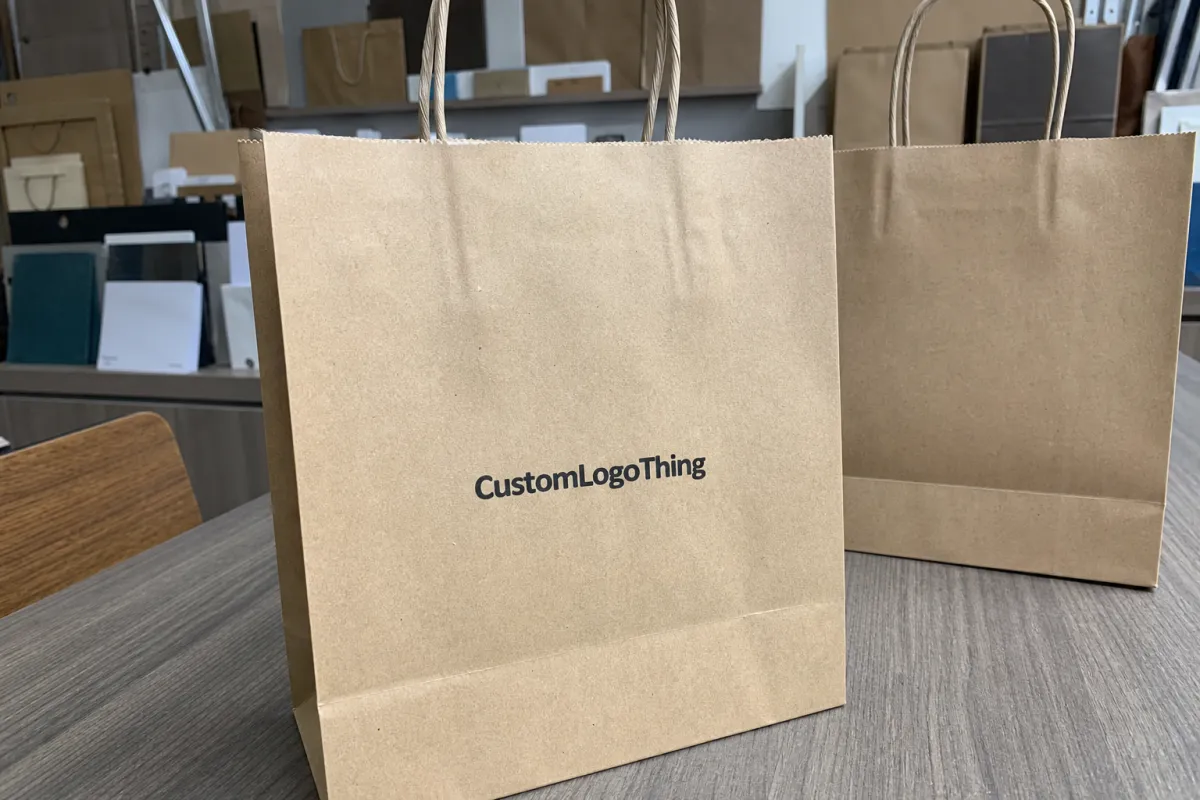
A flat file does not behave like a formed paper bag. Once the side gussets fold in, the bottom panel turns, and the twisted handles are attached, the artwork moves. A centered logo on screen can drift a few millimeters in the real build. A QR code that looks safe in a proof can land in a crease. The bag still prints. It just prints wrong.
That gap matters most in fitness orders because the bag is often used immediately. A member receives a class pack, walks straight to the studio, and the bag becomes a moving billboard before the first rep. If the branding is off, the error is visible in public. If the bag collapses under a shaker bottle because the board insert was never confirmed, the brand looks cheap rather than busy.
Think of the proof as a contract for the bag build. If the spec sheet says 180 x 80 x 250 mm with a 100 mm handle drop and the proof shows something else, that is not a small mismatch. It is a production change waiting to happen. The same is true for handle reinforcement, bottom weight capacity, and the amount of artwork that can safely sit near a fold line. Paper bags are not posters; they are structural objects.
The strongest reviews focus on what the proof can prove. Layout. Measurements. Placement. Readability. Known limitations. Anything else belongs in color sampling or a first-article check, not in wishful thinking.
What the fitness twisted handle paper bags digital proof checklist should verify
Start with the structure. Confirm the finished size, gusset depth, bottom panel, handle drop, and any reinforcement such as a patch or board insert. If the bag is meant to hold apparel, a supplement tub, or a bottle-shaped item, structure matters more than decoration. A beautiful bag that tears at the handles is still a bad bag.
Then check every artwork zone. Front panel, back panel, side gussets, and bottom panel all need their own review. Verify safe margins, bleed, crop marks, and any place where the art comes too close to a seam or fold. Plan on losing a few millimeters to the physical build. That is normal. Pretending otherwise is how logos get cut off by the top fold.
QR codes and barcodes need special attention. They should be large enough to scan easily and surrounded by enough quiet space to avoid misreads. Tiny type near a crease is asking for trouble. So is placing a scan code over kraft paper with heavy ink coverage and no contrast check. On uncoated stock, ink can sink a little and soften edges. On white stock, the same design may read cleaner.
Material notes matter as much as the art. A good proof should say whether the bag is kraft or white base, what paper weight is specified, and whether the finish is matte, gloss, or uncoated. For smaller retail bags, 120-140 gsm may be sufficient. For heavier fitness kits, 150-200 gsm or a reinforced build is more realistic. If sustainability claims matter, ask for documentation rather than verbal assurance. FSC certification is a recognized standard, and the chain-of-custody paperwork should match the order, not sit in a vague promise somewhere else in the inbox: fsc.org.
The proof language itself deserves scrutiny. Ask whether it is layout-accurate, color-approximate, or production-intent. Those are not the same thing. Layout-accurate means placement is right. Color-approximate means the shade is close, not final. Production-intent means the proof is intended to drive the press as closely as possible. If the supplier does not say which one it is, ask before approving.
"Looks fine on screen" is not approval. It is a starting point.
If the order includes shipping cartons, inner packs, or a retail distribution plan, ask how the finished goods will be packed. The carton style and pack count can affect whether the bags arrive flat, wrinkled, or scuffed at the handles. For buyers who care about transit risk, the test logic behind ISTA is a useful reference point even if a formal lab test is not in the budget.
For an internal cross-check, the Manufacturing Capabilities page can help align print methods, finishing, and build options before approval. If multiple teams are weighing the order, the Custom Logo Things home page can also help keep the vendor context consistent.
Cost, pricing, and MOQ: what actually moves the quote
Pricing on Twisted Handle Paper bags is shaped by a few predictable variables: quantity, print colors, paper stock weight, handle style, finish, and how much of the bag is covered by artwork. One-side print is usually cheaper than full-wrap coverage. Kraft is often less expensive than white board with heavy ink coverage. A one-color logo costs less than a four-color design with gradients, fine type, and full bleed.
MOQ matters, but the term gets used loosely. Lower-volume digital runs are easier to approve because setup is lighter and changes are simpler. Larger quantities lower the unit cost because setup gets spread across more bags. A realistic planning range for custom twisted-Handle Paper Bags might look like this: 500 pieces at roughly $0.85-$1.45 each, 1,000 pieces around $0.62-$1.05 each, and 5,000 pieces around $0.18-$0.42 each. Those numbers shift with size, stock, handle reinforcement, and print coverage, so they should be read as planning ranges rather than promises.
| Order type | Best for | Typical MOQ | Unit price range | Proof behavior |
|---|---|---|---|---|
| Short digital run | Gym launches, events, small retail batches | 300-1,000 pcs | $0.85-$1.45 | Fast proof, easier revisions |
| Mid-volume branded run | Monthly reorders, franchise use | 1,500-3,000 pcs | $0.45-$0.82 | More spec checking, fewer surprises |
| High-volume production run | Chain-wide retail, nationwide promotions | 5,000+ pcs | $0.18-$0.42 | Best unit economics, tighter approval discipline |
Hidden quote traps matter more than the headline number. Watch for revision limits, setup charges, plate costs on non-digital jobs, freight, pallet fees, and rush surcharges. A quote that looks low before proof approval can rise quickly once revisions, shipping, and packaging extras are added. It also helps to confirm whether the proof round is included or billed separately. Some suppliers are direct about it. Others are less direct.
If you are comparing vendors, use the same spec set across every quote. Same size. Same stock. Same handle style. Same print count. Otherwise you are not comparing pricing. You are comparing different products.
Process and turnaround: from file upload to approved proof
The normal workflow is straightforward. Artwork intake comes first, then spec confirmation, then proof generation, then client review, revision round, final sign-off, production, packing, and shipping. If a supplier skips one of those steps, the order may move faster, but it usually moves wrong. Speed without a clean file is just faster confusion.
Timing depends on complexity. Simple proofing can take 1-3 business days if the dieline is ready and the artwork is clean. More complex layouts, multiple SKUs, or several review rounds can push approval longer. Specialty coating, reinforced handles, or unusual dimensions add time too. If the bags support a launch date or event window, build in a buffer. Good packaging schedules always include one.
Most delays come from predictable places: missing dielines, vague color references, last-minute copy changes, and approval chains with too many decision-makers. One person wants the logo bigger, another wants the legal line smaller, and nobody wants to make the final call. That is not workflow. That is drift.
For production-minded teams, a supplier that explains the proof flow clearly is usually easier to work with. Ask what happens after final art is sent, who marks up the proof, and how approval is documented. Basic control matters. It avoids the version confusion that shows up when someone searches their inbox for the "latest" file and finds three nearly identical PDFs. For broader sourcing terminology, Packaging.org is a useful external reference point for packaging basics and industry language.
One useful habit: ask for the final proof as a PDF with version control, not just a screenshot in email. Screenshots get lost. PDFs preserve notes, measurements, and the version actually approved. That matters when production later asks which file was signed off. The answer should not depend on memory.
Step-by-step checklist before you approve the proof
Use the fitness twisted handle paper bags Digital Proof Checklist line by line. Do not eyeball it. Do not assume the vendor already checked it. The job is to verify the final version, not trust the process by default.
- Match the dimensions. Confirm finished size, gusset depth, panel count, handle drop, and bottom panel against the spec sheet.
- Check structure notes. Verify handle patch placement, reinforcement, board insert, and any special fold or glue line.
- Inspect artwork zones. Review front, back, side, and bottom panels, then confirm no key element crosses a fold or seam.
- Test readability. Zoom in on small text, phone numbers, QR codes, barcodes, and legal lines. If it is hard to read on screen, it will not improve on paper.
- Confirm color intent. Ask whether the proof is approximate or production-intent, and reference Pantone codes if color accuracy matters.
- Check file control. Save the approved PDF, version number, date, and written sign-off in one place.
Approve the proof only when the spec sheet and the artwork agree. If they disagree, the file is not ready. That sounds obvious. It is also where a surprising number of orders go sideways because someone wants to move faster than the paperwork allows.
After sign-off, lock the approval in writing. Email is fine if it clearly states the version and the exact go-ahead. If the order is tied to launch timing or retail rollout, ask for a pre-production photo or first-carton check. That extra step can catch a carton count issue or a packing mix-up before the truck leaves.
A missed detail on a 500-piece trial run is annoying. A missed detail on a 5,000-piece run becomes a budget problem with a logo on it. That is the practical reason the checklist exists.
Common mistakes that stall fitness and retail orders
The most common mistake is treating screen color as final color. Monitors lie. Papers vary. Ink behaves differently on kraft than on white board. Even when the artwork is right, the print can shift because the substrate, coverage, and finish all influence the result. That is normal. Pretending it will not happen is not useful.
Another frequent miss is ignoring creases, gussets, and handle patches. A design can look balanced in a flat layout and then look awkward once folded. The eye expects symmetry, but bags are three-dimensional objects with seams. The proof should show where the real structure interrupts the art, or the first sample will do the teaching for you.
Operational errors cause plenty of delays too. Missing carton counts. Unclear ship-to details. Copy changes after approval. Assuming one proof round covers every revision. Those issues are boring, but they are the ones that move schedules. The art file may be finished. The order is not.
For fitness and retail brands, one more mistake shows up constantly: too much text on a small bag. If the bag carries a logo, a URL, a promo message, a QR code, and a legal claim, something will suffer. Usually readability. Sometimes the brand. Fewer words, larger type, and better spacing usually make the bag work harder.
When in doubt, simplify the message and protect the structure. A strong logo on a well-built bag beats a crowded layout on a flimsy one. Buyers remember the bag they can use, not the one that only looked good in a proof.
Expert fixes and next steps after the proof is approved
Once the proof is approved, do three things immediately. Save the final proof. Confirm the PO. Ask whether a pre-production photo, first-carton check, or shipping milestone will follow. Small habits prevent large misunderstandings later. It is unglamorous work, but boring is cheaper than reprinting.
If a reorder is likely, build a reusable spec sheet now. Keep the size, handle type, paper weight, print placement, Pantone calls, and finish notes in one file. That keeps the same questions from returning every time the order is repeated. It also makes comparisons against Manufacturing Capabilities easier when the team is deciding between options.
For recurring fitness bags, the goal is consistency: same bag, same approved file, same carton count. The fewer variables, the fewer places for the job to go sideways. That is why the fitness twisted handle paper bags Digital Proof Checklist is worth keeping as a standard step rather than treating it like a one-time formality.
One final rule is worth keeping close: do not release production until the proof matches the bag you actually want to receive. That sounds obvious, and yet almost-right orders still happen every week. Almost right is expensive.
FAQ
For fitness twisted handle paper bags, what should I check in the digital proof?
Check the finished size, handle placement, gusset art, bleed, and any barcode or QR code that needs to scan cleanly. Confirm the proof matches the spec sheet before you approve anything in writing.
How long does digital proof approval usually take for paper bag orders?
Simple proofs often turn in 1-3 business days, but complex layouts or multiple revisions can take longer. Fast approval depends on having the dieline, final copy, and color references ready from the start.
What changes the unit cost on a twisted handle paper bag quote?
Quantity, stock weight, print color count, finish, and handle reinforcement usually move the price the most. Rush timing, freight, and extra revision rounds can push the final cost higher than the base quote.
Can I approve a digital proof if the colors look slightly off on screen?
Yes, if you are approving layout rather than final color, but you should confirm whether the proof is color-accurate or approximate. If color matters, ask for Pantone references or a printed drawdown before production.
What happens after I sign off on the proof for a fitness bag order?
The job usually moves into production, which means late changes can get expensive fast. Save the approved file, confirm shipping details, and request a first-carton check if the order matters to launch timing.

