Pet treat Paper Shopping Bags print proof checklist sounds administrative, but it protects margin, timing, and shelf presentation in one pass. A proof is where small errors stop being abstract. A logo that sits too close to a fold, a barcode that loses its quiet zone, or a warm kraft stock that dulls a brand color can all survive a screen review and still fail in production.
Paper Shopping Bags for pet treats sit in a demanding category. They need to carry weight without looking flimsy, hold up through packing and retail handling, and still present a clean brand story at first glance. That means the proof has to verify structure as much as artwork. A beautiful render is not enough if the final bag has a gusset shift, a handle reinforcement that covers copy, or a bottom fold that eats the legal line.
The buyers who avoid the most reprints usually treat proofing like a manufacturing decision, not a design checkpoint. That mindset saves money because it catches the expensive problems early, when a file can still be corrected without resetting plates, rescheduling press time, or reworking cartons. A $40 proof is easier to defend than a $2,000 rerun.
Practical rule: if the proof does not show how the artwork lands on the actual bag panels, it is not ready for approval.
Pet Treat Paper Shopping Bags Print Proof Checklist Basics
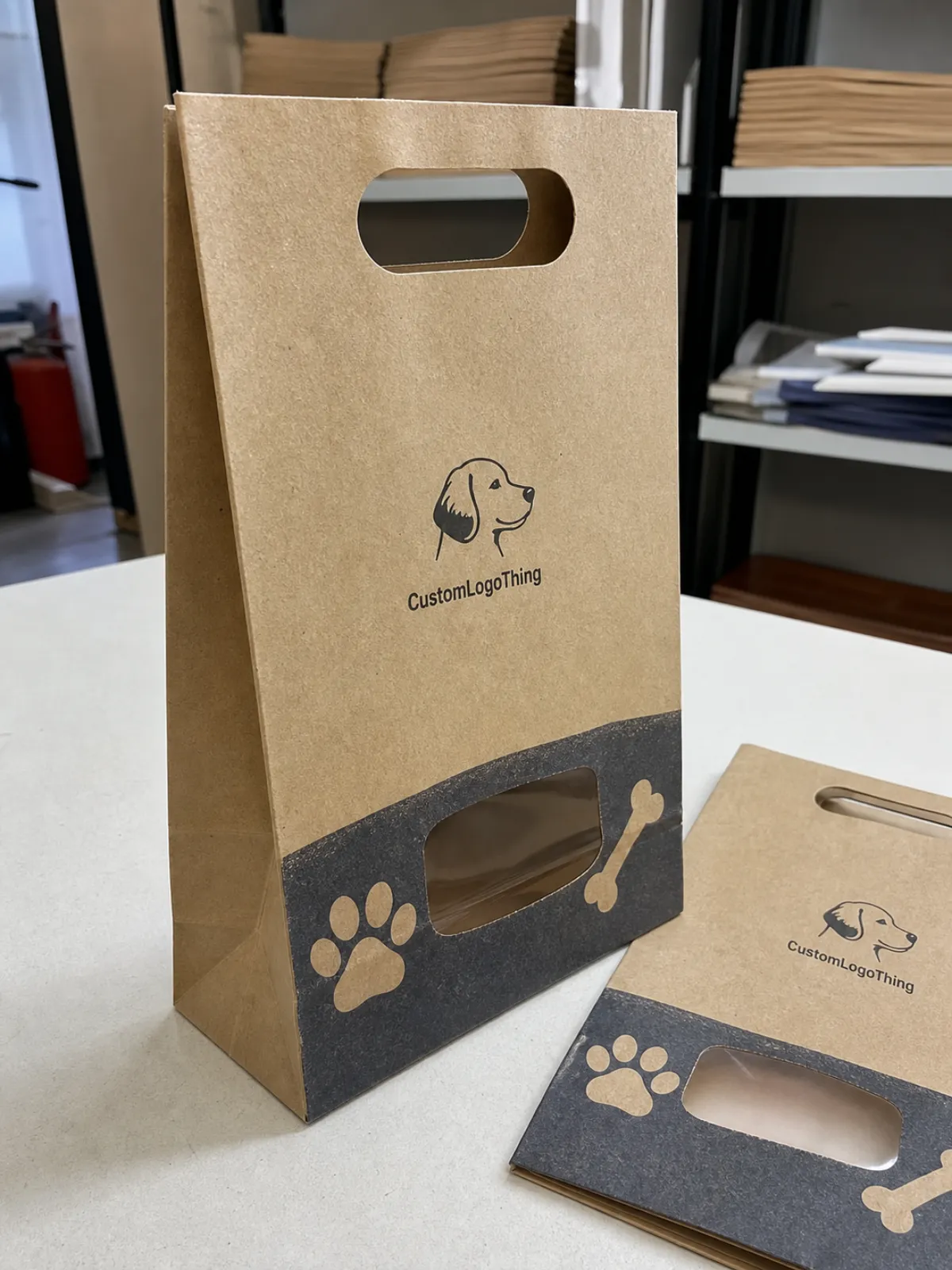
The pet treat Paper Shopping Bags print proof checklist begins before anyone opens the proof file. First, the buyer and supplier need agreement on the structure: finished dimensions, paper grade, handle style, print method, and any coating or lamination. Without those details, a proof can look correct while still describing the wrong bag.
That distinction matters because paper bags are not flat posters. They fold, glue, and convert. A front-panel logo can shift a few millimeters after converting; a line of copy can disappear into the bottom turn-in; a side panel can be narrower than it looked in the layout. Most mistakes are not dramatic. They are small, cumulative, and expensive when discovered late.
Pet treat bags have one more wrinkle: they often need to balance retail polish with practical claims. Brand name, product type, quantity, regulatory marks, recycling language, barcodes, and sometimes ingredient or distribution information all compete for space. A proof that ignores hierarchy may technically fit everything in, but the final bag can still read as crowded or hard to scan.
Proofing also guards against version drift. In fast-moving packaging jobs, the file sent to prepress is often not the same file the marketing team last edited. If the approval path is vague, one team may sign off on copy from version 6 while production builds version 5. That kind of mismatch is how clean-looking projects become rush reprints.
For that reason, the checklist should be used as a sign-off document, not a casual design review. It should answer three questions: is the structure right, is the artwork right, and is the file the final version everyone agrees to print?
How the Proofing Process and Timeline Work
A normal proof cycle starts with a dieline and print-ready artwork. Prepress checks resolution, linked images, embedded fonts, overprint settings, bleed, and any obvious panel conflicts. The customer then reviews a PDF proof, sometimes followed by a second round if copy or artwork placement changes. If the project calls for it, a color proof or physical sample follows before production release. The pet treat Paper Shopping Bags print proof checklist works best when each step has a named owner and a deadline.
Timelines usually slip in predictable places. Missing dielines delay the first pass. Unclear brand colors lead to back-and-forth over “slightly warmer” versus “less saturated.” Late legal copy changes can force a new proof even if the artwork is otherwise finished. And if two different people send two different “final” files, the entire schedule can wobble for no good reason.
The proof type should match the risk. A PDF proof is enough for layout, spelling, barcode placement, and panel structure. A digital color proof is useful when a buyer needs to judge tonal balance or compare a spot color target before committing to plates. A physical sample matters when the question is structural: how the paper feels, how the handles are attached, whether the finish scuffs, and whether the bag still looks right after folding.
Production timing varies with the method and complexity. Simple jobs may move from proof approval to shipment in about 10-12 business days. More involved orders, especially those with custom handles, heavy coverage, premium finishes, or multiple print colors, often need 12-15 business days or longer. Physical sampling can add a few more days, which is why buyers who need a launch date should build in a cushion rather than assume the shortest possible timeline.
One more detail is easy to miss: approval authority. The best process usually has one person collect input from design, operations, and purchasing, then issue one final response. When every department replies separately, the proof can end up “approved” and still not be usable.
Material, Finish, and Compliance Specs to Verify
The bag spec is the backbone of the proof. Before artwork is approved, confirm paper weight, stock type, handle style, gusset depth, bottom construction, and finished dimensions. For smaller retail paper shopping bags, paper weights often fall around 120-180 gsm. Heavier builds are common when the bag needs more stiffness, a stronger hand feel, or better support for a premium product presentation.
Finish changes the final result more than many buyers expect. Gloss coatings deepen contrast and make dark branding feel sharper. Matte and aqueous finishes soften reflections and can make text easier to read under retail lighting. Uncoated kraft behaves differently again; it warms up the artwork, darkens pale colors, and lowers contrast. A white logo or delicate pastel can lose punch on natural stock even when the file is perfect.
That is why a screen is not a trustworthy color reference by itself. A monitor can make white look cleaner, red look brighter, and black look denser than the printed bag will appear. If brand color matters, ask for a substrate-aware proof and review it under neutral lighting. A good proof should show what the bag will do on the actual paper, not on an idealized display.
Compliance details deserve the same attention as color. If the bag carries recycling language, sustainability claims, or certification marks, those elements need the correct version and enough clear space around them. For sourcing documentation, buyers sometimes ask for chain-of-custody verification such as FSC, especially when the package is part of a larger sustainability claim.
Scuff resistance is another practical issue. Pet treat bags are often packed, stacked, shipped, and handled more than a typical boutique retail bag. Heavy ink coverage, high-gloss finishes, and dense dark solids can show scratches more quickly than lighter designs. If the bag will be moved through several hands before it reaches the shelf, ask how the print and finish will hold up in transit.
It also helps to remember that the printed area on a flat proof is not the same thing as the live area on the finished bag. Bleed, glue zones, fold lines, and turn-ins move the artwork. A polished render may hide that reality. The production drawing does not.
For broader packaging context, buyers sometimes compare the bag spec against general packaging references such as Packaging.org when they need a neutral frame for material behavior, substrate selection, or end-use handling.
Cost, MOQ, and Quote Factors That Change Unit Pricing
Paper shopping bag pricing is shaped by a few variables that matter more than most buyers expect: size, paper grade, print sides, number of colors, finish, handle style, and total quantity. The pet treat paper shopping bags print proof checklist keeps those variables tied to the approved file, which matters because a small artwork change can alter setup, proofing, or plate cost.
MOQ changes the economics quickly. A 5,000-piece run usually carries a higher unit price than a 20,000-piece run because setup cost is divided across fewer bags. Simple Custom Paper Bags at moderate volume may land around $0.18-$0.28 per unit. Add heavier stock, multiple colors, special coating, or upgraded handles, and pricing can move toward $0.30-$0.45 or more. That range is not a promise; it is what the math tends to do when complexity increases.
Short runs have another hidden cost: they make proofing more expensive per piece. A detailed color proof or physical sample may look minor on a quote, but it matters more on a small order than on a large one. In those cases, the proof is not overhead. It is insurance against a reprint that can cost many times more than the sample.
Ask for pricing in separate lines whenever possible. Bag construction, print, proofing, and freight should not be folded into one vague number. Clear line items make it easier to understand whether a change affects the bag itself or only the approval process. If a supplier cannot explain what moved the price, the quote is harder to trust.
| Proof Option | Best Use | Typical Cost Impact | What It Catches |
|---|---|---|---|
| PDF layout proof | Copy, panel placement, bleed, barcode location | Often included or low cost | Typos, fold conflicts, missing elements |
| Digital color proof | Artwork balance and color targets | Moderate added cost | CMYK drift, contrast issues, image placement |
| Physical sample | Structure, substrate feel, finish, handle behavior | Higher than a PDF proof | Construction issues, real-world color shift, print finish |
Quote comparisons are only useful when the specs match. A cheaper price on a thinner stock or different finish may not be equivalent at all. The paper, print method, and finishing step all change what the final bag can do.
Step-by-Step Artwork and Panel Checklist
This is the part that prevents most avoidable mistakes. The pet treat paper shopping bags print proof checklist should force a review of the file in the same order the bag will be manufactured. Start with the dieline, trim, bleed, safe area, and panel orientation. If the front panel is mislabeled or the gusset is unclear, everything after that becomes guesswork.
- Confirm the dieline against the quote and the finished bag dimensions.
- Check the panels so front, back, side gussets, and bottom are identified correctly.
- Review typography for spelling, line breaks, web addresses, phone numbers, and legal copy.
- Inspect scannable elements like QR codes and barcodes at the size they will print.
- Match color intent with CMYK values or spot color references where needed.
- Verify quantity details including pack count, ship-to address, and product naming.
Barcode review should happen early. A barcode needs enough quiet zone around it to scan reliably, and that space can shrink once the bag folds or stacks. QR codes have similar risks. They may read perfectly on a proof screen and still fail if the printed version is too small, placed over a busy background, or softened by a heavy finish.
Color needs its own decision path. If the project is built around brand-critical color, decide whether the file is being approved in CMYK or with spot colors before the final sign-off. CMYK is fine for many graphics and photos, but it can wander on brand colors that need consistency from run to run. On kraft paper, even accurate color often appears darker and warmer than it does on coated white stock. That is normal, but it should be expected.
Compare the proof, the purchase order, and the spec sheet together. If one says 120 gsm and another says 140 gsm, or one file shows matte and the other shows gloss, pause and reconcile the difference. Small inconsistencies can create large production problems.
Good approval habit: keep one marked-up proof, one final PDF, and one spec sheet in the same folder. If there is more than one “final,” there is no final.
If the bag uses aqueous coating, varnish, or lamination, check how that finish affects type, solids, and edge detail. Fine lines and small reverse type often look different once finish is added. A finish can improve durability while making ultra-light copy harder to read.
Common Proof Mistakes That Cause Reprints
The most expensive proof mistakes are usually ordinary. A panel gets skipped, so copy lands too close to a turn-in. A version of the logo is used that no one intended to print. A barcode is approved from the wrong file. None of those errors are glamorous, and all of them are preventable.
One common failure is trusting the monitor too much. A backlit screen hides the warmth of kraft stock and makes white look brighter than it will on paper. It also smooths over small contrast issues that become obvious once the ink hits the substrate. A proof has to be judged in the context of the paper, not just the design software.
Another problem is late copy changes. Phone numbers change. Ingredient statements change. Compliance marks get updated. If a proof is approved from an old file, the order can be technically approved and still wrong. That is a version-control issue, not a print issue.
Method matters too. Offset printing usually handles fine detail well, but it will expose sloppy image prep. Digital printing can be quick for short runs and revisions, though color may vary with stock behavior. Flexographic printing on paper bags is efficient for longer runs, but thin lines and tiny reverse text need careful scrutiny. The proof should match the production method, not a generic ideal.
Reprints often happen when the artwork was reviewed as a brand piece instead of a manufacturing file. That is a subtle but costly mistake. Packaging is not just visual communication; it is a process document. If the file does not behave correctly in the press and converting room, the shelf value is irrelevant.
Expert Review Tips for Faster Approval
Fast approval usually comes from tighter structure, not faster reading. One person should gather comments from design, operations, and purchasing, then send a single response. That keeps the proof from bouncing around as a chain of half-edits and conflicting assumptions. The pet treat paper shopping bags print proof checklist works only when the review process is disciplined enough to support it.
Compare the proof against the purchase order and spec sheet, then compare it again against any prior reorder file. Reorders are where drift hides. Teams assume the artwork is unchanged because the project name is the same, but a small revision can have been made months earlier. If the current proof and the old approval do not match, stop and reconcile them before sign-off.
Markups should be direct. A red circle around a logo change is better than a long email trying to describe the same fix in prose. Visual comments reduce misread instructions and cut down on reproofs. If a change is intentional, say so plainly. If it is not, flag it as a correction. Prepress teams can work quickly when the direction is clean.
Zoom in on the areas that fail most often: punctuation, legal lines, seam interference, certification marks, and any text near a fold. If the bag carries a sustainability claim or an FSC reference, treat it as regulated copy, not decoration. It needs the right wording, enough space, and the correct version.
One useful habit is to create a single approval owner for the project. Not a person who knows every detail, but one person who collects the final decision. That prevents the common split where sales signs off one change, marketing signs off another, and production receives both.
Final Approval Steps and Production Handoff
Once the proof is right, the handoff should be tidy. Save the approved PDF, the revision notes, and the sign-off email in one shared folder. Send the final dieline, the artwork file, and the bag specifications together so no one has to guess which version belongs to the order. The pet treat paper shopping bags print proof checklist is not just for approval; it becomes the reference point for the next run.
Before release, confirm the production start date, the expected turnaround, and any sampling or freight milestones that sit around the job. Many paper bag projects move from final approval to shipment in about 10-15 business days, but the real number depends on quantity, print method, stock, and finishing. Custom handles, extra coatings, or multiple colors all stretch the schedule a little. Buyers who need a firm launch date should plan for that friction instead of hoping it disappears.
Store the final proof where future teams can find it fast. Six months from now, nobody should have to search through old email threads to identify the approved version. One folder, one approved file, one final spec sheet. That is enough to keep the next reorder from becoming a detective story.
Good production habit: the final approved proof should travel with the purchase order, not disappear into someone’s inbox.
For packaging teams, that last step is where the work becomes repeatable. The artwork is locked, the material is known, the timeline is visible, and production can proceed without guesswork. A disciplined approval process does not only protect the current order. It improves every reorder that follows.
What should a pet treat paper shopping bags print proof include before approval?
The proof should show the final artwork on the correct dieline, with panel orientation, bleed, and safe area clearly visible. It should also confirm bag size, paper stock, finish, print method, and any placement rules for logos, barcodes, or claims. A version number or approval date helps everyone identify the exact file that is authorized for production.
How many proof rounds are normal for pet treat paper shopping bags?
Most projects need one internal review and one customer review, with a possible extra round if copy, color, or structure changes after that. The number rises when artwork is incomplete, legal text changes late, or the team needs to compare the proof against a physical sample. The cleanest way to keep rounds under control is to send one consolidated response instead of many partial edits.
How does MOQ affect the proof and unit cost for pet treat paper shopping bags?
Higher MOQ usually lowers unit cost because setup expenses are spread across more bags. Smaller runs tend to cost more per unit and can make proofing feel expensive relative to the order size. Lock the proof before requesting a revised quote so pricing stays accurate and setup changes do not creep into the order.
Why do pet treat paper shopping bags proofs look different on kraft paper?
Kraft paper is naturally darker and warmer than white stock, so printed colors usually look deeper, softer, or less saturated. If a design depends on bright white or vivid brand color, it should be checked against the actual substrate rather than only on a monitor. A substrate-specific sample is the safest way to judge the shelf result.
What is the fastest way to avoid reproofs on pet treat paper shopping bags?
Use one approval file, one decision-maker, and one checklist so the same version is reviewed by everyone involved. Compare the proof against the spec sheet, purchase order, and legal copy to catch the small details that are easiest to miss. Confirm barcode, contact information, panel placement, and quantity before sign-off, then archive the approved file for future reorders.


