Custom Logo Things
Pet Treat Twisted Handle Paper Bags Unit Cost Review
Pet treat Twisted Handle Paper Bags Unit Cost Review work gets difficult fast if the only number under scrutiny is the lowest quote. A bag can look fine in a spreadsheet and still fail in the hand: the handle twists loose, the sidewall shows grease, or the bottom starts to sag before the customer reaches the car. That is not a cosmetic flaw. It is a packaging failure that makes the product feel less considered than it should.
For pet treat brands, the carry bag does more than move a purchase from counter to customer. It protects the product, signals quality, and affects how the brand is remembered five minutes later. Shoppers notice whether the bag stands upright, whether the handle feels comfortable, and whether the outside stays clean after a short trip. Retail buyers notice the same things, only faster. A clean bag can support a premium treat line. A weak one can undermine a good product before anyone opens it.
The useful way to read a quote is to ask what the price includes, what the bag needs to survive, and where the hidden cost sits. Heavier paper, stronger glue, better registration, and a more careful finish all cost more. So do small runs. So do rushed changes. The goal is not to buy the cheapest carrier. The goal is to buy the lowest-cost bag that still behaves properly under normal retail use.
Why the Cheapest Carry Bag Often Costs More
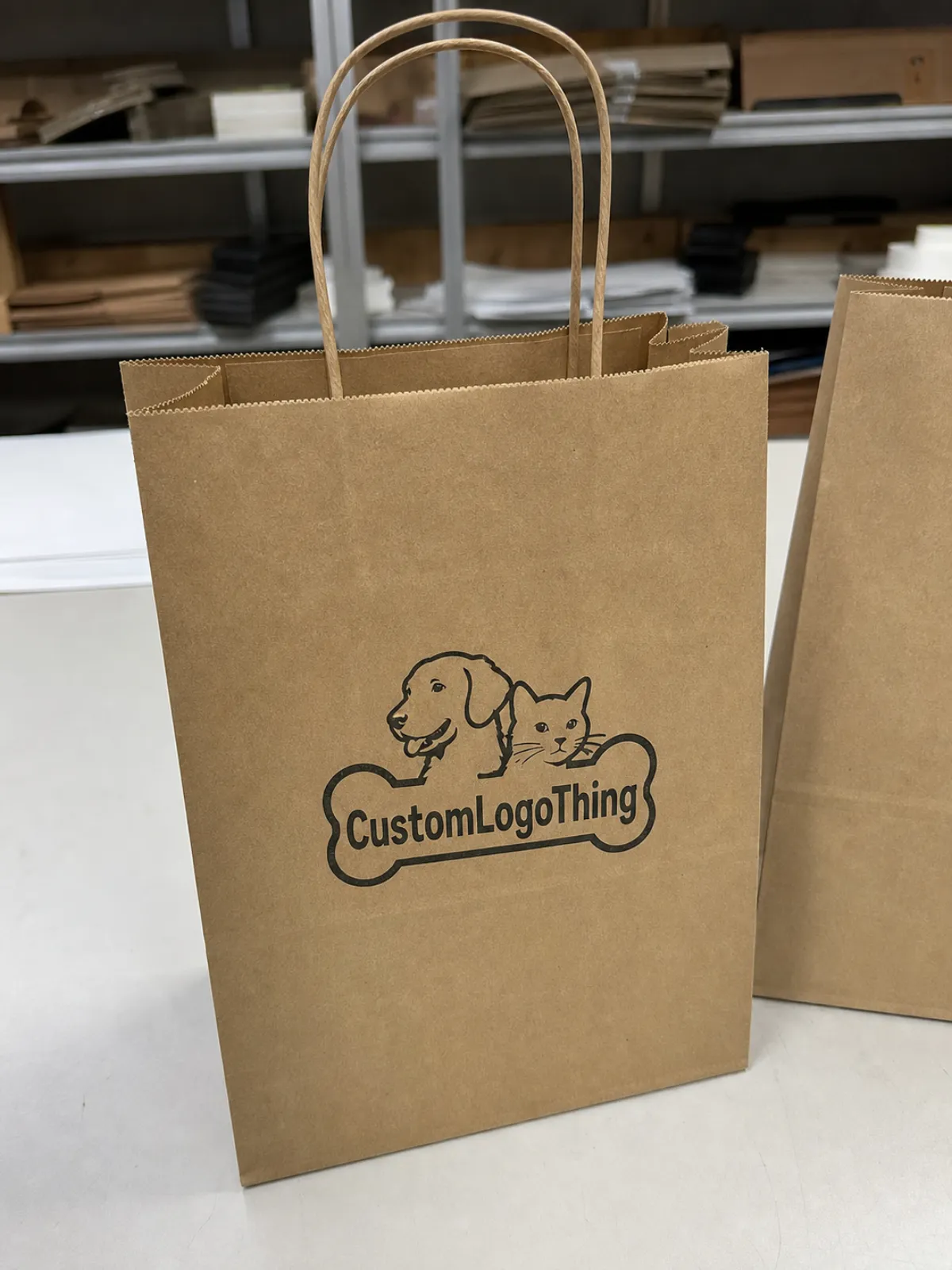
The cheapest option often carries the highest total cost because the failures show up after the order ships. A thin bag may save a few cents per unit, then create damage claims, replacement requests, or complaints from stores that expect a cleaner presentation. Once the handle fails or the bottom gives way, the original savings disappear very quickly.
Pet treats are not a random retail item. They are food-adjacent, frequently oily, and often bought alongside other goods. That means the carry bag has to do quiet work. It needs to feel solid in the hand, resist scuffing, and keep the product from rubbing against the sides or leaking residue onto another purchase. If the brand positions itself as natural, premium, or carefully made, the bag has to support that claim rather than work against it.
The lowest unit cost can be the highest total cost if the bag fails at the register.
The price gap between a basic bag and a better-built one is often modest once the run size grows. In bulk, a few cents can separate a fragile spec from one that has stronger paper, better handle anchoring, and more reliable print quality. That difference is easy to dismiss on paper and easy to justify on the shelf. A bag that arrives intact, carries well, and looks clean does part of the selling for you.
There is also a brand-memory effect that buyers sometimes underestimate. A customer remembers a handle that cut into the hand or a bag that drooped while carrying treats for a dog. They may not talk about it, but they notice. A replacement order is expensive; a second bad impression is worse because the brand has already been given a chance.
Bag Construction for Pet Treat Weight and Grease
Construction matters more than decoration. Start with the paper. For lighter treat packs, a well-made kraft bag in the 120gsm to 150gsm range may be enough. For heavier biscuits, multi-pack bundles, or boxed sets, moving closer to 170gsm or specifying reinforcement is usually safer. The paper should match the load, not the other way around. A nice-looking bag with a weak body is a liability waiting to happen.
Handle style deserves the same attention. Twisted paper handles are common because they balance cost and durability, but only if the anchoring is sound. Loose gluing, uneven placement, or poor tension during assembly turns a standard feature into a weak point. Buyers should ask how the handle is attached, what reinforcement is used at the top edge, and whether the supplier has a standard test for pull strength. If the answer stays vague, the risk is real.
Grease is another factor that changes the spec. Dry biscuits and sealed pouches are easier. Treats with oils, coatings, or richer ingredients can mark uncoated paper in a day. That is where a water-based coating, a matte varnish, or a suitable inner layer can help. The point is not to add finish for its own sake. The point is to stop the outside of the bag from looking tired before it reaches the consumer.
Bottom structure matters too. A pasted bottom with controlled adhesive application is generally better for heavier contents than a flimsy fold. Wider gussets help the bag stand upright and make loading easier for staff. If the bag is near its capacity limit, test it with the actual product weight. A bag that passes with air in it and fails with real stock is not useful.
Retail staff care about small details that never make it into a quote. They want a bag that opens quickly, packs neatly, and does not twist awkwardly when carried by one hand. The top edge, handle placement, and fold quality all affect that experience. None of these details look dramatic in a spec sheet. They matter a great deal in a busy checkout area.
Sizing and Print Choices That Affect Retail Performance
Size should follow the product. A single pouch of treats may fit a compact bag with a modest gusset. A bundle, rigid box, or mixed SKU order usually needs more depth and more room at the handle. If the bag is too tight, the contents look forced in. If it is too large, the carrier wastes material and feels loose in the hand. Either way, the customer notices.
Handle height changes how the bag carries. Too short and the load bunches against the hand. Too long and the bag swings more than it should. A practical carry bag leaves enough room for comfortable pickup, neat folding at the top, and easy packing by store staff. These are small constraints, but they affect the perceived value of the whole order.
Print choice is a major unit-cost driver, though not always in the way buyers expect. One-color logos on kraft are usually the most efficient route when the goal is a clean retail presentation. Two or three colors can still be economical if the artwork is simple and the coverage stays contained. Full-coverage art, inside printing, or multiple special inks add setup, press time, and QC attention. Those costs add up quickly on short runs.
Finish should fit the brand position. Matte surfaces tend to read calm, natural, and slightly more refined, which suits many pet lines that want an earthy or wholesome look. A light varnish can improve scuff resistance without making the bag feel coated in a heavy way. Heavy gloss is harder to justify unless the design calls for it. For pet treats, clarity usually beats spectacle.
A useful comparison is to think in three bands:
- Lean spec: kraft bag, one-color logo, standard handle, lower MOQ.
- Balanced spec: thicker paper, reinforced top, two-color print, better shelf presence.
- Premium spec: heavier paper, coating, more ink coverage, tighter finish control.
The right band depends on where the bag will live. A pop-up table has different requirements than a pet boutique counter. A subscription order has different stress points than a brick-and-mortar checkout. Matching the spec to the channel is one of the few ways to keep cost under control without sacrificing appearance.
Pet Treat Twisted Handle Paper Bags Unit Cost Drivers
The main cost drivers are paper basis weight, bag size, handle type, print coverage, finish, and the amount of manual work the order needs. If one of those rises, the unit price rises with it. Buyers sometimes assume the logo is the expensive part. It rarely is. The biggest jumps usually come from heavier stock, more colors, coatings, tighter tolerances, and low-volume orders that spread setup costs across too few pieces.
Short runs deserve special caution. A factory still has to prepare the press, check registration, cut the material, and inspect the finished bags. Those fixed steps do not shrink just because the order is small. As a result, a 1,000-piece run can cost much more per unit than a 10,000-piece run even if the design is identical. That is not a markup trick. It is simply how conversion costs behave.
Broad pricing ranges help with planning, though they are never exact. Material markets shift. Paper prices move. Freight changes. Still, the following ranges are a reasonable starting point for quote review:
| Spec level | Typical MOQ | Unit cost range | Best fit |
|---|---|---|---|
| Plain kraft, one-color logo | 3,000-5,000 pcs | $0.18-$0.30 | Simple retail carry, lower artwork coverage |
| Thicker paper, two-color print | 5,000-10,000 pcs | $0.24-$0.38 | Most pet treat brands that want better shelf appeal |
| Reinforced build with coating | 5,000-10,000 pcs | $0.30-$0.50 | Heavier packs, oily treats, premium retail positioning |
| Small run, custom spec | 1,000-2,000 pcs | $0.35-$0.70 | Testing a new line, pop-up retail, short launch window |
These ranges hide an important detail: quote format matters as much as quote price. Some suppliers include tooling or plate charges in the bag cost; others list them separately. Freight may be included, excluded, or shown only after the main number has already caught your eye. A quote only makes sense if it lists the bag size, paper grade, print colors, MOQ, sample cost, production unit cost, and shipping terms in the same format every time.
Where buyers get into trouble is comparing unlike numbers. One supplier may quote a coated bag with reinforcement, another a plain bag with lighter paper, and both may seem close enough to pass. They are not close enough. If the numbers do not describe the same construction, there is no real comparison. The lowest price may simply be the thinnest spec.
For pet treat brands, the smartest comparison is often between two versions of the same bag: one stripped down to hit a tight shelf price, the other improved just enough to protect the product and elevate the presentation. That side-by-side view exposes where the extra cents go. Most of the time, the better spec is easy to defend once the bag’s job is defined clearly.
Sampling, Approval, and Production Lead Time
Lead time starts moving the moment the dimensions and artwork become real. If the size is still under discussion, the process slows down. A standard workflow usually includes dieline confirmation, artwork proofing, sample or pre-production approval, mass production, packing, and then domestic or export shipment. Each step can move quickly, but only if decisions stay fixed long enough for the factory to work.
Typical timing depends on complexity and responsiveness. Artwork proofing may take one to three business days when files are complete. A physical sample can take five to ten business days, sometimes longer if the structure is unusual or if the first proof needs changes. Mass production often lands in the 12 to 20 business day range after approval. Larger runs, more colors, and special finishes can extend that window.
Freight is separate from production and should be treated that way. Air shipping is faster and more expensive. Sea shipping is slower and usually better for unit cost. If the order is tied to a launch date, the production calendar needs to be realistic from the start. A fast quote is useful; a fast quote with impossible timing is not.
The quickest orders tend to share three traits: the artwork is final, the bag size is fixed, and the paper grade has already been chosen. Delays usually come from second-guessing after proofing has started. Every new revision creates more waiting. A one-day decision often prevents a one-week delay.
Rush production is possible, but it is not free. Compressed schedules leave less room for rework and less time for careful inspection. If the launch date matters more than the packaging detail, that should be acknowledged early. If the bag must also carry well and look clean, the schedule has to leave room for those checks.
How to Vet the Supplier Before You Place the Order
Start with sample consistency. If the first sample looks good and the second drifts in color, glue coverage, or handle placement, the risk is already visible. A supplier should be able to explain the paper source, handle reinforcement, print method, and carton packing standard in plain language. If the explanation stays fuzzy, the process behind it is probably fuzzy too.
The more telling question is how they handle repeat orders. A weak factory can sometimes produce a decent sample. Reorders expose process discipline. Color drift, uneven glue, and handle failures tend to surface when the same specification comes back months later. Buyers who plan for repeat business should treat reorder consistency as part of supplier evaluation, not an afterthought.
Ask for quality-control checkpoints that match the job. For Twisted Handle Paper bags, that usually means paper weight verification, handle pull checks, glue inspection, print alignment review, and carton drop or stacking review when shipping cartons are part of the job. The purpose is not to add paperwork. It is to catch the problems that are easiest to miss and hardest to fix after shipment.
For transport protection, industry references can help frame the discussion. The ISTA test methods are useful when you want a practical benchmark for carton handling. For broader packaging resources, the Packaging Machinery Manufacturers Institute site is worth keeping on hand. The exact testing level depends on the distribution path, but the principle is simple: the bag should arrive ready to use, not merely ready to inspect.
Compliance also matters, especially for food-adjacent packaging. Ask about inks, adhesives, and paper sourcing. If your brand needs FSC paper, low-VOC inks, or other documented material claims, check that the supplier can provide the paperwork before the order is placed. Sustainability language without supporting documents does not carry much weight with buyers who know the category.
Finally, the supplier should understand the market position of the product. A value line, a veterinary channel, and a premium gift treat line do not need the same finish or the same cost structure. Good suppliers recognize that quickly and quote accordingly. Poor ones treat every order as interchangeable, which usually means the quote is generic for a reason.
What to Send for a Fast Quote and Reorder
A quote is only as accurate as the inputs. Send the finished bag size, quantity, print colors, finish, shipping destination, and the actual product weight or pack type the bag needs to carry. That last detail is often missing, and it is the one that matters most. A single pouch of treats, a multi-pack, and a rigid gift box do not belong in the same bag spec.
Ask for at least two versions. One should be lean and cost-conscious. The other should be stronger, cleaner, or more polished for retail display. Seeing both numbers side by side makes the tradeoff easier to judge. It also prevents over-specifying the bag just because a supplier offered a premium option first.
For reorders, keep the approved artwork, final dimensions, paper spec, and carton pack details in one place. That saves time later and reduces the chance of a small revision slipping in unnoticed. Reorders should be checked against the original approval, not rebuilt from memory. That is especially true when several SKUs share the same base structure but differ in print or size.
Bottom line: a useful quote is specific, a useful bag is built for the load, and a useful supplier can explain the cost difference between a lighter spec and a stronger one without hiding behind vague language. For pet treat twisted handle paper bags Unit Cost Review decisions, the cleanest brief is the one that names the exact size, quantity, print colors, finish, shipping location, and product weight. That is how you get pricing that actually matches the job.
FAQ
What affects pet treat twisted handle paper bag unit cost the most?
Paper weight, print coverage, and handle reinforcement usually move the price more than buyers expect. MOQ matters too because setup cost gets spread across fewer or more bags. Add-ons like coating, special inks, and custom sizing can push the unit cost up quickly.
What MOQ should I expect for custom pet treat carry bags?
Common MOQ tiers usually start in the low thousands, but the exact number depends on print method, bag size, and finish. Lower MOQ orders are possible, but the per-bag cost is typically higher. If you want multiple colors or a special coating, expect the minimum to rise.
How long is the lead time after artwork approval?
Sample and proof stages can take several days, especially if changes are needed. Mass production often takes a few weeks depending on quantity and finishing. Shipping time is separate, so buyers should plan freight on top of production.
Can twisted handle paper bags hold heavier pet treat packs?
Yes, if the paper grade, handle reinforcement, and bottom structure are matched to the load. Heavier pouches or rigid treat boxes need wider gussets and stronger paper. A supplier should test the bag structure before full production if the fill weight is close to the limit.
What should I send to get an accurate quote fast?
Send finished size, quantity, print colors, finish, and delivery location. Include the actual product weight or pack type so the supplier can size the bag properly. Attach artwork files or a logo mockup if you want the quote to reflect the real design.

