A cuffed beanie can look refined or forgettable with the same logo and the same color. The difference usually lives in the yarn, knit density, cuff proportion, and how well the shape survives handling. That is why the Premium Cuffed Beanies material and sizing guide matters before anyone starts comparing quotes.
Buyers often notice color first and fit second, which is exactly backwards. A beanie that looks full on a website can arrive looking soft and expensive, then collapse on a shelf because the cuff is too shallow or the crown has too much give. The reverse happens too: a dense knit can feel excellent in hand but still fail if it is sized for the wrong audience or the wrong decoration method.
A good cuffed beanie has to do three things at once: keep warmth in, present the logo cleanly, and hold its shape after repeated wear. Miss one, and the product moves out of premium territory fast.
Premium Cuffed Beanies Material and Sizing Basics
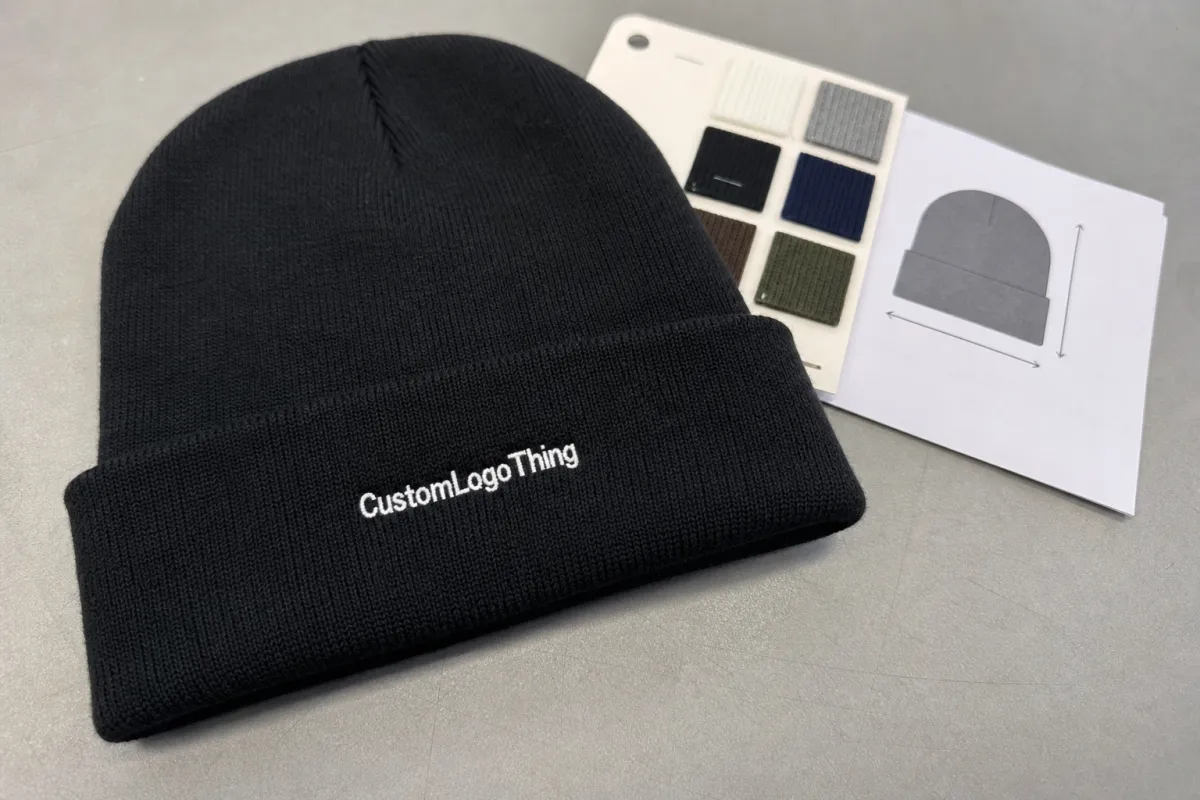
The same silhouette can feel elevated or low-grade depending on three factors: yarn quality, stitch structure, and how the cuff sits once folded. A tighter knit usually feels more substantial, keeps embroidery neater, and resists the loose, tired look that shows up after a few wears. A softer open knit may feel pleasant at first touch, but it often exposes the scalp more than buyers expect and can lose shape quickly if the yarn recovery is weak.
Cuff depth changes perception more than most people think. It affects the decoration zone, but it also changes the visual balance of the whole hat. Add 2 cm of cuff depth and the beanie can read more structured; remove it and the crown may appear saggy even if the actual crown height never changed. Small dimension changes alter the look more than a lot of buyers assume.
That matters on shelf. Folded beanies are usually packed flat in a polybag, sleeve, or carton, and the front fold is the first surface customers see. If the cuff collapses or wrinkles badly, the product looks underbuilt. If the crown balloons, it looks oversized and awkward. Either one makes a premium item seem less deliberate than it should.
There is also a packaging memory issue that gets ignored until the first shipment lands. Dense knits with decent recovery unfold cleanly after transit. Weak knits hold creases longer, especially when cartons are packed tightly or left in a hot container for too long. A beanie can lose part of its perceived quality before it ever reaches a store fixture.
For that reason, the Premium Cuffed Beanies material and sizing guide should be treated as a production tool, not a styling note. It helps decide whether the product is meant for cold-weather resale, corporate gifting, fashion drops, or a broad promotional program. Once the use case is clear, material choice and sizing stop being abstract and start becoming specs.
Material Choices That Change Feel, Warmth, and Finish
Material is where the tradeoffs become visible. Acrylic, wool, cotton, and blends behave differently in the hand, under embroidery, and after laundering. The best choice is rarely the softest sample on the table; it is the yarn that gives the right mix of warmth, structure, recovery, and cost.
Acrylic is still the default for a reason. Good acrylic offers stable stretch, predictable dyeing, and clean knit definition. It is usually the easiest route for sharp logos and consistent sizing, and it keeps unit cost in a manageable range without looking cheap when the yarn quality is decent. Poor acrylic, though, can feel plasticky and catch too much light, which is where bargain-bin signals start showing up.
Wool brings warmth and a more serious hand feel. It also supports a stronger premium story, especially for colder climates or retail assortments with higher price points. The tradeoff is care and cost. Wool tends to sit higher in price, can move more after washing, and asks for a buyer who understands that a nicer fiber often needs a little more handling discipline.
Cotton feels softer and more breathable, but it usually does not read as winter-heavy the way dense acrylic or wool does. That can work for fashion-led drops or mild-weather regions, yet it may disappoint customers who expect real insulation. Cotton also tends to show shrinkage more honestly than many buyers want to hear. If it is not tested, it will make the point later.
Blends are often the practical middle ground. Acrylic/wool blends can balance warmth, stretch recovery, and price in a way that pure natural fibers sometimes cannot. They also tend to be easier to standardize across repeat orders because the yarn behavior is usually more consistent. For programs that need scale and repeatability, a blend is often the safer choice.
Gauge matters as much as fiber. A 7-gauge knit has a chunkier, more winter-weight appearance, while 9-gauge or 12-gauge styles can look smoother and more fashion-oriented. The wrong gauge can make a good yarn feel ordinary. A loose gauge in a premium build usually reads cheaper than the fabric cost suggests, and a too-tight gauge can feel stiff enough to defeat the comfort buyers were trying to buy in the first place.
Decoration should follow the fabric. Embroidery likes stable knit structure. Woven patches sit well on a cleaner surface. Badges and sewn labels can help when the yarn is soft or slightly uneven, because they hide minor knit variation that would otherwise show through. If the knit is too open, small stitch detail disappears and the logo ends up looking smaller than the artwork file implied.
If sustainability claims are part of the brief, use real materials and real paperwork. FSC certified paper tags and inserts can support the packaging story, while recycled content can reduce the environmental burden of the retail pack. For transit, kraft paper and corrugated cardboard still do the heavy lifting. They are not glamorous, but they are easier to defend than vague green language. If a supplier says a package is biodegradable, ask which component, under what conditions, and in what timeframe. Otherwise the claim is marketing, not specification.
For buyers who want to verify the packaging side, the Forest Stewardship Council and ISTA are useful references for material claims and transit testing. That is not the exciting part of the order, but it is where a lot of avoidable damage gets prevented.
How to Size the Cuff, Crown, and Stretch Range
Start with head circumference, not age labels. Adults are not one size, and neither are teenagers. For retail, gifting, or team programs, define the fit target first: snug, standard, or relaxed. That single decision influences the entire spec sheet.
A useful premium cuffed beanies Material and Sizing guide separates three measurements: pre-stretch circumference, cuff depth, and crown height. Many adult styles sit around 18 to 20 inches flat before stretch, but the number only matters in relation to recovery and real fit. A beanie that stretches wide but stays baggy after wear is not flexible. It is just tired elastic with a logo.
Stretch recovery is more important than raw circumference once the hat has been worn. After several hours, the cuff should return close to its original shape without curling, bagging, or twisting. If the recovery is poor, the product starts looking old quickly, especially on shelves where samples are handled repeatedly.
Use A Real Fit Test
The simplest test is still the most useful: measure the beanie flat, stretch it to typical use, then check how it rebounds after a full day and again after one wash. If crown height drops too much or the cuff rolls out of shape, the knit is too weak for premium positioning. Catching that in sampling is cheap. Catching it after 3,000 units have shipped is not.
Watch The Cuff As A Design Surface
Deeper cuffs give more room for embroidery, woven labels, or a clean patch placement. They also stabilize the visual shape of the hat, which helps when the product will be photographed or displayed in stacks. A shallower cuff exposes more of the body knit and can look cleaner in some fashion assortments, but it leaves less room for branding and makes fit variation easier to notice.
You should also treat youth sizing as its own spec. A youth beanie is not simply a smaller adult version. The crown shape, stretch ceiling, and cuff proportion all need separate checks, or the result is a product that technically fits and practically irritates everyone. One-size-fits-most is a retail phrase, not a sizing method.
For mixed programs, a head circumference window is more useful than an age bracket. As a rough operational example, one style might target about 21.5 to 23.5 inches for adults, while another sits closer to 19 to 21 inches for youth. Those numbers are not universal, but they are far more actionable than guessing from a marketing brief.
Fit also changes with finishing. Washing, steaming, folding, and packaging pressure can all shift the final hand feel. If a beanie feels perfect before pack-out and slightly tight after, the issue may not be the knit at all. Sometimes the difference is a combination of pressing, carton compression, and a cuff that was folded too aggressively during packing.
Pricing, MOQ, and Unit Cost Tradeoffs
This is where buyers get practical, and rightly so. The Premium Cuffed Beanies material and sizing guide should help read a quote with less optimism and more realism. Yarn type, stitch density, cuff height, decoration complexity, and color count all push the price in different directions.
MOQ usually rises when the design becomes more complicated. Multiple yarn colors, custom woven labels, and extra finishing steps all add setup time, and setup time does not care whether the order is small. If the factory has to knit several colorways or stop for additional hand finishing, the minimum order usually climbs with it.
Do not compare factory price to final cost as if they are the same thing. Unit cost is the number on the quote. Landed cost is the number that actually matters. Shipping, sampling, duties, carton specs, packing inserts, and rework can move the total much more than people expect. A cheap quote with expensive freight and repeat sampling is not a bargain. It is a spreadsheet with a trap hidden in it.
| Option | Typical Unit Cost at 5,000 pcs | Strengths | Tradeoffs |
|---|---|---|---|
| Basic acrylic | $2.10-$3.20 | Stable fit, good color consistency, clean embroidery surface | Can feel less luxurious if yarn quality is weak |
| Acrylic/wool blend | $2.80-$4.50 | Warmer hand feel, better premium positioning, balanced recovery | Higher cost than basic acrylic, more care sensitivity |
| 100% wool | $4.50-$7.50 | Strong warmth, upscale feel, better retail story | More expensive, more care issues, can be less forgiving in wash |
| Cotton or cotton-rich blend | $3.00-$5.00 | Soft, breathable, fashion-friendly | Less winter warmth, more shrinkage risk |
Savings are real when the spec is simplified with intention. One yarn family instead of three, one consistent cuff depth, fewer color changes, and one decoration method can cut cost without making the beanie look cheaper. Standardized sizing also helps because it reduces variation in knitting and finishing.
If budget is tight, protect the details customers notice first: cuff structure, logo placement, and shape recovery. You can often reduce packaging spend by using simple kraft paper wraps or recycled paper inserts, but do not save a few cents there and damage the retail presentation. That is false economy with a nicer font.
Another hidden cost is revision time. A sample that is almost right still consumes labor if the cuff is too short, the logo is a few millimeters off, or the color reads warmer than expected under indoor light. Those corrections are cheap only if they happen before bulk production starts. Once the order is in motion, every small fix tends to become expensive.
Production Steps, Lead Time, and Sampling
The clean production path is simple on paper: tech pack, yarn selection, knit sample, fit approval, bulk production, finishing, and packing. The trouble comes from skipping one of those steps and expecting the final run to correct itself. The Premium Cuffed Beanies Material and sizing guide works best when each stage is approved before the next one begins.
Sampling is usually the first source of delay. If the buyer has not locked yarn type, color target, cuff depth, or logo placement, the sample round tends to bounce back and forth. A first sample often takes 5 to 10 business days, though it can stretch longer if the color match is sensitive or the yarn needs to be sourced from a specific lot.
For bulk production, a realistic first-run timeline is often 12 to 20 business days after approval. Multiple colors, custom labels, or extra finishing steps can add time. Repeat orders are usually faster because the knit settings and placement notes are already documented. A reorder can land in 10 to 15 business days if the spec stays unchanged.
What Slows Orders Down
- Unclear artwork placement, especially on a wide cuff or short front panel.
- Missing size specs, which forces the supplier to guess at fit.
- Late approvals, even when the sample is already close to correct.
- Color corrections after sample arrival, which are common but time-consuming.
Good approvals save real time. If measurements, label details, and packaging instructions are already set, production teams can move without waiting for extra emails. That matters more than most buyers admit. A factory usually moves faster than a purchase team can finalize decisions, and the delay often sits on the client side rather than the production side.
Packaging should be reviewed at sample stage too. If the finished beanies go into printed boxes, polybags, or folded retail sleeves, check the fold appearance alongside the hat itself. A decent beanie in a bad pack-out still looks wrong. The same is true for transit packaging: if the outer carton is too soft, the contents arrive compressed and the cuff crease can stay ugly for days.
Corrugated cardboard remains the default for shipping because it is predictable, stackable, and easy to spec. If you want a cleaner retail presentation, use a kraft paper insert or sleeve and let the carton handle the structural work. Fancy packaging should support the product, not compete with it. That sounds obvious, but it is one of the most common mistakes in accessory programs.
Common Fit and Quality Mistakes to Avoid
Do not choose by texture alone. A soft knit that photographs well can sag after a few wears, and then the customer feels misled. That is a poor outcome for any premium line. The premium cuffed beanies material and sizing guide should stop that mistake before it leaves sampling.
Do not ignore wash behavior. Acrylic, wool, and cotton do not behave the same way after laundering, and the differences show up more clearly once the hat is actually worn in winter weather. A beanie that looks fine before washing and awkward afterward is not fit for a premium claim, even if the first sample looked beautiful on a table.
Do not place embroidery too close to the cuff fold. The stitch line can distort every time the cuff is flipped or stretched, which makes a clean logo look off-center. Keep the decoration high enough above the fold that the design remains readable in real use, not just in a flat product photo.
Do not assume one size works for every audience. A campus order, a corporate gift program, and a winter retail drop may all use the same basic silhouette, but the fit expectation is not identical. If those are bundled into one generic spec, somebody will complain, and usually with good reason.
Do not skip the sample review because the quote looks competitive. Cheap surprises are still surprises. A lower price only helps if the cuff rebounds properly, the crown stays clean, and the logo lands where it should. Otherwise, the buyer simply paid less for a problem with nicer packaging.
Do not let the packaging mask quality issues. A beanie in a simple bag with recycled paper backing can still look premium if the knit is strong and the fold is crisp. A weak knit in flashy packaging just looks like the budget went to the wrong place. Customers notice that mismatch faster than suppliers do.
Finally, do not confuse “soft” with “premium.” Softness is only one variable. Structure, recovery, and visual balance matter just as much, and sometimes more. A beanie that keeps its shape after repeated handling will outlast a softer competitor that slumps after the first wear.
Expert Next Steps Before You Place the Order
If you want fewer surprises, build a one-page spec sheet before you request final pricing. Include head range, cuff depth, crown height, decoration method, label style, wash expectations, and packaging format. The premium cuffed beanies material and sizing guide works best when translated into a spec the supplier can actually follow without guessing.
Then ask for two or three yarn or knit options. Not ten. Just enough to compare hand feel, price, and fit behavior. One sample tells you what that sample does. Three samples tell you whether the supplier has meaningful options or just one preferred answer.
Request a pre-production sample before bulk approval. Check logo placement, stretch recovery, fold appearance, and how the cuff behaves after being flipped a few times. If packaging is part of the order, approve the carton count, inner wrap, and label placement together. A nice hat in a bad pack-out is still a bad customer experience.
Compare unit cost, shipping, and packaging as one number. That is the only way to know what the order actually costs. If the supplier offers FSC certified inserts, recycled materials, or a simpler kraft paper fold card, weigh those against the retail story you need. Sometimes the simplest pack is the smartest one.
Use the premium cuffed beanies material and sizing guide as the final checklist before production starts. Lock the spec, approve the sample, and move. The best orders are usually the boring ones, because every variable was handled early.
What material is best for premium cuffed beanies with embroidery?
Acrylic or acrylic-blend yarns usually give the cleanest embroidery surface and the most stable stretch. Wool can look richer, but it costs more and usually needs more care. Avoid very loose knits if you want logos to sit flat instead of sinking into the fabric.
How do I size premium cuffed beanies for adult and youth orders?
Measure by head circumference and target fit, not by age label alone. Use separate youth specs if your audience includes smaller heads or tighter fit expectations. Test stretch and recovery after the cuff is folded so the fit matches real wear.
How much shrinkage should I expect from cuffed beanie materials?
Wool and cotton usually move more after washing than acrylic blends. Ask for pre-shrunk or wash-tested yarn if the product will be laundered often. Always confirm post-wash sample measurements before bulk production.
What MOQ is typical for custom premium cuffed beanies?
MOQ depends on yarn colors, decoration method, and whether the order uses custom labels or packaging. Simpler one-color builds usually keep the minimum lower than multi-color or highly detailed designs. Ask for tiered pricing if you need multiple variants, because small changes can affect setup cost.
How long does production usually take for custom cuffed beanies?
Sampling is usually the first time cost if the spec is not already locked. Bulk turnaround depends on yarn sourcing, sample approval, and finishing steps. The fastest orders are the ones with clear measurements, approved artwork, and no last-minute revisions.
If you are buying for retail, gifting, or a winter promo program, the premium cuffed beanies material and sizing guide boils the decision down to three things: choose the yarn for the job, size the cuff for the logo and the fit, and test recovery before ordering in volume. That is how a beanie feels premium instead of merely expensive.


