Buyer Fit Snapshot
| Best fit | Printed Courier Bags with Logo projects where brand print, material claims, artwork control, MOQ, and repeat-order consistency need to be specified before quoting. |
|---|---|
| Quote inputs | Share finished size, material target, print colors, finish, packing count, annual reorder estimate, ship-to region, and any compliance wording. |
| Proofing check | Approve dieline scale, logo placement, barcode or warning zones, color tolerance, closure strength, and carton packing before bulk production. |
| Main risk | Vague material claims, crowded artwork, missing packing details, or unclear freight terms can make a low unit price expensive after revisions. |
Fast answer: Printed Courier Bags with Logo: Film, Print, MOQ, and Carton Packing should be specified like a repeatable production item. The safest quote records material, print method, finish, artwork proof, packing count, and reorder notes in one written spec.
Production checks before approval
Compare the actual filled-product size with the drawing, then confirm tolerance on folds, seals, hang holes, label areas, and retail display edges. Reserve space for logos, QR codes, warning copy, and material claims before decorative graphics fill the panel.
Quote comparison points
Review material grade, print process, finish, sampling route, tooling charges, carton quantity, and freight assumptions side by side. A quote is only useful when the supplier can repeat the same color, closure quality, and packing count on the next order.
The package is often the first physical brand touchpoint, not the product itself. That is why printed courier bags with logo can shape perception before the seal is broken. A customer may forget a banner ad in seconds, yet a parcel that arrives in a crisp, well-made mailer stays visible through the whole delivery journey. For a packaging buyer, that matters because the bag is doing three jobs at once: protecting goods, identifying the shipment, and signaling how seriously the brand treats routine operations. Handled well, printed courier bags with logo feel less like an add-on and more like part of the shipping system.
There is a practical side to this too. A plain mailer disappears in transit, while branded printed courier bags with logo can make repeat orders feel more deliberate, reduce anonymous-looking deliveries, and help warehouse teams sort outbound stock at a glance. The real decision is not whether to print. It is how to balance material, cost, timeline, and durability so the bag works under pressure, not just on a mockup screen.
What Printed Courier Bags With Logo Signal at First Glance
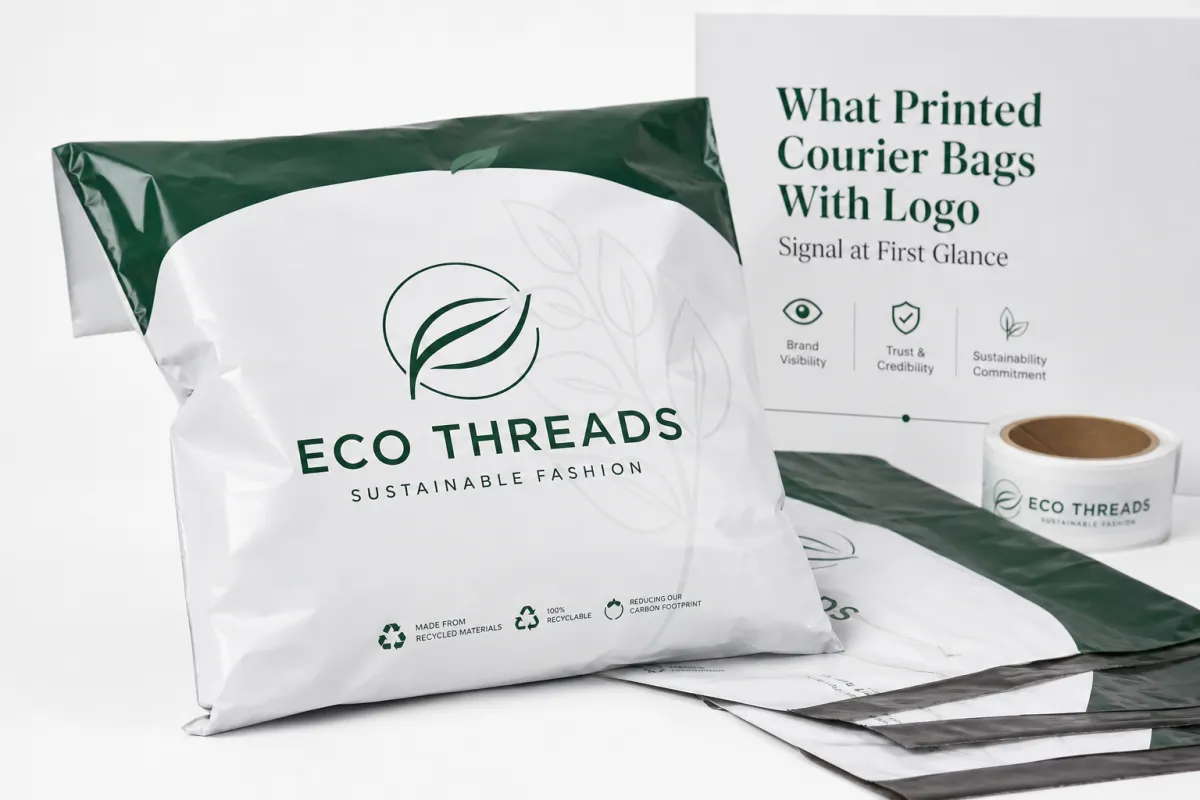
printed courier bags with logo are lightweight shipping mailers or courier envelopes customized with a brand mark, repeated pattern, return details, or a short message. In e-commerce, they usually carry soft goods, apparel, documents, accessories, or small boxed products. In B2B shipping, they often move samples, replacement parts, and promotional kits. The format is simple, but the signal is strong. A branded mailer tells the recipient that the shipment was planned, not improvised.
That matters because the first visible layer of the shipment often sets the tone for the rest of the experience. A plain bag can make a shipment feel generic, even if the product inside is premium. By contrast, printed courier bags with logo create a visual cue that the order came from a company with repeatable processes. Buyers notice that. So do warehouse teams and retail partners. It is a small detail, but small details are what make a brand feel established rather than temporary.
From a packaging buyer's point of view, the best use of printed courier bags with logo is not decorative excess. It is identification, trust, and consistency. Think of the bag as a moving label with a personality. The logo may sit on the front panel, the return address may sit on the flap or back seam, and a repeat pattern may run across the body for extra visibility. Each choice says something slightly different. A large logo says confidence. A restrained mark says restraint and price discipline. A pattern says the brand has invested in packaging as a system, not an afterthought.
There is another practical effect that gets overlooked. Branded Shipping Bags are easier to spot in mixed staging areas, cross-dock facilities, or multi-brand warehouse operations. That can reduce misidentification and speed up hand sorting. It does not make a parcel travel faster on the courier network, but it can make the handoff phases smoother. For businesses shipping thousands of orders a month, that is not a cosmetic benefit. It is an operational one. Once a team gets used to printed courier bags with logo, going back to a completely anonymous outer pack can feel like a step backward.
In practice, the question becomes this: does the bag need to say “premium,” “efficient,” “eco-conscious,” or “high volume and reliable”? The answer shapes everything from film thickness to print coverage. printed courier bags with logo are flexible enough to support all four, but only if the spec matches the message.
How Printed Courier Bags With Logo Work in Shipping
The customer journey for printed courier bags with logo is straightforward, yet every stage puts different demands on the bag. The item is packed, the bag is sealed, the shipment is scanned, the parcel is sorted, the bag is handled multiple times, and then it reaches the end recipient. Branding remains visible through most of that route, while durability is tested every time the bag is lifted, stacked, dropped, or slid across a conveyor.
That is why construction matters so much. The most common formats are polyethylene courier bags, compostable mailers, paper-based mailers, and padded variants. Polyethylene is still the workhorse for many high-volume shipping programs because it is lightweight, tear resistant, and generally cost-effective. Compostable mailers appeal to brands with a sustainability story, though they need careful testing because heat, storage conditions, and supply consistency can vary. Paper-based options can feel more tactile and premium, especially for low-abrasion contents, but they are not always the best answer for moisture exposure. Padded mailers add impact protection, which is useful for small fragile items, but they also raise material cost and postage weight.
Print method changes how printed courier bags with logo are produced. Flexographic printing is common on larger runs because once plates are made, the per-unit economics can work well across thousands of bags. It is especially practical for one-color or limited-color branding, repeated patterns, and high-volume standard sizes. Digital printing is more useful when the artwork is more complex, the quantity is smaller, or the brand wants to test a design before scaling. The trade-off is simple: flexo usually rewards volume and consistency, while digital rewards flexibility and lower setup friction.
For operations teams, the benefit of printed courier bags with logo is not just what the customer sees. Clear branding can help warehouses separate shipments, match return labels to the correct brand, and reduce the chance of a mixed-brand error. If a company ships across multiple sales channels, the outer bag may also need to carry barcodes, QR codes, or return instructions. In that situation, the layout has to be planned so the logo supports the workflow instead of fighting it.
Branded and unbranded packaging behave differently in perception, even when they perform the same in transit. The shipping speed does not change. The courier network does not care about the print. The customer does. That is why printed courier bags with logo often outperform plain bags on perceived professionalism, especially for repeat orders, subscription shipments, influencer seeding, and business samples. It is not about pretending a mailer is luxury packaging. It is about making routine shipping feel intentional.
If the goal is to make the outer pack do real work, not just look tidy, the material and print choice should be evaluated together. A glossy bag with a crisp logo may suit one brand. A matte, low-glare mailer with muted branding may suit another. In both cases, printed courier bags with logo are doing the same core job: carrying the brand from packing table to doorstep without losing the message along the way.
Printed Courier Bags With Logo Cost, Pricing, and MOQ
Cost is where many packaging decisions get real. printed courier bags with logo usually price according to size, material thickness, print colors, number of printed sides, finish, and whether the artwork requires custom plates or special setup. The difference between a one-color logo on a standard poly mailer and a full-wrap printed compostable bag can be meaningful. So can the difference between a stock size and a custom format. Buyers who only look at the headline quote often miss the true landed cost.
A practical way to think about pricing is to separate printed courier bags with logo into three buckets: economy, mid-range, and premium. Economy orders usually use standard-sized polyethylene bags with one-color branding and modest coverage. Mid-range orders add stronger film, more print detail, or a second color. Premium orders may include custom finishes, paper-based substrates, compostable materials, or more elaborate artwork. None of those choices is wrong. They simply serve different margins and different customer expectations.
| Option | Typical MOQ | Approximate Unit Cost | Best For | Main Tradeoff |
|---|---|---|---|---|
| One-color polyethylene mailer | 3,000-10,000 pieces | $0.12-$0.22 | High-volume shipping, price-sensitive programs | Basic look, limited brand expression |
| Two-color printed courier bag | 5,000-10,000 pieces | $0.16-$0.30 | Retail-ready e-commerce, stronger shelf impact | More setup complexity and higher plate cost |
| Compostable mailer with print | 5,000-20,000 pieces | $0.20-$0.42 | Brands with an eco-positioning story | Higher base cost, storage sensitivity |
| Paper-based or padded mailer | 2,500-10,000 pieces | $0.28-$0.55 | Premium presentation, low-abrasion items | Weight, moisture resistance, and cost |
Those figures are not universal. They move with resin markets, paper availability, artwork coverage, freight, and order volume. Still, they are useful for setting expectations. For printed courier bags with logo, the hidden costs usually sit in tooling, sample revisions, freight, and storage. A plate charge might be modest on a large run, but if the design changes later, that cost can repeat. Artwork cleanup can also add time and cost if the source files are not print ready.
MOQ, or minimum order quantity, is another point where reality matters. Smaller quantities usually cost more per bag because setup is spread across fewer units. Higher-volume orders lower the unit price, but they also create inventory risk if the business misreads demand. That is why printed courier bags with logo should be bought with a forecast, not a guess. If the company ships 1,200 parcels a month, ordering 30,000 bags may look efficient on paper and still be a poor decision if the SKU mix changes in two quarters.
Compare quotes carefully. Look for whether the supplier includes artwork prep, tooling, freight, sample approval, and tax in the quoted number. One supplier may appear cheaper on unit price and end up more expensive once the extras are folded in. Another may charge a little more upfront but include the proof cycle and make-ready costs. For printed courier bags with logo, the most useful quote is the one that reflects the full landed picture, not just the print line on a spreadsheet.
One more point gets overlooked: ordering the wrong size or material can be more expensive than paying slightly more for the right one. A bag that is too large wastes film and creates sloppy presentation. A bag that is too light can tear, forcing repacking and replacement. In both cases, the cheapest version of printed courier bags with logo turns into the most expensive after the fact.
Printed Courier Bags With Logo Process and Timeline
The production path for printed courier bags with logo is usually more methodical than buyers expect. It starts with the brief, moves to dieline selection, then artwork setup, proof approval, printing, curing or finishing, quality checks, and final shipment. Each step sounds routine, but a delay at one point can ripple through the rest of the schedule. The fastest orders are usually the ones where the artwork is clean and the spec is already proven.
A typical order often moves through these stages:
- Brief and specification. Confirm size, thickness, print coverage, bag style, seal type, and target quantity.
- Artwork setup. Place the logo on the dieline and check bleed, margins, and barcodes if needed.
- Proof approval. Review a digital proof or physical sample and sign off on color, placement, and text.
- Production. Print, convert, cure, and finish the bags according to the agreed method.
- Inspection and dispatch. Verify carton counts, print accuracy, seal integrity, and packing for freight.
For simple repeat orders, printed courier bags with logo can often move from approved proof to shipment in roughly 10-15 business days if materials are in stock. New artwork, color matching, or custom material requests often stretch that to 15-25 business days. If the order involves compostable film, paper structures, or very large quantities, the timeline can lengthen further. That is not a failure. It is a reflection of setup, materials, and production capacity.
The real pressure points are rarely the press itself. They are usually artwork corrections, plate-making, and material availability. A logo can be technically “ready” and still cause delay if the file is too low resolution, the font is not outlined, or the brand color reference is vague. printed courier bags with logo perform best when the print file is treated like production art, not a social graphic. Vector files are usually safer than raster files, and exact placement on the dieline prevents ugly surprises at press time.
Build in buffer time for sample review, especially if the bags are tied to a launch, promotional campaign, or seasonal push. If a merchant needs branded shipping for a peak period, the safest move is to freeze artwork earlier than feels necessary. A final tweak after proof approval can push the whole run back and raise cost. With printed courier bags with logo, the calendar usually rewards early decisions and punishes late design changes.
The most expensive delay is the one caused by a design sign-off that arrived too late. A clean proof review can save days, and sometimes a whole launch window, when printed courier bags with logo are part of the shipping plan.
There is also a quality angle that matters. If the shipment will move through rough handling, ask whether the supplier can reference transit tests or internal validation methods. For shipping performance, organizations such as ISTA are useful benchmarks for drop, vibration, and compression testing. That does not mean every courier bag needs a lab protocol, but it does mean the packaging discussion should go beyond color and into real transit behavior. The best printed courier bags with logo are the ones that arrive intact after a rough week in the network.
Key Factors That Decide Fit, Function, and Brand Impact
Size comes first. A bag that is too large wastes material, increases movement inside the mailer, and often looks careless. A bag that is too small can split at the seal, wrinkle badly, or create a poor unboxing impression. That is why printed courier bags with logo should be spec'd around the actual SKU mix, not the most optimistic assumptions. If a business ships three product families, the correct answer may be two or three sizes, not one oversized standard.
Seal type matters just as much. Self-seal strips are common because they are quick and consistent on the packing line. Tamper-evident seals add another layer of confidence, especially for sensitive goods or high-value orders. Some brands also want a double adhesive strip so the same bag can work for outbound and returns. Each choice changes how printed courier bags with logo perform in a warehouse and how they are perceived by the end customer.
Material choice is where the business trade-off becomes clearer. Polyethylene films are still popular because they combine strength, flexibility, and price discipline. Paper-based options can feel more tactile, but they need the right coating or structure if moisture exposure is likely. Compostable materials suit a visible sustainability message, although buyers should ask for real documentation rather than accepting broad claims. If the supplier is making a paper-fiber claim, look for chain-of-custody documentation from FSC. If the claim is about post-consumer recovery or recycling behavior, check the local rules and align them with guidance from the EPA.
Artwork strategy is another lever that gets underestimated. A bold logo on a clean background sends a different message from a full-wrap repeat pattern. One says confident minimalism. The other says visual energy. Neither is automatically better. For a subscription brand, repeated branding can create recognition fast. For a premium direct-to-consumer label, a quieter design may feel more considered. The decision should reflect order value, audience, and how often the recipient sees the brand.
There is a compliance and operations side too. Barcode visibility, return labels, and shipping instructions can be more important than decorative elements. If a label needs a matte zone for adhesion, plan for it. If the warehouse uses automated scans, avoid putting the logo exactly where a code must sit. If the package may move through humid or cold conditions, ask how the substrate behaves under those changes. printed courier bags with logo should support the workflow instead of creating one more thing for operations to solve.
Good packaging is rarely the most dramatic option. It is usually the one that fits the item, survives the route, and still looks deliberate when the customer opens the parcel.
The sustainability discussion should stay grounded. A bag is not automatically better because it is described as eco-friendly. A lighter film that uses less material may be a better choice than a heavier alternative, even if the branding is simpler. Recycled content may help, but only if the bag still protects the product. printed courier bags with logo work best when environmental claims, transit performance, and cost all point in the same direction, not when one of them is carrying the whole argument.
Common Mistakes When Ordering Printed Courier Bags With Logo
The first mistake is choosing a bag based on appearance alone. A clean mockup can hide weak seals, poor tear resistance, or a size that does not fit the SKU mix. I see this most often when a business wants the brand to look premium but has not tested the mailer with the actual product weight and shape. printed courier bags with logo should be trialed with real packing samples before the order is locked.
The second mistake is overprinting. Too much text, too many colors, or a cluttered layout can flatten the logo and make the bag look busy instead of premium. A strong brand mark with one or two supporting elements often reads better than a full panel of visual noise. In other words, printed courier bags with logo do not need to shout to be noticed.
Proofing errors are another common problem. Low-resolution artwork, incorrect dimensions, and color expectations that do not match the substrate can create expensive confusion. A blue that looks rich on screen may print differently on a translucent film or uncoated paper. A logo placed without checking the die line may end up too close to the seal or the edge. When printed courier bags with logo are involved, the proof is not a formality. It is the final checkpoint before production starts.
Inventory mistakes are equally common. Some businesses order too few bags for a demand spike and then rush a second order at a higher price. Others overbuy a design that no longer fits the brand after a packaging refresh. Neither outcome is ideal. The smarter move is to tie printed courier bags with logo to a reorder calendar based on seasonal sales patterns, channel growth, and lead time rather than raw hope.
There is also a supplier assumption problem. MOQ, lead time, plate charges, and print quality are not defined the same way across every vendor. One supplier may quote a low unit cost and rely on separate fees for artwork or freight. Another may quote a more complete price but require a larger minimum. If the spec sheet is vague, printed courier bags with logo can become a source of friction instead of a packaging upgrade.
- Test the actual product. Put the item in the proposed mailer and check fit, seal, and handling.
- Check the artwork scale. Make sure logo placement and text legibility hold up at print size.
- Confirm the quote scope. Ask what is included: tooling, freight, samples, and tax.
- Verify the reorder plan. Keep enough lead time to avoid rushed replenishment.
- Ask about substrate behavior. Moisture, cold, and stacking can change how a bag performs.
None of these mistakes is dramatic on its own. Together, they can turn printed courier bags with logo into a recurring procurement headache. That is why a little discipline early on usually pays back in lower waste, fewer packing errors, and better brand consistency later.
Expert Tips and Next Steps for Printed Courier Bags With Logo
The cleanest way to approach printed courier bags with logo is to treat them like a repeatable packaging system, not a one-off design project. Start with a simple audit: which parcel sizes ship most often, which ones are high-value, and which ones deserve branded outer packaging first. The answer is rarely “everything at once.” More often, it is one or two core SKUs that account for the majority of volume.
Request samples from at least two suppliers. That sounds basic, but it is one of the fastest ways to separate a polished sales quote from a bag that actually performs. Compare thickness, print clarity, seal quality, fold consistency, and the feel of the finished mailer in the hand. If the brand relies on a premium unboxing experience, open the samples in a real packing environment, not just at a desk. printed courier bags with logo can look similar on a spec sheet and behave very differently in use.
Create a short internal checklist before placing the order:
- Size: exact dimensions and whether the SKU fits with room for labels.
- Material: polyethylene, compostable film, paper, or padded structure.
- Print colors: one-color, two-color, or full coverage.
- MOQ: the minimum quantity that keeps the unit price workable.
- Delivery date: proof approval deadline and shipment target.
- Artwork status: final file, font outlines, and dieline placement.
A reorder calendar helps more than most teams expect. Sales spikes are often predictable if someone actually looks at the previous 6 to 12 months of demand, promotions, and seasonality. If a brand knows it will need more printed courier bags with logo before a holiday peak or retailer campaign, it should order early enough to avoid a late freight premium and rushed sign-off. That kind of planning sounds small, but it protects both margin and brand presentation.
There is also a strategic question hidden inside every packaging decision: should the logo be bold, restrained, or pattern-driven? For some brands, a large mark on the center panel is the right answer because it creates instant recognition in transit and on doorsteps. For others, a smaller logo with strong material quality communicates more value. Either way, printed courier bags with logo should feel like part of the brand architecture, not a separate procurement task.
If the business ships through multiple channels, the smartest next step is to standardize the outer pack across the channel mix where possible. That keeps replenishment simpler and lowers the chance of stock fragmentation. In that setting, printed courier bags with logo become more than a marketing detail. They become a shipping standard that ties operations, customer perception, and cost control together in one practical format.
FAQ
How much do printed courier bags with logo usually cost?
Pricing usually depends on size, material, number of print colors, and order quantity. Lower quantities tend to cost more per bag because setup and printing are spread across fewer units. For a realistic quote on printed courier bags with logo, ask for an all-in number that includes artwork setup, tooling, freight, and any sample fees.
What is the typical MOQ for printed courier bags with logo?
MOQ varies by supplier and print method, with higher minimums common on custom runs. Standard sizes and one-color prints often have more flexible minimums than fully custom formats. If volume is uncertain, ask for a staged order plan or a few sample quantities before committing to printed courier bags with logo.
How long does production take for printed courier bags with logo?
Timeline depends on artwork approval, print method, and whether the material is in stock. New artwork and complex finishes usually take longer than repeat orders with approved files. Build in extra time for proof review so a late change does not delay the full shipment of printed courier bags with logo.
What artwork format works best for printed courier bags with logo?
Vector files are usually safest because they scale cleanly and preserve sharp logo edges. Suppliers often prefer editable files with outlined fonts and clear color references. Send artwork at the bag's exact dieline if possible so placement issues are caught before print on printed courier bags with logo.
Are printed courier bags with logo recyclable or eco-friendly?
That depends on the base material, ink system, and local recycling rules. Some options use recycled content or recyclable films, while others are chosen for durability first. Ask suppliers for specific material documentation instead of relying on general green claims when evaluating printed courier bags with logo.
For most brands, the real value of printed courier bags with logo is not a flashy first impression. It is the repeatable, measurable effect they have on presentation, sorting, protection, and customer confidence every time an order leaves the dock. If you are choosing a spec now, start with the actual product dimensions, the real shipping route, and the reorder window, then lock the print style around those facts so the bag does its job without surprises.
Related packaging resources
Use these related guides to compare specs, costs, quality checks, and buyer decisions before making the final call.


