Buying a printed Poly Mailer Bags quote for cosmetics usually starts with a practical brief: keep the shipment light, protect the brand presentation, and avoid paying for a carton when the product does not need one. For skincare samples, makeup accessories, and bundled beauty promos, a properly specified poly mailer can move through fulfillment with less weight, less wasted space, and less packaging material than a rigid box.
The real value is not only the mailer itself. It is the way the package works as a branded first touchpoint while also trimming shipping cost and simplifying pack-out. For cosmetics teams handling direct-to-consumer orders, subscription kits, and seasonal launches, that combination can be more useful than a more complicated pack structure that looks premium on paper but slows the line in practice.
Why cosmetics brands switch to printed poly mailers
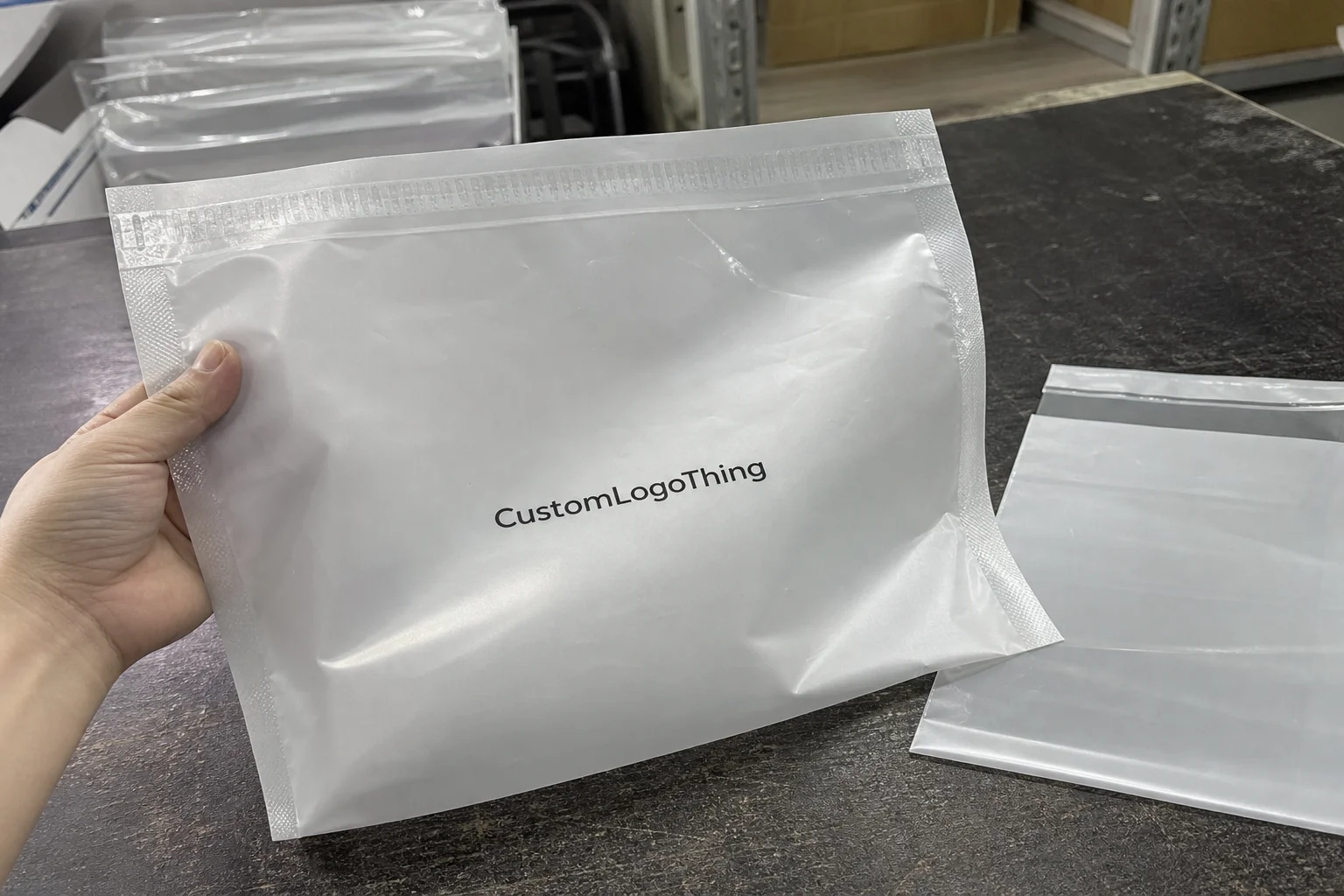
Cosmetics shipments often sit in a narrow range where a carton offers more structure than the product actually needs. A lightweight beauty accessory, a wrapped sample set, or a soft-goods promo bundle can usually ship more efficiently in a flexible mailer. That matters because a smaller package footprint tends to keep postage in check and reduces pressure on storage space in the packing area.
Presentation is the other major reason brands move to custom mailers. A printed mailer gives you a clean branded surface without the cost of a rigid box, inserts, and extra void fill. For many beauty buyers, the package still feels intentional and premium even when the contents are low weight. A clear logo, correct brand color, and straight seal line do a lot of work at the first physical touchpoint.
In day-to-day use, these are the most common applications:
- Skincare samples and trial kits
- Makeup accessories and beauty tools
- Subscription bundles with lightweight contents
- Promo packs for launches and influencer send-outs
- Non-fragile accessories that do not need a box
There is also an operations side that gets overlooked. Poly mailers stack flat, take up far less room than corrugated cartons, and feed quickly on a fulfillment line. If you are shipping volume, those savings in handling and storage can become meaningful over a season. For brands standardizing packaging across several SKUs, one or two mailer sizes can simplify inventory planning as well.
What usually gets missed is that the mailer is part of the customer’s impression of the brand. For cosmetics, it sits close to product photography, labels, and unboxing content, so print quality matters more than people sometimes assume. Color consistency, legible type, and a clean seal all affect how trustworthy the shipment feels when it arrives.
For broader packaging options, you can also review Custom Poly Mailers or browse Custom Packaging Products if you are comparing formats.
Print, material, and finish options that affect performance
The base construction comes first. Most printed mailers are made from co-extruded polyethylene film, often using an LDPE or blended LDPE structure that balances flexibility with puncture resistance. Thicker films generally handle sharper edges, denser bundles, and rougher transport conditions better, while lighter gauges work well for samples and soft contents. A typical buyer will see thickness choices in the range of roughly 50 to 120 microns, depending on the application and supplier capability.
Printing is usually handled with flexographic equipment for repeat production runs. That process is efficient for multi-color branding and larger quantities, but the artwork setup matters a great deal. Fine text, thin lines, and tight registration all need clean file preparation so the plate and press can reproduce the design accurately. If the logo has a narrow stroke or the brand palette depends on exact color recognition, the proof needs close review before approval.
Finish selection changes the look and feel more than many buyers expect. A glossy exterior tends to make colors pop, while a matte surface often reads as quieter and more restrained. Some brands prefer a white exterior for crisp branding, while others use opaque or tinted interiors for privacy and product concealment. If the contents are discreet beauty items or bundled promotional kits, opacity can serve a practical purpose, not just a style preference.
Closure details should be specified early. Most cosmetic mailers use a peel-and-seal adhesive strip, and some buyers prefer a tamper-evident closure for added confidence during transit. For e-commerce returns, a double-adhesive design can make the package more useful, although not every program needs that feature. If returns are rare, a simpler structure is usually easier to source and less expensive to produce.
“For beauty packaging, the right mailer is usually the one that protects the product, holds the print cleanly, and keeps fulfillment moving. Extra features only help when they solve a real operating problem.”
Size planning is another place where experience saves money. A mailer that is too large drives postage up and can make the shipment look loose or wasteful. One that is too tight puts stress on the seal and can damage the presentation during packing. Cosmetics buyers often need room for a retail box, a sample bundle, a padded insert, or a soft item that shifts slightly in transit. That extra tolerance is not waste; it is working room.
For production planning, standards and testing references can help set expectations. Packaging buyers who need transport validation often ask about ASTM or ISTA-related testing, especially if the contents are part of a larger fulfillment program. If sustainability claims matter, review material documentation alongside the quote and compare it against programs referenced by the Packaging Association and guidance from the EPA.
Specifications cosmetics buyers should confirm before ordering
A serious Printed Poly Mailer Bags Quote for cosmetics should be built on measurable inputs, not a vague request. The first specs to lock are bag dimensions, film thickness, print colors, logo placement, and seal type. If the artwork wraps both sides, that should be stated clearly, because full coverage changes both cost and press setup.
Thickness should match the load, not the marketing idea. Lightweight accessories and low-risk samples can often work in thinner film, while bundled sets, sharper-edged items, or heavier contents benefit from a stronger gauge. The wrong thickness is one of the easiest ways to create avoidable damage or a bag that feels flimsy in hand.
Artwork format deserves care too. Vector files are preferred for logos and text because they stay crisp in plate making and printing. If there are small legal lines, tiny product marks, or precise brand colors, the print-ready file should include bleed, safe area, and placement notes. That reduces the chance of proof delays and last-minute corrections.
Finish expectations should be stated clearly as well. A matte-look print can read differently from a high-gloss finish, and the surface changes how color appears under store lighting or phone cameras. Cosmetics brands care about this more than many buyers realize, because the mailer often appears in social content alongside boxes, labels, and product photography.
Flexible packaging also has real-world variation. Poly mailers are made within practical dimensional and gauge tolerances, not rigid carton-style tolerances. That is normal. Buyers should expect small production variation and make sure the filled pack still seals comfortably within the target size.
| Typical mailer choice | Best for | Common thickness range | Price impact |
|---|---|---|---|
| Lightweight stock-size mailer | Samples, accessories, soft bundles | 50–70 microns | Lower unit cost |
| Custom-size printed mailer | Branded launches, standard SKUs | 60–90 microns | Moderate cost, depending on setup |
| Heavier-duty custom mailer | Denser kits, sharper edges, higher handling risk | 80–120 microns | Higher material cost |
One small but useful buying habit is to confirm the packed size, not just the product size. A cosmetic set that looks modest on a spreadsheet can need more room once it includes an insert card, a folded brochure, or a secondary pouch. That is where mismatches happen, and it is usually cheaper to adjust the bag size before production than to discover the problem during pack-out.
Cost, pricing, MOQ, and quote drivers
The price of a cosmetic mailer depends on several moving parts, and the quote should show them clearly. The main drivers are bag size, film thickness, number of print colors, total ink coverage, adhesive style, packaging method, and destination freight. If any one of those changes, the final number can move more than a buyer expects.
Unit cost usually improves as quantity rises because prepress, plate work, and setup are spread across more pieces. That is why a run of 5,000 bags may price very differently from 25,000 or 50,000 bags, even when the same artwork is used. For lower quantities, the setup portion is proportionally heavier, and special print arrangements can push the per-unit number up.
As a planning range, many buyers see custom printed poly mailers for cosmetics land somewhere around $0.18 to $0.45 per unit depending on quantity, size, print coverage, and film spec. That is not a fixed market number, just a useful band for budgeting. If the quote sits far outside that range, ask what is driving it. Often the reason is heavier gauge, full-bleed graphics, low MOQ, or custom sizing.
MOQ is a real consideration. Low-MOQ custom mailers are available for launch runs and seasonal collections, but smaller runs usually carry higher unit pricing because setup costs do not disappear. That is normal. If a brand expects repeat orders, it is smart to ask for several tiers so the pricing curve is visible before the first purchase order is placed.
Here is a simple way to compare quote inputs fairly:
- Same finished size
- Same film thickness
- Same print color count
- Same closure type
- Same packaging and freight assumptions
One practical savings move for cosmetics brands is to standardize one or two mailer sizes across several collections. Instead of designing a different package for every SKU, you can use a small number of formats that cover most orders. That trims storage complexity and often improves pricing because the supplier can repeat the same specs more efficiently.
Pricing can also shift based on how much inspection or special packing is requested. Individually bagged bundles, pallet wrapping requirements, or unusual carton counts can add labor. Those details matter because a cheap unit price can be offset by packaging inefficiency if the freight or handling method is not clearly defined.
If you are ready to talk numbers, the fastest path is to Contact Us with a specification set rather than a general idea. A clear brief gets a cleaner quote and fewer revisions.
Process and timeline from artwork to shipment
The order flow is usually straightforward, but a few steps need attention if you want the timeline to hold. It starts with inquiry and specification review, followed by quotation, artwork checking, proof approval, plate preparation, production, inspection, and shipment. Each step matters, and if one part is missing the schedule tends to slip.
What slows projects down most often? Missing artwork files, unclear Pantone targets, late approvals, or design changes after proofing. Those are the usual culprits. Once a job moves into plate work or press scheduling, changes become more expensive and more disruptive, especially for a launch tied to retail or social timing.
Lead time depends on order size, print complexity, film sourcing, and whether the bag is a standard size or a custom dimension. As a planning range, many custom runs ship in roughly 12 to 15 business days after proof approval, though complex orders or tighter sourcing conditions can extend that. Freight time is separate, so buyers should account for both production and transit when planning replenishment.
Proofing matters more for cosmetics than for many categories because the package often sits beside printed cartons, labels, and photography assets. If the mailer color is off, the brand can look inconsistent even when the product inside is fine. That is why the proof should be checked against other brand packaging, not approved in isolation.
For jobs that require technical validation, testing references can be useful. Many buyers use ISTA methods or similar transit-related checks to understand how a package behaves under handling and distribution conditions. You can review the standards at ISTA if you need a benchmark for distribution testing language.
Inspection is another part that deserves more attention than it usually gets. A good run should be checked for print alignment, color consistency, seal strength, film thickness consistency, and cut accuracy. On flexible packaging, small problems can become big ones if they show up late, because a slit too close to the edge or a weak adhesive zone can affect the whole shipment.
For teams managing multiple launches, it helps to work backward from the ship date and build in time for proof review. A rushed approval often costs more than it saves, especially if the order includes special artwork or a finish that needs a visual check under different lighting. A few extra days at the proof stage can prevent a missed replenishment window later.
How to compare supplier capability beyond the price tag
A good quote is only useful if the supplier can deliver the same result again on repeat orders. That means checking print clarity, seal strength, consistency across the run, and how well the supplier handles reorders. A cheap first order that cannot be repeated cleanly is not really cheap.
Technical responsiveness matters more than many buyers expect. The right packaging partner should help refine sizing, point out artwork problems, and flag risk before production starts. If the supplier simply repeats whatever is written without asking sensible questions, that is not a strong sign. Cosmetics packaging benefits from a supplier who understands both presentation and transit realities.
Documentation and sampling support are also useful indicators. A supplier that can provide clear spec sheets, proofing steps, and straightforward communication will usually save you time when the order gets busy. That is especially helpful if your packaging team is balancing several SKUs, different launch dates, and promotional shipments at once.
Pay attention to how the supplier talks about quality control. The better answer is not “perfect every time.” The better answer is a description of print checks, gauge control, seal inspection, and how the run is handled when a variation appears. That is what real production looks like.
Another sign of capability is how well the supplier handles reorder consistency. With printed film, repeatability depends on keeping plates, ink references, and approved artwork records aligned. If those records are not managed carefully, the second order can drift from the first. For cosmetics branding, that drift is visible quickly.
The best supplier is the one that balances cost, quality, and reliability. A low nominal quote means very little if the bags arrive late, the color is off, or the seal fails in transit. That is why cosmetic brands should compare more than price when reviewing a printed Poly Mailer Bags quote for cosmetics.
Next steps for a faster, more accurate order
To get a cleaner printed Poly Mailer Bags quote for cosmetics, gather the essentials before you send an inquiry: finished bag size, estimated quantity, artwork file, target ship date, and any special preference for closure or finish. If you already know the product dimensions, even better. That lets the bag size be checked against the actual packed item instead of guessed from a spreadsheet.
If you are unsure about sizing, send a sample pack photo or list the packed contents. A good supplier can usually spot whether the mailer should be sized for a retail box, a sample bundle, or a soft-goods pack with extra tolerance. That small step can prevent a size mismatch that costs money later.
Ask for side-by-side pricing at two or three quantities if you expect repeat orders. Sometimes the difference between 5,000 and 10,000 pieces is enough to justify a larger first run, especially when the artwork and setup are already fixed. The same idea applies to thickness: a slightly heavier film may save you money in damage reduction or customer service issues, even if the unit price is a bit higher.
My practical advice is simple: approve one spec set, confirm the artwork, and lock the production window before launch or restock. That keeps the order moving and avoids the back-and-forth that tends to stretch timelines.
If your spec sheet is ready, send it in and request a printed Poly Mailer Bags quote for cosmetics. Once the dimensions, artwork, and quantity are set, pricing and timing can usually be finalized faster than most buyers expect.
FAQ
What size printed poly mailer bag is best for cosmetics shipments?
Choose the finished size based on the actual packed item, not the retail SKU alone. Allow room for any inner box, insert, or sample bundle so the mailer closes cleanly without strain. For mixed cosmetics sets, it is often smarter to standardize one mailer size for several pack configurations.
How does print coverage affect a poly mailer quote for beauty brands?
More ink coverage usually increases cost because it adds print complexity and material usage. Multi-color logos, full-bleed backgrounds, and tight registration can require more setup than a simple one-color mark. The final quote should reflect the same print area, color count, and finish assumptions for fair comparison.
Can I order low MOQ custom mailers for a cosmetics launch?
Yes, low-MOQ options are often available for launch runs or seasonal campaigns. Per-unit pricing is typically higher at smaller volumes because setup costs are spread across fewer bags. If you expect repeat orders, ask for pricing at several tiers to see where unit cost improves.
What artwork files are needed for printed poly mailer bags?
Vector artwork is preferred for logos and text because it stays crisp during plate making and printing. Color references should be provided clearly, especially if brand colors must match other cosmetics packaging. A print-ready file with bleed, safe areas, and exact placement notes reduces proof delays.
How long does production usually take after artwork approval?
Lead time depends on quantity, print complexity, and whether the bag size is standard or custom. Artwork approval, plate preparation, and production scheduling all affect the final ship date. Freight time is separate from production time, so both should be included when planning a launch or restock.


