Buyer Fit Snapshot
| Best fit | Printed Pouch Bags with Cmyk projects where brand print, material claims, artwork control, MOQ, and repeat-order consistency need to be specified before quoting. |
|---|---|
| Quote inputs | Share finished size, material target, print colors, finish, packing count, annual reorder estimate, ship-to region, and any compliance wording. |
| Proofing check | Approve dieline scale, logo placement, barcode or warning zones, color tolerance, closure strength, and carton packing before bulk production. |
| Main risk | Vague material claims, crowded artwork, missing packing details, or unclear freight terms can make a low unit price expensive after revisions. |
Fast answer: Printed Pouch Bags with Cmyk: Film, Print, MOQ, and Carton Packing should be specified like a repeatable production item. The safest quote records material, print method, finish, artwork proof, packing count, and reorder notes in one written spec.
Production checks before approval
Compare the actual filled-product size with the drawing, then confirm tolerance on folds, seals, hang holes, label areas, and retail display edges. Reserve space for logos, QR codes, warning copy, and material claims before decorative graphics fill the panel.
Quote comparison points
Review material grade, print process, finish, sampling route, tooling charges, carton quantity, and freight assumptions side by side. A quote is only useful when the supplier can repeat the same color, closure quality, and packing count on the next order.
Printed Pouch Bags with CMYK can look sharp on a monitor and still land a little flatter, warmer, or darker once the artwork moves onto film, laminate, and a real warehouse shelf. That mismatch catches a lot of buyers off guard. The proof looked fine. The shipment arrives. The blue feels duller than expected, and suddenly everyone has an opinion.
The short version: printed pouch bags with CMYK use cyan, magenta, yellow, and black process inks instead of a separate spot color for every shade. That matters because the print method affects how a pouch reads on shelf, how repeat orders match, and how much room a procurement team has to balance color, lead time, and unit cost. A small shift can snowball into rework, longer approvals, and awkward conversations about why the second run does not look quite like the first.
From a packaging buyer’s angle, CMYK is attractive because it handles photos, gradients, and busy layouts without a custom ink setup for every hue. That makes it practical for short and medium runs. The tradeoff is straightforward. Four-color process printing can move a little depending on substrate, coating, and press conditions. Plan for that early and the result is usually clean. Ignore it and you end up debating a color that is technically acceptable and still wrong next to the previous batch. Packaging has a way of doing that.
What Printed Pouch Bags with CMYK Mean
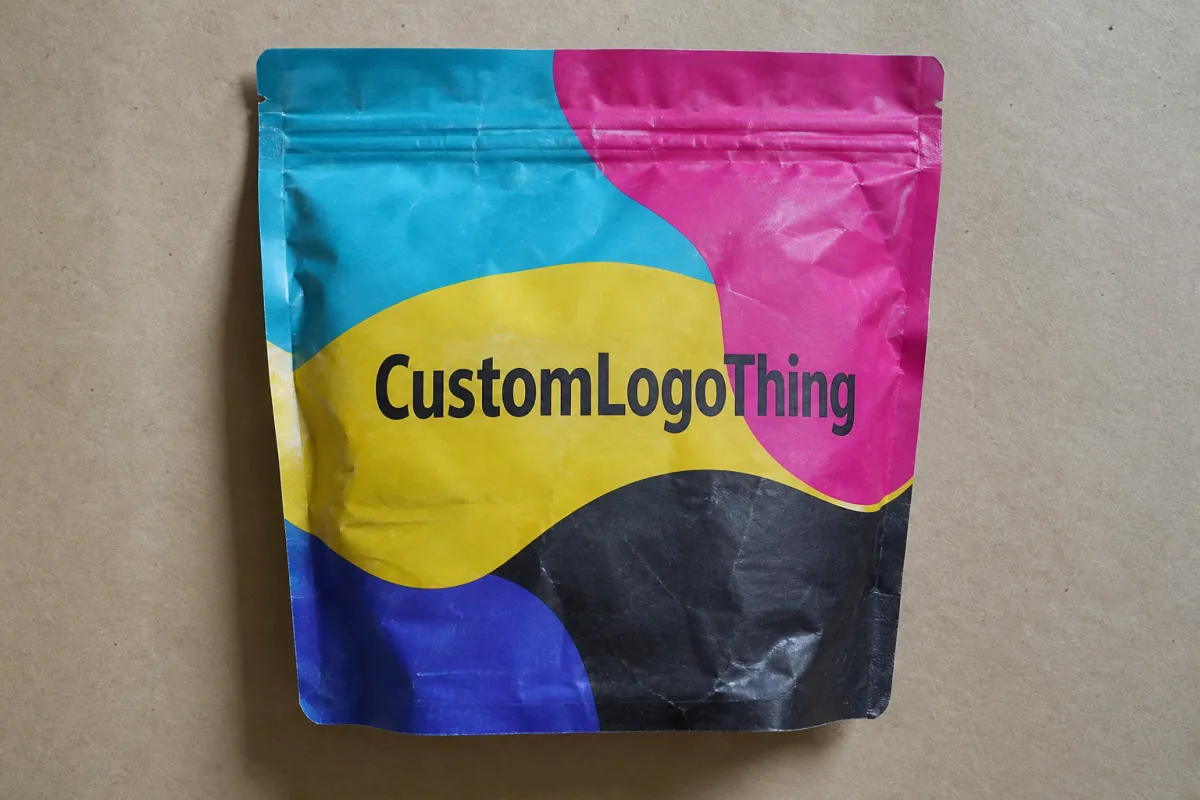
At the simplest level, printed pouch bags with CMYK are flexible pouches printed with four process inks that blend visually into the colors you see on the package. Rather than mixing a separate ink for every brand color, the artwork is separated into cyan, magenta, yellow, and black layers, then reproduced as tiny dots across the pouch surface. Your eye blends those dots at normal viewing distance. That is why a photograph, a gradient, or a detailed background can be printed at all.
That sounds tidy, but packaging is not a flat poster. The pouch changes the result. A white film gives more brightness and contrast. A clear film can mute pale colors. Metallic and kraft-style structures behave differently again because the base material becomes part of the visual outcome. The same file can look sharp on one substrate and denser on another, even if nothing in the artwork changes. Buyers who have spent time with carton printing sometimes expect the same behavior. It is not the same beast. Flexible packaging has its own rules.
CMYK matters in logistics and retail because consistency drives recognition. Shelf presence depends on repetition. If the blue panel on a protein pouch looks different from one reorder to the next, the package starts to feel inconsistent even when the product inside has not changed. Procurement teams care about that. A stable color match helps a brand reorder with confidence and keeps SKU families aligned across sizes, flavors, and seasonal editions.
There is also a budget angle. Spot color printing can be the right answer for a strict brand color or a simple logo, but it usually adds setup complexity. CMYK often gives more design flexibility with fewer ink stations or fewer setup changes, which helps when artwork changes often or when a company is testing multiple variants. If a brand color has to land within a tight tolerance, a spot color may still be the better choice for the main brand field, with CMYK handling images and secondary graphics.
Packaging reality check: a proof that looks right on a monitor can still miss the shelf if the pouch material, white ink plan, or finish changes between proof and production.
For brands with mixed channels, CMYK pouch printing supports a practical launch rhythm. A startup may begin with digital printing for a small order, then move to flexographic printing as demand settles. A larger brand may keep CMYK artwork for graphics and add a spot color only where the logo needs to stay locked. That mix works because it balances visual flexibility with commercial control. Nothing glamorous. Just sensible packaging work.
How CMYK Printing Works on Pouch Bags
CMYK pouch production starts long before ink reaches the film. The artwork is prepared in a color-managed file, then separated into four channels that the printer can reproduce on press. Each channel contributes a portion of the final image, and the final look depends on how the dots overlap, how dense they are, and how the substrate receives them. A small design detail, like a thin line in a logo, can print cleanly on one structure and soften on another if trap, dot gain, or ink laydown is not handled properly.
That conversion is why designers should not treat a pouch like a screen graphic. Monitors use light. Ink absorbs and reflects light. A design that looks bright on a backlit display may need more contrast in print, especially on matte film or natural kraft structures. White ink adds another layer. If the pouch is clear or metallized, a white underprint may sit beneath the CMYK layers to keep colors from turning translucent or muddy. Without that base, the artwork can look thin and washed out.
Surface finish changes the result again. A gloss laminate can make the same CMYK layout feel brighter and more saturated. Matte softens the appearance and cuts glare, which helps on retail shelves but can flatten the color a bit. Soft-touch laminate adds a premium feel, though it can shift the visual temperature of the artwork. Those are not defects. They are material behaviors. Good print finishing is not just about touch. It is part of the color plan.
Different production methods handle CMYK in different ways. Digital printing is often the easiest route for short runs and versioned artwork because there are fewer setup steps. Flexographic printing is a workhorse for larger pouch volumes and steady reorders. Rotogravure is usually reserved for very large, stable programs because the cylinder investment only makes sense when volume is high and artwork changes are limited. Flexible pouches generally need film-compatible processes rather than an offset mindset, which is why packaging teams should compare print methods carefully instead of assuming one category behaves like another.
Proofing is where this becomes useful for shipping and procurement teams. A flat PDF is not enough to sign off on a retail package that will be stacked, packed, and handled across multiple nodes. A good supplier should provide printed or digital proofs, material confirmation, and a clear explanation of how the final pouch will be built. Industry groups such as the Institute of Packaging Professionals (IoPP) tend to make the same point from another angle: packaging is a system, not just a print file. The artwork, film, seal structure, and distribution environment all affect each other.
Key Factors That Affect Print Quality and Supply Chain Fit
Color accuracy starts with the substrate. A white, clear, metallic, or kraft-look pouch can make CMYK behave differently. The printer can control a lot, but the base material still changes brightness, contrast, and saturation. If the brand color sits on silver film, it will usually feel deeper and richer. On a paper-based look, the same color may feel warmer and less clinical. That may be exactly the right effect, but it should be a decision, not a surprise.
Artwork complexity matters just as much. Tiny nutrition panels, QR codes, lot codes, and warning text all fight for space on a pouch panel that may be only a few inches wide. A design that looks roomy on a digital comp can feel crowded once seals, zipper headers, and tear notches are in place. Legibility is usually the first casualty. A clean package is not always a minimal package. It is one where the regulatory and operational details still read after converting trims the usable area.
Durability is the next filter. Pouches do not live gently. They move through pallets, cartons, warehouse racks, distribution centers, and retail replenishment cycles. Scuff resistance, moisture exposure, and abrasion all matter. If the pouch is going into chilled storage or humid lanes, buyers should ask how the print and laminate behave after transit. A package that looks strong on a sample table can start wearing out after a few days in a hot trailer or a damp backroom. That is not dramatic. It is just reality.
The supply chain fit should also include environmental conditions. Pouches traveling through hot or humid routes can show more variation in seal strength, ink appearance, and laminate performance than a package that stays in a climate-controlled lane. That is one reason some companies use supply chain testing similar to the methods referenced by ISTA. They are not testing color alone. They are testing whether the package survives the route without deformation, scuffing, or seal failure.
Brand consistency across multiple SKUs is another practical issue. One pouch may be a 50g trial size, another a 1kg refill, and a third a club-store format with a much larger front panel. If those packages do not share the same visual grammar, the range looks fractured. Good CMYK art direction helps build a family look across different sizes even when the print area changes. That usually means repeating a few brand cues: a border shape, a logo position, a signature color block, or a photographic style that scales cleanly.
Sustainability adds one more layer. Recycled or compostable films can be solid choices, but they may print differently from conventional laminates. Some eco-oriented structures are a little softer in tone, and that can lower perceived color intensity. If a pouch uses a paper outer layer, the printer may also need to think differently about fiber sourcing and finish compatibility. In paper-based supply chains, certifications such as FSC can help buyers validate material claims, especially when the packaging includes a paper component or a matching paperboard shipper.
Cost, Pricing, MOQ, and Quote Basics for CMYK Pouches
Price for printed pouch bags with CMYK is shaped by more variables than many buyers expect. Bag size is one. Film construction is another. Add closure style, window cuts, matte or gloss finish, registration sensitivity, and print coverage, and the quote can move quickly. A pouch with dense full-bleed graphics and a zipper is not priced the same way as a plain pouch with light coverage and no extra features.
Minimum order quantity affects unit cost directly. Setup work has to be spread across the run, and the lower the quantity, the more each pouch absorbs that burden. That is why a first run can feel expensive compared with a reorder. It is also why short-run digital printing is popular for trials and seasonal launches, while flexographic printing becomes more economical as volumes rise. A buyer should ask not just what the unit price is, but how that price changes at 1,000, 5,000, and 10,000 pieces. That comparison tells a much better story than one quote line ever will.
Quotes should be read with a sharp eye. A good quote usually includes prepress checks, proofing, material spec, print method, packaging of the finished goods, and freight assumptions. If cylinders or plates are needed, those should be visible too. If color matching is discussed, the tolerance should be written in plain language. If the supplier says the job is quoted ex-works, shipping is your problem. If it is quoted delivered, the details still matter: what route, what packaging, what timing, and what happens if transit changes.
| Print Option | Typical Setup Cost Profile | Typical Unit Cost Behavior | Best Fit | Watch-Out |
|---|---|---|---|---|
| Digital printing | Lower setup, faster start | Higher per unit at scale | Small orders, test launches, multi-SKU runs | Can get expensive on large reorders |
| Flexographic printing | Moderate setup with plates and press prep | Usually drops well as volume rises | Steady demand, repeat SKUs, larger runs | Setup changes can slow revisions |
| Rotogravure | Higher cylinder investment | Strong at very large volume | Long runs with stable artwork | Less forgiving when designs change often |
For rough planning, many buyers see smaller CMYK pouch runs land somewhere around $0.18 to $0.45 per unit depending on size, coverage, and finish, while larger volumes can drop once setup is spread across more bags. That range is not universal. A simple matte pouch is not the same job as a high-coverage metallic pouch with a zipper and a custom window. Still, it is useful because it reminds teams that the cheapest quote is not always the lowest landed cost. Cheap quotes love hiding in the fine print.
Hidden costs show up fast. Samples, freight, customs handling if production is overseas, and rework caused by color approvals can all affect the final number. If a quote looks unusually low, check what is excluded. The missing items are often the ones procurement will need later. That is why a good buying brief should state size, substrate, finish, order volume, expected repeat frequency, and whether Pantone references are being used alongside CMYK.
Process, Timeline, and Lead Time for CMYK Pouch Orders
The production sequence is usually more predictable than a first-time buyer expects. It starts with artwork prep, then file review, then proofing. After that comes material confirmation, press setup, converting, packing, and shipment. Each step has its own failure point. A file can pass initial review and still need corrections because the barcode is too small, the bleeds are wrong, or the dieline is not aligned with the intended seal structure.
Most delays happen before press time. Proof revisions are the usual culprit. A buyer may request a wording change after seeing the first layout, or a legal team may ask for a nutrition panel adjustment after the proof is already built. Those changes can look tiny and eat a week of schedule. One extra day on a proof round can turn into several once the supplier has to rebuild multiple components.
Lead time depends heavily on whether the order is a repeat or a new launch. Repeat jobs move faster because the supplier already has the art, the material, and the process settings in hand. New jobs require more checking. If the pouch includes custom structures, specialty laminates, or regulated label content, the timeline stretches further. A realistic range for a straightforward repeat order may be about 10 to 15 business days after approval, while a first-time custom run can take longer, especially if samples and revisions are involved.
Shipping schedules can matter just as much as production schedules. A pouch may leave the plant on time and still miss a launch if the warehouse is not ready to receive it. That is why teams should map the full path: production, transit, customs if relevant, receiving, and storage. If the product is going to a co-packer or a fulfillment center, make sure those windows are booked before the bags ship. A perfect package sitting outside a locked dock is still a problem.
One habit saves a lot of pain: tie approval dates to launch dates. Do not wait to “see how the proof looks” before deciding when the item must arrive. Work backward. If the launch is fixed, the proof deadline is fixed too. That discipline prevents the most common packaging delay, which is not a factory failure but approval drift.
Common Mistakes When Ordering Printed Pouch Bags with CMYK
The biggest file mistake is still painfully basic: designing in RGB and hoping the printer can sort it out later. RGB files are built for screens, not for process printing on film. That mismatch often leads to color shifts, especially in bright reds, electric blues, and deep greens. A file can look rich in software and then print more muted than expected. The fix is simple, but it has to happen early. Build the artwork in CMYK from the start, and keep an eye on image resolution so photographs do not soften in print.
Another common error is ignoring substrate color. A white pouch and a kraft-look pouch are not interchangeable surfaces. If the same artwork is moved between them without adjustment, the color can swing dramatically. Clear films add another twist because the background can show through. Designers who have spent most of their time with label stock or carton board sometimes underestimate that effect. Flexible packaging behaves less like paper and more like a layered build.
Skipping proofs is a fast way to create expensive conversations later. A digital mockup is useful, but it is not proof of final behavior. The exact pouch material, ink coverage, and finish need to be part of the approval. If the supplier says the previous job will match automatically, ask for confirmation that the structure is identical. A prior run on a different laminate does not guarantee the same result. Small shifts in film, coating, or press conditions can move color enough to matter on shelf.
Brands also overfill the panel with text. It is tempting to place every claim, certification, storage instruction, ingredient line, and campaign line on the pouch because the package feels like free advertising space. In reality, small copy loses power fast. Once the pouch is formed and filled, a dense layout may be hard to read from a retail peg or shipping carton. A cleaner hierarchy usually wins: logo first, product name second, key benefit third, regulatory copy where required, and extra details only if they remain readable at distance.
A vague brief is another hidden risk. Saying “make it match our brand color” without defining the material, tolerance, proof method, or reference standard invites disagreement later. Buyers should be specific about finish, acceptable variation, sample approval method, and whether a spot color is being held for the logo while CMYK handles images. The more exact the brief, the fewer debates at the end of production.
Here is the trap many teams miss: they assume print accuracy is the only issue, but packaging problems often start with communication gaps.
- Do not approve artwork before confirming the actual pouch structure.
- Do not assume matte and gloss will read the same.
- Do not use a monitor as the color standard.
- Do not leave barcode and legal text placement until the last revision.
- Do not compare two jobs unless the substrate and print method truly match.
Expert Tips and Next Steps for Better Results
The strongest CMYK pouch jobs usually start with a tight brief. Confirm size, substrate, finish, artwork format, Pantone expectations, barcode placement, and order volume before asking for quotes or samples. That sounds obvious because it is obvious. Still, it saves a great deal of back-and-forth. A supplier can only price accurately if the spec is real. A buyer can only compare quotes if the suppliers are quoting the same structure.
Ask for proofs that approximate real packaging conditions. A screen mockup can help with layout, but a printed or digital proof on the intended material gives a much better read on color and contrast. If the pouch is supposed to feel premium, test the actual finish. If the package needs to survive transport, ask how the supplier handles scuff resistance and post-print protection. The point is not to chase perfection in a lab. It is to reduce surprises once the product moves through the supply chain.
It also helps to keep a master reference pouch. Once the first production run is approved, retain one sample as the color and finish reference for future reorders. That makes drift easier to spot. If the next run looks off, there is a physical standard to compare against instead of a memory of what “should” have happened. Memory is a lousy quality control tool.
A practical workflow usually looks like this:
- Review the pouch spec and define the print method.
- Send artwork in CMYK with correct bleeds and resolution.
- Request a quote that includes proofing, material, and freight assumptions.
- Approve a sample or proof on the actual pouch structure.
- Schedule production around the launch or replenishment date.
When sustainability is part of the brief, make the material question explicit. If the pouch has paper content, ask whether FSC-certified fiber is available. If the package is supposed to support a lower-waste claim, ask how the laminate and seal structure affect recyclability or compostability claims. Those claims need to be precise. Guessing is a bad plan, and packaging statements tend to travel far beyond the original design meeting.
For teams juggling multiple SKUs, the smartest move is usually to standardize what can be standardized. Keep the same base structure where possible. Use the same proofing method. Hold the same tolerance language across suppliers. The result is not just cleaner art; it is cleaner purchasing. Less friction. Fewer disputes. Better reorder behavior.
Frequently Asked Questions
Are printed pouch bags with CMYK good for small orders?
Yes. They are often a strong fit for smaller or mixed-SKU orders because CMYK can reproduce detailed artwork without requiring a separate spot color for every design. That makes launch quantities and test runs easier to manage. The real question is whether the supplier’s minimum order quantity and setup charges make the first run more expensive than the reorder.
How close will CMYK pouch printing match my screen color?
It will usually be close, but not exact. Screens use light, while printed pouches use ink on film, and the substrate changes the final look again. For better control, ask for a proof on the actual pouch material and define acceptable color variation before production starts. That is the most practical way to avoid arguments later.
What affects the unit cost of printed pouch bags with CMYK?
Unit cost is driven by pouch size, material, print coverage, finish, and order quantity, with larger runs typically lowering the per-bag price. Freight, proofing, and custom features such as resealable zippers or windows can also shift the landed cost. If one quote is much lower than the others, check what it leaves out.
What file format is best for CMYK pouch artwork?
Vector formats like AI, PDF, or EPS are usually preferred for logos and text, while linked images should be high resolution and embedded correctly. The artwork should be built in CMYK, not RGB, so the printer can evaluate the color separation before output. That simple step prevents a lot of avoidable print surprises.
How long do printed pouch bags with CMYK usually take to produce?
Lead time depends on proof approval, materials, order size, and whether the job is a repeat or a first-time custom run. A straightforward reorder usually moves faster than a new launch, so it is smart to build time for revisions, sampling, and freight into the schedule. For most brands, printed pouch bags with CMYK are worth that extra planning because they keep color control, budget, and delivery timing in balance.
Takeaway: If you want printed pouch bags with CMYK to land well in production, lock the pouch structure, substrate, finish, and proof method before you approve artwork. That one move solves most of the expensive surprises later, and it gives you a cleaner repeat when the next order comes around.
Related packaging resources
Use these related guides to compare specs, costs, quality checks, and buyer decisions before making the final call.


