Private Label Buyer OPP Header Bags Production Quality Checklist
A private label buyer OPP Header Bags production quality checklist should start with structure, not graphics. The artwork can be perfect and the pack can still fail on shelf if the header drifts, the hang hole is off-center, or the seal line wanders enough to make the bag hang crooked. Those faults are small on paper. In a retail bay, they read as inconsistency.
Header bags punish vague specs because several parts of the package have to work together. The film needs to stay clear, the header needs to stay stiff, the opening has to be practical for packing, and the final unit has to hang cleanly on the fixture it will actually meet in store. If any of those variables is left unmeasured, the buyer ends up comparing samples that look similar but behave differently.
"A clean proof does not guarantee a clean run. Hole placement, seal width, and carton count have to be controlled if the shelf result is going to match the mockup."
The most expensive mistakes rarely show up as dramatic defects. They show up as tiny losses: extra scrap at packing, slower line speed, a few cartons rejected at receiving, or a reorder that no longer matches the first run. That is why a procurement-minded checklist matters more than a design brief. It gives the buyer a way to judge repeatability, not just appearance.
Why Header Bag Failures Start Before Printing
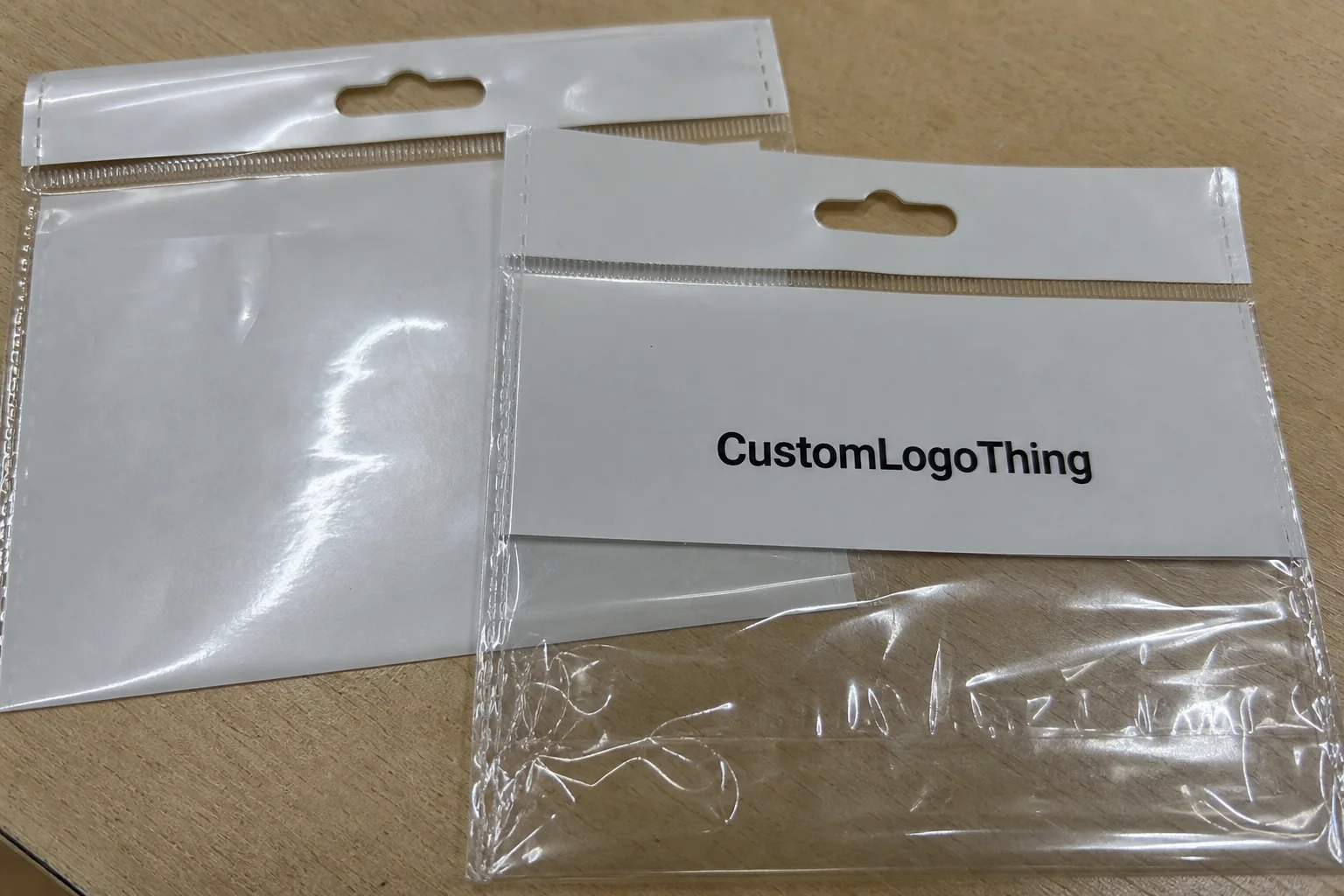
Most complaints about header bags get blamed on print quality because print is the easiest thing to see. The deeper issue often begins earlier. If the film gauge varies, the header fold is inconsistent, or the die-cut drifts even slightly, the package can look unstable before it is filled. A few millimeters can change the way the bag hangs, stacks, and survives handling.
Retail presentation is unforgiving. A hole that sits a little high can make the bag tilt forward. A seal that runs unevenly can create a taper. A top edge that is not square makes the whole pack look cheaper, even when the artwork is excellent. Buyers may not describe the problem in those terms, but they notice it immediately.
That is why the private label buyer OPP Header Bags production quality checklist should open with structural questions. Ask the supplier how they control incoming film, cut accuracy, header position, and seal stability. Then compare that process to their answers about artwork and color. If the supplier only discusses the print file and ignores the line behavior, the quote is incomplete.
If the program also includes label or tag components, align those specs early so the shelf set looks like one system rather than separate pieces assembled later. For coordinated print collateral, buyers often keep the same approval rhythm across the bag and Custom Labels & Tags.
What To Verify In OPP Film, Header Design, And Retail Presentation
Start with the film. OPP, or oriented polypropylene, is used because it is light, clear, and clean-looking under retail lighting. The point is visibility. The product has to remain easy to see, but the film also has to protect against dust, scuffing, and handling marks during freight and stocking. For lighter goods, buyers often see films in the 30 to 40 micron range. Heavier packs or harsher distribution routes usually move toward 40 to 50 micron, sometimes more if the product is sharp-edged or the package has to survive extended handling.
The header deserves equal attention. Buyers should confirm header height, fold style, reinforcement, hang-hole shape, and hole placement. A 25 mm header can work for simple pegged displays, but a wider header may offer better branding space and more stiffness. The tradeoff is straightforward: more material, more cost, and more chance for waste if the manufacturer cannot hold alignment on repeat runs.
Think about the end use before you approve a spec. An accessory pack, an apparel bundle, and a hardware refill pack do not need identical presentation logic. Counter display favors visibility and easy access. Pegged display needs precise hole location. Shipping protection needs seal strength and stiffness. One generic sheet is rarely enough to cover all three without compromise.
There is also a visual hierarchy problem that buyers sometimes miss. The package should support the product, not compete with it. Too much print coverage can make the pack feel crowded. Too little header space can bury the brand mark. Film that is too cloudy can erase the clean retail look that makes OPP useful in the first place. The buyer’s job is to keep the package readable at a glance while still protecting the item inside.
- Check film clarity against the actual product, not only a white proof.
- Confirm header height and whether it leaves enough room for branding.
- Verify hole placement against the peg hook style used in the store.
- Ask about reinforcement if the pack carries a heavier item or ships far.
- Review opening style so packing teams can fill the bag without slowing the line.
If cartons, inserts, or printed shippers sit in the same program, ask for sourcing documentation before approval. Paper-based components may need FSC-backed sourcing records, while the bag itself may not. For the buyer, the lesson is simple: retail presentation is a system, and one weak part can distort the whole.
Quality Checklist For Gauge, Seal Strength, Print, And Die-Cut Accuracy
This is the section that usually saves the most money. Buyers need measurable acceptance criteria, not broad promises. Ask for film gauge tolerance, width and length tolerance, seal width, seal uniformity, hang-hole position, and carton pack count. If the supplier cannot put numbers behind those points, the quote is not ready for procurement review.
For print, the checklist should cover color match, registration, barcode legibility, text sharpness, and ink rub resistance. If the bag carries a UPC or QR code, scan it before approval. Retail packaging has to survive touch, friction, and handling in transit. A proof that looks right on screen can still fail once an operator packs, stacks, or bins it.
Seal performance matters just as much. Ask about burst resistance, edge curl, and seal consistency across the width of the bag. If the seal is too narrow or too hot, the film can distort. If it is too weak, the package opens during freight. For products that move through multiple handling points, some teams adapt ISTA-style transit checks so the sample is not judged only by appearance.
Dimensional control is where many private label programs slip. A header that is skewed by a few millimeters can make the pack tilt on a peg. A die-cut that drifts can create feeding problems on automated lines. A film roll that varies in thickness can change stiffness from one lot to the next. Those are not cosmetic problems. They are production stability problems, and they become expensive fast.
A practical checklist should be specific enough that a QC tech can use it at receiving and a buyer can use it during sample approval. It should also reflect the realities of the packing line. If the product is packed manually, opening behavior matters. If the product is inserted by machine, edge consistency matters more. If the item is sharp, the film gauge and seal strength have to be higher from the start.
- First article sample: confirm the supplier can hit the spec once.
- Production sample: confirm the line can hold the spec during a real run.
- Retained master sample: keep one approved piece for reorder comparison.
- Final carton audit: verify count, label accuracy, and packing condition before release.
Buyers who want fewer surprises should insist on documented tolerances and a signed approval chain. That is the practical value of the private label buyer OPP Header Bags production quality checklist: it turns a vague packaging conversation into a repeatable decision tool.
Cost, Pricing, MOQ, And Unit Cost Drivers For Custom Orders
Pricing is rarely one number. It is a stack of decisions. Film grade, bag size, header reinforcement, print colors, tooling, sample fees, pack-out method, and manual handling all affect the final cost. A buyer who only compares unit price is missing half the economics.
MOQ changes the math quickly. A lower minimum can look attractive, but if setup cost is spread across too few units, the unit price rises fast. That is why a 3,000-piece order can feel expensive next to a 10,000-piece order, even when the supplier’s setup fee looks modest. Fixed cost matters more than the headline number.
For directional planning, buyers often see simple clear or lightly printed OPP header bags around $0.08 to $0.14 per unit at 5,000 to 10,000 pieces. More involved print or reinforcement can move to $0.12 to $0.20. Heavier graphics, tighter dimensional control, or more manual handling can land around $0.18 to $0.32. Tooling or plate charges often add $80 to $250 per color, and late artwork changes can push that higher.
Compare every quote on the same basis. Ask for unit price, tooling, sample fees, carton configuration, freight terms, and any charge tied to art revisions. The cheapest line item is not the lowest landed cost if it creates waste, rework, or a receiving rejection. Buyers who ignore that usually pay twice.
There is also a hidden cost in inconsistency. If the first batch is cheap but the second batch needs reapproval, re-sampling, or rework, the procurement team has not saved money. It has simply pushed cost into a later month. That is why a clean checklist is not bureaucracy. It is a way to keep the true cost visible.
| Order Profile | Typical MOQ | Unit Price Range | Setup/Tooling | Best Fit |
|---|---|---|---|---|
| Clear unprinted header bag | 3,000-5,000 pcs | $0.06-$0.12 | Low to moderate | Basic retail protection and fast replenishment |
| 1-color custom print | 5,000-10,000 pcs | $0.10-$0.18 | Moderate | Private label SKUs that need visible branding |
| 2-color print with reinforced header | 10,000+ pcs | $0.18-$0.32 | Higher | Retail programs with stricter display and durability needs |
A useful rule: if a supplier cannot explain each cost driver in plain terms, the quote is not procurement-ready. That applies to header bags and to adjacent packaging items such as Custom Labels & Tags that have to stay consistent across the same private label program.
Production Steps, Lead Time, And Approval Gates From Proof To PO
The production path should be explicit from the start. Begin with spec confirmation, then dieline review, proofing, sample approval, pre-production setup, the full run, QC, packing, and dispatch. If any of those gates are fuzzy, lead time slips. The most common delays come from missing artwork files, unclear tolerances, slow proof approval, or late decisions on pack count and carton labeling.
For planning, many custom runs move in about 12 to 15 business days after proof approval if the order is straightforward and the supplier has line availability. Add more time if the print is complex, if the header needs reinforcement, or if the supplier is coordinating multiple approval rounds. Rush work is possible, but it is rarely free. Faster scheduling usually leaves less room for inspection and less flexibility in the queue.
Build the schedule backward from the launch date, not forward from the quote date. That simple shift makes risk visible early. It also keeps sales, procurement, and operations on the same calendar. If the launch is fixed, the bag spec cannot remain open-ended for several weeks.
The approval gates matter because they reduce ambiguity before materials are committed. No order should move into production without signed specs, a color reference, a retained sample, and a clear inspection standard. If the supplier offers only a verbal okay, that is not enough. Written approval protects both sides when a later shipment needs to match the first one.
- Proof approval: lock artwork, size, and print placement.
- Sample signoff: confirm the physical bag against the buyer spec.
- Pre-production check: verify materials, tooling, and carton plan.
- Final release: confirm shipment count and inspection result.
If the package has to pass through a formal transit qualification, align the test plan with an ISTA method before launch. That is especially useful for fragile contents, heavy items, or distribution routes with more handling points than usual.
How To Vet A Manufacturer Without Guesswork
The strongest suppliers do not just promise quality. They show how they control it. Look for incoming material checks, in-process inspection, final audits, and a corrective-action process that is actually documented. If the answer is, "We check everything carefully," that is not enough. Ask what gets checked, how often, and against which tolerance.
Communication style reveals a lot. Serious manufacturers answer with numbers, sample logic, and defined next steps. Weak ones answer with adjectives and broad assurances. A supplier that can reproduce the same bag twice is more valuable than one that can produce a single impressive prototype. Private Label Buyers live on repeatability.
Capacity matters too. A vendor that can handle a small launch may struggle when the SKU grows, especially if the same job has to be reordered months later with the same color and size. Ask how they handle color retention, die replacement, and lot-to-lot consistency. Those questions are not abstract. They determine whether the reorder is routine or messy.
Service language and production discipline are not the same thing. A fast yes is not the best signal. The better partner helps reduce failure points before production starts, because fixing a spec now is cheaper than fixing a shipment later. Buyers do not need perfect optimism. They need clean controls.
"A supplier who can explain how they measure variance is usually safer than one who only says the bags look good."
Use the same standard across categories. If you are already buying printed packaging, compare how the supplier handles header bags against your other programs, including Custom Labels & Tags. Consistency across formats is usually a better signal than a polished sales deck.
Next Steps To Lock Specs, Samples, And A Clean Reorder Plan
Turn the checklist into one page. List bag size, film type, header dimensions, print details, pack count, carton count, and acceptable tolerances. That document becomes the reference point for the quotation, the sample, the PO, and the reorder. If a detail is not written down, it will be interpreted differently later.
Request at least two samples or sample rounds before committing to the production order. Compare them against the same checklist. That may feel slower than it should, but it is cheaper than arguing over a dimensional miss after shipment. Sample discipline is one of the clearest ways to keep a private label program clean.
Then ask the supplier for a timeline with milestones rather than a single delivery promise. You want proof approval, sample signoff, manufacturing, and shipping dates in sequence. That makes launch risk visible. It also tells you whether the supplier is thinking like a production partner or just a quote machine.
Finally, document what will trigger a revised quote, what stays fixed for reorders, and who approves any color or artwork changes. That protects margin on the second and third run, which is where private label programs often become profitable. The first order sells the idea; the reorder pays for the system.
Use the private label buyer opp header bags production quality checklist to lock the spec, compare quotes on the same basis, and keep reorders predictable. Then request samples, confirm the timeline, and approve only what can be measured.
FAQ
What should be on a private label buyer OPP header bags checklist?
Include size, film gauge, header height, hang-hole location, seal width, print requirements, carton pack count, and inspection tolerances. Add sample approval steps so the buyer can compare the pre-production sample against the final shipment. Also confirm what stays fixed on reorders and what can change if artwork or volume changes.
How do I compare pricing for private label OPP header bags fairly?
Compare quotes using the same size, film spec, print count, header construction, and packaging format. Separate unit price from setup, tooling, sample, freight, and packaging charges so hidden differences are visible. Use landed cost, not just per-piece price, when evaluating suppliers.
What MOQ is normal for custom OPP header bags?
MOQ varies by size, print complexity, and tooling, so there is no single industry number that fits every order. Higher print complexity and more setup usually push MOQ upward because the run needs enough volume to absorb fixed cost. If the MOQ seems unusually low, ask what tradeoffs were made in price, lead time, or specification flexibility.
How long does production usually take after artwork approval?
Lead time depends on proofing speed, sample approval, production capacity, and shipping method. The fastest delays usually come from unclear artwork files or slow signoff on samples and specs. Ask for a schedule with milestones instead of a single delivery estimate so you can manage launch risk.
What quality issues are most common in OPP header bags?
Common issues include off-center hang holes, inconsistent seals, print misregistration, and film thickness drift. Packaging can also fail on display if the header is skewed or if the pack is not dimensionally consistent. A good QC checklist should catch these before shipment, not after the bags hit the warehouse.


