If you are placing a Cuffed Knit Beanies private label order, the fastest way to protect margin is not to chase novelty. It is to lock the body spec early, keep the branding simple enough to reproduce cleanly, and stop changing the details after quotes come in. A cuffed beanie gives you a usable logo zone, a forgiving fit, and a product category where small decisions move the economics more than flashy design choices do.
That is why this item keeps showing up in seasonal assortments, team programs, and direct-to-consumer winter drops. A cuffed knit beanie photographs well, stacks well in a warehouse, and reorders without much drama if the original spec is disciplined. The appeal is practical before it is aesthetic.
Cuffed knit beanies private label order basics
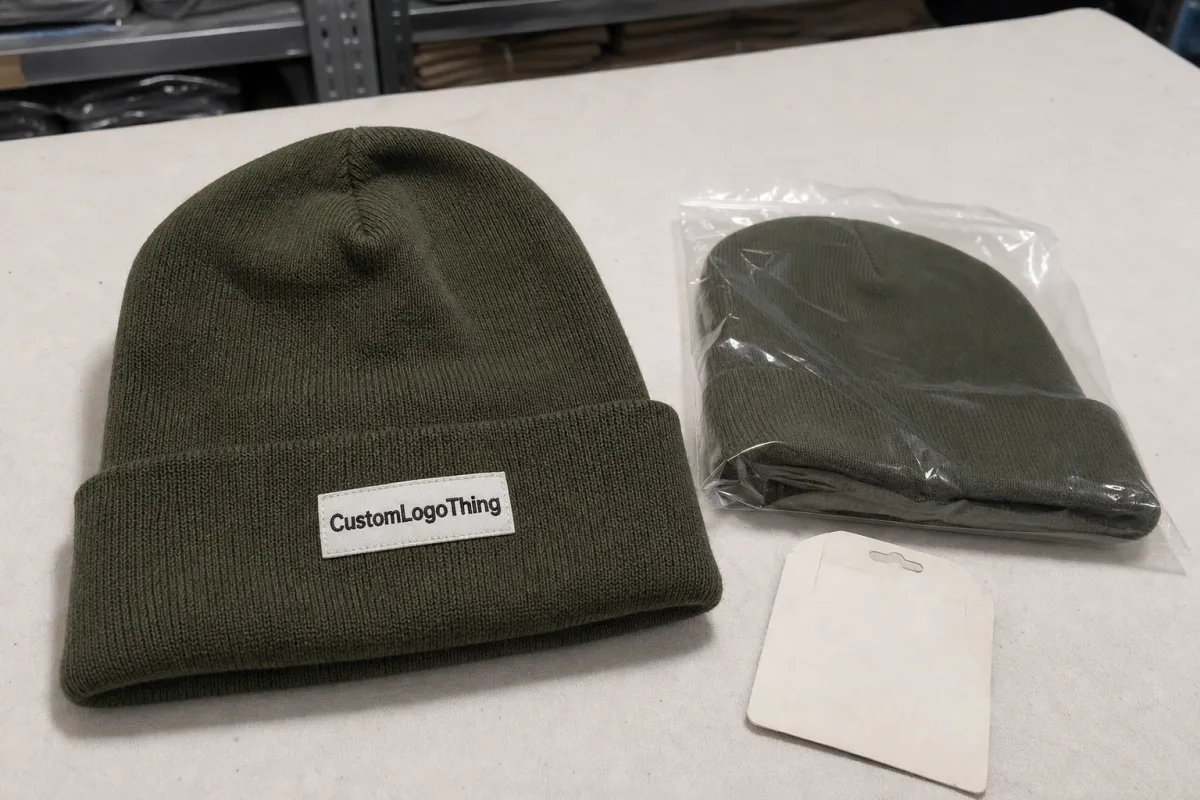
Cuffed Knit Beanies are one of the cleaner private label products to source because the construction is simple enough to standardize. The cuff creates a stable decoration area, and that matters more than buyers sometimes expect. A logo placed on the cuff is easier to read, easier to photograph, and easier to repeat across production runs than decoration placed on a stretch-heavy crown.
For a cuffed knit Beanies Private Label Order, the buying logic usually comes down to repeatability. The style works across retail, promo, outdoor, and gift channels because the silhouette is familiar and the risk of fit complaints is low. Customers usually care more about whether the hat feels soft, keeps its shape, and looks like the brand they expected than about technical knit terminology.
The most common mistake is approving decoration before the body is settled. A buyer sees a patch or woven label mockup, approves it, and only later realizes the cuff is too short, the crown is too tall, or the decoration area collapses once the knit stretches. That sequence leads to awkward revisions and re-quoted samples. Choose the body first, then size the branding to the cuff and knit gauge.
A good private label beanie is not a list of features piled together. It is one body, one cuff depth, one clear logo treatment, and a fit that survives real wear.
From a merchandising standpoint, the style has another advantage: it is easy to classify. That sounds minor until you are managing seasonal replenishment, colorway planning, and freight timing. A cuffed beanie that performs can usually be reordered in the same construction with fewer surprises than fashion headwear that depends on exact shaping or decorative details. For buyers, that predictability is worth real money.
If your wider accessory program needs consistent labeling across categories, align the headwear brief with Custom Labels & Tags so the beanie, outerwear, and gift packaging all speak the same visual language.
Materials, knit structure, and branding options
Material choice changes the commercial profile of the whole project. Acrylic remains the default workhorse because it is affordable, easy to color, and generally stable in production. It also gives suppliers more room to hit target price points. Wool and wool blends cost more, but they usually feel warmer and more substantial in hand, which can justify the premium in retail or gift programs. Recycled yarns are now common in branded assortments, though they can introduce tighter supply constraints and a bit more color variance.
Knit gauge matters more than many first-time buyers realize. A tighter gauge usually gives a cleaner surface, sharper logo definition, and less snagging. A looser gauge can feel softer and more relaxed, but it also makes fine artwork harder to read and can make the cuff look less refined. The tradeoff is real: more texture can feel more casual, while more density often looks more premium. Neither is automatically better.
The cuff is the most valuable branding zone on the product, so the decoration choice should fit both the yarn and the target channel. Woven labels are dependable when you want readable branding and controlled cost. Embroidered patches add texture and tend to mask minor surface irregularities. Faux leather tabs suit lifestyle and outdoor positioning, though they can feel out of place on a softer fashion program. Direct embroidery is efficient for simple marks, but thin lines and small text often blur into the knit.
That last point is less about manufacturing skill and more about material behavior. Knit surfaces move. Yarn thickness, stretch recovery, and stitch density all influence how artwork lands. A supplier can do excellent work and still fail to make micro text legible if the logo itself is too detailed for the fabric. This is why vector art alone is not enough; the design also has to be knit-friendly.
Color consistency deserves its own caution. In knitwear, yarn color is not identical to a Pantone chip, even if the supplier is careful. Fiber content, dye lot, and yarn source all affect the final shade. If the brand color is sensitive, request a lab dip or yarn strike-off before bulk approval. If the color is more flexible, define an acceptable visual range instead of pretending knit yarn can behave like coated paper.
Branding should also match the sales channel. Premium retail usually supports woven labels or embroidered patches. Promo orders often need simpler decoration because the budget is tighter and the timeline is shorter. Outdoor or team programs may want branding that tolerates repeated wear and washing without fraying. For shelf-ready presentations, paper belly bands or carton marks can carry secondary branding without crowding the cuff itself.
Packaging materials matter more than some buyers budget for. If paper components are part of the presentation, ask for FSC-certified stock where it supports the claim you need to make. For shipper performance, carton testing aligned to ISTA methods is worth discussing if the order is traveling long distances or handled by multiple distribution points. The packaging may be simple, but the risk of crushed presentation or damaged labels is not theoretical.
Specs to lock before you request quotes or samples
Good quotes start with plain details. Give suppliers finished dimensions, cuff height, yarn content, target colors, logo size, attachment method, and packaging plan. If one of those is missing, every supplier fills the blank differently, and the quotes stop being comparable. That is how teams end up arguing about price while actually comparing different products.
A one-page tech pack is usually enough for a simple cuffed knit beanie. Include a flat sketch, measurements, decoration placement, yarn or fiber notes, and a short section for packaging and folding direction. Leave the long backstory out. The more a brief reads like a conversation thread, the more likely the sample will come back with assumptions baked in.
Artwork should be vector-based, but that is only the starting point. Thin lines, tiny lettering, and delicate icon details often disappear on textured knit surfaces, especially with heavier yarn. If the mark only works at one large size, the design may be too fragile for this product. Ask the supplier to confirm the minimum line weight and text height they can reproduce clearly before approving the sample.
Packaging belongs in the brief from day one. Decide whether the beanie ships in a polybag, with a hang tag, with a belly band, with a size sticker, or in bulk cartons. Each choice changes labor, material cost, and final presentation. Shelf-ready retail packs take more work than basic bulk packing. If the goal is efficient freight and low handling cost, say that explicitly so nobody adds presentation features that never had budget behind them.
For Private Label Buyers, the quote checklist is short but nonnegotiable:
- Finished dimensions and cuff height
- Yarn content and preferred hand feel
- Color targets and tolerance range
- Logo file format and size limits
- Branding method and placement
- Packaging format and carton count
- Target quantity and delivery window
That list cuts revision rounds, but it also protects the budget. A supplier cannot price freight, labor, or setup properly if the spec keeps moving. For headwear, small changes are not small once they spread across hundreds or thousands of units.
If the order needs branded hang tags, woven labels, or other secondary details, keep those aligned with the primary spec rather than treating them as afterthoughts. The same logic applies if the project is tied to a broader label and packaging system. Consistency keeps the product line from feeling assembled one piece at a time.
Cost, pricing, MOQ, and landed unit economics
Pricing for a cuffed knit beanie comes from yarn, knit complexity, decoration, labor, packaging, testing, and freight. That sounds simple because it is simple. The challenge is knowing which lever is moving the quote. An acrylic beanie with a woven label will sit in a completely different price band from a wool blend with a patch, retail packing, and multiple color approvals.
For many private label programs, a plain custom cuffed beanie in acrylic may land around $1.20-$2.10 per unit at higher bulk volumes. Wool blends and recycled yarn options often move into the $2.20-$4.50 range, especially if the yarn is harder to source or the finish is more controlled. Add a patch, custom packaging, or a more demanding label application, and the landed unit price climbs again. These are broad ranges, not promises. Volume, destination, and the actual spec matter.
| Option | Typical MOQ | Quoted Range | Best Fit |
|---|---|---|---|
| Basic acrylic body with woven label | 500-1,000 pcs | $1.20-$2.10 | Promo, ecommerce, entry retail |
| Acrylic or recycled yarn with patch | 800-2,000 pcs | $1.70-$3.20 | Brand stores, seasonal launches |
| Wool blend with premium packaging | 1,000-3,000 pcs | $2.80-$4.50 | Higher-margin retail, outdoor, gift |
MOQ changes for predictable reasons. More colors usually mean more handling and more setup. Special yarns raise the floor because the mill or knitting line needs dedicated material. Decoration complexity can also push MOQ higher if the supplier has to source special labels or separate finishing steps. If the target is a lower unit cost, keep the style narrow and the options disciplined. Factories price efficiency, not wish lists.
Ask whether sample fees, setup charges, and decoration costs are included or separate. A quote that looks cheap can be misleading if it excludes sampling, freight, carton labeling, or rework. The only number that truly matters is the landed unit price, because that is the number that reaches your margin sheet. A low factory quote does not matter if it gets erased by air freight or a second round of corrections.
The cleanest comparison between suppliers is identical spec against identical spec: same yarn, same gauge, same cuff height, same decoration method, same packout, same delivery terms. If any of those differ, the comparison is distorted. A cheap quote is only useful if it is quoting the same product you intend to buy.
For reseller or wholesale programs, volume tiers can change the economics enough to justify a slightly better spec. A higher-quality yarn or cleaner label may make sense if the item is meant to repeat across multiple months. If the style is a one-off campaign, keep the spec tighter and avoid expensive features that do not help sell-through.
One more practical point: a beanie with a low quote and a weak hold on color may cost more after the fact. Rejection risk, rework, and slow-moving inventory eat margin in ways that do not show up in the quote line. Buyers who track landed economics carefully usually end up choosing the product that is easiest to repeat, not the product that looks cheapest on day one.
Process, timeline, and delivery checkpoints
A clean project flow usually runs in this order: quote, spec confirmation, artwork proof, sample, revisions, production, QC, and shipment. That sequence sounds linear because it should be linear. The teams that get in trouble are the ones who reopen fit, packaging, and decoration after production has already been scheduled. Every late change has a cost attached to it.
Sample development often takes 7-14 business days if the artwork is clean and the spec is stable. Bulk production commonly takes another 15-30 business days, depending on yarn availability, decoration complexity, and factory workload. Then freight gets added on top. Air may only take a few days, but ocean can stretch into several weeks once port timing and customs clearance enter the picture.
The delays that hurt most are usually basic. Artwork arrives late. Color approval stalls. Packaging keeps changing. Someone asks for a cuff adjustment after sample signoff. None of that is exotic; it is just expensive. The most efficient buyers keep the approval cycle tight and limit the number of open questions before production starts.
Ask for real checkpoints rather than soft assurances. A solid supplier should be able to provide pre-production approval, in-line QC, and final inspection photos before shipment. Larger programs may justify a buyer-specific inspection standard or a packaging audit. If the carton travels far or passes through multiple handling points, ask how drop or vibration tests are handled and whether the supplier references ISTA methods or an internal equivalent. For paper inserts or labels, FSC paper confirmation is worth requesting when the claim matters.
Testing depends on the channel, but it should never be ignored. Retail partners may ask for pilling resistance, colorfastness, or stitch strength checks using recognized methods such as ASTM-based testing. You do not need to turn a simple beanie into a laboratory project. You do need to know whether the product can survive normal wear and whether the supplier can document that claim if challenged later.
From quote to PO: final approval and reorder planning
Before RFQs go out, gather the spec sheet, logo files, target quantity, color list, packaging choice, and delivery deadline. That is the minimum that lets suppliers price accurately. If half the information is missing, the quote will be padded, vague, or both. Buyers do not need more ideas at this stage. They need fewer unknowns.
The approval sequence should stay simple: confirm the sample, lock the bulk color standard, approve the carton pack, then release production. If merchandising, sourcing, and the factory are each working from a different version, the product is not approved. It is fragmented. One version of the truth saves a surprising amount of time.
For a cuffed knit Beanies Private Label order, reorder planning should begin before the first shipment leaves the dock. If the style is seasonal and likely to repeat, preserve the approved yarn, cuff measurement, decoration method, and packout in a single record. That makes the next order faster and protects the product from spec drift six months later when the original sample is buried in someone’s inbox.
A lot of private label problems come from unclear ownership. One person should control the tech pack. One person should approve artwork. One person should sign off on final sample photos or the physical sample. Shared responsibility sounds collaborative, but in sourcing it often means nobody owns the mistake when the label is crooked or the logo size changes by accident.
Checklist before issuing the PO:
- Confirm finished dimensions and cuff depth
- Approve yarn, color, and knit gauge
- Lock branding method and placement
- Verify packaging and carton pack
- Review sample photos or physical sample signoff
- Check lead time against launch date
- Confirm freight terms and delivery address
If the order is set up properly, the rest is manageable. If it is not, small issues multiply into revisions, delays, and avoidable chargebacks. The best private label beanie briefs are short, specific, and a little boring. That is a compliment.
For repeat buying, treat the first order as the template for the next one. Keep the approved spec, record the landed cost, and note any production or packaging changes that were made during sampling. That turns a single purchase into a dependable program instead of a fresh negotiation every season.
What is the usual MOQ for a cuffed knit beanies private label order?
MOQ depends on yarn type, color count, and decoration method. Simple acrylic styles can start in the 500-1,000 piece range, while more customized programs often need higher volumes to cover setup and material handling.
How long does a private label cuffed knit beanie order usually take?
Sample development often takes 1-2 weeks if the artwork and measurements are clear. Bulk production and shipment usually add several more weeks, so seasonal orders need buffer time built in.
Which branding method works best on cuffed knit beanies?
Woven labels and embroidered patches usually give the cleanest private label result on the cuff. Direct embroidery can work too, but small text and fine details are harder to read on textured knit fabric.
What specs do I need before requesting a quote for cuffed knit beanies?
Have the beanie dimensions, cuff height, yarn content, color targets, logo files, and packaging requirements ready. Clear specs lead to faster quotes and fewer sample revisions.
Can I split a cuffed knit beanies private label order across colors or packaging?
Yes, but extra colorways or packaging variations can raise cost and sometimes increase MOQ. Keeping the core style consistent usually gives better pricing and a cleaner reorder path.
How do I compare two suppliers without getting misled by price alone?
Make sure both suppliers are quoting the same spec, decoration method, packout, and delivery terms. The lowest quote is not always the best value once freight, lead time, and rework risk are included.
The short version is straightforward: choose the right body, lock the cuff and branding specs, compare quotes on identical terms, and plan the timeline before the season starts moving. A well-run cuffed knit beanies private label order is not complicated. It rewards buyers who pay attention to the details that actually affect cost, fit, and sell-through.


