Recycled Paper Shopping Bags Low MOQ Custom Order Quote
If you are comparing recycled Paper Shopping Bags low MOQ Custom Order options, the real question is not whether a supplier can make a short run. It is whether the bag carries well, prints cleanly, and still makes financial sense once setup, paper grade, handle style, and freight are all included.
That is where many buying decisions go sideways. A sample can look fine on a desk, then crease strangely in transit, or feel too soft once it is filled with an actual product. The difference between a workable bag and a disappointing one is usually found in the details that do not show up in a quick quote.
Why Low-MOQ Recycled Bags Make Sense for Reorders
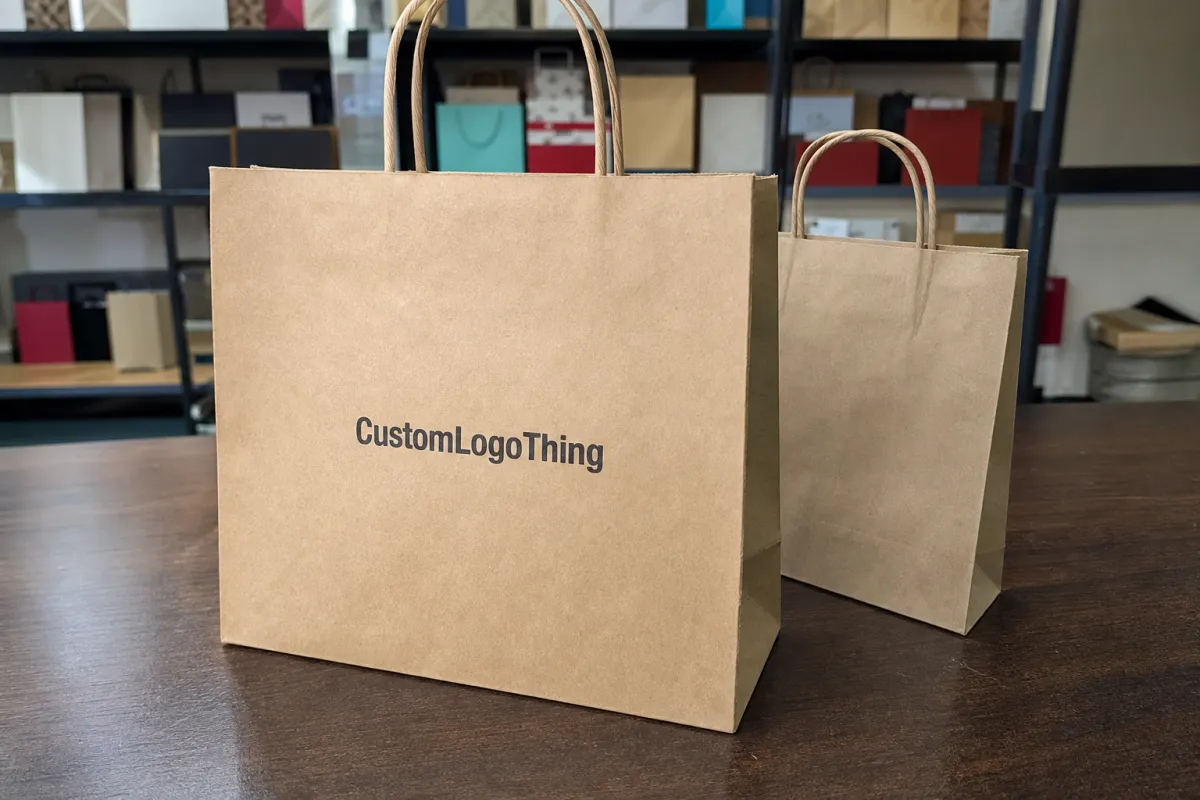
Low-MOQ recycled paper bags are often the smartest move when a brand wants to test packaging without locking up cash in a large inventory commitment. A short run lets you see how the bag reads under store lighting, how it feels in the hand, and whether the artwork still looks deliberate once the bag is folded, carried, and stacked with other packaging.
That matters because bag performance is not abstract. A 10-inch bag may look perfectly proportioned in a flat proof and still feel awkward if the product has a tall profile or sharp corners. A recycled sheet can also behave differently from a virgin-fiber sheet: the tone may be warmer, the surface may show more fiber, and the print can soften slightly if the ink density or color management is not controlled.
For buyers, the appeal is practical. Small runs protect cash flow, reduce obsolescence risk, and give you a way to verify the package before you scale. That is useful for boutique apparel, gift items, cosmetics, and lightweight food-service products. It is also useful when branding is still evolving and you want to avoid sitting on boxes of bags that no longer match the rest of the line.
A bag can feel premium without expensive finishing. What tends to expose weak construction first is the mouth fold, handle attachment, and the way the gusset behaves under load.
If you are comparing this format with other retail packaging, our Custom Packaging Products page is a useful place to see where bags sit alongside custom printed boxes and related branded packaging formats.
For short-run programs, the order works best when the size, handle, print area, and delivery expectations are decided early. That keeps the project in production territory rather than in endless quote revision.
Paper Stock, Handles, and Print Specs That Change the Build
The paper grade drives both the look and the performance. Recycled kraft blends usually give the most natural appearance, with enough stiffness for everyday retail use and a print result that feels honest rather than glossy. If the goal is a smoother surface and tighter logo detail, a refined recycled sheet or coated recycled stock can help, but the tradeoff is usually cost, a slightly different hand feel, and less of the raw kraft texture that some brands want.
Recycled content is not just a marketing line. Post-consumer fiber can change surface consistency, color tone, and fold memory. A high-recycled sheet may look more textured and slightly less bright, which can be a strength if the brand is going for a grounded, material-first look. It can also make fine typography harder to read if the font is too thin. That is why the print method and the paper should always be chosen together.
Handle style changes the user experience just as much as the stock. Paper twist handles are a reliable middle ground for retail because they balance cost and strength. Flat tape handles usually keep the price down and work well for lighter loads. Rope handles give a more polished presentation, which is helpful for premium retail and gifting. Die-cut handles make a compact, clean silhouette, but they need reinforcement if the bag is carrying anything with real weight.
| Handle Type | Best Use | Typical Feel | Cost and Build Impact |
|---|---|---|---|
| Paper twist | General retail, boutiques, gift items | Balanced, familiar, sturdy | Usually moderate cost; a dependable default for low-MOQ runs |
| Flat tape | Value-focused programs, lightweight goods | Simple and practical | Often the lowest-cost handle option |
| Rope | Premium retail packaging, presentation-led brands | More refined in hand | Raises unit cost and can add assembly time |
| Die-cut | Smaller bags, minimal presentation, tight pack-out | Streamlined, compact | Can reduce separate handle parts, but needs good reinforcement design |
Print specs deserve the same level of attention. A one-color logo on recycled kraft is usually the cleanest and cheapest route. Full-coverage artwork, inside printing, matte varnish, embossing, or foil accents all affect price and usually extend lead time. So does heavy process color on a rougher recycled surface, where the image can look softer than it did on a screen proof.
There is also a practical visual issue that gets ignored too often: dark ink over natural kraft does not always behave like dark ink on white paper. A rich black can shift warmer, and a pale pastel can disappear into the stock if the contrast is weak. Buyers who want a strong print result usually do better with bold shapes, clear line weights, and controlled color count rather than crowded artwork.
If recycled-content claims matter to your team, the paper source should be traceable. FSC certification language is explained clearly on fsc.org, and the EPA’s recycling resources at epa.gov are a useful check on terminology before a label or product page is finalized.
Sizing, Gussets, and Weight Limits for Safer Carrying
Before asking for pricing, lock down width, gusset, height, and handle drop. Those four measurements determine usable volume, how the bag sits in the hand, and how much room is left once the product is inside. A bag that is too shallow can crush a box top. One that is too narrow can buckle as soon as a customer tries to carry it one-handed.
For lighter retail items, a 100 to 120 gsm recycled kraft is often enough, especially if the load stays around 2 to 4 lb and the carry distance is short. Once the contents get denser, wider, or more expensive, a 150 to 200 gsm build becomes more realistic. At that point, reinforced handles and a stronger mouth fold stop being nice extras and start being part of the basic structure.
Gussets matter more than many buyers expect. A deeper gusset helps the bag stand and improves the fit for squared-off products, but it also changes how the side panels flex. If the merchandise has corners, bottles, or a hard edge, a slightly wider base can prevent stress at the fold lines and reduce the chance of tearing at the corners. A narrow, elegant bag may look good on paper and still fail the actual carry test.
Actual product testing beats generic load assumptions. A stack of T-shirts is not the same as one boxed candle set. A folded sweater does not behave like a rigid carton. If the bag is meant for mixed merchandise, ask for a sample packed with the heaviest likely combination rather than a convenient substitute weight. The bag should survive the product, not just frame it.
Art placement should follow the dieline, not intuition. Safe zones keep logos away from folds, and a clean art map avoids awkward cutoffs near the bottom or handle attachment. A dependable supplier should tell you the file format, any minimum line thickness, and the color target for the print method. That matters more on short runs, because there is less room to absorb avoidable revisions once production starts.
If you need a broader set of answers on order prep, the FAQ page covers the file and production questions that usually slow a quote down.
Cost, MOQ, and Unit Price Drivers for Custom Orders
The price of a custom recycled paper bag is shaped by a handful of variables that buyers can actually control. Paper grade, finished size, handle type, print count, and finishing complexity usually move the unit cost more than anything else. A standard-size bag with one-color printing and paper twist handles will sit in a very different cost band from a large bag with heavy coverage, rope handles, and specialty finishing.
MOQ exists because setup, material yield, and press time create fixed costs. That does not make small orders a problem; it means the build needs tighter control. When quantity is low, every unnecessary revision, special color, or custom structural tweak carries more weight in the final number. For many buyers, the cleanest way to keep pricing under control is to simplify the print, choose a standard handle, and avoid decorative finishes that do not change the customer experience.
For a low-MOQ run, a realistic ballpark for simple recycled paper shopping bags is often around $0.24 to $0.48 per unit at 1,000 to 3,000 pieces, depending on size and print coverage. More complex builds can move into the $0.38 to $0.75 range or higher. Those are reference points, not fixed rates. Freight, packaging method, and stock availability can shift landed cost quickly, especially if the order must move by air or if the paper grade is not already in stock.
At very small quantities, under 500 pieces, some suppliers quote the order more like a premium sample run than a normal production lot. That is not necessarily bad. It simply means the economics change because setup is spread across fewer bags. The cheapest quote is not always the best value if the print weakens the brand presentation or the bag fails in daily use.
| Build Choice | Approx. Unit Cost Impact | Lead Time Impact | Best For |
|---|---|---|---|
| Standard recycled kraft, one-color print | Lowest | Shortest | Simple retail packaging and reorders |
| Custom size with paper twist handles | Moderate | Moderate | Brands balancing presentation and budget |
| Full-color print with matte finish | Higher | Longer | Image-led package branding |
| Rope handles with reinforced mouth | Higher | Moderate to longer | Premium product packaging and gift sets |
Compare bag cost against the job it has to do. If it protects the product, supports the shelf or counter experience, and survives the carry distance your customers actually make, the spend is easier to defend. That is especially true for retail packaging that needs to look dependable without drifting into overbuilt territory.
For teams buying several packaging categories, it can help to compare this project against other needs, including custom printed boxes, mailers, and branded inserts. Our Wholesale Programs page is useful when repeat ordering and monthly demand are large enough to justify a more structured sourcing plan.
Production Steps and Lead Time From Proof to Shipment
A clean order follows a simple sequence: RFQ, dieline confirmation, artwork proof, sample approval if needed, production, carton packing, and shipment. When everyone understands the sequence, the job usually moves faster because the supplier is not waiting on missing files or unclear instructions midway through the run.
The steps that extend schedule are usually easy to spot in advance. Artwork revisions can add several days. Custom colors may need another proof round. Structural sampling can be necessary if the bag is carrying a heavier product or if the handle position needs to be checked in the hand rather than only on paper. A buyer who plans for those risks early usually avoids the most annoying delay: discovering them after the quote is already accepted.
For many low-MOQ recycled paper bag projects, the production window is often about 12 to 15 business days after proof approval when the build is straightforward. More complex runs can take longer, especially if the supplier needs a specific recycled paper grade, extra reinforcement, or a more elaborate handle structure. If a sample is required before mass production, add another 3 to 7 days depending on the material and the speed of signoff. Treat the quoted lead time as an estimate until all details are approved.
Carton count and pack method matter more than many buyers expect. If the bags are flat-packed in bulk, the carton size affects freight efficiency. If they are packed for resale or store distribution, inner quantities may need to be adjusted. That needs to be decided before production begins, because shipping prep is part of the schedule and can delay dispatch if it is left to the end.
Recycled paper also reacts to humidity. In a damp warehouse, the sheets can curl or lose crispness faster than a buyer expects, which is why storage conditions matter before the bags are even used. Flat, dry storage with stable temperature is a small operational detail that prevents a lot of avoidable damage.
If your shipping lanes are long or involve multiple handoffs, transit strength deserves a quick check too. The International Safe Transit Association at ista.org is a practical reference if your team wants more context on packaging durability and transport stress.
Sampling, Proofing, and Reorder Consistency
A digital proof is useful for layout, not final judgment. It will confirm logo placement, copy, and proportion, but it cannot fully show how the paper feels, how the handle sits in the hand, or how the ink behaves on a recycled surface. If color accuracy or finish matters, a pre-production sample is the safer choice. That is especially true on short-run orders where the first shipment may become the visual standard for later reorders.
One small mismatch can matter more than buyers expect. A logo that looks centered on-screen may sit slightly high once the handles are attached. A border that appears generous in the PDF can shrink after folding and gluing. These are not defects so much as normal production realities, but they need to be seen before a full run is approved.
Once the order is approved, save everything together: the dieline, approved art files, color references, paper spec, handle style, sample photos, and any notes about fold or reinforcement. That documentation is what keeps the next run close to the first one in paper tone, print alignment, and handle placement. Reorders stay more predictable when the original build is not being reconstructed from memory.
Document control also reduces friction. Clear signoff records limit rework, avoid spec drift, and keep the next production slot on schedule. If the packaging changes later, even a small revision can alter the bag dimension or print registration enough to require a fresh proof. That is normal. It is also one of the best arguments for treating the first run as a reference standard rather than as a disposable transaction.
Reorders are where a lot of the value shows up. Once the bag has been used in real conditions, you know whether it is too stiff, too soft, too narrow, or carrying better than expected. That feedback is more trustworthy than assumptions made from a rendering.
What a Reliable Supplier Should Provide on Small Runs
A reliable supplier should quote low-MOQ work clearly and explain what is included. Setup charges, plate or print fees, sample charges, and freight should be separated so the final number is easy to compare. If the quote hides those details, the landed cost usually shifts later, which makes it hard to judge value.
Fast replies matter, but they are not enough on their own. Look for realistic lead times, consistent sample handling, and a willingness to confirm important details in writing. If the supplier is vague about paper source, print method, or reinforcement, slow the process down. Good partners treat the spec sheet as a working document, not a loose suggestion.
Quality control should be visible, not implied. Ask what gets checked before packing: print alignment, handle security, gusset formation, glue adhesion, and carton count are all worth confirming. A simple handle pull test and a quick visual scan of the mouth fold catch many problems before the cartons leave the plant. If the bags are crossing multiple touchpoints, you want the supplier thinking about shipping damage before it happens, not after the cartons arrive.
Traceability matters too. If recycled-content claims are being used in packaging copy or product pages, ask what proof supports them. If the order is supposed to meet a specific certification or paper source requirement, that needs to be documented before the run starts, not reconstructed from a vague promise later.
For buyers deciding between a one-off project and a repeat program, the best supplier is the one that can state the limits clearly. Some teams need a simple retail bag for a seasonal launch. Others need recurring runs tied to promotions or store resets. The mechanics are similar. The tolerance for mistakes is not.
If you are comparing recycled paper shopping bags Low MOQ Custom order proposals from more than one source, give each one the same brief. Same size, same paper, same handles, same print coverage. Anything else turns the comparison into guesswork.
Next Steps for a Clean Quote and Production Start
Before asking for pricing, prepare the target size, quantity, print count, handle style, delivery location, and any recycled-content requirement. A quote comes back cleaner when the supplier does not have to chase the basics. If you already know whether the bag needs to hold apparel, gifts, or another product class, include that too, because the load often determines the right paper weight and reinforcement.
Send logo files, brand colors, and any retail or compliance notes together. That reduces back-and-forth and keeps the proof stage efficient. If your brand already has packaging standards, share them. A single reference sheet can save a lot of revision time and help the printer match expectations more closely.
If your team is planning more than one run, use the first order to define the template for later purchases. The right low-MOQ order gives you a working standard for paper grade, handle type, and print placement. After that, repeat orders are easier to manage and much easier to compare on cost.
For buyers focused on recycled paper shopping bags Low MOQ Custom Order projects, the most useful next step is not another round of general brainstorming. It is a complete brief, a proof that matches the spec, and a first run that can be reordered without guesswork.
What is the typical MOQ for recycled paper shopping bags custom orders?
MOQ depends on bag size, paper grade, print coverage, and handle style because each choice changes material yield and setup time. Smaller custom runs are usually easier when the artwork is straightforward and the construction stays within standard production limits. Ask for a quote that separates setup, printing, and finishing so you can compare options fairly.
Can low-MOQ recycled paper bag orders use full-color printing?
Yes, full-color printing is possible on many small runs, but coverage, color count, and paper surface all affect pricing and lead time. Simple graphics with strong contrast usually reproduce more predictably than dense imagery or heavy ink coverage. A proof or sample is the safest way to confirm color expectations before mass production starts.
How do I choose the right paper weight for custom recycled shopping bags?
Start with the product weight, then add a margin for handling, stacking, and customer carry distance. Heavier goods usually need thicker paper, stronger handles, or reinforced construction at the mouth and base. If the bag is for lightweight retail items, a lighter board may be enough and can help control unit cost.
What affects the lead time on a low MOQ recycled paper bag order?
Lead time is driven by proof approval speed, artwork changes, sample requirements, and the complexity of the bag build. Orders move faster when the size, print files, and delivery details are complete before quoting. Freight planning should be included early so the production schedule and shipping schedule stay aligned.
Can I reorder the same custom bags later without changing specs?
Yes, repeat orders are easier when the approved dieline, art files, and sample references are saved from the first run. Reorders stay more consistent when paper grade, handle style, and print settings are locked before production. Ask the supplier to confirm that the original specs are still on file before you release the next order.

