Retail Bulk Knit Beanies Reorder Plan That Keeps Core Colors in Stock
A retail Bulk Knit Beanies reorder plan is not about buying more hats. It is about buying the right hats before the shelf starts looking thin. The first style to disappear is usually the predictable one: black, charcoal, navy, maybe oatmeal if the buyer leaned into a neutral assortment. By the time a display looks obviously sparse, the margin hit has usually already started.
Retail sell-through rarely fails in a dramatic way. It slips. A cold front moves through a region, a promo lands harder than expected, or one color outperforms the rest by a wide margin, and suddenly the replenishment math changes. Buyers who track only style-level inventory miss that shift. Buyers who track color-level velocity usually see the problem early enough to fix it without paying for rushed freight or emergency artwork changes.
The practical goal is simple: protect the top performers, keep the assortment believable on shelf, and avoid reordering dead stock just because it was part of the last PO. The rest is discipline. Not glamorous, but it keeps a knit beanie program profitable.
"The cheapest reorder is the one that lands before the shelf goes empty."
How a retail bulk knit beanies reorder plan prevents stockouts
Most stockouts happen because the reorder decision arrives too late. The inventory looks adequate on paper, then one strong week or one weather shift burns through the fastest color before the next shipment can land. Knit beanies are especially sensitive to that timing because demand can spike hard, then flatten just as quickly.
A useful reorder formula is not complicated: average weekly sell-through multiplied by lead time, plus a safety buffer for the top colors. If a style sells 300 units a week and the replenishment cycle takes four weeks, the reorder point is already in the four-digit range before anyone starts talking about a seasonal spike. Add a regional promotion or a sudden temperature drop and the buffer disappears fast.
That is why the best reorder plans track three things by SKU and color, not just by style:
- Sell-through speed for each colorway and size profile.
- Lead time risk across approval, production, and transit.
- Carryover value for colors that stay relevant outside the peak season.
The hidden cost of a late reorder is rarely the unit price. It is the rush freight, the extra sample round, the rework on packaging, the missed floor-set window, and the time spent explaining why the best seller is missing from the rack. On a small urgent shipment, air freight can add 18% to 35% to landed cost. That is enough to erase a healthy margin on a basic knit accessory.
Retail buyers also run into an assortment problem when one color sells out and the others linger. A display with an empty black bin and a full pile of light gray does not read as healthy inventory. It reads as a missed order. This is why a reorder plan should protect the best-selling color first, then decide whether the slower colors deserve another run at all.
One practical habit helps more than people expect: keep a dated record of the approved sample, the production spec, and the last carton count. Repeat orders move faster when the reference point is clear. A buyer should not have to rebuild the product from memory every time the PO number changes.
The product details that keep beanies moving off the shelf
Not every knit beanie sells the same way. Cuffed beanies usually perform best in retail because they have a clean profile, a clear decoration zone, and enough stretch to fit a broad customer base without much argument. Slouch styles can work, but they are more trend-dependent and less forgiving if the customer wants a classic shape. Rib knit constructions tend to hold structure better, while smoother flat knits can look cleaner for branded programs.
Fiber choice matters more than a lot of replenishment sheets admit. Acrylic remains common because it is affordable, color-stable, and easy to source in repeat runs. Wool blends feel warmer and often read as more premium, but they can raise cost and complicate wash expectations. Recycled polyester and recycled acrylic blends are increasingly common for buyers who want a sustainability story, though the hand feel can vary a lot from one yarn lot to another. None of those options is automatically right. The right answer depends on the shelf price, the intended margin, and how the customer will actually wear the hat.
Fit is another quiet driver of repeat sell-through. A beanie that is too tight tends to create returns, while one that stretches out too quickly looks tired after a few wears. If a style is being reordered, keep the crown shape, cuff height, and stretch recovery as close to the original as possible. Small visual shifts are enough for repeat customers to notice, even if the SKU code stays the same.
Decoration changes the perceived value. For retail replenishment, the most reliable options are usually:
- Embroidery for a durable, straightforward branded look.
- Woven labels for a lower-profile finish that does not fight the knit texture.
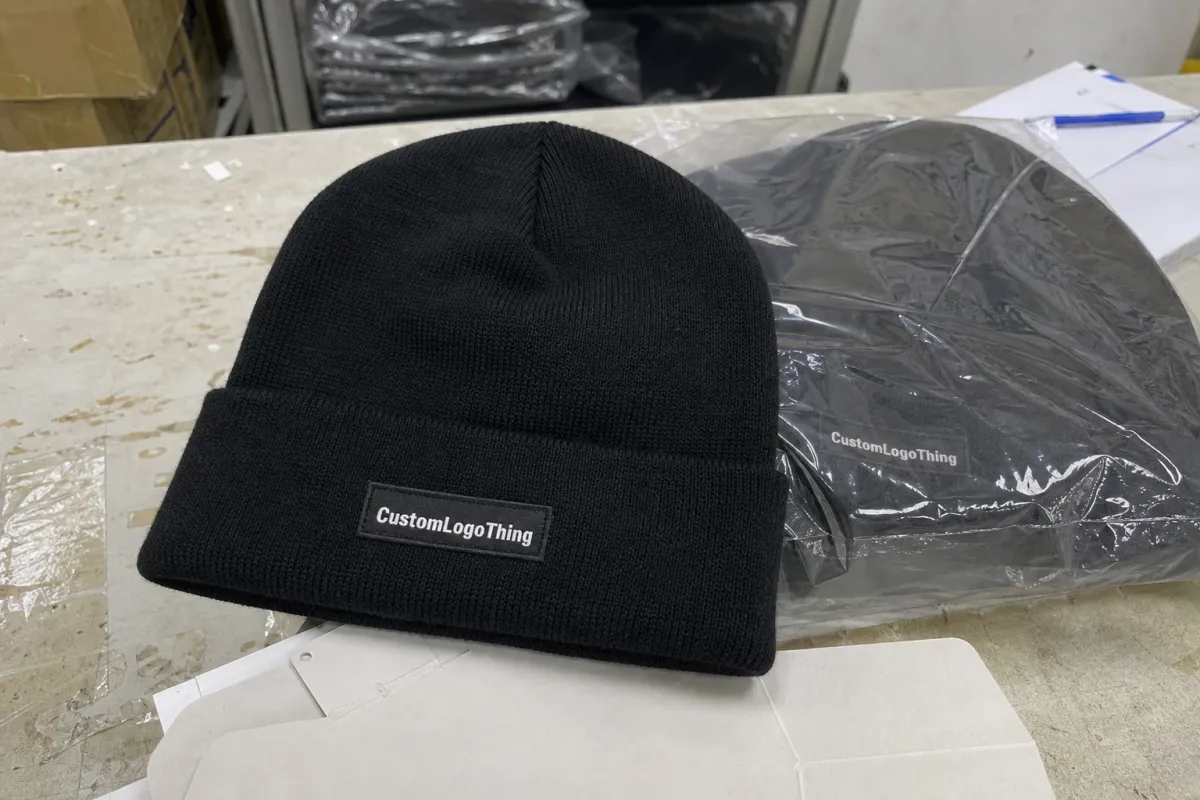
- Patches for a heavier retail presence and a slightly more premium feel.
- Private-label packaging when shelf presentation and barcode handling matter from day one.
| Style | Best Use | Typical MOQ | Indicative Unit Cost | Notes |
|---|---|---|---|---|
| Cuffed knit beanie | Core retail replenishment | 300-1,000 pcs | $1.35-$3.10 | Best logo space and easiest repeat order |
| Slouch beanie | Trend-led or fashion line | 500-1,500 pcs | $1.55-$3.60 | More style risk; demand can swing quickly |
| Rib knit core style | Durable evergreen program | 500-2,000 pcs | $1.45-$3.40 | Good stretch recovery and stable shelf appeal |
| Blank retail beanie | Private label or fast branding | 250-1,000 pcs | $1.10-$2.40 | Lowest setup friction, useful for speed |
One thing should stay fixed across reorder cycles: the core SKU definition. If the crown changes, the knit changes, and the decoration moves, the buyer is no longer reordering. That is a new product with a familiar name. Retail teams usually discover the difference only after the cartons land.
Specs to confirm before the next bulk purchase
Before the next PO, lock the spec sheet. Properly. The more exact the product, the fewer surprises in production and receiving. For knit beanies, the details that matter most are yarn blend, knit gauge, cuff height, folded length, finished width, and decoration placement. A photo can make two batches look identical while the hand feel and stretch behave very differently.
Color control deserves special attention. Black, navy, charcoal, heather gray, and oatmeal are common retail staples because they move consistently. They are also the colors where dye variation is easy to spot. Ask for a physical swatch, a lab dip approval, or a prior-order reference sample and keep it attached to the tech pack. If the supplier cannot match the same shade band twice, the reorder is already at risk.
Tolerances are normal in knitwear, but they need to be agreed in advance. A finished width can land slightly above or below target without becoming defective. What matters is defining the acceptable range before bulk production starts. That avoids arguments later about whether the product is “close enough.” Close enough is not a specification.
Retail packaging deserves the same discipline as the knit itself. UPC placement, carton counts, polybag thickness, hang tag format, and retail label placement all affect how quickly the shipment moves through receiving. If the paper components are part of the presentation, FSC-certified paper is a sensible check. For carton handling and distribution, ISTA test protocols are a useful reference point because beanies may look soft, but compressed cartons still fail when they are packed badly.
A practical pre-production checklist usually includes:
- Sample approval date and revision history.
- Yarn composition, gauge, and stitch density.
- Color reference and acceptable shade tolerance.
- Logo method, placement, and thread or patch spec.
- Packaging format, UPC location, and carton count.
- Wash test or wear test results if the item will sit in premium retail.
It also helps to define what will be inspected on the finished goods. Many buyers use a simple quality check for measurement, stitch consistency, color matching, label placement, barcode readability, and trim security. For bulk knitwear, that is usually enough to catch the problems that hurt retail sell-through without overcomplicating the process.
A second-order mistake is often small, not dramatic. One label is sewn 8 mm off-center. One dye lot leans slightly warmer than the first run. One carton count is wrong. None of those issues sounds serious in isolation, but they turn into receiving delays and store-floor inconsistencies once the shipment is in motion.
Cost, pricing, MOQ, and unit-cost levers to watch
Unit cost on a knit beanie is never just the beanie. It is the yarn, the decoration, the label, the packaging, the order size, and how many hands need to touch the product before it ships. A blank style can be cheap to produce, then lose that advantage once retail packaging, embroidery, and freight are added. That is why a retail Bulk Knit Beanies reorder plan should compare the full landed cost, not the factory quote in isolation.
Here are the cost buckets buyers should actually compare:
- Sample fees: often $20-$80 depending on revisions and artwork complexity.
- Setup or digitizing: commonly $25-$75 for embroidery-related work.
- Decoration: embroidery, patch application, or label sewing can add $0.15-$0.70 per unit.
- Packaging add-ons: retail polybags, inserts, and hang tags often add $0.12-$0.45 per unit.
- Freight and duties: highly variable, and they can move landed cost by double digits.
- Cartonization: stronger cartons cost a little more, but they reduce damage and receiving problems.
The MOQ question is where buyers often get caught between price and flexibility. Smaller orders are useful for testing a style, but the per-piece cost is usually higher because setup is spread across fewer units. A 300-unit reorder may be fine for a color test or a short seasonal run. A 2,000-unit run, if the SKU is stable, often improves pricing by 15% to 25% because the supplier can spread labor and setup over a larger volume.
Tiered pricing is worth requesting every time. Ask for the same style in several quantities, and ask for the quote to separate decoration, packaging, and freight. Otherwise the quote can look better than it really is because the hidden charges are sitting somewhere else in the order. Clean pricing makes for cleaner decisions.
Material choice also moves price in predictable ways. Basic acrylic tends to sit at the lower end of the range. Wool blends and specialty recycled yarns usually cost more, sometimes enough to change the retail price point entirely. If the sales plan depends on a specific shelf price, the yarn choice and decoration method need to be aligned before the PO is approved, not after.
One more practical point: do not reorder all colors evenly just because the line sheet looks balanced. Sell-through usually is not balanced. The top color often moves at roughly double the pace of the slowest color, and a neat allocation can turn into excess stock in the wrong shade. Buyers who match quantity to velocity usually end up with fewer markdowns.
| Program Type | Best For | Price Behavior | Speed | Tradeoff |
|---|---|---|---|---|
| Trial run | Testing demand | Highest unit cost | Moderate | Lower risk, weaker pricing |
| Steady reorder | Core retail replenishment | Better unit cost | Faster once specs are on file | Needs clean demand data |
| Seasonal push | Promos and holiday buys | Good volume pricing | Depends on production slot | More exposure if the trend cools |
Production steps and timeline from approval to delivery
Good reorder execution follows a boring sequence. That is a compliment. Boring means fewer surprises. The usual flow is RFQ, spec confirmation, artwork or label proof, sample approval, bulk production, inspection, packing, and shipment. If one of those steps is vague, the schedule slips.
The slowest part is often not the knitting itself. It is the approval chain. Missing artwork, unclear color references, delayed sign-off, or a last-minute packaging change can add days or weeks. Reorders only move quickly when the supplier already has the tech pack, the approved sample, and the carton spec on file.
A realistic repeat-run timeline for knit beanies often looks like this:
- Proof and sample approval: 2-7 business days if the spec is clear.
- Yarn or trim procurement: 3-10 business days if a specialty color or component is needed.
- Production: often 12-20 business days for a repeat run, depending on quantity and decoration.
- Quality control and packing: 2-4 business days.
- Transit: a few days domestically, longer if the order moves by ocean freight.
That timeline can stretch during peak season, around major holidays, or when a factory is already locked into large orders. A repeat style is still faster than a fresh one, but only if the paperwork is clean and the supplier has the required materials in hand. If the yarn needs to be sourced again, the order is no longer truly “repeat” from a scheduling perspective.
Rush orders almost always cost more. The factory has to reshuffle its production queue, compress approvals, and sometimes pay for faster freight just to hit the requested delivery date. If someone promises a rush at the same price as a planned reorder, something is missing. Usually it is time, freight, or inspection depth.
"Repeat orders should move on a known path. If every reorder feels like a new project, the process is broken."
For retail buyers, the best timeline is not the shortest one. It is the one that lands product before the shelf goes empty and still leaves enough time for carton checks, barcode scanning, and a quick count against the PO. A small buffer protects margin better than a last-minute apology.
What makes a supplier reliable for repeat knit beanie orders
Reliability starts with consistency. The strongest supplier for a reorder is usually the one that can make batch two look and feel like batch one. Not the one with the most polished pitch. Not the one with the lowest opening quote. The one that can repeat the spec without drifting.
Communication matters just as much. Buyers need status updates on approval, production, delays, and shipment readiness before they have to ask twice. If a supplier only reaches out once a problem is already visible, the relationship is reactive. That is expensive in retail, where timing matters almost as much as quality.
Look for proof points that show the supplier can handle repeat business without hand-holding:
- Documented specs for yarn, size, decoration, and packaging.
- QC photos before packing and before shipment.
- Stable dye matching across repeat runs.
- Reliable carton counts and label accuracy.
- Comfort with inspections and a clear method for resolving defects.
Retail deadlines are unforgiving. A supplier that understands reset calendars, promo windows, and seasonal floor-set dates is worth more than a slightly cheaper option that lands late. One missed ship date can wipe out the profit from the whole program. That is not an exaggeration; it is retail arithmetic.
Buyers also benefit from suppliers who hold on to approved references. Keeping the original sample, tech pack, and production notes reduces the chance of drift on the next run. For simple knit accessories, that file should be detailed enough that another order can be placed without rebuilding the item from scratch.
Even a good supplier can stumble if the order information is vague. Clear quantity splits, clear delivery dates, and a clear color priority reduce the odds of delays. The same is true on the buyer side: if the team keeps changing the plan midstream, the production schedule gets messy fast.
Next steps for a clean reorder and faster restock
Start with data, not habit. Review sell-through by color, style, and region so the next order reflects actual demand instead of last season’s assumption. That one step often changes the reorder mix more than buyers expect, especially if one neutral color is carrying most of the volume.
Then confirm the exact SKU matrix, target quantity, decoration method, packaging format, and delivery date before asking for pricing. If those details are still floating through email threads, the quote will be vague too. Tight input usually produces tight pricing and fewer surprises after the PO is issued.
A clean reorder process usually follows the same sequence every time:
- Pull sell-through numbers from the last replenishment window.
- Separate core colors from slow movers.
- Approve the latest sample or confirm the archived spec.
- Lock packaging, carton counts, and barcode placement.
- Request tiered pricing for the exact reorder size.
- Place the PO early enough to protect margin and shelf presence.
Build the budget around landed cost, not just the factory price. Include decoration, packaging, freight, duties, and receiving costs. If the numbers only work before shipping, they do not really work. A Reorder Plan That ignores freight and receiving is usually written by someone who never had to explain a shortage to retail operations.
A strong retail bulk knit Beanies Reorder Plan is not complicated, but it does require discipline. Keep the core spec steady, reorder before stock gets thin, and use actual sell-through to guide the next buy. That is the difference between a clean replenishment cycle and a scramble that eats margin.
How many units should a retail bulk knit beanies reorder plan cover?
Base the next order on sell-through data, lead time, and a small buffer for the top colors. A practical reorder usually covers the next replenishment window plus room for demand spikes, especially if one color is carrying most of the sales.
What specs should I confirm before reordering knit beanies in bulk?
Lock yarn blend, knit gauge, cuff height, finished size, color references, decoration method, packaging format, carton counts, and barcode placement. Those details have the biggest impact on whether the repeat run matches the original order.
How does MOQ affect repeat knit beanie pricing?
Lower quantities usually carry higher unit cost because setup and labor are spread across fewer pieces. Larger reorders often improve pricing fastest when the SKU stays consistent and packaging stays simple.
How long does a knit beanie reorder usually take from PO to delivery?
Repeat orders commonly move through approval, production, inspection, and shipping in a few weeks, but the exact timing depends on decoration, material availability, and transit method. Specialty yarns and peak-season capacity can extend that schedule.
Can I change labels or packaging on a repeat beanie order?
Yes, but each change can add approval time and sometimes new setup costs. If speed matters, keep the core product unchanged and update labels or packaging only when the margin still works.