Retail Merch Caps Factory Quote for Bulk Custom Orders
Getting a Retail Merch Caps factory quote should feel like a buying exercise, not a guessing game. The cap on the render may look ordinary; the quote often tells a different story. A six-panel brushed cotton cap with flat embroidery, a metal clasp, and a retail hangtag sits in a different cost bracket than a similar-looking cap with reinforced front panels, dense satin stitching, and packed case labels. The differences are small on a shelf and very real on a production sheet.
For buyers, the hard part is not finding a factory that can quote a cap. It is getting a quote that reflects the actual product, the actual pack-out, and the actual sales channel. A cap that needs to hang on a pegboard in a chain store is not the same job as a cap that ships loose in bulk to a distributor. If the brief is vague, the quote will be vague. If the brief is clear, the numbers become useful.
That matters because Retail Merch Caps live or die on three things: how they look from six feet away, how consistently they repeat in bulk, and how cleanly they arrive at the warehouse. A good quote should account for all three. Anything less invites surprises later, usually in the form of revisions, delay, or margin compression.
Why Two Similar Caps Can Quote Very Differently
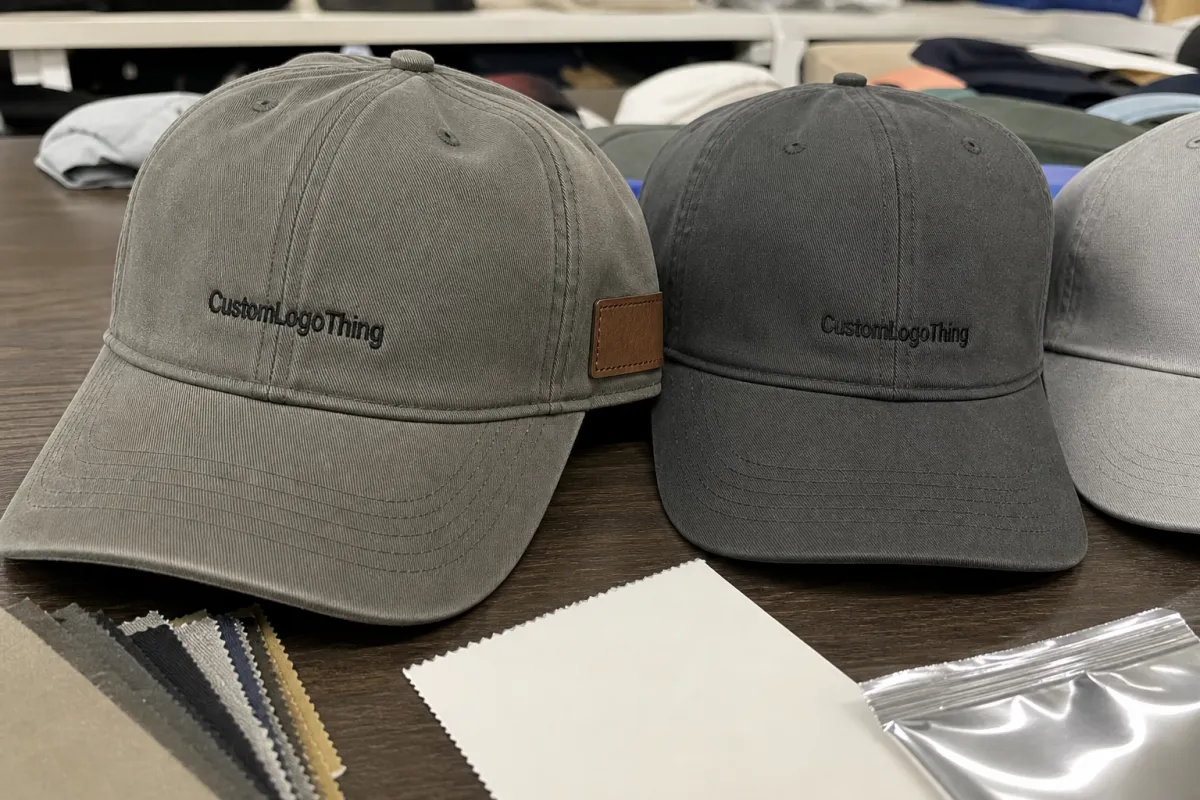
Two caps can appear nearly identical and still land in very different cost bands. The reason is simple enough. The factory is not pricing the silhouette alone; it is pricing construction time, trimming, decoration, and quality-control risk. A structured front panel adds support material. A higher crown changes patterning. A metal buckle takes more time to source and assemble than a plastic snap. Dense embroidery needs more stitches, and stitches are labor.
Fabric choice also moves the number more than many buyers expect. A 260-300 gsm cotton twill cap usually carries a different cost profile than a lighter brushed chino or a polyester blend. Cotton often feels more familiar and can hold embroidery well, but heavier fabric can stiffen the cap and push sewing time up slightly. Polyester can improve shade consistency across reorders, yet it may need a different hand-feel decision to avoid looking cheap on the rack. None of that is obvious from a product photo.
The same goes for retail pack-out. A cap sold in a branded polybag with barcode, hangtag, fiber content label, and size sticker is not the same job as a cap tossed into an export carton. Packaging can add only a small amount per unit, but on a 5,000-piece run, those cents become a line item worth reading carefully. A buyer who skips pack-out details often ends up paying for them later at the warehouse.
A quote becomes useful only when it separates the fixed build from the optional extras. Otherwise, the lowest number is just the least complete one.
There is also the issue of repeatability. Retail programs often reorder. The first run may include a color approval, a sample sign-off, and a lot of extra attention from the factory. Reorders are less forgiving. If the first cap uses a custom thread shade or a specialty buckle, that part has to be sourced again. If the second run lands three months later, dye lot variation becomes part of the story. A careful quote should flag those risks before the order is placed.
Style and Decoration Options That Fit Retail Shelves
Retail cap styling is more than a fashion choice. It affects how fast the product moves. A 5-panel cap gives a wide front panel and a cleaner print field, which helps if the logo has hard edges, typography, or a simple graphic mark. A 6-panel cap feels more traditional and usually handles embroidery well because the front panel shape is familiar to most cap factories. Dad caps bring a softer, lower-profile look. Trucker caps add ventilation and can read lighter in summer assortments. Snapbacks skew more streetwear. Rope caps, especially with a contrasting rope, often lean into heritage or outdoor retail.
Decoration should fit the artwork, not force the artwork to fit the decoration. Flat embroidery is the workhorse: durable, easy to explain to retail buyers, and often the best balance of cost and shelf impact. 3D puff embroidery has stronger dimensional presence, but it is less forgiving on tiny letters or intricate line work. A woven patch can preserve small text better than stitches can. Printed patches are useful when the art needs color nuance or a gradient that embroidery would flatten. A woven label or small badge can also keep the cap body cleaner, which helps if the brand wants a quieter, more premium look.
There is a practical trade-off that shows up on every sample table. High-impact decoration usually increases cost and approval time. More texture means more chances for registration issues, loose threads, or edge cleanup problems. A buyer focused on retail margin sometimes gets a better result by simplifying the logo and improving the cap body instead of trying to cram every detail into the front panel. The cap ends up more readable, and the factory has fewer ways to miss the mark.
| Program type | Typical MOQ | Indicative FOB range | Best fit |
|---|---|---|---|
| Simple embroidered dad cap | 300-500 pcs per color | $1.80-$2.90 | Core retail basics, promo programs, steady replenishment |
| Patch-decorated 6-panel cap | 500-1,000 pcs per color | $2.40-$4.20 | Sharper shelf presence with moderate decoration cost |
| Premium rope cap with specialty trim | 1,000 pcs and up | $4.00-$6.50 | Higher-ticket retail, souvenir lines, lifestyle drops |
Those ranges are directional, not promises. A custom inner label, a matched underbrim, a special sweatband, or a complex closure can move the quote faster than the cap body itself. Add a retail hangtag, barcode sticker, and sealed polybag, and the difference between a loose bulk pack and a shelf-ready pack can become visible on the invoice.
One detail that gets overlooked is how the cap should look after transit, not just after sewing. Soft caps can flatten in carton. Structured fronts can crease if the insert is too thin. A retail program that needs the cap to hold shape on arrival should specify the packaging format early, because a factory will quote a different packing method for a cap that must stand up on display than for one that will be unfolded by the customer later.
Construction Specs Buyers Should Lock Before Ordering
Before asking for samples, lock the specs that affect both appearance and cost. Crown height, brim curve, front-panel structure, back closure, sweatband type, and seam taping all change the final result. So does the number of panels. A structured front panel supports embroidery better. An unstructured front feels softer, but it can show distortion if the logo is too large or the fabric is too thin. A fabric strap with a brass buckle sends a different retail signal than a plastic snap. That difference is not cosmetic trivia; it changes the manufacturing path.
Material selection should be tied to the channel. Cotton twill is still the safest starting point for many retail programs because it handles embroidery well and has familiar hand-feel. A brushed chino cap can look a little cleaner and slightly more refined. Polyester is useful for consistent dye lots and lower moisture retention. Mesh makes sense for summer assortments and lighter weight. Recycled blends work when the brand needs a sustainability story, although the texture and price can vary more than buyers like to admit. Some recycled fabrics look close to standard twill; others feel noticeably different. That should be evaluated before bulk approval, not after.
There is a temptation to specify the heaviest possible fabric because heavier sounds premium. In practice, that is only half true. A 300 gsm twill can help a cap sit crisply, but in hot weather or in a soft-fashion program, it can feel overbuilt. A lighter cap may sell better if the buyer wants comfort and casual wear rather than a rigid display piece. The right answer depends on the retail floor, not the spec sheet alone.
Color management deserves its own line in the brief. Pantone references, thread codes, and logo placement tolerance should be spelled out clearly. A half-millimeter shift can look trivial in a CAD file and obvious on a finished cap. If the artwork includes small type, gradients, or thin borders, the factory may recommend a woven patch, a printed patch, or a simplified stitch count. That advice is usually worth taking. It is cheaper to simplify the art than to reject a bad sample three times.
| Spec item | Common retail choices | Buyer impact |
|---|---|---|
| Fabric weight | 220-300 gsm depending on style | Affects structure, hand-feel, and shipping bulk |
| Front panel | Structured or unstructured | Changes embroidery support and overall shape |
| Closure | Snap, strap buckle, Velcro, fitted | Influences cost, retail positioning, and fit perception |
| Decoration zone | Embroidery, patch, print, badge | Determines stitch time, art clarity, and approval risk |
A one-page tech pack saves time because it keeps everyone quoting the same object. The sheet should show cap style, fabric, lining or sweatband choice, closure, decoration method, trim details, packaging, carton count, and target ship date. Leaving any of those blank sounds harmless at first. Later, it becomes the reason two quotes cannot be compared fairly.
How to Read a Retail Merch Caps Factory Quote
A proper retail merch Caps Factory Quote should show more than a single unit price. The most useful quotes break out the sample fee, decoration setup, cap body cost, trim cost, packing cost, and shipping terms. If one supplier is cheaper but does not include labels, barcodes, or carton packing, the low number is not really low. It is incomplete.
The line items matter because each one hides a different kind of labor. Sample fees cover prototype work and artwork handling. Decoration setup may include digitizing embroidery files, making patch tooling, or preparing screens. Packing costs cover folding, bagging, labeling, and carton handling. Freight terms change the comparison entirely. FOB, EXW, and delivered pricing are not interchangeable, even when the cap looks identical on the screen.
MOQ has a direct effect on price, and that effect is not linear. A 500-piece run often costs much more per unit than a 5,000-piece run because setup fees are spread across fewer caps. That is not the factory being difficult. It is math. If the order is split across multiple colors, the cost can rise again because each color may need its own trim count, label count, and carton plan. A buyer who wants a clean price comparison should ask for pricing at 500, 1,000, 3,000, and 5,000 pieces if the program may scale later.
| Quote line item | What it covers | Why it matters |
|---|---|---|
| Sample fee | Prototype making and art setup | Tells you whether the factory is building a true approval sample |
| Decoration setup | Embroidery digitizing, patch tooling, or print prep | Often the biggest swing factor on small orders |
| Packaging | Polybag, hangtag, size sticker, barcode label, inner carton | Needed for shelf presentation and warehouse handling |
| Freight terms | FOB, EXW, or delivered pricing | Needed to compare offers on the same basis |
A clean quote should also show what can change the price later. Common examples are thread color changes, extra embroidery colors, custom buckles, special wash finishes, and retail packing changes after sample approval. If those items are hidden in the quote, the buyer ends up negotiating against the invoice instead of the brief.
The most honest suppliers are the ones that tell you where the sharp edges are. For example, if your logo has tiny lettering, the factory may warn that embroidery will blur and suggest a patch. If you want a soft cap with a structured front, they may point out that the front will not sit naturally unless an insert is added. Those observations are not upsells by default. Often they are the difference between a cap that sells and a cap that sits in inventory.
Factory Process and Timeline From Approval to Shipment
The production flow usually follows a predictable sequence: quote review, spec confirmation, artwork check, sample development, sample approval, bulk cutting and decoration, sewing, finishing, quality control, and packing. The order sounds straightforward because it is. The problem is that delays tend to cluster around the same three points: missing artwork details, slow sample approval, and material shortages. A buyer who controls those three areas usually gets a cleaner timeline.
Standard materials speed things up. A vector logo, Pantone references, and a clear placement map help the factory move from quote to sample without guessing. A blurry screenshot or a logo sent as a low-resolution image forces extra back-and-forth. Custom-dyed fabric, specialty buckles, and unusual trims add time because they have to be sourced and checked before bulk work starts. On a small order, a custom part can matter more than the cap body itself.
As a planning baseline, many simple samples can be turned in about 7-10 business days. Bulk production often runs 12-20 business days after approval, though this changes with quantity, peak season pressure, and how much decoration is involved. A flat embroidery cap can move faster than a patch-heavy or specialty-trim program. The range is wider than many purchasing teams would like, but it is more realistic than pretending every cap takes the same amount of time.
Shipping deserves its own schedule because the factory schedule is only half the picture. Inland transfer, booking, export paperwork, customs checks, and warehouse receiving all add friction. If the retail launch is tied to a specific event, the buyer should build in buffer time rather than squeeze the calendar. Caps are not fragile in the same way glass is fragile, but they are easy to crush, crease, or mislabel. Carton strength, stacking height, and pallet planning can matter more than people expect.
There is one more practical point. The production timeline should reflect the order's real complexity, not the optimistic one. If the first sample required a stitch adjustment, assume a little extra time for the bulk run. If the artwork changed after approval, reset the clock mentally, because a changed logo is almost never a free change. That kind of discipline keeps the project honest.
Why a Cap-Focused Factory Delivers Better Retail Results
A factory that works on caps regularly tends to be sharper on the details that retail buyers care about. Panel symmetry, front-panel stiffness, embroidery registration, visor curvature, and closure alignment are all easier to control when the team sees the same product category every day. The difference shows up first in the sample and later in the reorders. That is where a cap specialist usually earns trust.
Repeatability is a bigger issue than many buyers expect. Retail programs do not always end after the first purchase order. If the cap sells, the reorder has to match the original well enough that customers do not notice the change. A factory with cap-specific experience is more likely to keep the same stitch settings, trim standard, and packing format intact. That does not eliminate variation, but it reduces it.
QC should be specific rather than broad. A careful cap inspection checks logo placement, stitch tension, crown symmetry, brim curve, stain marks, loose thread ends, label accuracy, carton count, and packing consistency. Some buyers also ask for shade banding control on colored panels or compare samples under different lighting because a cap that looks identical under warehouse lights can shift under store lighting. That is not overcautious. It is how color complaints get prevented.
There is also a structural benefit to a cap-focused factory: they are more likely to suggest a construction adjustment before a problem turns into scrap. A slightly smaller stitch field can clean up a logo. A different thread weight can keep fine lines legible. A modified insert can help a front panel sit correctly without over-firming the cap. Those are practical fixes, not theory, and they often save both time and budget.
For the buyer, the payoff is less drama. A clearer Retail Merch Caps factory quote makes it easier to compare margin, launch timing, and reorder risk. A better factory makes the quote match the build, the build match the sample, and the sample match the bulk order. That chain is what retail teams actually need.
Next Steps to Request a Clean Factory Quote
Start with a brief that answers the basic production questions: cap style, quantity by color, fabric preference, decoration method, trim details, packaging format, target retail price, and required delivery date. If you have a hard ceiling on cost, say so. If the cap needs to fit a display fixture or ship in a specific carton count, include that too. The more concrete the brief, the less the factory has to assume.
It also helps to name one primary decoration method and one fallback. For example, flat embroidery may be the main option, with a woven patch as the backup if the design is too detailed. That gives the factory room to quote both paths without confusion. A good quote is not just a number. It is a comparison tool that helps the buyer decide whether the product belongs at the planned retail price.
The strongest programs are the ones that treat the cap as a finished retail object, not as a blank blank-slate item. That means thinking through the shelf, the carton, the reorder, and the warehouse before the quote is even sent. Do that, and the price starts making sense instead of looking arbitrary.
What should I send for a retail merch caps factory quote?
Send the cap style, artwork, quantity by color, fabric preference, decoration method, packaging needs, and target delivery date. If you have a retail price target or shelf format, include that too, because it changes the recommended build.
How does MOQ affect retail merch cap pricing?
Lower MOQs usually raise unit cost because setup, sampling, and decoration work are spread across fewer pieces. Larger runs lower the per-unit price, but only if the extra inventory fits the sell-through plan.
What decoration method usually works best for retail caps?
Flat embroidery is the most common starting point because it is durable and easy to read. Patches and 3D puff can create more shelf impact, but they work best when the logo details and price point support the extra cost.
How long does cap sampling and bulk production usually take?
Simple samples often take about 7-10 business days, and bulk production commonly runs 12-20 business days after approval. Specialty trims, custom-dyed fabric, or slow artwork approval can stretch that timeline.
How do I compare two quotes fairly?
Make sure both quotes use the same cap style, fabric, decoration method, packaging, quantity, and shipping terms. Check whether sample fees, labels, cartons, and freight are included before judging the lower price.


