Ribbed Winter Hats material and sizing guide decisions can look straightforward on paper, yet the finished hat is shaped by far more than the color and logo. A ribbed beanie depends on yarn choice, stitch density, cuff construction, and how much recovery the knit keeps after repeated wear. Two samples may appear almost identical on a table and still behave very differently once they are pulled on, folded into a pocket, left in a cold car, or worn for an entire commute.
That is why buyers who approach ribbed hats as a material-and-fit project usually get better results than those who treat them as a simple decoration order. The right build holds shape, fits a wider range of heads, and still feels comfortable after the first few wears. The wrong build may look fine at delivery, then loosen, pill, or sit too shallow at the forehead once real use begins.
For retail programs, staff uniforms, and seasonal promotions, those differences matter. A one-size hat needs enough stretch to suit most adults without feeling sloppy, and enough structure to look intentional on a shelf or display rack. The choices below keep the process practical: what the rib does, how the fiber changes performance, where fit usually fails, and which specs deserve a closer check before production starts.
Ribbed winter hats material and sizing guide
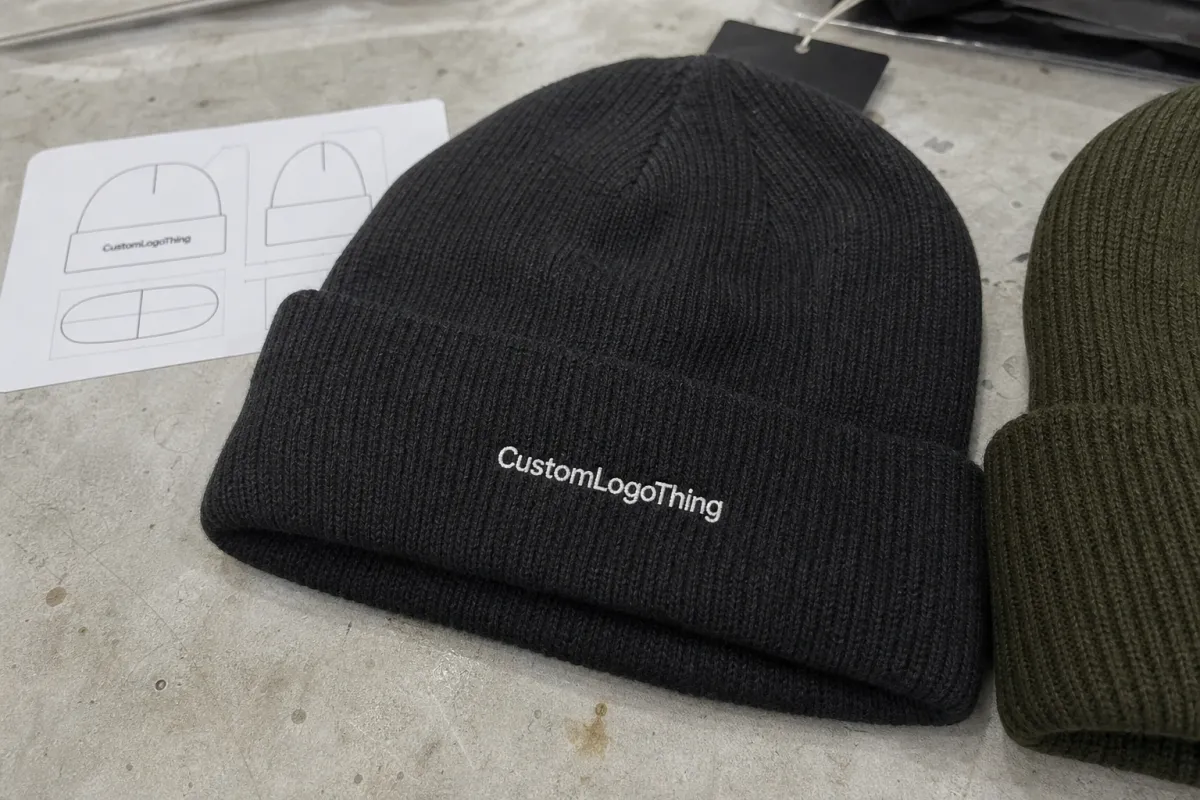
Ribbing is not just a visual texture. The raised and recessed columns create a knit that stretches sideways, then pulls back into shape. That built-in movement is the reason ribbed beanies can fit a broad audience without needing multiple size runs. A flat knit can also work, but ribbed construction is usually more forgiving and often warmer because the vertical structure traps air more effectively.
Still, “forgiving” does not mean “universal.” A tight rib in a wool blend behaves differently from a loose rib in lightweight acrylic. One may feel firm, close to the head, and more premium. The other may feel easygoing and comfortable but lose shape sooner if the yarn has weak memory. The buyer needs to decide whether the priority is durability, warmth, softness, low cost, or a more fashion-led drape.
That decision should also reflect the wearer. A winter hat for outdoor crews, a ski-shop retail line, and a campus giveaway do not need the same hand feel or the same amount of slouch. A custom beanie that works well for a broad adult audience often needs a middle path: enough stretch to avoid pressure points, enough rebound to stay neat, and enough loft to feel warm without turning bulky.
In practice, the most dependable orders are the ones that define fabric, fit range, and decoration together. That keeps the ribbed winter hats Material and Sizing guide grounded in actual use rather than in abstract spec language. A better sample leads to better approval, and better approval reduces returns, rework, and awkward surprises after delivery.
How rib knit construction changes stretch and warmth
Rib knit fabric works like a small series of springs. Pull it outward and the columns open; release tension and the knit should return close to its original shape. That stretch is why ribbed beanies often fit a wide head range with less visible strain at the seams than a tighter woven cap would show.
Rib density changes the result more than many first-time buyers expect. A denser rib usually looks cleaner, feels heavier, and holds heat more effectively because the knit structure is compact. A looser rib stretches more easily and may fit larger heads or thicker hair better, but it can also relax faster if the yarn is soft with limited recovery. Once that happens, the hat starts sliding lower and looking tired before the season ends.
Recovery deserves as much attention as warmth. A sample that expands well but stays stretched out after wear creates a return risk, especially in retail. The same issue appears at the cuff and crown, where pressure is highest. If the hat loses its spring there, the whole piece looks worn out even when it is still new.
Compared with flat-knit styles, ribbed hats are generally better at absorbing fit variation. That does not mean the design is carefree. It means the knit can hide a wider range of heads while still keeping a decent silhouette. For buyers, that is useful because one size can cover more people, but the exact fabric and stitch choice still decide whether the result looks polished or oversized.
If a supplier cannot explain rib density, recovery, and finished stretch range in plain terms, ask for a revised spec sheet before approving the sample.
There is also a packaging side to this. A hat that is folded cleanly and shipped in a corrugated cardboard mailer with kraft paper fill often arrives with a better retail presentation than one thrown into a loose poly bag. If sustainability claims are part of the brief, confirm whether the packaging uses FSC certified board, post-consumer recycled content, or biodegradable packaging components. Small details like that matter because they affect both presentation and credibility.
Materials that change feel, durability, and insulation
Fiber choice has a direct effect on warmth, pilling, wash care, and price. Acrylic remains common because it is cost-effective, easy to dye, and soft enough for many everyday programs. Wool insulates better in cold, damp weather and usually feels more premium. Wool blends sit between the two, giving some of the warmth and structure of wool while reducing cost or scratchiness. Recycled polyester is used more often now because many buyers want recycled materials and a cleaner sustainability story.
| Material | Feel and warmth | Durability | Typical buyer use | Relative cost |
|---|---|---|---|---|
| Acrylic | Soft, moderate warmth, strong color range | Good if knit tightly; pilling can appear with wear | Value retail, giveaways, staff programs | $ |
| Wool or wool blend | Warmer, breathable, more premium hand feel | Usually strong structure; care needs are higher | Retail, premium merch, colder climates | $$$ |
| Cotton blend | Light, breathable, less insulating | Washable, but not the best winter performer | Mild weather, fashion-led collections | $$ |
| Recycled polyester | Smoother hand, medium warmth, consistent look | Often strong shape retention and color stability | Sustainability-led programs | $$ |
Acrylic is often the default for large orders for a practical reason: it keeps unit cost manageable without giving up too much softness. A tightly knit acrylic hat can work well for seasonal promotions, especially if the goal is broad appeal and moderate warmth. Wool and wool blends usually cost more, but they also raise perceived value. That can matter if the hat is being sold alongside apparel rather than handed out at an event.
Lining changes the equation quickly. A fleece or thermal lining improves comfort in windy or very cold conditions, but it reduces the natural stretch of the ribbed shell. That means a hat that felt generous unlined can become noticeably snug once a lining is added. Buyers often miss that until a wearer with thicker hair or a larger head tests the final piece.
Material choice also affects decoration. Dense acrylic and wool blends often hold embroidery well, but very soft knits can show distortion around stitched areas if the backing is too heavy. Recycled polyester may offer better shape stability in some constructions, though the yarn hand can feel different from standard acrylic. If the order depends on logo clarity, sample the exact construction that will be produced, not a close substitute.
Quality claims should be checked with the same care. If the project uses FSC certified cartons, recycled mailers, or biodegradable packaging, confirm which components actually meet the standard and which only support the aesthetic. The EPA provides straightforward recycling guidance at epa.gov, and ISTA standards are often referenced for packaging and transit testing at ista.org.
Sizing ranges, cuff depth, and fit tolerances
With Ribbed Winter Hats, size is less about a label and more about the usable range of the knit. Most adult programs need coverage around 21.5 to 24.5 inches in head circumference, but that range should be adjusted for the intended audience. A technical workwear order, for example, may need a roomier opening. A fashion retail order may need a closer, cleaner fit.
Measure actual wearers if possible. A generic size chart is a starting point, not proof. Two hats marked one size can still differ enough in relaxed width to create fit complaints, especially if one knit is denser or uses a heavier yarn. A half-inch difference may not sound large on paper, but on the head it can separate a secure fit from one that slips.
Cuff depth is one of the simplest ways to fine-tune the fit. A deeper cuff increases forehead coverage and gives the hat more presence. A shallower cuff looks cleaner and can reduce bulk. It also changes how much visible space is available for embroidery or labels. If the logo needs to sit centered and flat, cuff proportion is not a decorative detail; it is part of the sizing spec.
Request tolerances in both the relaxed and stretched states. Reasonable variance might be a quarter inch, depending on the construction. Once the difference grows beyond that, the hat can look inconsistent from piece to piece. That is most noticeable in retail packing, where two hats in the same color should feel like they belong to the same production run.
Decoration should be tested after the hat is stretched, not only in its flat state. Embroidery, woven labels, and sewn patches can change how the hat sits on the head. A piece that feels fine before decoration may become tighter, heavier at the front, or slightly tilted once the branding is attached. That is especially true on lighter knits where extra stitching has more influence on the structure.
Pricing drivers, MOQ, and unit cost
Price usually comes down to yarn, stitch complexity, decoration, lining, color count, and pack-out. A simple ribbed beanie with a woven label is one cost profile. A wool blend hat with embroidery, custom hang tags, and branded retail packaging is another. The fabric may be similar in shape, but the production path is not.
MOQ has a real effect on unit price because setup work is spread across the run. A 200-piece order often costs more per unit than a 2,000-piece order, even if the hat looks nearly identical. That is not just margin; it reflects sample handling, machine setup, yarn allocation, and inspection time. For basic acrylic programs at larger quantities, unit pricing may fall around $3.50 to $6.50 per piece. Wool blends, lining, complex decoration, or lower MOQs can move the range to roughly $7 to $14 per piece or more, depending on the specification.
Sampling, revisions, and color matching can add extra cost before production begins. A buyer who asks for a custom crown shape, adjusted cuff height, or a specific Pantone match should expect at least one revision cycle. Those changes are normal, but they should be budgeted instead of treated as an exception.
Compare quotes only after every supplier is matching the same details. One quote may appear cheaper because it excludes lining or uses a thinner yarn. Another may include FSC certified cartons, kraft paper fill, or individual retail packs. The landed cost can be higher, but so can the presentation and shipping protection. The useful question is not just what the hat costs at the factory door; it is what arrives on the receiving dock.
- Lowest visible price: basic acrylic, limited decoration, simple bulk packing.
- Mid-range value: better yarn, cleaner recovery, woven label, standard carton pack-out.
- Premium: wool blend or recycled yarn, lining, special trim, branded packaging, tighter QC.
The cheapest quote is rarely the best choice if the hat pills, stretches out, or arrives with uneven sizing. A modest increase in yarn quality can pay back through fewer complaints, better reorders, and a more credible retail appearance.
Sample approval, production steps, and turnaround
Good approvals happen in stages. First comes the brief: material, fit range, cuff height, logo placement, color, quantity, and packaging. Then comes the sample. Then comes sign-off. If one of those steps is skipped, the final production run has more room to miss the target.
The production flow is usually straightforward: yarn sourcing, knitting, finishing, labeling, inspection, and packing. If a lining or sewn patch is included, the process adds another stage. Color matching can also extend the schedule, especially when a buyer wants a specific shade rather than a standard stock tone. For standard ribbed hats, lead time often lands around 12 to 20 business days after sample approval, although cold-weather peak season and specialty yarn sourcing can stretch that window.
Fit samples should be worn, not just held. The smallest intended wearer and the largest intended wearer should both test the hat for several minutes. A beanie can look perfect on a table and still feel too tight at the temples, too shallow at the crown, or too loose around the ear line once it is worn. Those issues are easier to catch before production than after hundreds of pieces are already in motion.
Ask for the sample in the final production yarn. A substitute fiber can hide stretch and warmth problems that only appear in the real knit.
Packaging belongs in the approval process too. Bulk shipping in corrugated cardboard with kraft paper separation is efficient and usually protects shape well. If the program is retail-facing, the fold direction, insert card, and carton count should be fixed before production. If the buyer needs biodegradable packaging or a recycled-material claim, the supplier should specify exactly which parts qualify. Vague sustainability language helps no one during a receiving inspection.
Transit handling should also be considered, especially for larger distributions. A hat is not fragile in the same way glass is, but poor pack-out can still crush the cuff, bend the labels, or introduce moisture problems in humid shipments. Thinking about packaging early saves unnecessary repacking later.
Step-by-step sizing checklist for buyers
A simple checklist solves many ribbed hat problems before they turn into production revisions. Use the steps below before signing off on the order.
- Define the wearer. Retail customer, employee, student, or event audience each needs a different fit attitude.
- Set the weather target. Mild chill, windy commute, or real winter cold changes the fabric and lining decision.
- Measure the head range. Record actual circumference numbers for the smallest and largest intended users.
- Choose stretch behavior. Decide whether the hat should feel snug, relaxed, or roomy over hair or a helmet.
- Pick rib density. Tight ribs look firmer; looser ribs open more easily but may relax sooner.
- Confirm cuff height. Cuff depth affects warmth, fit, and the usable space for decoration.
- Verify decoration placement. The logo should stay centered after stretching and not drift when worn.
- Lock packaging early. Fold style, insert cards, and carton format should be approved before production.
The strongest briefs are specific about what the hat must do in use. A buyer who knows whether the wearer will be outdoors all day or wearing the hat on a commute can choose a better yarn blend. A buyer who knows the logo needs to sit above a folded cuff can avoid a placement problem that otherwise shows up only after finishing. The best use of this Ribbed Winter Hats material and sizing guide is to keep those details visible before the sample is approved.
Common mistakes, expert tips, and next steps
The most common mistake is assuming all ribbed beanies behave similarly because they look similar. They do not. A dense 2x2 rib in wool blend will feel different from a softer acrylic knit, and a lining changes the fit again. Even if the appearance is close, the wear experience can be far apart.
Another recurring problem is approving the sample without a real wear test. Flat inspection catches surface issues, but it does not show pressure points or recovery loss. Ask a few people with different head sizes to wear the sample for at least ten minutes. If the hat rides up, leaves marks, or opens out too much at the cuff, the fit needs another round.
These checks are worth keeping in front of every order:
- Request relaxed width, stretched width, and cuff depth in inches or centimeters.
- Check seam comfort inside the crown, especially on lined hats.
- Compare the sample on smaller and larger heads rather than on a single mannequin.
- Match quotes only after yarn, knit density, label method, and packaging are identical.
- Confirm whether any recycled or FSC claim is supported by actual documentation.
The best orders are usually the least dramatic ones. They have clear specs, realistic expectations, and a fit sample that was tested by actual wearers. A slightly higher yarn cost can be a smart spend if it holds shape longer, feels better on the head, and reduces complaints after distribution. That is especially true for custom winter merch that people are expected to wear often.
If the choice is still open, narrow the field to two or three yarn blends, request a true fit sample, and compare stretch, warmth, and price side by side. That approach usually reveals the best balance faster than reviewing a stack of near-identical quotes. Keep the fit logic, not the sales language, at the center of the decision.
How do I choose the right ribbed winter hats size for different head sizes?
Start with real head circumference ranges instead of assuming one universal fit. Then choose a rib density and cuff depth that allow stretch without losing shape. The most reliable check is a wear test on both the smallest and largest intended users before production begins.
What is the best material for ribbed winter hats if warmth is the priority?
Wool and wool blends usually insulate better than standard acrylic, especially in cold, damp conditions. Acrylic is still a useful option for lower-cost programs and easier care. If the hat has to perform in harsher weather, adding a lining is often more effective than relying on the outer knit alone.
Why do some ribbed beanies fit loosely after a few wears?
The yarn may have weak recovery, even if the hat felt snug at first. A looser rib structure can relax faster than a tighter knit, and repeated stretching, heat, and rough handling can speed up that change. That is why recovery should be checked during sampling, not guessed from appearance.
What affects the price of ribbed winter hats the most?
Material, stitch complexity, and branding method usually have the biggest impact. MOQ changes unit cost because setup is spread across the run, and lining, special packaging, or extra revisions can raise the final quote. Compare like with like so the numbers stay meaningful.
What should I confirm before placing a custom ribbed winter hat order?
Confirm the size range, material blend, cuff height, logo placement, and packaging format. Ask for a sample and test comfort, stretch, and recovery on real wearers. Also verify the production timeline, pack-out details, and approval deadline before releasing the order.
For most buyers, the best result comes from balancing fit, warmth, and cost without overcomplicating the specification. Keep the ribbed winter hats Material and Sizing guide tied to real users, true samples, and practical packaging choices, and the finished hats are far more likely to perform well through the season.


