A rope handle bag can look finished long before it behaves like a finished product. That is the trap. A sample that looks crisp on a screen or under showroom lights can still fail once it is lifted, packed, stacked, or carried for more than a few seconds. A knot sits too high. A handle length feels awkward in the hand. The base bows under a real gift set instead of the lightweight dummy that was used for photography. The point of a rope handle gift Bags Sample Checklist is not to admire the sample. It is to expose those small failures before they become production losses.
Packaging buyers tend to learn that lesson the hard way. The visible defects are easy to catch. The expensive ones are quieter: paper board that looks thick but flexes too much, lamination that scuffs during transit, print that shifts a few millimeters and suddenly crowds the handle punch. Those mistakes do not just affect appearance. They affect fill rate, customer perception, and the cost of replacing or reworking stock.
So the job is straightforward, even if the details are not. Compare the sample against the spec, test it with the actual product, and record what passes and what fails. If the bag is meant to support a premium retail item, the sample should prove that it can do more than sit upright.
What the Sample Checklist Should Catch
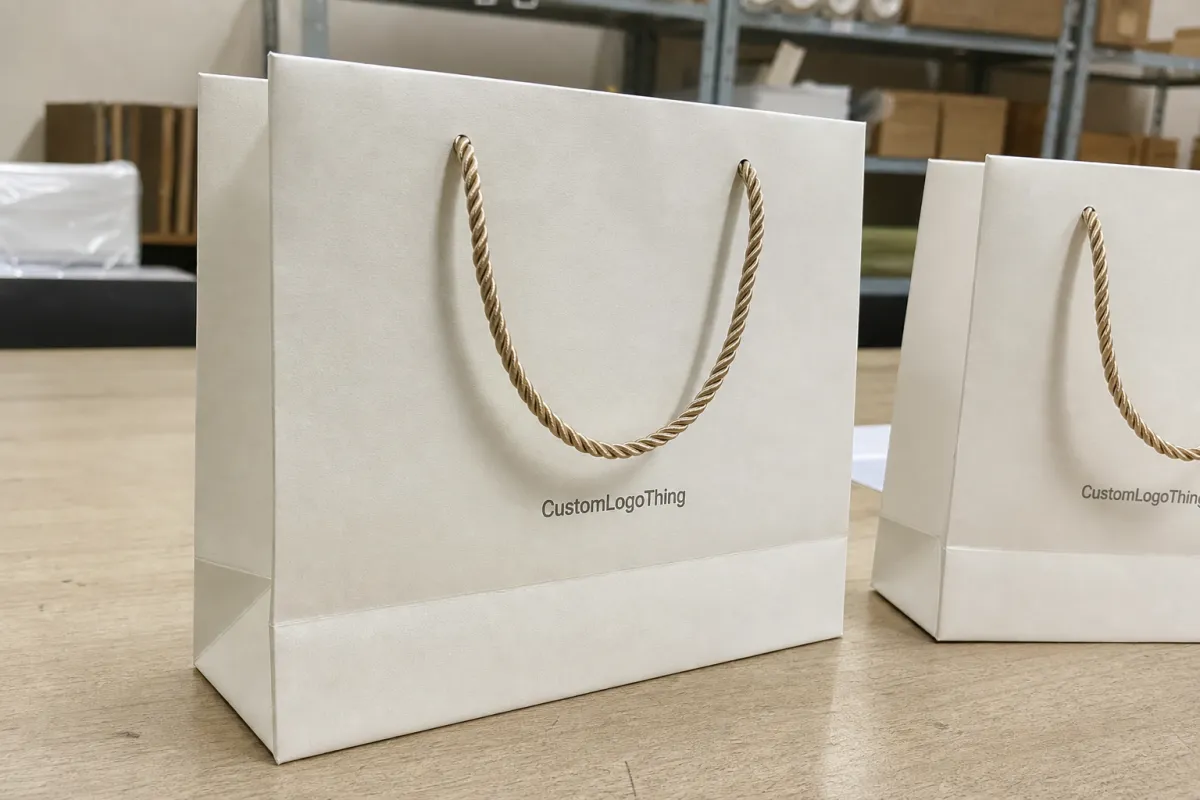
The first thing a good sample review catches is the gap between appearance and performance. A rope handle gift bag can pass the photo test and still fail the hand test. The handle may dig into the fingers. The top edge may collapse when the bag is tilted. The gusset may be too shallow for a box with rigid corners. Those are not decorative problems; they are functional ones.
A proper Rope Handle Gift Bags sample checklist should start with the physical basics: outer dimensions, usable internal space, board weight, handle type, reinforcement, and print placement. Then it should move into use conditions. How does the bag hold up with the real product inside? Does the bottom remain square after lifting? Does the opening stay wide enough for easy insertion? Does the handle knot stay centered? Small deviations matter because they stack up. A 2 mm shift in one place and a slightly weak fold in another can make the bag feel cheaply made even when the materials are acceptable.
Load capacity deserves more attention than it usually gets. A gift bag that works for a perfume box may fail badly when asked to support a heavier candle set, a multi-item holiday bundle, or a boxed apparel item with hard edges. A buyer does not need laboratory-grade testing for every order, but a practical load check is non-negotiable. Lift the packed bag. Hold it for 10 to 20 seconds. See whether the handles stretch, whether the top board bends, and whether the base begins to open at the corners.
A sample should answer one simple question: will this bag still look right after the product goes in and the customer picks it up?
That question cuts through a lot of noise. It forces the review away from vague impressions and toward real use. It also stops buyers from overvaluing a beautiful finish that cannot survive the actual packaging job.
How the Sampling Process Works From Brief to Approval
Most bag sampling follows a fairly predictable sequence. The buyer sends size, artwork, quantity target, material preference, handle style, and any special requirements such as matte lamination, foil, or a reinforced board insert. The supplier then produces a sample based on the stage of the project. A stock sample gives a general quality reference. A press proof checks print and placement. A pre-production sample should reflect the final construction as closely as possible.
Those categories are easy to mix up, and that is where many misunderstandings begin. A stock sample is not a promise of final dimensions. A proof is not a full test of handling performance. A pre-production sample is the one that should matter most when the order is close to release. If those roles blur, the buyer may approve the wrong thing and discover later that the production bag differs in structure, finish, or load behavior.
The best reviews are done with the real product, not a placeholder. Put the item inside. Close the bag. Lift it by the handle. Set it down and look at the fold lines. Check whether the product shifts in transit or bruises the interior walls. A bag can appear to be the right size on a specification sheet and still feel tight if the gusset shape or interior board reduces usable space. That detail is easy to miss until the sample is tested under normal packing conditions.
Written approval matters as much as the visual review. Mark up the sample, annotate the spec sheet, or use an approval form that records the exact version being accepted. That paper trail reduces arguments later, especially if the final run differs by handle knot style, sheen level, or logo placement. Buyers who document their decision carefully usually spend less time untangling disputes and more time fixing the actual issue.
Material, Size, and Reinforcement Specs That Change Performance
Three decisions shape most of the bag’s behavior: paper weight, reinforcement, and handle attachment. A 180gsm art paper bag does not behave like a 250gsm board-backed bag, even when the printed surface looks nearly identical. Heavier board improves stiffness, but stiffness is not the same as strength. If the handle anchor points are weak, the bag can still tear at the punch or crease sharply at the top edge.
The Rope Handle Gift Bags sample checklist should inspect the side gussets, bottom reinforcement, and the way the rope is fixed. Some bags use simple knotted rope through punched holes. Others use reinforced eyelets or internal tabs that spread force across a wider area. That difference matters. A well-anchored handle reduces the chance of tearing during repeated lifting. A weak one concentrates stress in a small spot, and paper loses that fight quickly.
Size deserves a careful read as well. Buyers often focus on height and width, but the usable opening is usually what determines whether the pack-out feels smooth. A wide exterior dimension can still be awkward if the top folds inward too much or if the handle positioning crowds the opening. That becomes a real problem with taller boxes, rigid cartons, or products that need to be inserted at a slight angle. Measure the actual internal opening, not just the marketing dimensions.
Finish changes behavior too. Matte lamination lowers glare and feels softer in hand. Gloss can brighten colors and give a stronger shelf presence, but it shows fingerprints and can reflect light aggressively. Uncoated paper often gives the most natural look, though it marks more easily and offers less protection against handling moisture. Soft-touch coatings can look expensive, but they may scuff if the bags travel through rough packing, tight cartons, or long freight routes. None of these finishes is automatically better. The right choice depends on where the bag will be used and how much handling it will face.
| Specification choice | Typical effect | Buyer risk if underspecified |
|---|---|---|
| Light board with rope handle | Lower cost, lighter feel, suitable for small gifts | Sagging base, weaker carry performance |
| Heavier board with reinforcement | Better structure and retail presence | Higher cost if the board weight exceeds the need |
| Matte or soft-touch lamination | Premium hand-feel, reduced glare | Surface scuffing if the finish is too delicate |
| Uncoated or natural paper | Organic look, easier recyclability in some formats | Less moisture resistance and easier marking |
Match the construction to the product weight and the retail setting. A candle box on a boutique shelf has different demands than a holiday hamper moving through distribution. If a buyer needs a reference point, testing practices from groups such as ISTA can help frame transit stress, while the Institute of Packaging Professionals offers useful packaging education. Those resources do not replace a spec sheet, but they help set realistic expectations for performance.
Artwork, Finishes, and Branding Checks Before You Sign Off
Print is where a sample either builds confidence or exposes slippage. Buyers should check logo placement, color consistency, type size, barcode clarity, and alignment against folds and edges. A logo that sits a few millimeters too low may still look acceptable in isolation, but it can clash with the handle punch or appear cramped once the bag is assembled. Tiny type often disappears on textured paper. Barcodes can blur if the coating is too shiny or the ink gain is too high.
Special finishes need extra scrutiny because the screen version rarely tells the full truth. Foil looks sharp in a digital rendering and can soften under warm retail lighting. Embossing can flatten detail if the artwork is too fine. Spot UV or other contrast finishes can look elegant on smooth stock and muddy on absorbent paper. Buyers should expect small differences between the approved proof and the finished sample. The mistake is expecting those differences to be trivial when they can change the tone of the whole package.
Lighting matters more than many teams admit. Review the sample under daylight and under indoor light. A navy logo that reads cleanly near a window may look flat under warm LEDs. Red, black, and metallic inks are especially sensitive to the lighting environment. If the bag will sit beside tissue, inserts, sleeves, or cartons, compare those pieces together. The package should feel like one system, not a stack of separate purchases.
If sustainability claims are part of the brief, confirm the material and finish before production starts. FSC paper, recyclable paper structures, and water-based inks are all useful options, but the claim has to match the actual build. A laminated bag may still be acceptable, depending on the program, yet it should not be described as something it is not. For teams that need traceability, FSC is a practical reference for certification language and chain-of-custody expectations.
One useful habit: place the sample next to a known-good branded item from the same product line. That side-by-side comparison exposes issues that a single sample can hide. The gloss may be too high. The logo may be too large. The color may sit just outside the family. Design teams usually catch this quickly. Operations teams may not, because they are focused on feasibility and cost. Both views are necessary.
Pricing, MOQ, and Quote Drivers
Price for a rope handle bag is shaped by five main variables: board grade, print complexity, finish level, handle type, and quantity. Two bags that look similar can land in very different price bands if one uses plain kraft stock and the other adds foil, lamination, custom rope color, and a reinforced bottom. A unit price alone can hide the real story. Setup, tooling, and sourcing are often what move the number.
MOQ has a direct effect on unit cost. Smaller runs carry more setup burden because the same printing and converting work is spread across fewer units. For a basic custom bag, a small-volume order may sit around $0.90 to $1.60 per unit, depending on size and construction. Larger orders can come down if the materials are standard and the supplier already has the paper and rope on hand. Add specialty finishes or unusual colors, and the cost can rise quickly. That is not a sign of evasiveness. It is how conversion work behaves.
Buyers should ask for quotes in a format that separates the key cost elements. Sample cost, plate or tooling charge, production unit price, freight, and carton format should each be visible. Bundled pricing makes it difficult to tell whether one supplier is actually cheaper or simply hiding a higher setup charge inside the unit price. A transparent quote is easier to compare, easier to negotiate, and easier to defend when finance asks why one bag costs more than another.
| Quote element | What it covers | Why it matters |
|---|---|---|
| Sample cost | One-off sample build and setup | Shows the real development expense |
| Tooling or plate charge | Print setup or die-related preparation | Separates one-time cost from repeat order cost |
| Production unit price | Bag cost at the agreed order volume | Lets buyers compare vendors on equal terms |
| Freight | Shipment from factory to destination | Can shift landed cost more than expected |
| Packaging format | Inner packs, cartons, palletizing | Affects damage rate and warehouse handling |
That is why the sampling process should not stop at the sample itself. If the quote is opaque, the approval is weaker than it looks.
Lead Time and Production Steps After Sample Approval
Once the sample is approved, production usually moves through final file lock, material booking, printing, converting, assembly, inspection, and packing. The sequence is familiar, but the timing is not fixed. Specialty paper, custom rope, or a finish that requires extra curing can slow the process before the first sheet is even printed. Sample turnaround and production lead time are rarely the same thing.
Typical production timing for a custom rope handle bag often falls around 12 to 15 business days after proof approval, although that depends on the build and the factory schedule. If the order needs custom rope color, foil stamping, or heavier board that is not currently in stock, the schedule can stretch. If artwork arrives late or needs correction, the timeline can reset. Buyers who want to avoid surprises should treat artwork discipline as part of schedule management, not as a separate design issue.
Milestones should be documented in writing. Approval date, material booking date, print start date, packing date, and ship date all matter. A promised delivery window is less useful if the team cannot see where the order stands inside that window. That matters most for launches, seasonal promotions, and trade events. A two-day slip can look minor on paper and still cause a missed shelf date.
Quality control is worth asking about before production starts. Does the supplier check handle strength, print registration, carton count, and finish consistency? Are random samples pulled from the run? Is there a final visual check before packing? These questions are practical, not academic. A sample can pass cleanly while the production run drifts if the paper lot changes or the converting line is adjusted mid-job.
Common Sampling Mistakes That Create Rework and Delays
The biggest mistake is approving the sample without testing it with the actual product. A jewelry box is not a candle set. A folded garment is not a rigid carton. A bag that feels fine empty can fail the moment the load changes shape or weight. Buyers should test the real item, or a close proxy, before signing off on anything structural.
Vague feedback creates another round of delay. Comments like “looks nice” or “almost right” are not useful for production. They force the supplier to guess. The better version is specific: move the logo up 4 mm, shift the handle color to match the ribbon sample, widen the bottom board, or reduce gloss on the outside laminate. The tighter the note, the faster the revision.
“Nice” is not a production instruction.
Comparing samples without a controlled method is another common error. One sample may use heavier stock, another may be smaller, and a third may simply be underfinanced in the quote. Without the same review sheet, the same lighting, and the same packed product, the comparison says more about the test than the bag. A fair comparison needs consistency.
Small mistakes on the dieline can also trigger big delays. A typo, a barcode too close to the fold, or a Pantone target that was never confirmed can turn a straightforward approval into a reprint. These are avoidable, and they are expensive when they are not caught early. Once the run is in motion, every correction costs more time and often more money too.
Expert Review and Next Steps Before Ordering
A final review should be methodical. Start with the brief and verify dimensions, weight capacity, print placement, handle strength, and finish quality. Then handle the sample the way a customer would: lift it, open it, load it, carry it, and inspect it again after use. That sequence reveals problems that are not obvious on a flat table. A fold that looked harmless may become clear once tension is applied to the handles.
Side-by-side scoring helps keep the decision practical. If there are two or three samples, rank each one on structure, print, comfort, and presentation. A simple 1-to-5 scale is enough. It narrows the debate. The best-looking bag is not always the best purchase. The right one is the one that supports the product, the brand, and the cost target without introducing hidden risk.
If changes are needed, request one revised sample with exact notes rather than a stack of open-ended edits. Then lock the approved spec sheet, quote, and timeline before releasing the order. That is where a Rope Handle Gift Bags sample checklist pays for itself. It turns a subjective approval into a documented buying decision.
My practical rule is simple: if the sample cannot survive your own review table, it is not ready for retail handling. Use the rope handle gift bags sample checklist to catch structural weaknesses, print mismatches, and quote surprises before they turn into rework. A careful hour at the sampling stage usually saves far more time than it costs.
What should a rope handle gift bags sample checklist include?
It should cover size, paper weight, handle type, reinforcement, print quality, finish, and pack-out fit. It should also confirm MOQ, unit cost, sample Cost, and Lead Time before approval.
How do I compare two rope handle bag samples fairly?
Use the same product, the same lighting, and the same review sheet for both samples. Score durability, color accuracy, handle comfort, and presentation instead of judging only appearance.
What affects rope handle gift bag pricing the most?
Material grade, print complexity, specialty finishes, handle style, and order quantity usually drive cost the most. Ask for a quote that separates setup, sampling, freight, and production so the unit price is clear.
How long should sample turnaround take?
Simple samples may return quickly, but custom materials, special finishes, or revised artwork can extend turnaround. Confirm the review window in writing so the full process timeline stays realistic.
What is the biggest mistake buyers make with bag samples?
They approve a sample without testing it with the actual product or checking handle and bottom strength. They also skip detailed notes, which creates avoidable production rework later.

