A Ribbed Winter Beanies reorder plan is a timing and spec-control exercise. Once a winter accessory starts moving, the window to restock core colors closes quickly, especially when cold-weather demand spikes after the first real drop in temperature.
The first run already proved the style can sell. The repeat order is about protecting the exact fit, handfeel, decoration, and landed cost that made it work the first time. If those details are not locked, a reorder can turn into a new product decision instead of a simple replenishment.
A retailer can usually absorb a small unit-cost increase. It is much harder to absorb a stockout during peak cold-weather demand.
That is why the best repeat programs keep specs, pricing, decoration, and lead time tied together. The order should be easy to quote, easy to approve, and easy to inspect against the last approved sample.
Why a missed winter restock hurts sell-through faster than a small price increase
Winter accessories do not sell evenly through the season. Demand often stays quiet, then jumps after the first cold snap, a weekend event, or a holiday push. Core colors like black, charcoal, navy, and heather gray usually move first because they work across more buyers and more channels. Once those colors are gone, the remaining stock often slows down even if the product itself is strong.
That is why a small price increase is usually easier to handle than a missed replenishment. A 5% to 10% unit-cost change may be manageable, but lost in-season sell-through is not. Late inventory often needs markdowns, and those discounts can cost more margin than the higher factory price would have.
This is also why the reorder trigger should come before the shelf looks empty. Waiting until inventory is visibly thin creates pressure on production, freight, and packaging. A disciplined ribbed winter beanies reorder plan protects the styles That Sell Fastest and treats slower fashion shades as a separate decision.
The practical takeaway is simple: if the style is working, reorder while there is still enough runway to absorb approvals and transit. Once the weather window is gone, the value of the repeat order drops fast.
Rib construction, yarn blend, and cuff details that shape repeat orders
Rib knit is popular because it stretches, recovers well, and gives a clean surface for branding. But not every rib behaves the same. A tighter 1x1 or 2x2 construction usually holds shape better, while a looser rib can feel softer but may relax more after wear.
Yarn choice changes both cost and performance. Acrylic is still the most common option because it is affordable, easy to source, and consistent across colorways. Acrylic-wool blends often feel warmer and more premium, but they raise cost and may require clearer care guidance. Polyester blends can improve color consistency and drying time, though the handfeel is usually less natural. Recycled yarns are increasingly common, but they can narrow supply options and make shade matching slower, especially in darker colors.
Cuff depth matters more than many buyers expect. A shallow cuff creates a lower-profile look and leaves less room for branding. A deeper cuff gives more space for embroidery or labels and can improve warmth, but it also changes the silhouette. If the cuff is too deep for the knit, a logo can look stretched when the beanie is worn.
Small construction changes can make a repeat order feel like a different product. Two beanies can share the same artwork and still wear differently if the knit density, yarn twist, or cuff fold changes. That is why a Ribbed Winter Beanies reorder plan should freeze build details as tightly as the logo file.
Three checks help separate a strong repeat style from a risky one:
- Shape retention: does the rib spring back after wear?
- Handfeel: does the blend feel retail-ready without losing durability?
- Decoration compatibility: does the surface support the chosen branding without puckering?
Specs to standardize before you request a repeat run
A repeat order should start from the approved spec sheet, not memory. The most common source of quote drift is a vague request that leaves the supplier to infer details from the first run. If the original style worked, lock the measurements before asking for a new price.
At minimum, the reorder file should confirm:
- Finished size: crown height, folded height, and fit range for adult unisex sizing.
- Cuff dimensions: width, fold depth, and available branding area.
- Yarn reference: Pantone, lab dip, retained swatch, or production code.
- Knit density: enough detail to reproduce the same body and stretch.
- Trim placement: side seam, back hem, center front, or cuff edge.
- Packaging format: flat pack, hang tag, tissue wrap, barcode sticker, or bulk carton count.
Some changes are low risk, such as a new carton count or a revised hang tag. Other changes should trigger a new proof. If the yarn blend changes, the cuff size changes, the logo moves, or the decoration method changes, the repeat is no longer a straight reorder. It is a revised product.
For teams managing several SKUs, one master record and one approved image set per version usually prevents confusion. That is often what separates a clean reorder from an email chain that keeps reopening the same decisions.
Cost, pricing, MOQ, and quote inputs that change unit cost
Pricing for ribbed beanies usually comes down to quantity, yarn type, color complexity, decoration method, and packaging. A 300-piece repeat with single-color embroidery will not price like a 2,000-piece run with custom yarn, woven labels, and retail-ready pack-out. The gap reflects setup time, knitting labor, finishing, and material cost.
MOQ usually rises as customization rises. Stock colors support lower minimums. Custom yarn shades, specialty patches, and multi-step packaging often push the minimum higher because the supplier has to reserve material and line time for a tighter window. A reorder that stays close to the original spec usually keeps MOQ and pricing more stable.
To sharpen a quote, the supplier needs a few concrete inputs: target quantity, delivery destination, approved spec sheet, prior PO if available, and exact decoration method. If the order includes multiple colors or sizes, the breakdown needs to be explicit. Ambiguous requests slow quoting and can create pricing with hidden room for revision later.
| Build type | Typical MOQ | Indicative unit price | What moves the cost | Best use |
|---|---|---|---|---|
| Stock acrylic, single embroidery hit | 300-500 pieces | $1.85-$2.60 | Simple yarn, standard colors, limited finishing | Fast replenishment for proven sellers |
| Acrylic-wool blend, woven label | 500-1,000 pieces | $2.40-$3.40 | Higher yarn cost, premium handfeel, label application | Retail programs with stronger perceived value |
| Custom color, patch, retail packaging | 1,000+ pieces | $3.10-$4.80 | Color matching, extra decoration steps, pack-out labor | Campaign drops and branded merchandise sets |
Those figures are directional. Seasonality, freight mode, destination, and raw material availability can move them quickly. A rushed repeat with split shipments can erase any savings from a better unit price. Packaging can also change landed cost more than buyers expect, especially when the original order was bulk packed and the reorder needs individual retail packing.
A sound Ribbed Winter Beanies reorder plan compares landed cost, not only the factory quote line. That gives a truer read on the real margin impact of a repeat run.
Process and timeline: sampling, approvals, and production steps
A repeat order moves quickly only when the factory does not have to guess. The usual sequence is quote, mockup, sample if needed, approval, knitting, finishing, quality check, packing, and shipment. Each step can add time if the details are still shifting.
Lead time usually expands for predictable reasons. Artwork edits trigger another proof. Color matching can add days if the yarn is not already confirmed. Peak season also creates queue pressure, and that pressure becomes more visible as autumn ends and shipping schedules tighten.
For an unchanged repeat, a 10 to 15 business day production window after approval is a reasonable working estimate, depending on queue and freight method. A custom rerun with new decoration or packaging often lands in the 15 to 25 business day range before transit. Shipping time still needs to be added on top of that.
The main planning question is whether the order is a true repeat or a repeat with revisions. If the beanie is unchanged, approve the existing spec and move. If the logo size, label, cuff depth, yarn color, or packing format is changing, expect sampling and a longer timeline. That distinction keeps the Ribbed Winter Beanies reorder plan realistic.
In QC, the comparison should be against the last approved sample, not only the tech pack. Measurements, stitch tension, loose ends, and carton counts all need to match. A repeat order that passes on paper but fails in the carton is not a successful reorder.
Decoration choices and branding placements that hold up through the season
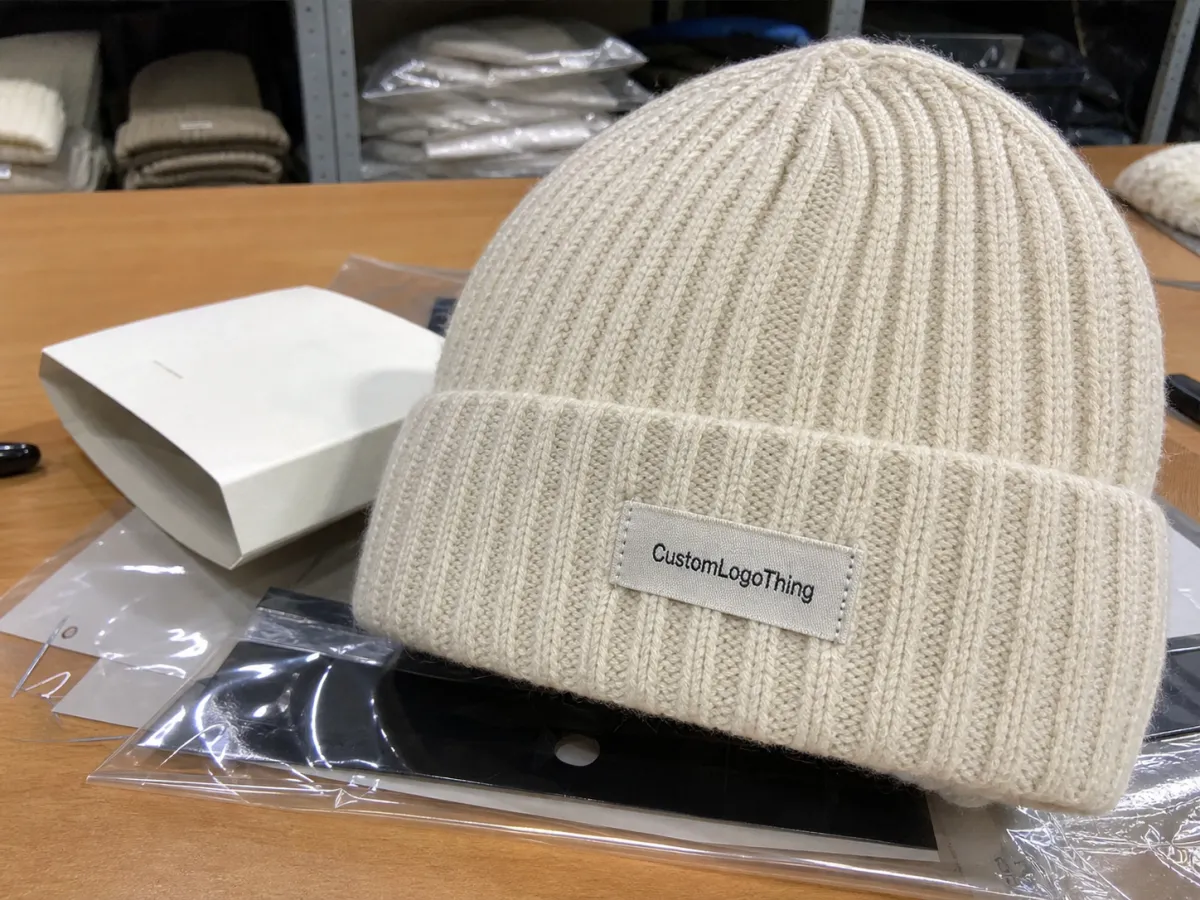
Decoration is where repeat orders either stay consistent or start to drift. Embroidery is durable and familiar. Woven labels create a clean retail look. Patches add dimension and can support more detailed logos. Knit-in graphics work best when the logo should feel built into the garment rather than added afterward.
Placement matters as much as method. Ribbed knit stretches, so small text can distort if it sits too low or too close to the fold. Very narrow logos can pucker. Oversized logos can lose the flat surface they need for a clean finish. On a cuffed beanie, a medium-size mark often reads more clearly than a tiny satin-stitch logo on a heavily stretched rib.
Repeat orders should usually preserve the decoration method that already proved stable. If embroidery held up through wear and shipping, keep embroidery. If the woven label stayed flat through the season, there is little reason to replace it with a new option just for variety. The point of a reorder is continuity, not novelty.
Durability checks should stay practical:
- Wash resistance: does the mark keep its form after cleaning?
- Abrasion: does the surface fuzz, pill, or flatten under wear?
- Readability: does the logo still look clear after the cuff stretches?
Small logos can look refined in a mockup but weak on a ribbed beanie. Larger, cleaner marks usually hold up better through the season. That is one of the easiest lessons to overlook in a ribbed winter beanies reorder plan: the best decoration is the one that still looks right after real use.
What a reliable supplier should document on every reorder
A reliable supplier treats repeat orders like a file with memory. They keep the approved spec, artwork, yarn references, color codes, pack-out instructions, and production notes together. That record matters because the second or third order usually happens under more pressure than the first.
Good documentation prevents avoidable mistakes. If the first run used a specific cuff fold, that note should be easy to retrieve. If the embroidery thread matched a particular navy tone, the thread code should already be in the file. If one warehouse received 24 units per case and another required 48, that should be documented too.
The best suppliers also keep communication checkpoints tight: proof approval, pre-production confirmation, ship date, and freight tracking. Those are the moments that catch most of the problems during seasonal replenishment. Buyers do not need more messages. They need the right ones at the right time.
Repeatability should matter more than the first quote. A lower price means little if the second run arrives in the wrong shade, with a shifted label, or with a cuff that sits differently from the approved sample. Buyers who reorder often compare suppliers on proof discipline, file retention, and production consistency for exactly that reason.
Useful questions are direct: How long do you keep approved files? Do you retain color references from the last run? Can you reproduce the same pack-out? Can you confirm carton testing standards such as ISTA shipping tests and paper component sourcing like FSC-certified materials? Those answers reveal more about repeat quality than a polished sales deck usually does.
The strongest supplier relationship is the one that shortens the next order. That is the real value behind a disciplined ribbed winter beanies reorder plan: less guesswork, fewer surprises, and a better chance that the second run looks like the first.
Close the loop on your ribbed winter beanies reorder plan
Start with inventory, not instinct. Count units by color, identify the top seller, and set the reorder trigger before the gap becomes visible on the shelf. A few days of cushion are far cheaper than a full stockout during peak weather demand.
Then pull the last PO, the approved artwork, and the target ship date into one message. If nothing changed, say that plainly. If the logo, color, packaging, or cuff depth changed, flag it immediately so the quote reflects the real build instead of the old one. That keeps the conversation precise and avoids backtracking later.
If the spec is unchanged, there is usually no reason to restart from scratch with a new sample. Move straight to production approval. If the spec changed, sample again and give the timeline enough room to breathe. The order should be treated as a controlled repeat, not a guess wrapped in a deadline.
The strongest ribbed winter beanies reorder plan is the one that preserves the original selling point and keeps the next run simple enough to repeat again. In seasonal accessories, consistency usually beats cleverness.
How far ahead should I place a ribbed winter beanies reorder?
Place the reorder while inventory still has enough runway to survive a sudden sales spike. For seasonal programs, build in time for proof review, sample approval, production, and shipping. If the design is unchanged, a repeat order can move faster than a first-time custom run, but transit time still needs to be included.
What MOQ should I expect for a repeat ribbed beanie order?
MOQ depends on yarn choice, decoration method, and whether the colors are stock or custom. Stock builds usually support lower minimums than fully custom programs. If the order combines several colors or styles, the supplier may still price the run against the highest-cost component.
Which specs should stay fixed to protect reorder pricing?
Keep the same yarn blend, knit structure, cuff size, and branding placement whenever possible. A frozen spec sheet reduces proof revisions and lowers the chance of surprise cost changes. Packaging and labeling should stay consistent too if the goal is stable unit cost.
Can I change colors or logos on a ribbed winter beanies reorder?
Yes, but any change should be re-proofed so the supplier can confirm color match and placement. Artwork changes can affect both lead time and price, especially if new thread colors, patch tooling, or label revisions are needed. Keep the last approved version on file so comparison is fast.
What information speeds up a reorder quote the most?
Send the last PO, quantity by color, target ship date, delivery address, and final artwork files. Include a spec sheet with dimensions, decoration notes, and packaging instructions. If the reorder matches a prior run, say that clearly so pricing and timing can be confirmed faster.