Soap Brand Paper Shopping Bags Sample Approval Steps
Soap Brand Paper Shopping Bags sample approval is the cheapest place to catch a logo that slips under a handle fold, a base that sags under real soap weight, or a finish that looks rich on a monitor and flat in the hand. A 3 mm placement error sounds minor until it repeats across 10,000 bags and turns into scrap, storage costs, freight costs, and a very awkward finance meeting.
For soap brands, the bag is not just packaging. It carries the brand identity, shapes the unboxing experience, and quietly affects brand recognition the second a customer leaves the store. Soap Brand Paper Shopping Bags sample approval sits right between brand ambition and production reality, and that collision gets expensive if structure, print, and material are not checked together.
A clean brief matters more than packaging jargon. A real sample matters more than a polished render. Size, load, color, finish, and sustainability claims all need to be tested before anyone signs off. That is the core of soap brand Paper Shopping Bags sample approval, and the sections below keep it practical.
Soap Brand Paper Shopping Bags Sample Approval: Why the First Sample Matters
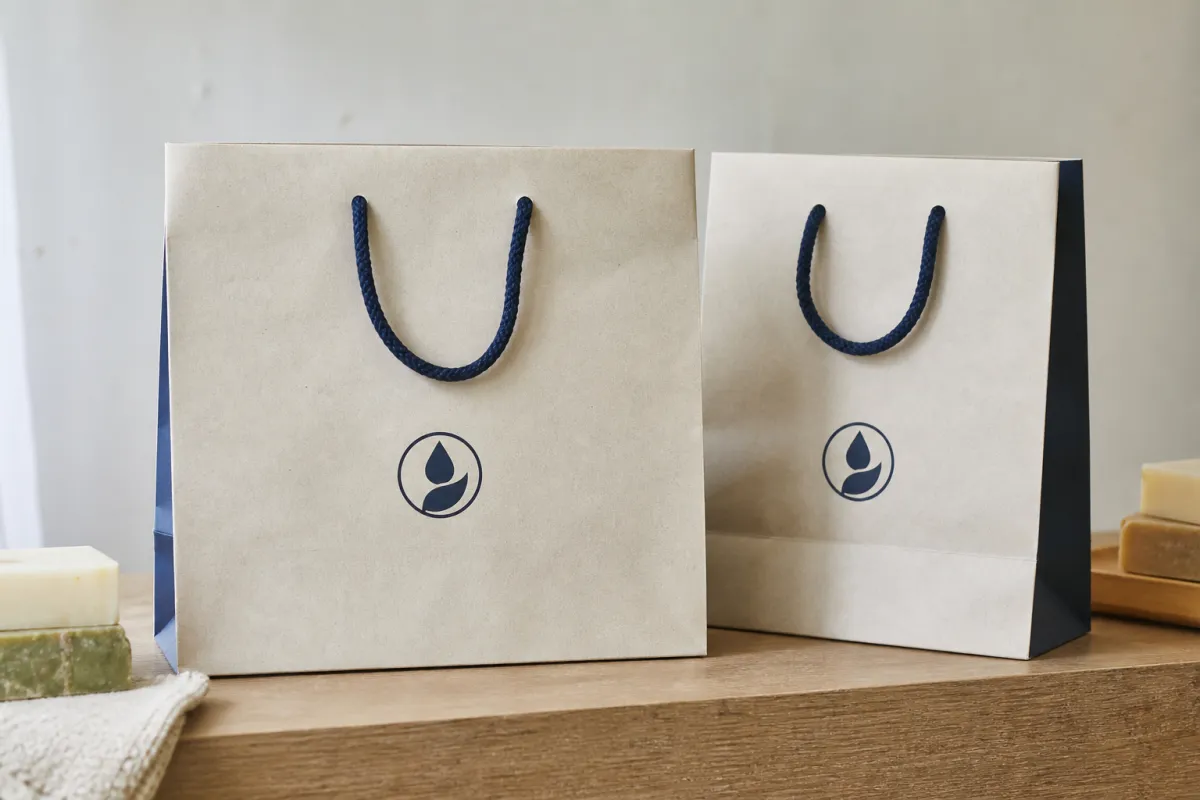
The first physical sample is usually the moment the PDF stops winning arguments. On screen, the bag can look balanced, premium, and centered to the millimeter. In hand, the handle fold can cut through the logo, the gusset can eat into artwork space, or the base can flex the second a few soap bars go in. Soap brand paper shopping Bags Sample Approval closes that gap between “looks fine” and “actually holds up.”
I have seen teams approve a bag because the mockup looked elegant, only to discover later that the handle reinforcement sat exactly where a brand mark was supposed to go. That kind of miss is not rare. It is just expensive, and it shows up most often when people skip the physical sample and trust the computer a little too much.
The cost difference is easy to see. One sample may cost a fraction of the full order. Five thousand unusable bags are a separate problem entirely, with scrap, rework, and delivery delays layered on top. A bag that is 5-10 mm too small can force a redesign. A weak handle reinforcement can fail in transit. A paper weight that works for tissue paper will not always work for dense soap packaging. Soap brand paper shopping bags sample approval is the low-cost checkpoint.
Sustainability belongs in the sample stage too. Recycled paper can show a rougher fiber pattern. Water-based inks can behave differently on kraft than on coated stock. A matte coating may improve scuff resistance and still complicate recycling claims depending on the final build. If the bag supports an FSC claim, verify it early at FSC while the spec is still flexible.
“The sample is not a formality. It is the moment the bag proves whether the brand story survives contact with real paper, real glue, and real soap.”
From a buyer’s point of view, soap brand paper shopping bags sample approval has one job: confirm that the bag performs in store, in transit, and at the customer’s front door. That means testing with actual soap units, not a guessed weight. If the final packout is four 120 g bars wrapped in tissue, the sample should be loaded that way. Empty bags tell a very polite lie.
Soap brand paper shopping bags sample approval also protects brand consistency. A slightly off Pantone, a handle color that clashes with the label, or a 4 mm print shift can make a careful brand feel rushed. Customers notice that kind of drift fast. Once they see one sloppy detail, they start seeing the rest.
How Soap Brand Paper Shopping Bags Sample Approval Works
The process is straightforward once the noise is stripped away. Soap brand paper shopping bags sample approval usually moves through five steps: brief, dieline, artwork proof, physical sample, and signed approval. Miss one step and confusion shows up later. Miss two and the delay is self-inflicted.
Start with the brief. The supplier needs exact dimensions, paper stock, handle style, finish, print colors, expected load, and whether the bag needs to match an existing retail line. If the soap brand already has shelf packaging, the shopping bag should echo that visual language instead of improvising. Strong packaging supports the product family; weak packaging looks like it was designed in separate rooms.
The dieline and artwork proof turn the idea into something measurable. Fold lines, handle holes, glue zones, and the bottom board all take space, and the artwork has to respect those limits. Soap brand paper shopping bags sample approval should pause until the brand team checks where the logo lands, whether the tagline survives a crease, and whether any QR code remains readable after folding.
The physical sample is the proof point. A true sample is not a cheerful render, not a flattened mockup, and not a screenshot with fake shadows. It should use the closest match to the actual paper grade, handle style, print process, and finishing method that the factory can produce before full run. If someone says “sample approved” based on a PDF alone, that is not soap brand paper shopping bags sample approval. That is wishful thinking in a browser tab.
Each side has a clear job. The brand team checks the look, messaging, and retail fit. The supplier checks structure, load capacity, repeatability, and whether the factory can build the bag at scale without surprises. When both sides check the same facts, soap brand paper shopping bags sample approval becomes a short decision instead of a long debate.
The approval sheet should be specific enough to survive a future reorder. Include:
- Exact dimensions, including gusset and handle drop
- Paper stock and gsm or point weight
- Handle style and reinforcement method
- Finish, coating, or lamination
- Pantone targets or approved color reference
- Load limit and actual test packout
- Any FSC, recycled content, or ink requirement
If you need a reality check on how packaging decisions translate into production outcomes, our Case Studies page is more useful than a polished mockup deck. It shows the kind of detail that matters once a sample becomes a run. You can also compare how structure and presentation show up across different projects on the main Custom Logo Things site.
One more point deserves attention: soap brand paper shopping bags sample approval should lock the real build, not just the look. A sample that photographs well but uses the wrong paper or handle reinforcement is a trap. Teams approve the pretty part and forget the part that has to carry dense soap bars from shelf to street.
What Changes the Final Bag: Paper, Print, Handles, and Finish
Paper choice changes more than most people expect. Kraft paper gives a natural, honest look and usually supports an eco-friendly story, but it handles fine detail differently from coated stock. Coated art paper gives sharper print and richer color, which helps premium soap brands, yet it can scuff more easily unless the finish is chosen carefully. Recycled board strengthens the sustainability message, though it can bring visible fiber variation that one brand treats as texture and another treats as a defect. Soap brand paper shopping bags sample approval needs to show that difference in the hand, not just on a spec sheet.
Handle construction matters just as much. Twisted paper handles are common and cost-effective, but they need proper anchoring if the soap packout is heavy. Rope handles feel more premium and usually carry more load, though they raise cost and shift the bag’s visual tone. Die-cut handles look clean and modern, but they are not always the right fit for a dense, rectangular bundle of soap bars. The sample should be lifted, shaken, and carried with the actual product inside. If the handle creaks or the top board tears, approval stops there.
Finish choices can make or break the final look. Matte lamination softens the tone and reduces scuff marks, but it adds cost and can complicate recycling claims depending on structure. Gloss coating boosts color pop and works well for bolder branding, while soft-touch finishes feel expensive in the hand and rarely come cheap. Foil stamping and embossing add dimension and perceived value, though they also introduce more setup and slower approval because registration, pressure, and balance all need checking. Soap brand paper shopping bags sample approval should decide whether the finish supports the product story or simply eats budget.
Print method matters too. Offset printing is usually the better choice for sharp graphics and tighter color control on larger runs. Flexo can work well for simpler artwork and some kraft bags, especially where the design is not loaded with tiny text or subtle gradients. Digital sample printing helps with proofing, but the final run may still use another method, so it should be treated as a reference rather than a promise. If the bag uses multiple Pantones or heavy dark coverage, ask how the process affects ink density and drying time. That is not decorative detail. That is the difference between a crisp brand and a muddy one.
The table below gives a practical way to compare common options before soap brand paper shopping bags sample approval moves to sign-off.
| Option | Typical Sample Behavior | Price Impact | Best Fit |
|---|---|---|---|
| Kraft paper | Natural look, less color punch, hides minor fiber variation | Usually lower to mid | Soap brands with an eco-forward or handmade feel |
| Coated art paper | Sharper graphics, richer color, more premium feel | Mid to higher | Premium retail soap, gift sets, seasonal launches |
| Recycled board | Visible texture, stronger sustainability message, slightly less uniform print surface | Mid | Brands with recycled content claims or muted design systems |
| Matte lamination | Soft finish, less glare, scuff resistance improves | Higher | Retail bags that need a quiet, upscale look |
| Foil or emboss | Strong visual depth, better shelf impact, more setup sensitivity | Higher | Limited editions, gifting, branded displays |
Compliance and sustainability checks belong in the same review. If the paper is FSC-certified, document it. If recycled content is part of the claim, make sure the wording is accurate. If the ink is water-based, confirm how it interacts with the paper and finish. The EPA’s guidance on sustainable materials is useful for thinking beyond the bag itself and into the wider waste stream: EPA Sustainable Materials Management. That matters because soap brand paper shopping bags sample approval is not only about appearance; it is also about what the customer believes the bag says about the brand.
Dense soap bars behave differently from feather-light retail goods. A bag that works for a T-shirt may fail with six wrapped soap bars, tissue, and a sample card. The sample needs to be tested with real fill weight, because soap brand paper shopping bags sample approval should reflect actual use, not a fantasy version of it.
Soap Brand Paper Shopping Bags Sample Approval Timeline and Lead Time
Most teams want a neat timeline. Fair enough. The real answer is usually this: quote and dieline review can take 1-3 business days if the brief is complete; sample production often takes 5-10 business days; and shipping time sits on top of that. If the sample needs to cross borders, freight can add another week or more depending on the lane. Soap brand paper shopping bags sample approval moves quickly only when the brief is clean and the revisions stay contained.
Custom sizes, unusual handle structures, multiple print colors, metallic finishes, and special coatings slow things down. Overseas freight does the same, because a sample that takes a week to make can still spend another week or two in transit, customs, or a warehouse queue. Testing three size versions and two finish options in parallel stretches the calendar too. No mystery there.
One complete feedback round is faster than five tiny ones. That pattern shows up constantly: a brand team asks for a small artwork tweak, then another, then another, and each change forces the supplier to re-check placement, re-align files, and sometimes re-quote the job. Soap brand paper shopping bags sample approval works best when comments are collected into one response. The more complete the feedback, the fewer expensive delays follow.
Rush orders are not magic. They usually cost more because the factory has to interrupt a queue, hold material, pay for faster freight, or remake a sample with overtime. If a supplier offers a rush with no extra cost, ask what tradeoff is hiding underneath. Usually, it is not generosity. It is a delay somewhere else in the schedule.
It helps to think about approval in stages. First approve size and structure. Then approve print and finish. Only after both are right should the order move toward production release. If the sample still needs structural changes, do not approve it because the logo looks nice. Nice is not the test. Carrying soap is the test.
If the project is large or the bag has to perform in a retail chain environment, testing starts to look more like shipping verification than design review. Standards from groups like the ISTA help frame that thinking. You may not run a full lab program for every soap bag, but compression, drop, and vibration logic still matter once the products leave the shelf and enter transit.
Soap brand paper shopping bags sample approval should not be rushed past structural issues just because a launch date is close. If the bag does not stand upright, if the handle fails under the real fill, or if the finish dulls the brand colors, the schedule should move to the bag, not the other way around. Reprinting a bad run costs more time than pausing for one careful review.
Cost, Pricing, MOQ, and Quote Variables for Sample Approval
Sample cost and production cost are different numbers, and people mix them up constantly. A plain structural sample may be modest, while a printed sample with special finish, custom handle, or faster freight can cost much more than expected. Depending on size and complexity, a sample may sit in the low tens of dollars or climb higher once setup and shipping are added. Soap brand paper shopping bags sample approval should budget for the prototype separately so the team does not get surprised later by the production quote.
The final unit price is driven by a small group of stubborn variables. Bag size matters because more material means more cost. Paper weight matters because heavier stock usually costs more but may be necessary for dense or tall soap packs. Print coverage changes ink usage and the number of passes. Handle type, inserts, and carton packing all appear in the quote too. If the bag includes a reinforced bottom board or a premium finish, expect that to push the price upward. Nothing mystical here. Material, labor, and setup costs are just doing their job.
MOQ pressure is real as well. Smaller orders carry a higher unit price because the supplier still has to pay for plates, setup, cutting, folding, gluing, and packing. Larger runs spread those fixed costs across more units, which usually brings the per-bag price down. That does not make bigger automatically better. If the soap brand only needs a seasonal run or is testing a new line, a smaller MOQ may be the right call even when the unit price looks less attractive. Paying to store inventory you cannot sell is a bad hobby.
Here are practical sample and production ranges that buyers often see for soap brand paper shopping bags sample approval:
- Plain structural sample: often the lowest cost option, especially if no print or special finish is involved
- Printed sample: usually higher because plates, setup, and color matching enter the picture
- Express freight: can rival the sample fee if the timeline is tight or the sample ships internationally
- Production unit price at scale: generally drops as quantity rises, but premium paper and finishes still move the number up
For a rough production reference, simple custom paper shopping bags can land in a wide range depending on size and print coverage, often around a few tenths of a dollar per unit at larger quantities and more for premium builds. A 5,000-piece run with standard kraft, one or two colors, and ordinary handles will usually price very differently from a smaller run with matte lamination, foil, and custom rope handles. Soap brand paper shopping bags sample approval helps narrow that gap before the quote is locked.
The biggest hidden cost is skipping approval. If the sample is wrong and the team ignores it, the factory may need to scrap pre-production work, reorder material, or restart the run. Add rush freight and the fix can cost more than the original sample. That is why soap brand paper shopping bags sample approval is not a box to tick. It is the control point that keeps the budget from wandering off.
“Just a quick sample” usually means “certainty without paying for uncertainty.” Fair enough. The sample still needs enough detail to be useful. A cheaper sample that leaves out the exact paper weight, handle style, or finish is not cheaper if it creates the wrong production order. Soap brand paper shopping bags sample approval saves money only when the sample actually mirrors the final bag.
Common Mistakes That Delay Soap Brand Paper Shopping Bags Sample Approval
The first mistake is approving from screen images only. A render can hide glue lines, soften color shifts, and flatten the structural problems that matter most. If nobody touches the bag, nobody notices whether the base stands up or whether the handle fold cuts through the logo. Soap brand paper shopping bags sample approval exists because a photo is not the same as a folded, glued, filled bag.
The second mistake is checking print and ignoring structure. That happens all the time. The brand team loves the color, the foil looks strong, the logo sits in the right place, and then the handles tear under actual load. That is not a good sample. That is a pretty failure. The bag has to survive in the hand, not just in the file.
The third mistake is forgetting to test with real soap weight. Soap bars are dense, and bundles shift inside the bag. A sample should be filled with the exact packout: same number of bars, same tissue, same insert card, same inner wrap. If the bag sags with the real fill, it will sag in the store. Soap brand paper shopping bags sample approval should be based on the actual contents, not a guessed equivalent.
The fourth mistake is vague approval notes. “Looks good” is not a production instruction. “Approved with 180 gsm kraft, rope handles, matte lamination, Pantone 7724 for the logo, and the current bottom board” is useful. The more vague the note, the more likely the factory will treat feedback as optional. That is how good intentions become expensive misunderstandings.
The fifth mistake is changing artwork after approval and expecting the schedule to stay put. It will not. Even a small artwork tweak can affect color balance, plate setup, and print alignment. If the line is already in motion, the change may force a reproof or a new sample. Soap brand paper shopping bags sample approval should be the final checkpoint before release, not a warm-up round for extra ideas.
A sample can also hide weakness if the factory hand-finishes a prototype more carefully than the actual run. That is why the approval sheet should say whether the sample is representative or only visual. If the production bag will be machine-glued, the sample should not be treated like a handcrafted exception. You want repeatable quality, not a single perfect unicorn.
For teams that need a packaging partner to stay organized, a clean approval workflow matters more than fancy vocabulary. Keep the notes short, specific, and final. That one habit alone can save a week. In soap brand paper shopping bags sample approval, a week is often the difference between “launch on time” and “why is this still in transit?”
Expert Tips and Next Steps After Approval
Use a one-page approval checklist. Keep it binary: pass, revise, or reject. No paragraphs that wander around politely avoiding a decision. List the bag size, stock, handles, finish, load limit, color target, and any certification requirement. If the sample passes everything on that list, sign it and move on. Soap brand paper shopping bags sample approval should close the loop, not reopen the whole conversation.
Save the approved sample, signed PDF, and final spec sheet together. Better yet, keep them in one folder with the order number and approval date. That way the next reorder does not start from memory, which is a terrible archive system. Good records preserve brand consistency and keep the next batch aligned with the same visual decisions.
Ask for production photos or a pre-shipment check if the order is large, the print is sensitive, or the launch matters. That extra step pays off when the bag is tied to a seasonal campaign or a premium retail display. It is easier to correct a stack of finished bags in a warehouse photo than a truckload of boxed product after it has already left. Soap brand paper shopping bags sample approval is the last clean chance to catch a mistake, but not the only check if the order deserves more oversight.
Set a reorder trigger based on sales, seasonal demand, and minimum stock. Soap brands often wait too long and then rush the next purchase because they are down to the last carton. That pushes everyone into tighter lead times and weaker negotiating power. A simple reorder rule, even one based on four to six weeks of cushion stock, makes a real difference.
The shortest path to fewer headaches is to treat the sample as the production contract in physical form. That mental shift matters. Soap brand paper shopping bags sample approval is not a decorative milestone; it is the point where the bag becomes real enough to trust. Lock the sample, lock the spec, and only then release the order. That keeps print, structure, and budget pointed in the same direction.
Here is the practical takeaway: approve only after the bag passes size, load, print, finish, and certification checks with the actual soap packout in hand. If any one of those fails, revise the sample before production. That single discipline does more for soap brand paper shopping bags sample approval than any pretty mockup ever will.
How long does soap brand paper shopping bags sample approval usually take?
Simple projects can move from brief to approved sample in about 1-2 weeks if the artwork is ready and the supplier has the right paper in stock. More complex Bags with Custom handles, special finishes, or multiple revisions often take 2-4 weeks or longer. Shipping can be the hidden delay, especially if the sample has to cross borders.
What should I check before approving a soap brand paper shopping bags sample?
Check dimensions, handle strength, print placement, color accuracy, and whether the bag stands up under real soap weight. Confirm the paper stock, finish, and any sustainability claims such as FSC or recycled content. Make sure the approval note is final and specific, not a vague thumbs-up.
Can I approve a soap brand paper shopping bags sample from photos only?
You can review photos first, but they should not replace a physical sample for final approval. Photos hide weak glue, poor folding, low stiffness, and handle failure. If you must use photos early, treat them as a pre-check and still request the actual sample before release.
Does sample approval change MOQ and final unit cost?
Sample approval itself usually does not change MOQ, but it can confirm whether the chosen structure is realistic at your target quantity. If the sample needs expensive finishes or a stronger paper weight, the quote and unit cost may rise. A cleaner approved spec often helps the factory price the run more accurately.
What happens if I find a mistake after soap brand paper shopping bags sample approval?
If production has not started, the factory can usually revise the file or remake the sample, though timing and cost may change. If the order is already in production, the mistake can trigger rework, delays, or scrap. That is why the final approval should be treated as the last chance to catch structure, print, and size issues.


