Stationery Ribbed Winter Beanies Unit Cost Review for Buyers A good stationery Ribbed Winter Beanies unit cost review should not stop at the quoted price. The useful question is simpler and sharper: how much useful wear, brand exposure, and distribution flexibility does each beanie buy? A hat that leaves the box once and disappears into a drawer is expensive at any price. A hat that stays in circulation through one winter, and then gets pulled out again next year, changes the economics completely.
That is why these beanies keep showing up in stationery bundles, employee welcome kits, trade show packs, and seasonal reseller programs. They are small enough to ship efficiently, visible enough to carry a logo, and practical enough that recipients usually keep them. Rib knit helps too. It stretches, recovers, and covers more head sizes without forcing buyers into a narrow fit range. In bulk buying, fewer size problems usually means fewer surprises later.
The rest of the deal lives in the details: yarn choice, decoration method, cuff height, packaging, and the minimum order quantity tied to each option. Those are the levers that move the real cost.
Why Ribbed Winter Beanies Still Pay Off in Promo Budgets
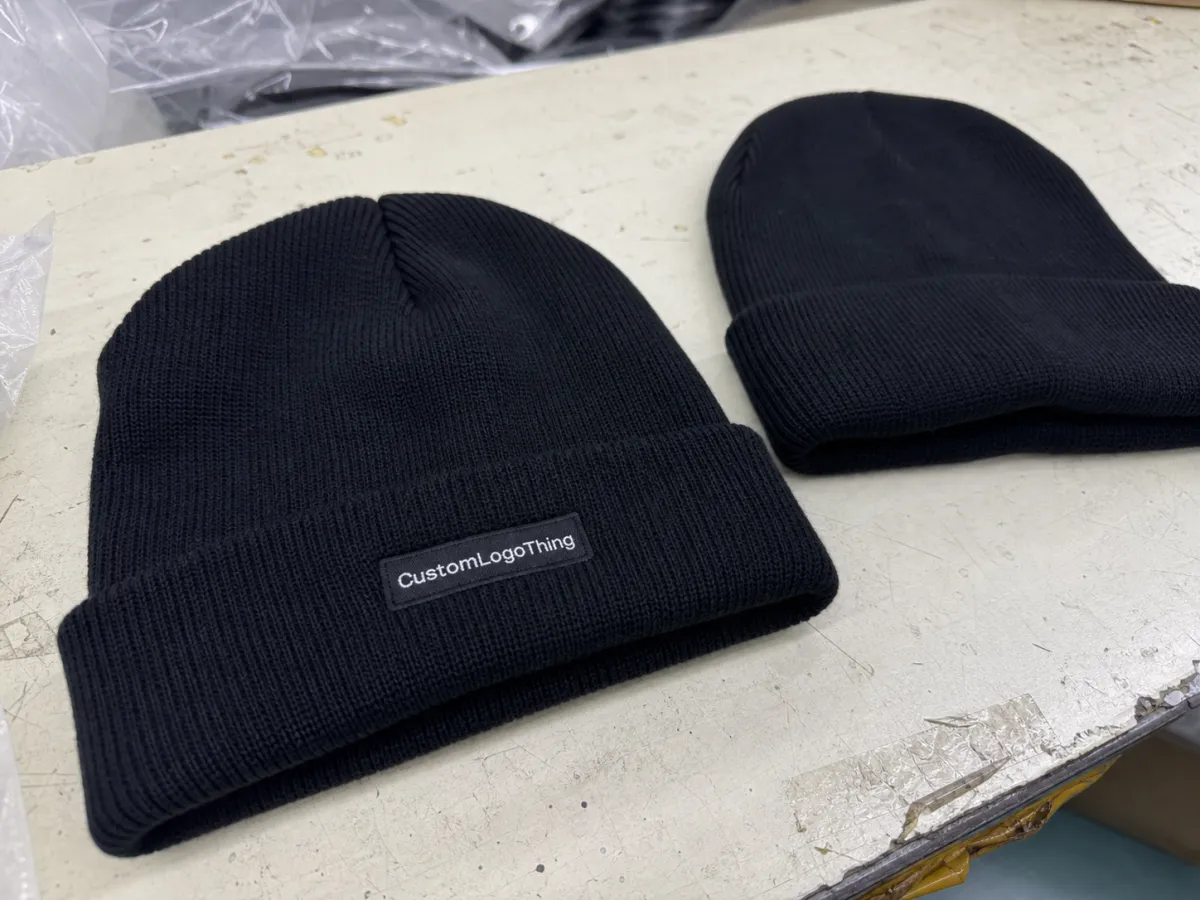
For promotional stationery programs, price per piece is only half the picture. A $2.70 beanie that gets worn twenty times is cheaper in use than a $1.60 item that pills, loses shape, or feels flimsy on first contact. Buyers sometimes get trapped by the smallest quoted number and forget that the end user judges comfort before branding. That is a poor place to save money.
Ribbed construction earns its keep in three ways. It stretches across different head sizes, so the fit is less fragile than a flat-knit style. The folded cuff gives the logo a stable area with better visual contrast. And the rib texture makes even standard acrylic look more substantial than it is.
That visual weight matters. In a stationery bundle, the beanie has to sit beside notebooks, pens, planners, or desk accessories without looking like leftover inventory. A ribbed style does that better than a thin novelty hat. It feels intentional, which is exactly what most corporate and reseller buyers want.
Buyer reality: the cheapest quote can become the most expensive order if the cap shrinks, twists after washing, or arrives with inconsistent sizing. The logo is only as useful as the hat holding it.
One practical way to think about value is cost per wear. If a beanie costs $2.80 ex-factory and gets worn 25 times, the raw wear cost is 11 cents before any logo impressions are counted. That is often a better framework than comparing yarn costs line by line. Promotional buys are supposed to work over time, not just on invoice day.
Rib knit also lowers inventory risk. A rigid cap can fit beautifully in a sample and awkwardly on the broader audience it reaches later. Ribbing smooths that problem out. For buyers managing a single SKU across multiple teams, regions, or client packs, that flexibility is worth real money.
Product Details That Change Perceived Value Fast
Most cuffed winter beanies start from the same basic formula: acrylic or acrylic-blend yarn, a ribbed body, a folded brim, and one decoration zone on the cuff. The difference between an average product and one that reads as polished usually comes from small finish choices, not dramatic redesigns.
Typical dimensions matter. A body height around 20-23 cm before stretch and a cuff around 7-9 cm are common because they balance warmth, fit, and decoration space. A deeper cuff gives a cleaner branding field. A narrower cuff can look more casual, but it reduces room for a logo and makes placement less forgiving. Add a pom-pom and the tone shifts immediately toward playful. Keep it clean and the piece feels more corporate. Neither is better in isolation; the audience decides that.
Decoration does most of the selling. Simple embroidery is durable and familiar, especially for one-color logos with clean lines. Woven patches handle fine text and multicolor artwork better than stitching alone. Heat-transfer patches can work on shorter runs or when the artwork is intricate, though the finish usually feels less permanent. Sewn-on woven labels suit restrained branding, especially for stationery packs that are meant to look quiet rather than loud.
| Finish Option | Typical Appeal | Cost Impact | Best Use Case |
|---|---|---|---|
| 1-color embroidery | Durable, clean, familiar | Lowest setup burden | Simple logos, broad distribution |
| Woven patch | Sharper detail, retail feel | Moderate tooling fees | Small text, multicolor marks |
| Heat-transfer patch | Good for short runs | Mid-range, depends on coverage | Promos with tighter deadlines |
| Custom woven label | Subtle, polished branding | Lower than full embroidery coverage | Minimalist stationery bundles |
Color choice changes the market response as much as the decoration. Black, navy, heather gray, and oatmeal tend to be the easiest colors to place because they work with most corporate palettes and look stable in photos. Exact Pantone matching is possible, but it tends to raise cost and extend approval time. If the program is a seasonal one-off, standard stock colors are often the cleaner choice. If the beanies are part of a branded retail line, color control matters more and the added cost may be justified.
Packaging deserves a quick mention because it changes perceived value faster than many buyers expect. A beanie packed with a notebook and pen in a coordinated set reads as a complete gift. The same beanie tossed into a loose polybag reads as bulk merchandise. Neither is wrong, but they are not the same product in the customer’s mind.
Specs Buyers Should Verify Before They Request Samples
The easiest way to lose money on a knit order is to approve a sample without a written spec. The sample can look fine while hiding small issues that become obvious at scale. A half-cent shift in cuff height sounds trivial until the logo sits too close to the edge on every carton in the order. The same is true for stitch tension, crown shape, and stitch pull around the decoration area.
Before sample approval, buyers should verify the material and construction in plain language:
- Yarn composition: acrylic, acrylic/poly blend, or recycled-content blend if needed.
- Knit gauge: finer gauges usually look cleaner but can cost more.
- Cuff height: fix this early so logo placement stays consistent.
- Finished circumference: confirm the relaxed and stretched measurements.
- Stretch recovery: the rib should snap back after use.
- Colorfastness: check for bleeding or fading after washing.
- Decoration placement: lock the logo position before bulk approval.
Appearance testing is not enough. Pull on the embroidery and watch the knit around it. Check for loose threads at the crown seam. Rub the surface to see whether pilling shows up quickly. If the decoration is dense, look for distortion in the rib structure around the edges. Those are the failure points that tend to show up after the buyer has already committed to the run.
Tolerance bands should be spelled out in the quote. Knit goods always move a little during production, but the movement should stay inside a range that does not affect fit or branding. If the order is repeatable, ask for tolerances on body height, cuff width, and decoration placement. That makes reorders easier and keeps the second run closer to the first.
Labeling can be overlooked until the end, which is usually too late. If the beanies are going into retail, cross-border distribution, or a corporate program with strict packing rules, the buyer should confirm fiber content, care instructions, and country-of-origin marking before production starts. Rework after packing is a waste of time and money.
For cartons and transit planning, the standards used by Packaging.org and the handling guidance from ISTA are useful reference points. Even a simple beanie order should have a carton and stacking plan if the goods are going to sit in storage or travel long distances.
If a supplier cannot explain the spec in measurable terms, the quote is not ready. Vague adjectives do not help when the order is on a deadline.
Unit Cost, Pricing Bands, and MOQ Breakpoints
Any stationery ribbed winter beanies Unit Cost Review worth using needs to separate the cost drivers instead of treating the quote as one opaque number. Quantity is the largest lever. Decoration method comes next. Packaging follows. Yarn quality and knit complexity matter too, but they usually sit behind those first three in the final price.
At low volumes, setup charges make the item look expensive. A 300-unit order may absorb the same digitizing or tooling work as a much larger run, so the cost per piece rises quickly. Once volume passes a real production threshold, those fixed charges spread out and the quote begins to make more sense.
For plain cuffed ribbed beanies with one decoration location, quoted ex-factory and excluding freight, duty, and local handling, a practical pricing view usually looks like this:
| Order Tier | Typical Unit Cost | What Usually Changes | Buyer Takeaway |
|---|---|---|---|
| 300 units | $3.20-$5.00 | Setup charges weigh heavily | Useful for testing demand |
| 1,000 units | $2.00-$3.40 | Better spread of fixed costs | Common sweet spot for promos |
| 5,000 units | $1.45-$2.35 | Material and labor rates improve | Stronger margin for resellers |
| 10,000+ units | $1.20-$2.05 | Best leverage on bulk pricing | Only if sell-through is proven |
Those ranges move quickly if the brief gets more complicated. A woven patch can add about $0.20-$0.60 per piece versus simple embroidery, depending on size and stitch count. Retail-ready packaging often adds another $0.15-$0.50. Custom hangtags, belly bands, or inserts raise labor time as well as material cost. None of those charges are unusual; they just need to be visible before approval.
Tooling and setup should be separated from unit cost unless the supplier has explicitly rolled them in. Embroidery digitizing often sits around $25-$75 for a small run. Woven patch tooling is commonly $60-$180. Custom labels usually fall somewhere in between. Buyers do not need to fear those figures, but they should not discover them after the order is already in motion.
There is another trap: the cheapest item on paper is not always the best landed value. A clean embroidered beanie at $2.10 can outperform a more complicated option at $1.95 if the lower-priced version looks thin, feels rough, or sells poorly. Freight, sampling, duties, and warehousing belong in the same calculation. Otherwise the quote is incomplete.
Practical rule: compare at least three price tiers before approving the order - MOQ, target volume, and stretch volume. That is usually where the curve becomes visible.
Production Steps, Lead Time, and Ship-Date Planning
Production failures usually happen in the handoffs, not in the knitting. The sequence is familiar: brief, artwork, sample, approval, bulk knit, decoration, inspection, packing, shipment. Each step sounds straightforward until one file is missing or one approval gets stuck in internal review.
Missing vector artwork slows digitizing. Color approval delays push back yarn booking. Sample revisions reset the schedule. If the logo changes after approval, the timeline slips even when the factory moves quickly. Buyers often underestimate how much time is lost between decisions rather than during production itself.
For stock-style orders with standard yarn and a simple decoration method, 12-15 business days after approval is a common production window, plus transit. Fully custom builds often take 18-30 business days. Peak winter demand can add another week or two if the factory calendar is tight. If the beanies are tied to a launch, event, or holiday shipment, that buffer should be written into the plan from the beginning.
Procurement work can begin before production does. Yarn booking, patch sourcing, and packing-material confirmation are separate from the knit line itself. Buyers who line those up early usually avoid the last-minute scramble that causes most preventable delays. That is especially true on mid-size orders, where production is large enough to matter but not large enough to get preferred treatment automatically.
A clean timeline usually has four gates:
- Artwork and spec sign-off.
- Pre-production sample approval.
- Bulk manufacturing completion.
- Pack-out and shipment release.
Each gate should have a named approver. If the role is unclear, the schedule becomes a group project, and group projects are slow. Freight choice matters too. Air keeps the calendar safe but can erase margin on a low-ticket item. Ocean is cheaper but requires earlier booking and more patience. The freight decision should sit next to the production decision, not after it.
What Makes a Supplier Worth Trusting on Repeat Orders
The true test is not whether a supplier can win one order at a low number. It is whether they can repeat the same result six months later without re-teaching them the spec. Repeat orders expose the weak spots fast: shifting shades, loose cuff tension, embroidery that moves off center, or packing that changes without warning.
Trustworthy suppliers keep the important parts in writing. They confirm yarn shade, decoration placement, packing format, and cost drivers instead of assuming the buyer remembers every previous detail. That matters because the second order is where small inconsistencies become expensive. A 4 mm shift in logo placement or a darker gray body may seem minor until the full batch is unpacked.
Quality control should not stop at carton counts. Ask for pre-shipment photos, carton checks, and spot inspection of logo alignment. If the order is retail-bound, request outer carton labels and pack-out confirmation before the shipment leaves the floor. That sounds formal, but formal usually beats damaged inventory.
Repeat-order support is a real cost advantage. When the supplier already has the artwork file, the approved color standard, and the knit reference, the next run starts faster and with less proofing. Less admin work usually means fewer mistakes and a shorter calendar.
"A supplier is inexpensive only until the second order reveals what the first one missed."
Flexibility matters too. Not every buyer knows final demand on day one. A vendor that can handle a test run of 300 units and then scale to 3,000 without rebuilding the spec is more useful than one that only quotes comfortably in a single volume band. That kind of range is especially helpful for stationery brands running seasonal collections or retail tests.
The best repeat suppliers understand that consistency is part of the product. They do not just ship hats; they ship the same hat again. That is the difference between a one-time buy and a program item.
What to Send for an Accurate Quote and Fast Start
A fast, accurate quote depends on the quality of the brief. If the input is vague, the unit cost will be vague too. For a stationery ribbed winter beanies Unit Cost Review, the useful numbers are the ones tied to a real production plan, not a rough guess.
Start with the basics:
- Quantity: minimum, target, and stretch volume.
- Target ship date: not just the event date, but the last acceptable arrival date.
- Color count: hat color, logo color, and any trim variations.
- Decoration method: embroidery, patch, label, or mixed finish.
- Packaging: retail-ready, bulk packed, or gift-set format.
- Artwork: vector logo files, Pantone references, and placement notes.
- Compliance needs: labeling, carton marks, or destination-specific requirements.
Editable vector art saves time. AI, EPS, or a clean PDF file is easier to work from than a raster image pulled from a website or presentation slide. Include the intended decoration size too. A logo can look fine on screen and still fail on a folded cuff once seam allowance and stitch density are taken into account.
It also helps to ask for three pricing scenarios: MOQ, planned volume, and a higher volume if the program expands. That makes the pricing ladder visible and reduces the chance of comparing incomplete offers. If the beanies are part of a stationery bundle, say so. Bundles change the packing format, and packing changes labor.
Finally, ask the supplier to spell out what is included: decoration, setup charges, tooling, packaging, carton marks, and sample cost. Clear inclusion lines make it easier to compare vendors without missing the real cost drivers. A clean quote is not always the lowest one, but it is the easiest one to buy with confidence.
Used carefully, this review gives buyers a way to compare suppliers, judge whether a quote is realistic, and avoid obvious traps in fit, finish, and timing. If the price ladder makes sense, the sample holds shape, and the ship date still works after freight is added, the order is probably worth moving forward.
What drives stationery ribbed winter beanies unit cost the most?
Quantity usually has the biggest effect because setup costs get spread across more units. Decoration method, packaging style, and yarn choice can move the quote quickly too. Freight, sampling, and duties should always be included in the landed-cost view.
What MOQ should I expect for custom ribbed winter beanies?
MOQ depends on the decoration method and color count as much as the hat itself. Simple stock-color embroidery often allows a lower entry point than fully custom knit details or extra packaging. Ask for a tiered quote so the cost change is visible at each volume.
Which branding method gives the best value on custom beanies?
Clean embroidery is usually the strongest balance of cost, durability, and brand clarity. Woven patches work well when the logo has small text or multiple colors. Avoid dense stitch counts unless the artwork really needs them.
How long does custom production usually take after approval?
Stock-style orders can move in roughly 12-15 business days after approval, while fully custom builds often need 18-30 business days. Peak season, sample revisions, and freight planning can extend that window. A deadline tied to a winter launch should include extra buffer.
How can I lower the price without hurting quality?
Keep the artwork simple, reduce decoration colors, and choose standard packaging when presentation is not critical. Larger quantities usually reduce the unit cost as setup fees spread out. The main goal is to cut complexity, not useful structure.
Buyers who stay disciplined on specs, pricing tiers, and timing usually get the best result. That is the real value hidden in a stationery ribbed winter beanies Unit Cost Review: a solid quote only matters if the beanie fits well, arrives on time, and still looks presentable after the first cold season.


