Stationery unstructured dad hats Unit Cost Review usually begins with a bad assumption: that the blank cap is the main cost. It rarely is. On small and mid-size runs, trim, decoration, setup charges, packing, and freight can move the number more than the hat body itself. A buyer can shave a few cents off the blank and still end up with a higher landed cost once the order is fully built.
That matters for onboarding kits, conference mailers, employee welcome boxes, and retail-adjacent giveaways. An unstructured dad hat brings a softer silhouette and less formal feel, which is useful in stationery programs where the cap has to sit beside paper goods, not overpower them. The product works because it feels easy to wear and easy to receive. It does not look like an afterthought, but it also does not demand the same cost profile as a structured premium cap.
What separates a good quote from a risky one is repeatability. A first-run price can look fine, then drift when the supplier changes a fabric source, adds an extra handling step, or revises the logo specification after sampling. A real stationery unstructured dad hats Unit Cost Review checks whether the order can be repeated without a surprise charge attached to every small change.
Why a simple stationery cap order can swing on trim
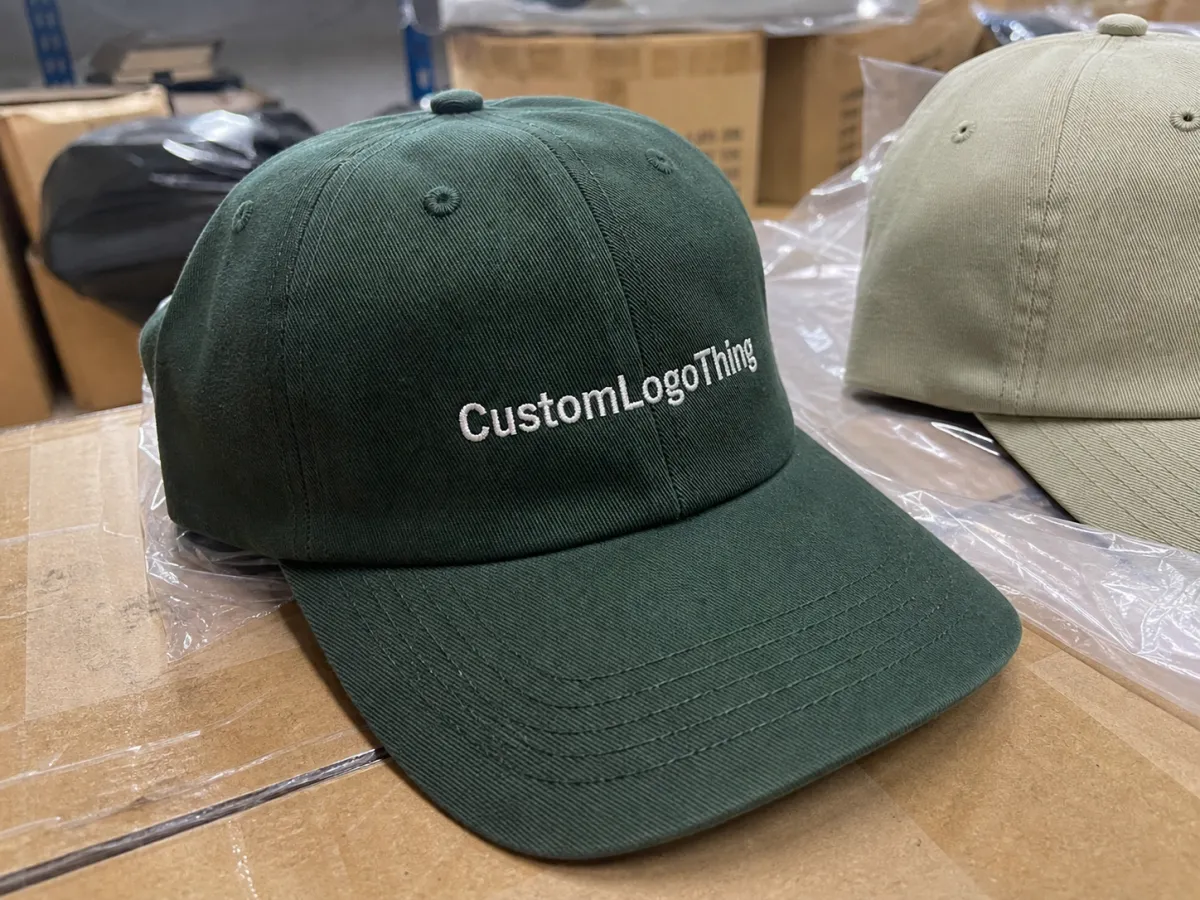
The cap body is only one line item. The trim package around it often carries more financial weight than buyers expect. A low-profile unstructured crown in cotton twill may cost only a little more than a plain promo blank, but once you add embroidery, a woven label, a metal buckle, custom taping, and retail-style packing, the unit price can climb quickly. The difference is not cosmetic. Every added touch usually means extra labor, extra inspection, or a new setup step.
That is why a stationery unstructured dad hats Unit Cost Review cannot stop at fabric weight. Two hats can both be listed as “cotton dad caps” and still behave very differently in production. One may use a soft brushed twill with a self-fabric strap. Another may use heavier canvas with a brass closure and a front panel insert to hold embroidery shape. The second cap tends to look cleaner, but it also asks more of the factory and the budget.
From a buyer’s point of view, this product earns its place because it is easy to live with. The silhouette is relaxed, the brim curves naturally, and the logo does not need to fight a stiff crown. That matters in employee kits and conference mailers, where the cap has to feel like a useful item rather than a loud promo object. On fashion-adjacent orders, the softer silhouette lowers rejection risk because wearability matters as much as visibility.
There is a second issue that shows up only when orders repeat: specification drift. If the supplier changes the closure style, the sweatband tape, or the front-panel reinforcement on the second run, the cost can rise even if the line-item quote looks stable. Good buyers compare not only the first invoice, but also how easily the same spec can be repeated six months later.
- Body cost moves with fabric type, panel count, wash treatment, and crown construction.
- Decoration changes faster than most buyers expect, especially with dense stitching or layered patches.
- Packing becomes expensive once the cap is bundled with notebooks, pens, postcards, or inserts.
- Repeat runs are cheaper only when the spec is documented tightly enough to survive reordering.
That is the practical frame: not “What is the cheapest cap?” but “What stays stable when the order repeats, scales, or changes packaging?” A disciplined review answers that before a purchase order goes out.
Product details that change the quote before production starts
Define the hat clearly, or every supplier will fill in the blanks differently. A standard unstructured dad hat is usually a low-profile cap with a soft front crown, curved brim, and adjustable closure. That sounds simple, but the spec can still move in several directions: cotton twill, brushed canvas, pigment-dyed fabric, garment-washed finish, heavier broken-in cloth, or a lighter promotional twill intended for broad distribution.
Those choices affect more than hand feel. They change how the cap holds shape, how embroidery sits on the front panel, and how much variance is acceptable from one piece to the next. Washed fabrics, for example, often have a more relaxed look but can vary slightly in shade. That is fine for some programs and unacceptable for others.
Decoration changes the economics too. Flat embroidery is usually the simplest to price because the machine path is straightforward and the logo lies flat against the fabric. 3D embroidery, woven patches, leather patches, and screen print each create a different cost structure. A patch can look premium, but it may also add tooling, sampling, and handling if it is applied after assembly rather than during panel construction.
Placement matters in a way many first-time buyers miss. A front logo is the baseline. Add a side mark, a back strap hit, or an interior label and the quote starts to pick up extra setup or line handling. The same is true for small construction details: eyelet count, sweatband finish, seam taping, closure type, and whether the crown needs a support insert to keep the embroidery from pulling the panel flat.
None of that is decorative trivia. Those are quoting inputs. If the supplier does not know whether the hat is five-panel or six-panel, whether the closure is a brass buckle or a fabric strap, and whether the finish is garment-washed or dry, the quote is already carrying assumptions. Assumptions turn into change orders.
Quality control starts here, not after bulk production. A buyer should be checking whether the logo sits centered on the front panel, whether the brim curve is even, and whether the crown collapses in an unintended way when the hat is handled. A cap can pass a mockup check and still fail the simple test of looking balanced from a few feet away.
“The cheapest cap quote is usually the one that gets corrected three times before purchase order.”
Specifications buyers should lock before asking for a quote
A proper spec sheet saves time and prevents a second round of pricing. Before asking for a quote, lock the panel count, crown height, brim curve, fabric weight, closure style, logo dimensions, and required packaging. If those items are vague, the supplier has to build assumptions into the price, and assumptions rarely help the buyer.
Artwork size deserves special attention. A clean 2.5-inch front logo can be economical, while a dense mark that covers most of the crown raises labor time fast. Stitch count matters because embroidery is machine time, thread use, trimming, and needle wear. A 3,000-stitch logo and a 9,000-stitch badge are not remotely the same job, even if they look similar in a mockup.
Color control is another place where cost creeps in quietly. If the buyer needs a PMS match, the supplier may need more review time, more sampling, or a different dye lot. Some orders can tolerate slight variation, especially with washed or pigment-dyed fabric. Others cannot. The tighter the color standard, the more important it is to state the tolerance up front rather than after the proof.
Approval steps also affect price and lead time. If pre-production photos are required, say so. If a physical sample must be approved before bulk production, that adds time and often freight. For larger stationery programs, many teams request a digital proof first, then a development sample, and only then release bulk. That adds a step, but it usually prevents more expensive rework later.
There are also practical checks that belong in the spec package. If the order will move through warehousing or mail fulfillment, ask for carton dimensions and pack counts. If the cap is intended to sit beside FSC-certified paper collateral, line up the paper components at the same time so the packout does not drift. If the program is likely to ship individually, ask whether the cap can be packed in a way that limits crushing at the front panel.
For transit packaging, standards can help buyers think more clearly about durability. ISTA references are useful for shipment tests, while FSC certification matters when paper inserts, hang tags, or kit materials need responsible sourcing. Neither one lowers price by itself, but both reduce the chance that packaging becomes a problem after delivery.
A buyer who locks these variables early gets a more accurate quote and fewer surprises after proof approval. That is the difference between a clean PO and a stream of edits.
Unit cost drivers: fabric, decoration, and packaging
If you want the fastest way to understand cost, start with the ladder from cheapest to most expensive input. The blank hat sits at the bottom. Decoration sits above it. Then come finishing, packing, and shipment. The final cost per piece depends on how many of those steps are being handled inside one order.
For common promotional quantities, a simple unstructured cap body might land around $1.10-$2.40 per unit, depending on fabric weight, finish, and sourcing region. Add flat embroidery and the number can move by another $0.18-$0.45. A woven patch or leather patch often adds more. By the time you include individual polybags, stickers, inserts, and kitting with stationery items, the landed unit cost can be meaningfully higher than the blank quote suggests.
MOQ pricing logic matters here. Lower quantities usually carry a higher unit cost because setup charges, digitizing, and handling fees are spread across fewer hats. A 100-piece order can feel expensive next to a 1,000-piece order, even when the decoration is identical. That is not a hidden penalty; it is fixed labor divided across a smaller run.
Packaging is the quiet variable. Many buyers ask for only the cap, then the order becomes a kit with a notebook, pen, postcard, and hang tag. Once that happens, individual polybags, carton labeling, size stickers, and insertion labor all become part of the cap quote. If the cap ships with stationery items, the supplier may need a separate kitting line, and that changes the economics again.
| Option | Typical price impact | Setup or tooling | Best use |
|---|---|---|---|
| Blank unstructured cap | Lowest base price | Minimal | Internal kits, price-led promotions |
| Flat embroidery | + $0.18-$0.45 per piece | Digitizing often $25-$75 | Most corporate stationery programs |
| Woven or leather patch | + $0.35-$0.90 per piece | Patch tooling may add $50-$150 | Premium welcome boxes, retail-adjacent gifts |
| 3D embroidery | + $0.30-$0.70 per piece | Digitizing plus more stitch time | Bold front logos with added depth |
| Kitted packaging | Depends on insert count and labor | Often separate handling charge | Stationery bundles and mailer programs |
The table matters because it forces like-for-like comparison. A quote that includes blank hats, embroidery, and packaging cannot be compared fairly against a quote that includes only the hat body. In a stationery unstructured dad hats Unit Cost Review, the buyer should always separate the cap, decoration, setup charges, and freight before deciding which vendor is cheaper.
There is another wrinkle: freight can outweigh decoration on small runs. A $0.30 embroidery charge is easy to notice. A $160 shipping bill spread across 120 units is less obvious until the landed cost is calculated. That is why a quote that looks strong on a per-piece basis may still lose once cartons, destination charges, and import fees are included.
Inspection costs matter too. Some programs only need a basic piece count and visual check. Others need a more formal pass for logo placement, color tolerance, and packaging integrity. The more steps the supplier has to document, the less likely a low headline price will survive. Buyers should ask whether final QC includes seam alignment, thread trimming, stain checks, and carton verification. Those are small controls, but they are usually the difference between “delivered” and “delivered cleanly.”
Process and turnaround from artwork approval to shipment
A clean production workflow is simple on paper and messy when skipped. The usual path is request, spec confirmation, digital proof, sample or mockup approval, bulk production, inspection, and shipment. Each step can be short, but none of them should be implied. When the buyer treats proofing as optional, delays show up later as corrections.
Realistic timelines depend on decoration complexity and order size. A straightforward embroidered hat with clear artwork and stable specs may move in about 12-15 business days after proof approval, sometimes faster if the factory already has the fabric and closure in stock. Patch applications, pigment-dyed materials, custom labels, or detailed kitting can add several days. If the order is offshore, transit time has to be added on top of production time, and that can become the biggest swing factor.
Rush orders are possible, but only if the spec stays tight. Print-ready files help. Fewer revisions help more. If the decoration changes after the proof is issued, the supplier may need to pause for another digitizing pass or a new sample round. That is where schedules slip. The factory is not simply moving slowly; it is protecting the order from a bad approval.
Seasonality matters too. Back-to-school, trade show season, and holiday kit windows compress capacity. During those periods, suppliers with stable workflows and clear communication usually outperform the lowest bidder. That is especially true for kitted stationery runs, where the cap is one item inside a larger program and any delay affects the whole box.
Quality control should be built into the process, not added at the end as a hopeful check. For a stationey cap run, a good pre-production review looks at logo centering, stitch density, front-panel puckering, brim symmetry, closure finish, and packaging count. On larger runs, an in-line inspection can catch thread tension issues before they become a carton-level problem. A final pass should confirm that the cap that was approved is the cap that is being packed.
“Fast shipping only helps if the proof was right.”
If a supplier cannot explain where the time is spent, that is a warning sign. A buyer should know whether lead time is being used for sampling, digitizing, production, inspection, or final pack-out. That level of clarity makes a review more than a price comparison; it becomes a scheduling tool.
Stationery unstructured dad hats unit cost review: how to quote it cleanly
The fastest quote comes from a complete first message. Send target quantity, hat color, decoration method, logo file, delivery deadline, and whether the order is a single campaign or a repeat program. If you already know the packaging format, include that too. A cap packed alone is not the same as a cap packed into a stationery kit with inserts and branded tissue.
Ask for a side-by-side quote sheet that breaks out unit cost, setup, sample, freight, and packaging. That split matters more than a headline number because it shows where the price is being built. If the quote is unusually low, check whether it excludes digitizing, relabeling, or carton-level packing. If the quote is unusually high, look for special handling, extra QC, or a small MOQ that spreads fixed costs across fewer units.
Good suppliers make comparison easier. They will show unit pricing tiers, explain whether the MOQ is tied to one colorway or one logo position, and answer artwork questions before production begins. They should also be willing to send a pre-production mockup or production photos. That does not guarantee perfection, but it lowers risk in a category where small details can change the landed number.
For buyers, the rule is straightforward: confirm specs, review the proof, and cross-check the quote against freight, decoration, and packaging before releasing the PO. That last pass is where expensive surprises usually disappear. A quote that survives that check is usually worth buying.
One more practical point: do not compare a stitched, packed, and labeled program against a bare-cap price and call it savings. Real savings show up in fewer revisions, stable repeat runs, and a supplier that can hold the same spec next month without inventing a new charge. That is what a disciplined Unit Cost Review is supposed to deliver.
What changes the unit cost for stationery unstructured dad hats?
The main drivers are decoration method, stitch count, fabric choice, closure type, order quantity, and packaging. Setup, digitizing, freight, and final QC can also shift the landed price even when the blank hat price stays flat.
What MOQ is typical for embroidered unstructured dad hats?
MOQ depends on the decoration method and the supplier’s production setup, but lower quantities usually carry a higher per-hat rate. Ask whether the MOQ is tied to one colorway, one logo position, or one production run so the quote reflects the real order.
How long does production take after artwork approval?
Turnaround depends on proofing speed, decoration complexity, and current factory load. Simple orders can move in roughly 12-15 business days after approval; custom patches, shade matching, and kitting usually add time.
Can I mix colors or logo placements in one order?
Sometimes yes, but mixed options can trigger extra setup or split-run charges. Confirm whether the supplier treats each color or placement as a separate SKU before you approve the quote.
What files do you need to quote stationery hat pricing quickly?
Send a vector logo file, target quantity, preferred decoration, and the delivery deadline. Include any packaging or branding notes so the quote covers the full order instead of just the hat body. That keeps the review focused on the real landed number.

