Supplement Woven Label Beanies: Unit Cost Review and Order Planning
If you are pricing a supplement woven label beanies Unit Cost Review, the label is not a small add-on. It changes how the beanie reads in a buyer's hand, on a shelf, and in a product photo. A plain knit cap can still be useful, but a clean woven label pushes it into merchandise territory. That shift matters more than most people expect because the cost of decoration is only part of the story; the real question is whether the finished piece looks intentional enough to justify the price.
For supplement brands, promo teams, and retail buyers, the decision is rarely about warmth alone. It is about perceived value, packing efficiency, and whether the beanie fits the rest of the program without looking improvised. A modest blank with disciplined finishing can outperform a better yarn blend if the label placement is right and the packaging supports the price point. The reverse is true too. A strong base can be undercut by crooked sewing, weak artwork, or a label that feels oversized for the cuff.
The most useful way to review these orders is practical: what the product costs, what it signals, and what can quietly add to the landed price before anyone notices. Freight, carton counts, bagging, hang tags, sampling, and label sewing all move the total. Buyers who see only the blank cost tend to miss the part that makes or breaks margin.
Why the Label Makes the Beanie Feel Retail-Ready
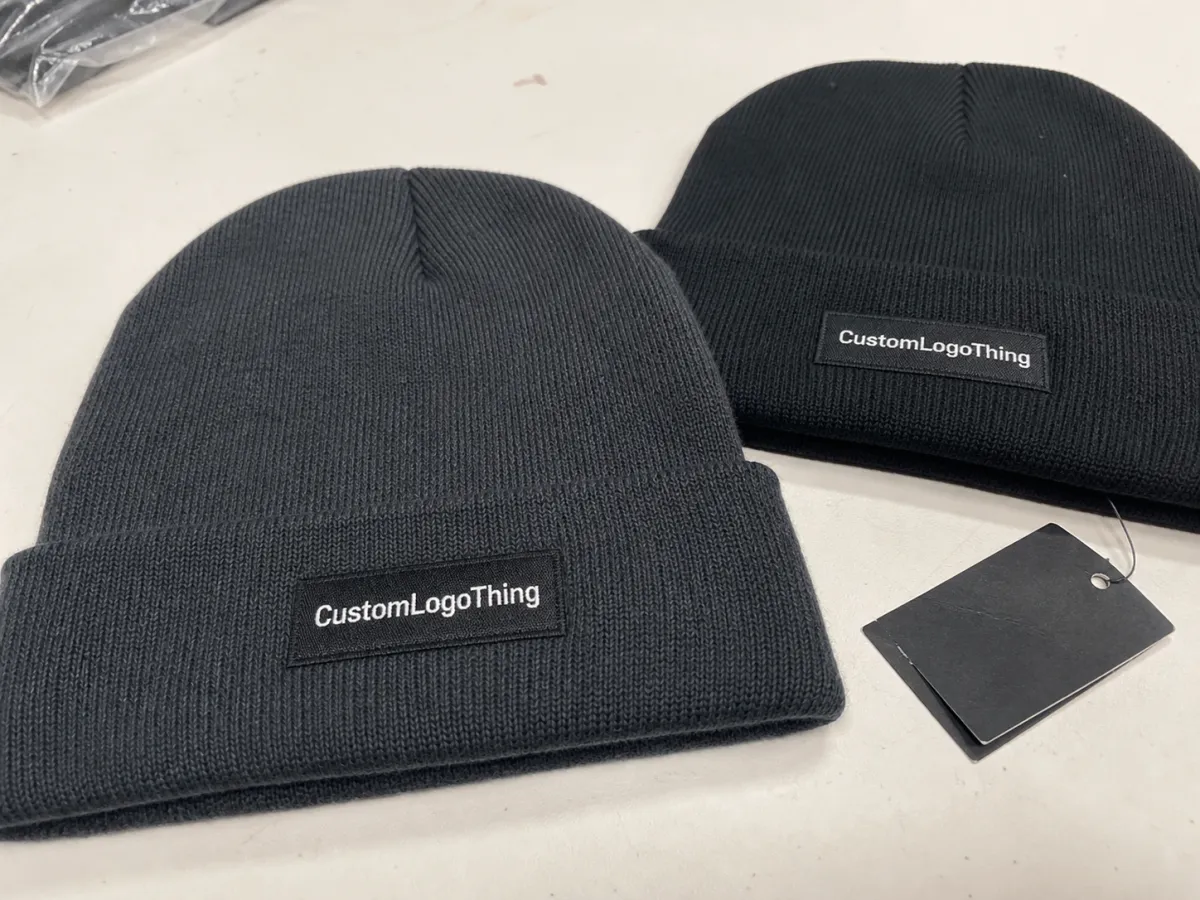
On small runs, the woven label often lifts perceived value more than a slight upgrade in yarn. That may sound blunt, but it is usually true. Buyers respond to presentation first. A basic rib-knit beanie can look like stock inventory. Put a tightly sewn woven label on the cuff, and the piece suddenly looks planned, branded, and easier to place in a retail or fulfillment setting.
That difference shows up in supplement programs, seasonal campaigns, and bundled merchandise alike. People do not buy a beanie because the acrylic felt soft in a spec sheet. They buy because the product looks like it belongs with the rest of the line, photographs well, and feels consistent with the price. The woven label becomes part of that judgment. It gives the cap a clear brand point of view without forcing a heavier decoration method.
There is also a practical packaging effect. A label makes it easier to sort, count, scan, and sell through. Retail teams like items that are simple to merchandise. Warehouse teams like items that are easy to identify. Even a small woven mark can help the piece feel closer to finished goods and farther from generic blank inventory.
Quality matters more than drama here. A lower-cost beanie with straight stitching and a balanced label often looks better than a supposedly premium blank with a crooked mark or a label that overwhelms the cuff. The eye catches mistakes quickly. Uneven placement, loose corners, and poor contrast are visible from a distance. Buyers may not know the stitch count, but they know when something looks rushed.
Practical rule: if the beanie has to sit in a mailer, on a counter, or in a retail tray, the label is part of the product, not decoration after the fact.
That is why label placement, weave detail, and packaging should be treated as a single decision. Separately, each one looks minor. Together, they decide whether the beanie looks like a real program or a leftover promo item.
What a Woven Label Beanie Run Actually Includes
A proper woven-label beanie order has four parts: the beanie body, the label, the attachment method, and any packaging. Leave one out and the quote may appear cheaper, but the piece can lose coherence fast. Buyers often ask for a simple beanie price and later discover that sewing labor, proofing, bagging, or carton labeling is not included. That is how budgets drift.
Common placements are center cuff, side cuff, and seam placement. Center cuff is the easiest to approve because the logo reads immediately and the location is familiar. Side cuff works well if the brand wants the label to feel quieter, almost like a signature mark. Seam placement gives the front a very clean look, but it can reduce visibility in photos and can be harder to keep perfectly straight if the knit stretches during sewing.
Cuffed beanies are the most forgiving choice because they offer a flat zone for the label. Slouch styles can still work, but the drape changes how the label sits in use. A beanie that looks balanced on a table may shift once worn. That is not a defect; it is a characteristic of the shape. Buyers should decide whether they want a structured presentation or a more casual profile before they approve artwork.
Typical add-ons include:
- Hang tag for retail display, barcode handling, and sku control
- Polybag for protection, transit handling, and warehouse sorting
- Care label for fiber content and wash instructions
- Gift box or sleeve for a more polished unboxing and resale feel
Packaging changes how the order is perceived. A loose beanie in a carton tells a different story than a folded piece in a bag with a hang tag and clean labeling. Buyers usually pay more for the second version because it looks easier to stock and easier to trust. That is not theory; it is what happens in the buying process when one sample feels ready and another feels unfinished.
Specs That Decide Hand Feel, Fit, and Shelf Life
The three specs that matter most are yarn blend, knit density, and cuff depth. Everything else sits behind them. A soft acrylic blend works well for broad distribution because it balances cost and comfort. Wool blends feel warmer and usually read as more premium, but they cost more and can introduce care concerns. Polyester-heavy blends can hold color well and usually keep pricing lower, though they may feel flatter if the knit is too loose or the yarn quality is inconsistent.
Knit density affects both appearance and durability. A tighter knit tends to hold shape better in shipping and makes the label area more stable. It also hides small surface inconsistencies. A looser knit can look casual and may suit some brands, but it is less forgiving if the knit face is uneven or if the label is sewn too aggressively. The beanie should not lose shape the first time it is packed, unpacked, and worn.
Cuff depth is easy to underestimate. A shallow cuff limits label size and can make the artwork feel cramped. A deeper cuff gives the label room to breathe and makes centering easier. That matters because woven labels are not posters; they are tiny readouts. If the logo needs fine lines, the cuff has to support that level of detail without looking crowded.
Woven label art has its own limits. Finer weave gives cleaner edges and sharper type, but only if the design is simple enough to survive the scale. Too many thread colors, tiny letters, or delicate linework usually turn muddy. The design is not broken; it is overworked for the format. Strong labels usually rely on bold shapes, limited colors, and enough negative space to let the weave do its job.
Fit should also match the intended audience. A streetwear-style beanie can be looser and more relaxed. A corporate promo version may need a more universal fit and a cleaner silhouette. The same blank does not always suit both groups. Buyers who skip that conversation often end up with a product that is technically correct but awkward in use.
Durability matters if the beanies will be worn often. A label sewn with weak tension can fray. A yarn blend that pills early can make the product look tired after only a few wears. If the order is meant for repeated use, ask for fiber content, stitch direction, and packaging that protects the knit during transit. For broad packaging and shipping context, the FSC site is useful for paper-based inserts or carton materials, and ISTA guidance helps when transit damage is part of the risk review.
Supplement Woven Label Beanies Unit Cost Review and MOQ
The core of any supplement woven label beanies unit cost review is not a single number. It is the stack: blank quality, label construction, sewing labor, packaging, setup, and freight. Buyers often anchor on the base beanie because it is the easiest number to compare. That can be misleading. A cheap blank with a more complex finishing package can end up costing more than a slightly better blank with simpler decoration.
At lower quantities, fixed costs dominate. Artwork setup, woven label proofing, sewing prep, and any label tooling or cut-charge fees are all spread across fewer pieces. That is why a small run often looks expensive on a per-unit basis. Once the quantity rises, those fixed costs begin to flatten out. The price does not magically collapse, but it becomes more sensible.
A realistic pricing frame often looks like this:
| Quantity | Typical Unit Cost | What Usually Drives It |
|---|---|---|
| 100 pcs | $5.50-$9.00 | Setup and proofing sit heavily on the order |
| 300 pcs | $3.80-$6.20 | Fixed costs begin to spread out |
| 500 pcs | $3.10-$5.20 | More efficient pricing if the spec stays simple |
| 1000 pcs | $2.40-$4.40 | Lower unit cost if the art and packaging remain straightforward |
These are reference ranges, not promises. Add more thread colors, request a more complex hang tag, upgrade the packaging, or split the shipment and the number moves quickly. Rush orders usually cost more as well. The same goes for multiple label positions, custom bags, and late changes to the artwork. In other words, the blank price is only one layer of the bill.
MOQ is tied to how efficiently the factory can set up the order. Smaller runs are possible, but the unit cost climbs because the work does not shrink in proportion to quantity. That is the part many buyers miss. A supplier may quote a low-looking number on a small run, then make the margin back through handling or finishing fees. The cleanest quote is the one that shows the breakpoints clearly.
For many programs, the practical sweet spot sits between 300 and 1000 pieces. That range is large enough to improve cost per piece, but not so large that inventory becomes a burden if the campaign changes. Supplement brands especially need to think about sell-through timing. A seasonal color that arrives late can become dead stock, even if the unit cost looked good on paper.
Process and Timeline From Proof to Packed Cartons
The production flow is straightforward if the buyer gives clear input. It starts with artwork submission, then label proofing, then approval. After that comes manufacturing, sewing, inspection, packing, and shipment. The process itself is not the problem. The delay usually comes from vague files, late color changes, or approval cycles that drag on after the proof has already been sent.
A normal lead-time plan often looks like this:
- Artwork and spec review: 1-3 business days if the files are ready
- Label proofing: 2-5 business days, depending on revisions
- Sample or mockup approval: 3-7 business days if a physical sample is needed
- Production: often 12-18 business days for standard runs
- Packing and export prep: 2-4 business days
- Freight transit: depends on route, service level, and customs timing
Those timeframes can stretch. Artwork that is not dimensioned correctly slows proofing. Color references that are described loosely create unnecessary back-and-forth. A buyer who changes packaging after approval can also reset the schedule. The actual bottleneck is often decision speed, not sewing speed.
Mockups or samples are worth the time if fit, label placement, or color has to be right on the first run. A quick sample can catch a label that is too wide for the cuff, a logo that disappears into the knit, or a shape that fits the hand differently than expected. That kind of problem is much cheaper to fix before production than after cartons are packed.
Rush work is possible in some cases, but it usually narrows the options. The factory may limit yarn choices, keep packaging simpler, or use label construction that is already in queue. Faster delivery does not come free. The tradeoff is usually fewer choices and less room for revisions. Buyers should assume that speed carries a cost unless the order is extremely simple.
Why Buyers Reorder This Beanie Program
Repeat orders work because the first run established a known fit, known label placement, and known color. That is the part buyers want to preserve. A reorder that comes back with a different cuff depth, a slightly shifted label, or a darker yarn shade can create more trouble than it should. The second order should behave like the first one, not like a new product disguised as a duplicate.
That is where clear spec sheets matter. So does disciplined quality control. If the supplier keeps the artwork, weave breakdown, placement notes, and packaging details in one place, the reorder process becomes much less fragile. The buyer does not have to rebuild the job from scratch, which saves time and reduces the risk of variation.
Reorder consistency is also a communication test. Buyers tend to stay with vendors who quote clearly, answer artwork questions directly, and flag issues before production starts. No one wants surprises in label size, stitching direction, carton counts, or shipment splits. A vendor that understands those details saves more than time; it saves internal credibility.
The larger lesson is simple. A good beanie program is not defined by a flashy first sample. It is defined by whether the second run matches the first one closely enough that nobody has to explain the difference. That reliability matters in supplement promotions, retail replenishment, and gift programs alike. A piece that can be reordered without changing its look is easier to budget and easier to defend.
Buyers return to this format because it is predictable. It hits the spec, stays within a workable budget, and does not create new problems every time the order repeats. That kind of consistency is more valuable than a one-time improvement that cannot be reproduced.
What to Confirm Before You Request the First Quote
Before asking for pricing, gather the essentials: quantity, target price, artwork, label placement, packaging, and delivery deadline. If those six items are ready, the quote is easier to compare and the Unit Cost Review becomes meaningful. If they are missing, the response usually comes back broad enough to be useless.
Ask for tiered pricing instead of a single number. You want to see 100, 300, 500, and 1000-piece breaks if possible. That lets you compare setup fees, sample costs, landed cost, and any surcharges tied to hang tags, special packaging, or split shipments. A low quote with hidden add-ons is not a better quote. It is just less transparent.
If reorders matter, confirm whether the supplier can match the same beanie shape, cuff style, and color in the next run. Also ask what artwork format is needed and whether the woven label proof is the final approval point. Small changes affect cost more than most buyers expect. A different thread count, a second label position, or heavier packaging can all shift the unit number.
These are the details worth locking before the order moves:
- Quantity tiers: 100, 300, 500, and 1000 pieces
- Decoration details: label size, placement, thread count, and sew method
- Packaging: loose pack, polybag, hang tag, or retail carton
- Timing: proof approval date, production window, and shipping method
- Pricing: setup charges, tooling fees, and landed cost
If you want the quote to stay focused, ask for the exact outcome you need. For example: "We need a retail-ready beanie with a center-cuff woven label, simple two-color art, and bulk pricing at 300 and 1000 pieces." That gives the supplier something concrete to price and helps keep the conversation on the actual supplement woven label Beanies Unit Cost Review instead of sliding into generic hat language.
For buyers who need the order to move cleanly, the sequence is still the same: confirm the spec, compare the tiers, approve the proof, and then release production. That order keeps the decision anchored in cost per piece, not guesswork. If you need labels, tags, or related finishing, see Custom Labels & Tags for the accessory side of the program.
What changes the supplement woven label beanies unit cost most?
Quantity is usually the biggest factor because setup gets spread across more pieces. Label complexity, attachment method, and packaging can move the number faster than buyers expect. Rush production and split shipping often raise the landed cost even when the base unit price looks acceptable.
What MOQ should I expect for custom woven label beanies?
MOQ varies by factory, but mid-size tiers usually deliver the best balance between price and flexibility. Small runs are possible, though the per-piece cost is higher because the setup burden does not shrink. Ask for tiered pricing so you can see where the order becomes efficient.
How long does production usually take after approval?
Most orders move through proofing first, then production begins after the final approval. A standard run often takes a few weeks from artwork sign-off to packed cartons, depending on quantity, label complexity, and shipping method. Rush service is sometimes available, but it usually limits customization and increases cost.
Can I lower the price without making the beanie look cheap?
Yes. Keep the label design simple, avoid unnecessary thread color changes, and choose a standard blank unless the market truly needs a custom base. Packaging can also be simplified without hurting presentation if the goal is a clean retail look rather than premium gift presentation.
What should I ask for in the quote before I order?
Ask for tiered unit pricing, setup fees, sample costs, shipping terms, and any packaging charges in one breakdown. Confirm label placement, artwork format, and whether the quote includes sewing and bagging. Request the production timeline and reorder pricing so the first order does not become a guessing exercise.


