A streetwear launch can look profitable on a spreadsheet and still bleed margin in the packing room. The streetwear drop Custom Poly Mailer Bags Unit Cost Breakdown usually changes once freight, setup, spoilage, and rework are included, which is why the lowest quoted bag price rarely tells the full story. A mailer that seems one or two cents cheaper can become the expensive option if it tears, prints off-register, or forces a rushed replenishment during a tight drop window.
From a packaging buyer's point of view, the mailer is not a throwaway envelope. It is the first physical proof that the brand cared about the shipment. If the film feels flimsy, the adhesive lifts, or the print lands dull, customers do not separate that from the garment inside. They just remember the package as part of the product.
"A mailer is cheap only if it survives the route and still looks intentional at the door."
Why the first bag price usually misses the real cost
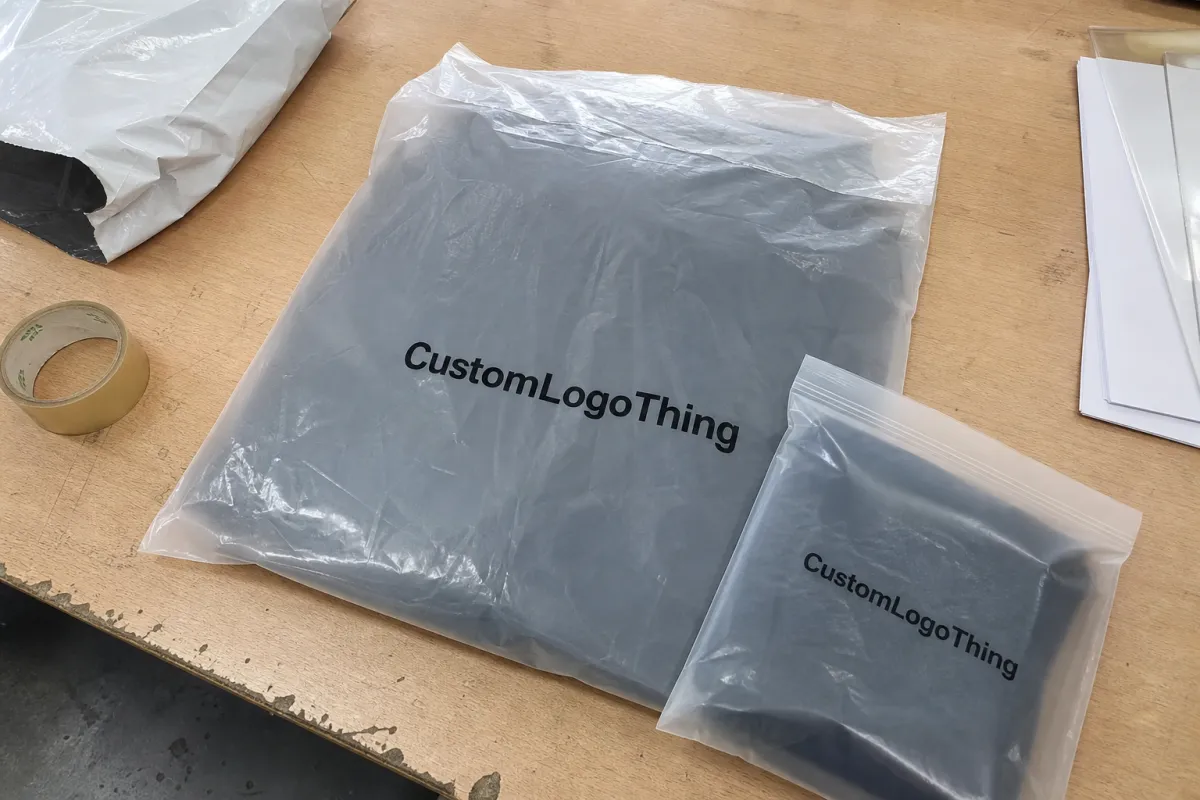
The first quote usually focuses on the bag itself. That makes sense for a quick comparison, but it hides the real landed cost. A usable number needs to include material, print setup, cartons, freight, customs or domestic delivery, and an allowance for spoilage or proofing. On a 1,500-piece hoodie drop, a $0.03 difference per bag sounds small until a damaged shipment, adhesive failure, or packaging mistake creates reshipments and support work that cost far more than the original savings.
Artwork changes also move the number. A one-color logo is straightforward. Add a QR code, a second ink color, or full-bleed coverage late in the schedule and the job becomes more expensive to set up and more sensitive to registration. The same applies to shipping weight and carton count. A slightly heavier film or a mailer that packs inefficiently may look harmless on one pallet, then show up as a meaningful freight bump across thousands of units.
What hurts streetwear teams most is not an awkward-looking quote. It is the cost of a bad drop. A torn seam or weak seal can trigger customer complaints, replacement shipments, and a dent in trust that is hard to measure on the day of launch. That is why the streetwear drop Custom Poly Mailer Bags unit cost breakdown should be treated as a packaging decision, not a line item to trim without context.
If the release includes heavyweight tees, hoodies, or layered sets, a stronger mailer spec is often the safer buy. A few extra cents spent on fit, gauge, and seal quality usually costs less than the first failure in transit.
What changes the bag spec before you print anything
The film is the first decision, and it drives more than appearance. Virgin PE film usually gives a cleaner feel and more predictable sealing, while recycled-content film may satisfy sustainability goals but can change stiffness, opacity, and surface finish. Single-layer film can work for very light apparel, but coextruded film is common for Custom Poly Mailers because converters can balance strength, sealability, and print surface across two or three layers.
Closure style matters more than many brands expect. A permanent adhesive strip is standard for one-way shipping. Peel-and-seal closures add convenience and a more finished closing line, but they do add cost. Tamper-evident features are worth a close look for high-value drops, especially when inserts or premium garments are inside. The adhesive should hold in normal warehouse temperatures, because a flap that fails in a warm dock or a cold truck is a problem that only shows up after the order is already moving.
Print method shapes both the look and the price. One-color logo work is usually the cleanest budget choice. Two- and three-color print raise setup time and ink usage, but can be justified when the package is part of the product story. Full-bleed coverage creates a more intense shelf presence and a stronger unboxing moment, though it also raises the chance of waste if the artwork or registration is not locked in early.
Finish is another cost lever. Gloss is usually the least expensive visual finish. Matte tends to read more restrained and premium. Soft-touch and heavy opaque coverage sit higher up the ladder because they demand more material and tighter process control. Dark films and white ink-heavy designs often cost more for a simple reason: getting opacity right takes more passes and more discipline on press.
Useful extras are easy to underestimate. Tear strips, inside printing, barcode panels, custom warning copy, and placement marks can all improve fulfillment speed or make the package feel more deliberate. For brands comparing Custom Poly Mailers and other Custom Packaging Products, the best spec is usually not the flashiest one. It is the one that protects the garment, fits the warehouse process, and keeps the margin intact.
If the drop also uses tissue, inserts, labels, or a secondary shipper, keep the system aligned across Custom Packaging Products and custom printed boxes. Mixed finishes and mismatched dimensions are where small packaging programs start to feel inconsistent.
Sizing, film gauge, and seal details that protect the product
Mailer size should come from the packed garment, not the garment folded on a desk. A tee may fit a smaller bag on paper, but once the polybag, hang tag, insert, and a little trapped air are added, the dimensions move fast. Hoodies and heavyweight fleece need even more room. If the mailer is too tight, the seams work harder, the adhesive flap has less contact area, and the package starts to look overstuffed before it even leaves the warehouse.
Film gauge is one of the easiest places to protect margin without making the package fragile. Light tee drops often work around 2.5 mil, while hoodies, sweatpants, and bundled sets usually belong at 3 mil or heavier. If the apparel has zippers, hard corners, dense print layers, or sharp hardware, a stronger film can reduce puncture risk and edge fatigue. A bag that fails on the first route costs more than a thicker one ever will.
Mailers also affect freight in a very practical way. Oversized bags eat carton space, which increases dimensional weight and can change the final shipping bill even when the contents are light. A mailer that is only 2 inches too long may not look like a problem until it affects pallet count, warehouse storage, or destination charges across 10,000 units. That is why sizing needs to match the real packout instead of a broad label like "tees" or "hoodies."
Seal details deserve a slow check. Look at flap length, adhesive width, and edge weld quality. A good seal closes flat, holds through handling, and resists accidental opening during sortation. If the shipment is high value or moving long distances, transit validation through organizations such as ISTA gives a more realistic test than a sales sheet alone. Packaging claims are easy to make and harder to prove.
Practical sizing tiers often start here:
- Small apparel: tees, socks, and light accessories - often around 10 x 13 inches with lighter film.
- Standard streetwear: tees with inserts, long sleeves, light fleece - often around 14.5 x 19 inches in mid-gauge film.
- Bulkier outerwear: hoodies, joggers, and bundled sets - often around 19 x 24 inches with stronger seal and heavier film.
Those are starting points, not rules. The goal is a mailer that looks intentional, closes cleanly, and gives the seam and adhesive enough room to do their job.
Streetwear Drop Custom Poly Mailer Bags Unit Cost Breakdown
The clearest way to read a quote is to split it into the parts that actually move the number. Material cost, print setup, ink coverage, bag dimensions, closure style, packing, and freight all push in different directions. The streetwear drop Custom Poly Mailer Bags unit cost breakdown only makes sense when those inputs are compared on the same basis.
MOQ changes the math quickly. At lower quantities, setup costs are spread across fewer bags, so the unit price stays higher. Once the order moves from 5,000 to 10,000 or 25,000 units, those fixed costs flatten out and the per-unit price usually improves. That is why two quotes for the same-looking mailer can still belong to different cost realities.
| Option | Typical landed unit cost at 5,000-10,000 pcs | Best use | Main trade-off |
|---|---|---|---|
| Plain stock mailer | $0.08-$0.14 | Basic shipping, quick replenishment | Lowest branding impact |
| One-color custom print | $0.12-$0.24 | Core tee drops, simple logo work | Moderate setup, strong value |
| Two- to three-color print | $0.18-$0.32 | Seasonal releases, collabs | Higher setup and ink cost |
| Full-bleed matte or opaque mailer | $0.24-$0.45 | Premium streetwear launches | Most expensive, strongest visual impact |
Those ranges are practical, not universal. A domestic run, a recycled-content film, or a simple one-color print can land lower. A heavier gauge, full coverage, special finish, or rushed ship date can push the number higher. The landed price matters more than a factory-only quote, because freight, cartons, destination fees, and duties can change the final number more than the bag itself.
Comparisons only work if the assumptions match. Use the same size, the same thickness, the same print count, the same closure, and the same delivery terms. A quote on EXW terms is not comparable to one that includes freight. A quote that assumes 5 percent spoilage is not the same as one that assumes none. If a supplier cannot explain the basis of the number, the number is not yet useful.
Some buyers also want a cleaner way to think about the cost stack. A simple internal breakdown often looks like this: film and additives, printing and color changeovers, die or setup time, packing and cartonization, freight, and a small allowance for spoilage or proofing. Once those pieces are visible, it becomes easier to see whether the premium is coming from material choice, print complexity, or shipping distance. That is the part most quotes hide.
Packaging standards and recycled-content claims can help you sanity-check a proposal. The EPA recycling guidance is a useful reference when a supplier talks about post-consumer content or disposal claims, and it is more reliable than a vague "eco" label. Honest quoting keeps a packaging decision from turning into a budget surprise.
Process, timeline, and lead time from proof to shipment
The production path usually starts with spec confirmation, then artwork review, then a digital proof, then prepress approval. After that, the bags move into printing, curing, slitting, and packing. A clean job can move predictably, but only if the spec is complete before the press starts. Missing files, unclear color targets, and late dimension changes are the fastest ways to turn a tidy run into a delay.
Simple stock-style runs tend to move faster than fully custom jobs. For many brands, a straightforward one-color mailer can run in roughly 12 to 15 business days after proof approval, while a more complex full-coverage piece may need 15 to 20 business days or more depending on current production load. That lead time should be measured from approval, not from the first inquiry, because artwork back-and-forth is usually where schedules slip.
Three delay points show up again and again. First, the artwork file is not press-ready, so the design team has to rebuild it. Second, color approval arrives late, which stalls the run. Third, the brand changes the size after the proof is signed, which forces a new setup. All three are avoidable if the buyer sends a complete brief before the quote is finalized.
For a timed streetwear drop, sampling matters. A preproduction proof or short sample run gives the team a chance to check print alignment, opacity, flap hold, and pack fit before the main order moves. If the release date is locked, that sample step is not a luxury. It is insurance. Brands that skip it often pay for the missed detail later, either in the warehouse or in customer service.
Good buyers also ask for a few simple QC checks before approving production: seal integrity after compression, print rub resistance, color match against the approved file, and pack-out fit with the actual garment. These are ordinary tests, not premium extras. They catch the kinds of problems that are expensive only after the order lands.
For shipments with heavier garments or multiple handoffs, some teams ask for additional validation against transit testing methods from ISTA. That is useful when the package has to survive sorting, stacking, and longer routes. The idea is simple: prove the bag before the drop, not after complaints start.
Why repeat-drop brands standardize on one mailer spec
Brands that ship often usually settle on one proven mailer spec for a reason. Once the size, gauge, print layout, and closure are locked, replenishment becomes faster and more predictable. The warehouse knows what to pull, the buyer knows what to reorder, and the cost comparison from one launch to the next becomes real instead of fuzzy. That matters when releases move quickly and inventory has to support more than one drop cycle.
Consistency also protects the look of the brand. Streetwear customers notice when a drop feels different from the last one, even if they do not describe it in packaging language. A stable mailer keeps the unboxing experience aligned across seasonal releases, collaborations, and restocks. It gives the brand a repeatable surface instead of making every shipment feel improvised.
Operationally, standardization helps the warehouse as much as the design team. Picking is easier, inventory counts stay cleaner, and the risk of ordering the wrong mailer falls sharply. Instead of redesigning the bag for each launch, the team can focus on the garment, the campaign, and sell-through.
The cost benefit is just as practical. If the spec stays stable, the unit cost comparison across orders becomes meaningful. That makes it easier to see whether freight moved, whether film prices shifted, or whether a finish upgrade is worth the premium. It also prevents the common mistake of comparing two mailers that are not actually equivalent.
If the collection uses paper inserts, care cards, or shelf-ready components, it helps to keep the paper side of the system aligned with the rest of the package. FSC-certified stock can be a sensible choice for that portion of the kit, and it fits neatly beside a more disciplined branded packaging plan. The same logic applies to custom printed boxes when a drop needs a secondary shipper or retail-ready presentation.
What to send for a fast quote and the next reorder
A quick quote starts with clean inputs. Send the flat width and length, the expected quantity, the number of print colors, the finish preference, and whether you want matte, gloss, or opaque film. If the product is a hoodie, heavyweight tee, or bundled set, say that up front so the supplier can recommend a gauge that actually fits the load.
Include the shipping destination ZIP code or country. That is what turns a factory estimate into a realistic landed number, because freight and delivery timing are often the difference between a quote that looks good and one that actually works. If you are comparing overseas and domestic options, ask for the same delivery basis on both sides so the comparison stays clean.
Artwork files matter too. A logo mockup is enough to start, but vector artwork, placement notes, and color callouts save time and reduce the risk of a bad proof. If you want a barcode panel, inside print, or tamper-evident detail, note that before the quote is issued. Changes after proof approval almost always cost more than sending the full brief on day one.
It also helps to ask for pricing across multiple tiers. A quote for 5,000 units shows one cost curve, while 10,000 and 25,000 units show where the setup cost actually spreads out. That makes MOQ easier to judge and makes it simpler to decide whether a deeper buy supports a drop series instead of treating each release as a one-off.
For brands that want the whole packaging stack to stay aligned, the same request package can cover mailers, inserts, labels, and other Custom Packaging Products. That approach keeps artwork, finish, and timing consistent, and it makes the next reorder easier to approve. The more complete the brief, the less guesswork sits inside the final number.
How do I estimate streetwear mailer unit cost by quantity?
Compare the same size, film gauge, print count, and closure style across each quantity tier. Ask for landed pricing so freight and carton charges are included with the bag price, then watch how the per-unit cost falls as MOQ rises and fixed setup costs are spread over more bags.
What details do you need for an exact custom poly mailer quote?
Send the flat width, length, desired film thickness, print colors, and finish choice. Add your quantity target and shipping destination so pricing and transit time are realistic, and include artwork files or a logo mockup if print placement or color matching matters.
What thickness works best for hoodies and heavier apparel drops?
Use a heavier film gauge for bulky or sharp-edged garments so seams and seals hold under handling. Match the gauge to the packed weight, not just the garment category, and if you ship mixed product types, choose the spec that safely covers the heaviest item in the drop.
Can custom printed poly mailers handle full-bleed streetwear branding?
Yes, but full-bleed coverage usually increases ink usage and can raise unit cost. Confirm whether the brand wants matte, gloss, or opaque coverage before quoting, and ask for a proof to verify color placement and edge wrap before production starts.
How long does production usually take after artwork approval?
Lead time depends on quantity, print complexity, and current production load. Simple runs move faster than full-coverage or multi-color jobs, so build in time for proof review and any revisions before the order is released.
For most streetwear brands, the best result comes from treating the mailer as part of the drop, not as an afterthought. Lock the spec, compare the landed numbers, and the packaging budget becomes easier to defend because the mailer is doing real work instead of just occupying a line on the PO.

