The fastest way to avoid expensive guesswork is to treat the tea Pom Pom Beanies Material Sample guide like a decision tool, not a courtesy step. A finished sample tells you what a rendering never can: how the knit sits on the head, how the pom changes the silhouette, whether the yarn feels soft or scratchy, and whether the whole piece still looks intentional after a few stretches.
That matters because headwear is unforgiving. Small changes in gauge, fiber, or trim can make the same design feel premium in one version and flimsy in the next. The sample is where preference becomes evidence. Skip it, and you usually pay for the lesson twice. First in the order. Then in the revision.
For tea Pom Pom Beanies, the sample should answer a few practical questions before money goes into bulk production. Does the cuff recover after wear? Does the crown stand too tall? Is the pom balanced, or does it drag the hat backward? Does the knit still look clean under daylight and indoor light? A buyer who cannot answer those questions is not ready to approve production.
Tea pom pom beanies material sample guide: what it proves
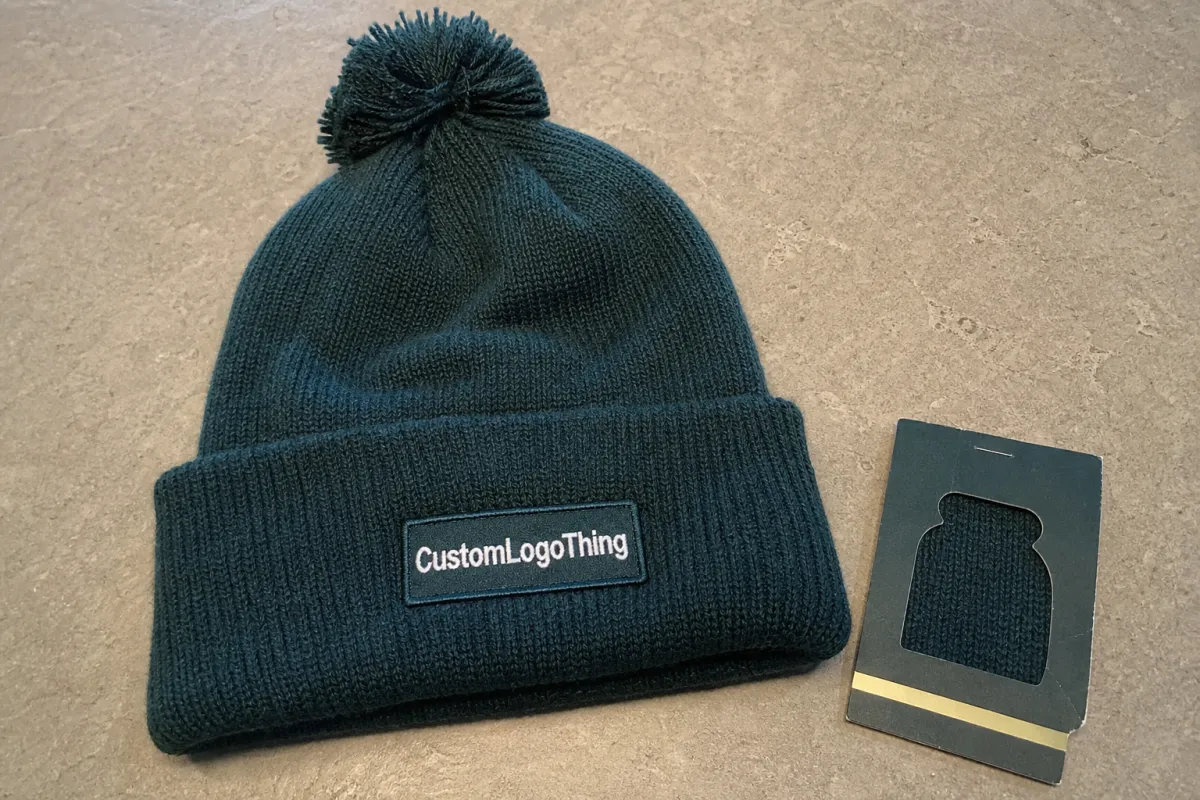
A useful tea pom pom Beanies Material Sample guide starts with one basic idea: the sample should show how the product behaves, not just how it photographs. Yarn cards help with fiber content and color reference. Knit swatches show stitch definition, stretch, and density. A finished sample shows whether all the parts work together as a wearable product.
That difference is easy to miss if you buy by image alone. A beanie made with 100 percent acrylic may feel lighter and hold its shape better than a wool blend. A recycled polyester blend may look cleaner after handling but feel less lofty. Neither is automatically better. The right call depends on the brand position, target price, climate, and how much consistency the customer expects across a run.
Sampling is most useful when the style is new, the yarn is unfamiliar, the launch is seasonal, or the cost of a miss is high. Holiday drops, school programs, and retail orders with fixed ship dates do not leave much room for correction. One wrong pom size or a color that reads off by a shade can force a second round of samples, and that delay costs more than the first sample ever did.
In practice, a sample should prove four things: fit, color accuracy, construction, and wearability. If the rib does not recover well, if the crown sits awkwardly, if the pom attachment feels weak, or if the knit itches after a minute of handling, the sample has already done its job. It just did the job by preventing a bad order.
"A sample that looks good on a screen but fails in the hand is not a win. It is a delay in disguise."
How the process moves from yarn selection to approval
The cleanest sampling process moves in a straight line. The buyer sends a clear brief. The supplier confirms yarn, trim, and dimensions. A first sample is produced. Then the buyer reviews it against the spec sheet and locks the changes before bulk production starts.
That sounds simple. It usually is not. The trouble starts when the brief is vague. "Soft but premium" is not a material spec. Neither is "make the pom pop." A good brief includes size, color direction, logo placement, pom preference, cuff depth, and any limits on cost or lead time. The more exact the brief, the fewer strange surprises later.
Written specs matter because different teams can approve different versions without realizing it. Merchandising might sign off on the look. Sourcing might sign off on the price. Operations might sign off on the delivery date. If those approvals are based on slightly different samples, the order can drift before anyone notices.
The review itself should be physical, not ceremonial. Put the beanie on a headform first, then on a real person with a normal head size. Pull it on and off a few times to check recovery. Run a finger along the seam. Tug the pom gently to see how the attachment feels. Check the color in daylight and under indoor light. Textured knits can read warmer, cooler, flatter, or darker depending on the room.
Packaging deserves attention at the sample stage too. A finished prototype should travel in protective corrugated cardboard or a padded mailer with enough fill to keep the pom from being crushed. If the supplier talks about FSC certified board or recycled materials, ask what that means in actual packaging terms. Are they using post-consumer waste content? Are they avoiding unnecessary plastic? Are they packing the item tightly enough to protect shape without overdoing the materials?
For transit testing standards, the International Safe Transit Association publishes useful guidance here: ISTA. For sourced materials tied to responsible forestry, FSC is the reference point: FSC.
Revisions should be specific. "Make it softer" is not actionable. "Reduce rib height by 5 mm, move the pom up 8 mm, and switch to the darker heather yarn" is actionable. The supplier can work with that. The factory can repeat that. Anything looser invites drift.
Material choices that change feel, shape, and wear
Material choice is where many beanie programs either stay on budget or wander into preventable trouble. Two hats can look almost identical in a render and feel completely different in hand. One yarn gives a crisp silhouette. Another collapses into a softer slouch. A third pills early and starts looking tired after a few wears, even if the first sample looked clean.
Acrylic is usually the easiest entry point. It is cost-effective, widely available, and usually holds color well across production. Wool blends feel warmer and more natural, but they can raise the price and bring care issues with them. Recycled polyester or blended recycled yarns can support a sustainability story, though the texture and loft can differ from conventional yarns. None of these are automatic winners. They are trade-offs.
Poms change the product more than some buyers expect. Faux fur poms look richer and photograph well, but they can add weight and may flatten during shipping. Knit poms are lighter and more consistent. Yarn poms are usually the cheapest and easiest to scale, though they read more casual. If the hat is meant to look playful without tipping into cheap, the sample should show how the pom size, density, and attachment method affect the whole hat.
| Material option | Typical feel | Common price impact | Best for |
|---|---|---|---|
| Acrylic yarn | Soft, light, easy to shape | Lowest sample and production cost | Promotions, school programs, broad retail use |
| Wool blend | Warmer, more textured, slightly more premium | Usually 10% to 30% higher than acrylic | Cold-weather drops, outdoor brands, elevated retail |
| Recycled polyester blend | Smooth, consistent, sometimes less lofty | Moderate, depending on fiber source | Sustainability-led programs and repeat color runs |
| Faux fur pom | Plush, visually strong, heavier | Higher trim cost and more handling care | Premium gifting and fashion-led collections |
Construction details matter just as much as fiber content. Gauge changes how tight or open the knit feels. Rib depth affects cuff recovery. Crown shaping determines whether the beanie sits close to the head or rises into a taller profile. A lining can improve comfort, but it can also reduce stretch and push the price up. That is why the sample needs to be worn, not just inspected on a table.
Color is another place where expectations need to be reset. Textured knits do not show shade the same way flat fabric does. A melange yarn can look lighter in daylight and deeper indoors. Dark yarns can hide stitch detail. Light yarns can reveal inconsistencies faster. If the supplier says the yarn matches a Pantone, ask how they are translating that reference into knit form. A knit surface is not coated paper. It never behaves exactly the same.
Quick performance checks are worth the time. Does the yarn hold shape after a few stretches? Does the fabric feel scratchy near the forehead? Does the pom shed? Does the sample smell strongly of finishing chemicals after unpacking? None of those questions are glamorous, but they are the ones that separate a workable product from a return problem.
Cost, pricing, and MOQ factors that shape the quote
Sample pricing and production pricing are not the same thing, and they should not be treated like they are. A sample has setup time, sourcing work, knitting labor, trim assembly, and shipping cost wrapped into one prototype. Production spreads those costs across many units, which is why a sample can feel expensive even when the final unit price is reasonable.
MOQ has a direct effect on unit cost. At lower quantities, each setup step weighs more heavily on every piece. At larger quantities, the fixed costs spread out. A 200-piece order may look close to a 2,000-piece order on paper, but the unit price usually tells the real story. The machine time, approval work, and trim sourcing do not shrink at the same rate as the order size.
For a basic custom beanie, buyers often see production pricing in the rough range of $3.20 to $6.50 per unit at 500 to 1,000 pieces, depending on yarn, pom type, logo method, and packaging. Add embroidery, a woven label, a premium faux fur pom, or retail-ready folding, and the number moves quickly. Sample fees can sit anywhere from $35 to $120, with revision charges added if the design keeps changing.
The hidden costs are usually the ones that cause friction. Custom poms. Extra stitch density. Woven labels. Hang tags. Tissue wrap. Biodegradable packaging. Insert cards. Slightly heavier cartons because the buyer wants a cleaner unboxing experience. A supplier that breaks these out line by line is usually easier to work with than one that hides everything in a single number.
Ask for at least two or three quote versions. One should reflect the base spec. Another should show the upgraded option. A third can isolate the main cost driver, such as a pom change or a tighter knit. That comparison makes the trade-off obvious. Often one upgrade gives a real visual lift for a small increase, while another barely changes the look and adds real money.
Packaging still matters at this stage, especially for brands that care about sourcing claims. If the sample ships in FSC certified corrugated board with kraft paper protection instead of mixed-material filler, that may not change the quote much, but it does show process discipline. Retail buyers notice those details. So do teams that need to speak clearly about recycled content or post-consumer waste claims later on.
Production timeline and lead time expectations
A realistic timeline keeps the project tied to the launch calendar instead of the other way around. Most custom beanie programs move through sourcing, sample knitting, review, revisions, final approval, and then the bulk run. Those steps do not happen at the same pace, and there is no prize for pretending they do.
If the yarn is already in stock, the schedule usually improves. If the artwork is clean, the measurements are locked, and one person has final authority, it improves again. A project can save days simply because nobody has to ask whether the pom should be 6 cm or 7 cm, or whether the logo sits centered or slightly lower on the cuff.
Delays usually come from the opposite. Seasonal backlog. Open color matching. Missing dimensions. Too many comments scattered across email, chat, and spreadsheets. A note in three different places can create three versions of the same instruction. That is how a sample that was "basically approved" turns into a production mistake.
Most buyers should build in a buffer for shipping, internal review, and one final check before launch or delivery. That buffer is not extra padding. It is the difference between a controlled approval and a rushed one. A sample can leave the factory on time and still arrive with only a few days left to review. If merchandising, sourcing, and sales all need to sign off, those days disappear fast.
For the tea pom pom Beanies Material Sample guide, the safest planning approach is simple: do not schedule the order around the best-case scenario. Plan for one revision, one shipping delay, and one round of internal comments. That version is the one that usually happens in real life.
If the launch date is fixed, request the sample early enough that a second prototype can still happen without panic. Rushed approvals hide compromises. Compromises are almost never cheap.
Common sample mistakes that distort the final hat
The biggest sample mistake is judging the beanie in the wrong context. A hat viewed under warehouse lighting on a desk will not read the same way it does on a head in daylight. Texture, color, and silhouette all shift with angle and light. That is especially true with knit surfaces, where shadow creates depth that product photography tends to flatten.
Fit errors are just as common. One head size does not tell the whole story. A sample should be tested on more than one person if possible, or at least on a proper headform plus a real wearer. Check stretch recovery after repeated wear. A beanie that starts strong but sags by lunchtime is not a good result, no matter how polished the first photo looked.
Another common mistake is comparing the sample to a mood board instead of the actual spec sheet. Mood boards are useful for direction. They are not production tools. If the approved yarn, the reference image, and the measurements do not belong to the same version, people start saying "it feels off" without being able to explain why. That is a process problem, not a taste problem.
Some performance checks get skipped because they sound secondary. They are not. Pilling after a few rubs. Seam comfort at the forehead. Pom security after a gentle tug. Color fastness after washing. Even a basic wash test can reveal whether a product is built for real wear or only for the first impression.
Document the approved version. Save photos from several angles, note the date, record the exact yarn and pom details, and keep the comments that led to approval. That record protects both sides. If production later questions a detail, there should be one answer, not a debate.
"If the approved sample is not written down, it is still open to interpretation."
Expert checks and next steps before you place the order
Before the PO goes out, run a final checklist. Yarn type. Gauge. Pom style. Color reference. Label method. Fit. Packaging. Carton quantity. Tolerance ranges for size and placement. The more custom the item, the less room there is for assumption. A few minutes of review can prevent a week of correction.
If the first sample needed changes, ask for one final pre-production sample or proof. That matters most on larger orders or fixed launch dates, where even a small mismatch can become a commercial problem. A proof is not a delay for its own sake. It is confirmation that the approved spec survives a second pass.
Written sign-off should include photos and exact specs. Not just "approved." Use language that can be checked later: approved yarn code, approved pom type, approved label placement, approved packaging format. If the bulk run drifts, everyone needs the same reference point.
After that, place the order, confirm the production schedule, and plan a spot check when the first cartons arrive. This is where teams get too comfortable. The sample may have been perfect, but bulk production still needs a quick verification. Check the first cartons for count, finish, and overall consistency before the order moves deeper into the chain.
The strongest buyers turn the tea pom pom Beanies Material Sample guide into a repeatable buying habit. They compare yarn, pom, fit, and color in a way the whole team can review later. That is how a preference becomes a standard and how a small accessory order avoids becoming a costly correction.
FAQ
What should be included in a tea pom pom beanies sample kit?
Ask for a finished sample, yarn swatches, and color references so you can judge handfeel and shade together. Include trim details such as label type, pom style, and stitch notes so nobody has to guess later. Request care instructions and any wash-test notes so the sample reflects real use, not just first impressions.
How many sample rounds are typical before bulk production?
One initial sample plus one revision is common when the style and materials are already well defined. Expect extra rounds if the yarn is new, the color is hard to match, or the fit needs refinement. Lock the approved version in writing before moving to bulk so the team does not drift back to an earlier sample.
How do I compare sample pricing between suppliers?
Compare what the fee includes: knitting, sourcing, revision time, shipping, and whether the sample charge credits the final order. Check whether the quote reflects the same yarn, trim, and packaging, since missing details can make one supplier look cheaper than it is. Ask for itemized pricing so you can see which spec changes raise cost and which ones are low-risk upgrades.
Why does a sample look different in person than online?
Screens flatten texture, while real knits show loft, structure, and shadow that change the appearance immediately. Lighting matters too: daylight, indoor warm light, and warehouse light can make the same color read very differently. Use a physical reference or approved photo set to judge the sample instead of relying on a product image alone.
When should I request samples in the buying timeline?
Request them before you commit to the bulk PO and while there is still time to change specs without rushing. Build in enough room for shipping, review, and one revision so the approval does not squeeze your launch date. If the project is seasonal, start early enough that the final order can move through production without shortcuts.


