Coffee Roasters Kraft Paper Bags Custom Size Quote requests usually sound straightforward until the supplier starts unpacking the actual build. A 12 oz bag that becomes a 1 lb bag can change material usage, seal length, carton count, freight cube, and even how the line fills. I have watched roasters get fixated on print price while the biggest cost swing came from the bag dimensions themselves. That is the part people miss.
For a coffee brand, the bag is not just a wrapper. It protects aroma, supports shelf presence, and quietly shapes the buyer’s first impression in a few seconds. I have seen beautiful roasts lose shelf value because the pack looked generic or because the size was awkward in a carton. A well-formed product packaging plan can support premium positioning. A poorly sized bag can nudge margins in the wrong direction without making much noise.
If you need a Coffee Roasters Kraft Paper Bags Custom Size Quote, start with structure, fill weight, and where the bags will actually go. Retail packs, subscription packs, and wholesale sample bags rarely share the same requirements. That is why a good supplier does more than spit out a number. It helps turn a rough idea into a quote that shows the trade-offs before the order is locked.
A useful quote is not just a price. It is a record of what is fixed, what is optional, and what changes once the dieline is approved.
Coffee Roasters Kraft Paper Bags Custom Size Quote: What Actually Changes Cost
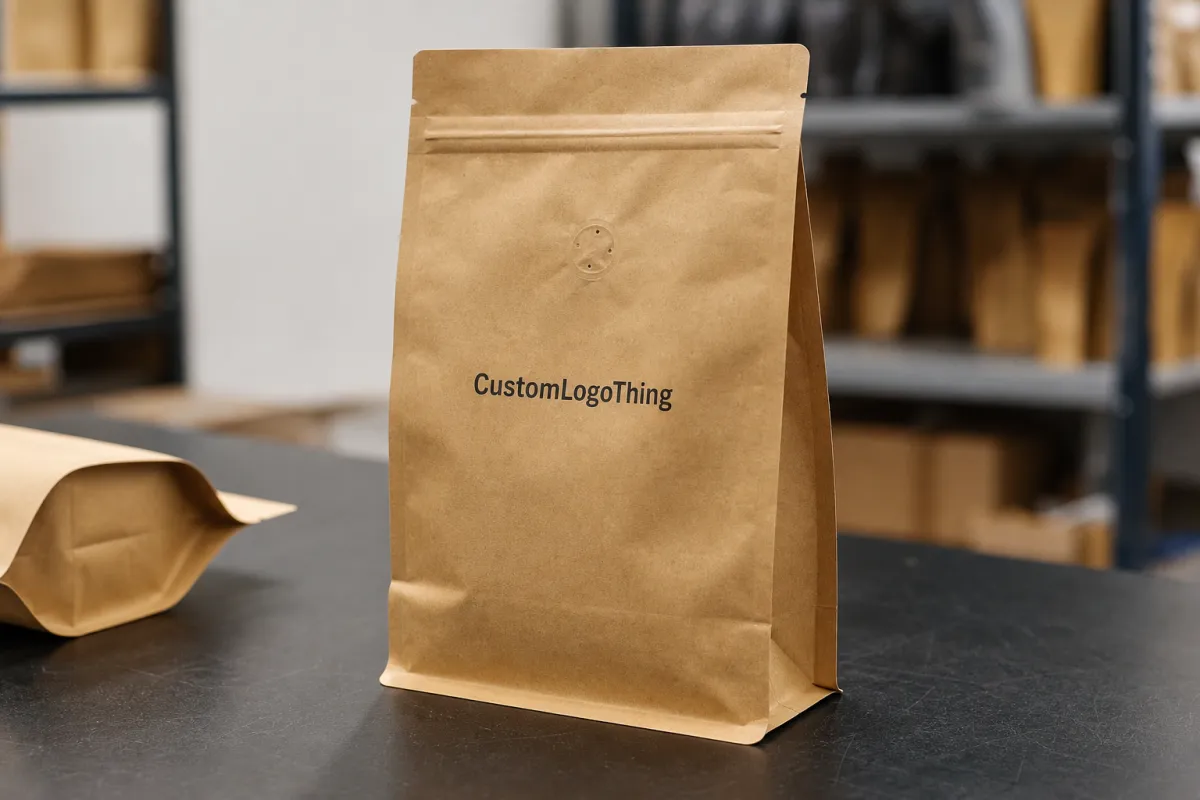
A coffee roasters Kraft Paper Bags custom size quote usually starts moving with dimensions, then keeps moving through the details many buyers overlook. Bigger dimensions mean more material, yes, but the ripple goes further than paper usage. It affects liner area, seal length, carton pack-out, and how many finished bags fit on a pallet. Two bags with similar artwork can still land at very different costs once those variables are counted.
The practical example is easy to miss. A roaster moving from a slim 12 oz profile to a fuller 1 lb gusseted bag may keep the same logo and color count, yet the shipping carton grows, pallet density drops, and freight rises per unit. The unit price might look manageable on paper. The landed cost can still move enough to affect margin by several points.
Functional features change the number too. A one-way degassing valve helps fresh roast release gas, but it also adds a component, a placement step, and another inspection point. A zipper improves repeat use and works well for retail packaging, yet many first-time buyers underestimate how much it adds. Tin ties can be cheaper than zippers in some runs, although they are not the right answer for every roast profile or shelf-life target. Sometimes the simpler closure is the smarter one. Sometimes not.
Barrier level matters just as much. Coffee is sensitive to oxygen and moisture, so the inside structure often uses metallized film, PE layers, or another barrier liner beneath the kraft face. The outer kraft layer gives a grounded, specialty-roaster look. The barrier layer is what protects aroma and flavor. Buyers tend to focus on the paper because that is what they can see. Suppliers focus on the inside because that is what keeps the coffee sellable after shipping, storage, and a few hands between roasting and opening.
Small runs feel expensive because fixed costs land on fewer units. Setup, plates, proofing, and any custom tooling get spread thin, so the per-bag price rises quickly. Larger volumes change the shape of the quote. The same setup gets amortized across more bags, which is why a tiered coffee roasters Kraft Paper Bags custom size quote is more useful than a single figure. It shows where scale starts to work in your favor.
Ask for a quote that separates these items:
- Bag price by quantity tier
- Printing setup and plate or tooling charges
- Optional components such as valve, zipper, tin tie, or tear notch
- Sample cost and proof charge, if applicable
- Freight and estimated carton count
The easiest suppliers to compare will break those lines out cleanly. If they do not, the quote may appear lower than it really is.
Product Details: Kraft Paper Bag Structures for Coffee
For coffee, the most common kraft-based formats are flat bottom bags, side gusset bags, block-bottom pouches, and stand-up pouches with a kraft outer layer. Each one supports a different sales pattern. A flat bottom bag usually gives the strongest shelf footprint for specialty retail. Side gusset bags often pack efficiently for larger fills. Stand-up pouches are familiar to shoppers and can work well for subscription or gift packs. Block-bottom styles sit between the two, balancing presentation with fill stability.
If you are comparing a coffee roasters Kraft Paper Bags custom size quote across those structures, ask which format fits your average roast volume and pack-out speed. Whole bean retail needs freshness, resealability, and shelf appeal. Ground coffee may need a tighter barrier if it will sit longer before use. Wholesale samples and tasting packs can usually prioritize low cube and simpler closures. One bag style rarely fits every use case without a compromise somewhere.
The functional options are what turn a bag into more than a paper face. A one-way degassing valve is standard for many freshly roasted coffees because gas release after roasting can swell the pack. A zipper makes sense for repeat use, especially in boutique retail. Tin ties are practical for smaller bags and can become part of a coffee brand’s visual language. Tear notches, hang holes, and heat-seal tops each change the buying experience and the production steps behind it.
The kraft exterior sends a strong signal. It suggests earthy, handmade, or specialty-roaster positioning without forcing the point. That can help branded packaging because the material itself does some of the storytelling. Material alone will not carry the shelf, though. Print coverage, color accuracy, and logo placement matter just as much. In many cases, a cleaner packaging design with one or two strong colors performs better than a crowded layout on a fully printed face.
There is also a sustainability detail that deserves honesty. Kraft paper on the outside does not automatically mean the bag is recyclable or compostable. The liner, adhesive, valve, and zipper often decide that. If the bag uses a laminate barrier, ask for the actual material build rather than assuming the paper face tells the whole story. That kind of clarity matters with retailers, too, because sustainability claims can get messy fast if the structure is misunderstood.
For buyers who package other products as well, there is a useful pattern here. The same brand might use kraft coffee bags for retail and Custom Packaging Products for sampler kits or accessories. That coordination makes package branding feel deliberate instead of improvised. It also keeps the line from looking like three different companies touched the packaging.
Paper sourcing deserves its own question. If the kraft layer is part of a sustainability claim, ask for documentation rather than relying on appearance. A supplier may provide FSC-related sourcing records, and that can matter to chains and specialty buyers. See FSC for the certification framework if you need to verify what the mark actually covers.
| Structure | Best Use | Common Features | Cost Pressure |
|---|---|---|---|
| Flat bottom bag | Premium retail coffee, stronger shelf presence | Valve, zipper, matte finish, high print coverage | Higher material use, strong carton efficiency if sized well |
| Side gusset bag | Wholesale, larger fills, efficient shipping | Tin tie, valve, simple print, compact pack-out | Often lower structure cost, depends on barrier spec |
| Block-bottom pouch | Retail and subscription packs | Zipper, valve, tear notch, natural kraft face | Middle ground on tooling and presentation |
| Stand-up pouch with kraft outer | Flexible retail, sampler programs | Zipper, hang hole, clear window, gloss or matte finish | Can rise quickly with add-ons and custom dimensions |
Specifications That Shape Your Coffee Roasters Kraft Paper Bags Custom Size Quote
The fastest way to get a usable coffee roasters Kraft Paper Bags custom size quote is to send dimensions at the start. Width, gusset, and height matter if you already know them, along with fill weight in ounces, grams, or pounds. A supplier can work backward from capacity, but the quote gets sharper when the target is clear. A 10 oz bag, a 12 oz bag, and a 1 lb bag do not behave the same on the line or on the shelf.
Barrier requirements should be stated plainly. Light roast, dark roast, ground coffee, and whole bean all age differently, and shelf-life targets matter. A bag meant for a 30-day retail cycle may need a different barrier spec than one that sits in distribution for months. That is a real cost factor, not a cosmetic one. A thicker structure or better oxygen barrier can protect product quality, but it can also change sourcing and price.
Construction details move the quote quickly. Paper grade, liner type, seal method, window placement, and finish all matter. Matte lamination can create a softer premium look; gloss can improve visual punch for certain graphics. A clear window can be useful in specialty food product packaging, but it adds complexity and can interrupt the kraft surface that buyers often want to show. For some roasters, the better answer is no window at all and a stronger label hierarchy instead.
The artwork package also needs to be complete. Send the final logo files, preferred color count, barcode placement, regulatory copy, and any SKU differences. If one bag needs a single-origin panel and another needs a blend panel, say so before proofing starts. Late changes add time and often create extra proof rounds. The same applies if your label system depends on batch codes, roast dates, or region-specific claims.
A disciplined supplier should confirm the dieline before production, then issue a pre-production proof or sample for signoff. That is the point where buyers protect themselves from avoidable mistakes. A size may look right on screen and still sit too tall in a retail carton or too wide in a roasting tray. The sample stage exists for a reason. It prevents expensive learning on full production.
For buyers shipping coffee into wider distribution, carton and transit testing are worth discussing early. If the bags will move through several handling points, ask how the outer cartons are tested. The packaging industry often uses ISTA methods to evaluate parcel and distribution performance. That does not mean every coffee bag needs formal lab testing. It does mean the shipment should be engineered with real handling in mind rather than guesswork.
One more practical detail: ask whether the quoted dimensions are internal fill dimensions or exterior finished dimensions. I have seen teams approve a bag size that looked right on the spec sheet, only to learn that the displayed measurement did not account for seal allowance. That sort of mismatch is annoying, but it is also preventable. A supplier that speaks clearly about measurement conventions usually saves you money later.
Cost, Pricing, MOQ, and What Your Quote Includes
A coffee roasters Kraft Paper Bags custom size quote should read like a financial worksheet, not a mystery number. The biggest pricing drivers are quantity, bag size, print method, barrier construction, and add-ons. If the supplier is using custom tooling, that needs to be visible. If the bags are built from an existing structure, that should be stated too. Buyers deserve to know whether they are paying for a new format or simply a new print run on a known base.
MOQ is where many conversations get fuzzy. Standard custom coffee bag programs often price best at 5,000 to 10,000 units and up, while specialized short runs can be possible at smaller volumes with a higher unit cost. That does not make the smaller order a mistake. It means the setup cost is being divided across fewer bags. If the launch is small, the economics may still be right. If the launch is national, the math usually favors volume.
To compare quotes properly, ask for the same line items every time. Unit price is only one part of the picture. Setup fees, tooling, samples, carton configuration, and landed freight can move the total more than expected. A quote that hides freight often looks cheaper until the bags are on a dock. A quote that includes better pack-out efficiency may appear higher on unit price but lower overall. That is especially true for corrugated cardboard cartons loaded to a tighter cube, where pallet count can change freight almost immediately.
Here is a useful way to compare a coffee roasters kraft paper bags custom size quote across suppliers:
- Ask for pricing at 5,000, 10,000, and 25,000 units.
- Confirm whether the quote includes valve, zipper, or tin tie pricing separately.
- Check whether proofing and sample approval are included.
- Verify whether carton configuration changes shipping cost.
- Request the estimated lead time for each tier, not just the best-case scenario.
For a concrete example, a bag may quote at $0.24 each at 5,000 units, then fall to $0.18 at 10,000 and $0.15 at 25,000 once setup is spread out. Those are illustrative numbers, not a promise, but they show the shape of the economics. If a zipper or valve is added, the difference can be meaningful. If the print coverage is minimal, the quote may stay tighter than a fully wrapped design. Buyers should always ask for the cost of each feature, not just the all-in total.
There is also a difference between sticker price and value. A slightly higher unit cost can still win if the bags reduce spoilage, run better on the fill line, or ship more efficiently. I have seen roasters pay less per bag and more overall because they had to repack, relabel, or replace damaged units. That is not savings. That is deferred expense.
For that reason, a solid quote request should ask for line-item detail and multiple volume tiers. If your supplier cannot explain why one structure is cheaper than another, the quote is not finished yet. And if the answer sounds suspiciously perfect, ask again. Real packaging always has trade-offs.
Production Steps, Lead Time, and Approval Milestones
The cleanest production path is simple: inquiry, spec review, artwork check, quote approval, proofing, sampling, production, inspection, and shipping. That sequence sounds ordinary, but it is where most delays get trapped. A coffee roasters kraft paper bags custom size quote often turns into a project timeline the moment the dieline is confirmed. If one step slips, everything after it slips too.
Timing depends on complexity. A straightforward stock-based build with a custom print can move faster than a fully custom bag with special finishes, multiple components, or a new closure layout. In practical terms, simple projects may run in roughly 12 to 15 business days after proof approval, while more complex builds can stretch toward 20 to 30 business days before transit. Those are planning ranges, not promises, because supply conditions and factory schedules vary.
Most delays happen for boring reasons. Missing dimensions. Unclear art files. Slow proof approvals. Late changes to the valve location or zipper style. These are not exotic problems, but they do eat time. If the buyer has not confirmed whether the bag needs a hang hole, tear notch, or matte finish, the quote may still be technically correct and practically incomplete. That is why a dated milestone schedule matters.
Ask your supplier to spell out the signoff points. The key ones are usually the dieline, the pre-production proof, the sample, and the first-run tolerance check. Each one reduces risk. Each one also gives the buyer a chance to catch a mismatch before the run is locked. For a brand with multiple SKUs, that matters more than it sounds. A small labeling error on one SKU can trigger a chain reaction across inventory, fulfillment, and retail launch plans.
Inventory planning needs a buffer. Coffee promotions, subscription launches, and seasonal roast releases often move faster than expected, which means packaging should arrive before the marketing calendar gets tight. Transit time matters just as much as production time. Air freight can rescue a timeline, but it can also erase margin. Ocean freight can protect cost, but it needs more planning. A good supplier will help you choose the trade-off instead of forcing a single answer.
For buyers who package more than coffee, this is also where broader retail packaging strategy comes into play. A coordinated run of coffee bags, cartons, and Custom Packaging Products can simplify launch timing. It also keeps the printed surfaces aligned across the shelf, which is a small detail with a large branding effect.
One more operational point: if your order will move through multiple warehouses or retailers, make sure the shipment data is realistic. A bag that fits perfectly in the factory carton can behave differently once it is packed with inserts or routed through a third-party fulfillment center. The timeline should include production, inspection, and transport, not just press time.
Why Choose Us and How to Request the Right Coffee Roasters Kraft Paper Bags Custom Size Quote
What should a buyer expect from a supplier? Consistent print quality, clear communication, size discipline, and a practical understanding of roaster operations. The best coffee packaging partner is not the one with the flashiest language. It is the one that can translate roast volume, shelf life, and fill-line realities into a bag that works on day one and still looks good after 10,000 units.
Last year, a roaster I worked with came to us after a previous vendor quoted a beautiful bag that turned out to be too tall for their auto-fill setup. The artwork was fine. The price was fine. The bag itself was the problem. We rebuilt the spec around the machine first, then the shelf, and the quote became easier to understand almost immediately. That sort of thing happens more often than people think. Packaging has to fit the process, not just the mockup.
If you want a strong coffee roasters kraft paper bags custom size quote, send the facts first. Include the bag style, fill weight, target dimensions, artwork files, quantity target, barrier needs, closure preference, and destination zip code. If you have a launch date, include that too. The more complete the request, the better the quote. Missing details usually do not save time; they just create assumptions.
The most useful quote is line-item based. It should show bag cost, print cost, setup fees, sample cost, freight, and expected turnaround. That format helps you compare suppliers on equal ground. It also exposes whether the supplier is quoting a stock-based structure, a fully custom format, or something in between. A buyer comparing two vendors should never have to guess which one is hiding a tooling charge in the unit price.
Here is a practical comparison strategy. Ask for two structures at the same volume: one with a zipper and one with a tin tie, or one flat bottom and one side gusset. If the landed cost changes only a little, the convenience feature may be worth it. If the price jumps sharply, you may have found the point where the feature stops earning its keep. That kind of comparison is more useful than chasing the lowest-looking quote.
We also recommend treating the bag as part of the larger packaging system, not a standalone purchase. The outer carton, secondary wrap, and any retail display elements should work together. That is how branded packaging holds up across channels. A well-built coffee bag paired with a mismatched carton can weaken the presentation immediately. The same is true if the bag is elegant but the shipper carton crushes during transit.
So, if you are moving forward, ask for a quote that names the fill weight, bag dimensions, barrier spec, closure type, print count, and delivery window in writing. That is the real takeaway. A coffee roasters kraft paper bags custom size quote only becomes useful when the supplier can price the packaging system, not just the printed shell. For roasters, that is the difference between a pretty estimate and a bag that actually works in production, shipping, and retail.
What information do you need for a coffee roasters kraft paper bags custom size quote?
Send the target fill weight, exact bag dimensions if you have them, preferred structure, and expected monthly or initial order quantity. Include print files, number of colors, closure needs, and whether you want a valve, zipper, tin tie, or window. Add your shipping destination and target launch date so the quote can include freight and a realistic schedule.
What MOQ is typical for custom kraft paper coffee bags?
Many custom coffee bag programs price best at 5,000 to 10,000 units or more, depending on structure and print method. Short runs can be possible, but the unit cost usually rises when tooling, setup, and waste are spread across fewer bags. Ask for tiered pricing so you can see the point where higher volume starts lowering landed cost.
How long does production usually take after approval?
Simple projects can move faster, while fully custom bags with special finishes, extra components, or new tooling take longer. A reasonable plan often includes proof approval, sample confirmation, production, inspection, and transit time. Build in a buffer if the bags support a launch, seasonal roast, or subscription program.
Can coffee roasters kraft paper bags include a valve and zipper?
Yes, both are common on specialty coffee packaging when freshness and retail convenience matter. The valve helps release gas from freshly roasted beans, while the zipper supports resealability after opening. Both features affect price, so they should be listed separately in the quote request.
What affects the unit cost most on custom-size coffee bags?
Bag size, barrier construction, print coverage, and quantity are usually the biggest cost drivers. Add-ons like windows, special finishes, zippers, and valves can increase the price more than most buyers expect. Freight and carton pack-out also matter, especially if the order is large enough to change pallet counts, so the best coffee roasters kraft paper bags custom size quote should show the total picture before you sign off.

