Waterproof Apparel Mailers Unit Cost Breakdown for Buyers
A wet parcel can erase the margin on a well-sold garment. That is why the Waterproof Apparel Mailers unit cost breakdown matters before artwork is approved, before MOQ is negotiated, and before buyers compare quotes that look similar but perform very differently in transit.
Apparel mailers have to protect tees, hoodies, swimwear, socks, and folded sets from rain, humid docks, conveyor abrasion, and rough carrier handling. If the bag fails, the cost shows up as returns, refunds, repacking labor, and customer complaints. The right spec is usually cheaper than the lowest unit price once real shipping risk is included.
For broader packaging planning, it helps to keep the outer bag inside a coordinated system, including Custom Packaging Products, so the mailer fits the order flow instead of being selected in isolation.
Why Waterproof Apparel Mailers Cut Returns Before They Start
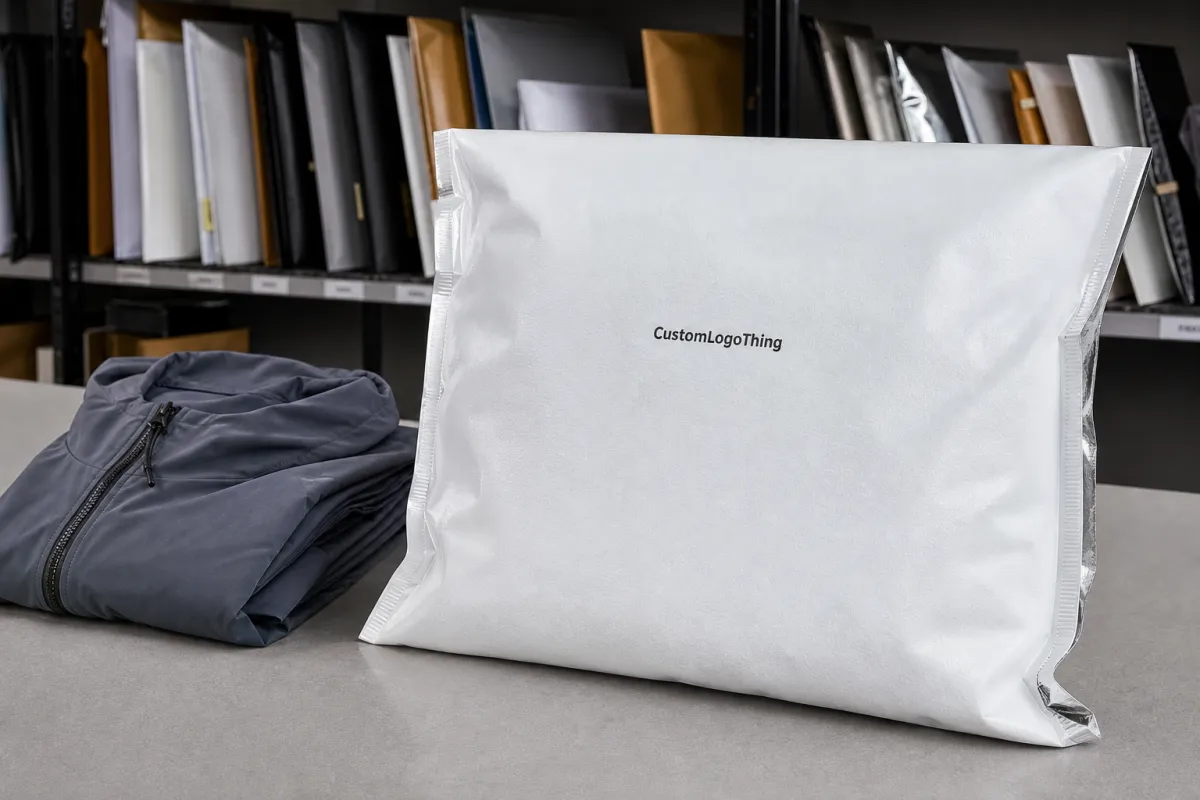
Buyers often focus on unit price first and risk second. That sequence is backward. A few cents saved on a mailer can be lost the first time a rain-soaked delivery, crushed pallet, or damaged insert triggers a return or replacement.
A good waterproof apparel mailer protects more than the garment. It also keeps care cards, hangtags, barcode labels, and promotional inserts clean enough to use. Customers experience the package as a single unit, so a bag failure reads as an order failure.
Moisture-resistant packaging can also reduce handling friction in the warehouse. Staff spend less time rebagging, replacing damaged inserts, or sorting avoidable returns. In high-volume apparel programs, that labor savings often matters as much as the material cost.
The practical goal is simple: enough barrier performance for the route, enough puncture resistance for the garment weight, and a closure that fits packing speed. Anything beyond that should be justified by the lane, the brand requirement, or the return policy.
Film Gauge, Seal Type, and Closure Options for Apparel Mailers
Film gauge is one of the first places where cost changes. A thinner mailer may work for lightweight knits and low-abuse lanes. It becomes a weaker choice when the bag is overfilled, dragged across rough surfaces, or moved through mixed-carrier networks with less predictable handling.
Most apparel programs land around 2.5 to 5 mil, depending on garment weight and route risk. A 3 mil construction is often enough for tees and socks. Hoodies, bulk sets, and premium orders usually benefit from 4 to 5 mil film, especially when puncture resistance matters. Thickness is not the only variable, though. Seal quality decides whether the bag keeps moisture out once pressure and flexing begin.
Closure choice affects labor and customer perception. Peel-and-seal is fast and common. Tamper-evident closures support retail or returns-sensitive programs. Dual-seal structures cost more, but they can support reuse or return workflows. Surface finish matters too, because a slick bag stacks and packs differently from a matte one.
Material make-up is another cost driver. Some waterproof mailers use co-extruded film for better puncture and tear balance. Others use simpler poly structures. Virgin resin usually costs more than heavily recycled blends, but it can provide more consistent seal performance and print quality. The right choice depends on the route, the brand requirement, and the tolerance for variation.
Size Ranges, Print Specs, and Performance Requirements to Lock In
Size is not just a fit question. It affects film usage, freight density, and packing speed. Measure the folded garment first, then add room for tissue, insert cards, or return slips. A snug fit is usually better than a loose one. Extra empty space wastes material and can make the parcel look underfilled.
For example, a hoodie that folds to roughly 12 x 10 x 2 inches needs a mailer that allows clean insertion without forcing staff to stretch the seam. If the opening is too tight, packing slows down and the risk of split flaps increases. If the bag is too large, the parcel shifts during transit and loses the premium feel many apparel brands want.
Print spec changes the quote faster than many first-time buyers expect. One-color branding is usually the most economical. Two to four colors raise setup and inspection time. Full-coverage graphics cost more again because they need more ink, tighter registration control, and more careful handling during production. Barcode placement, spot white underprints, and variable data all add complexity.
Performance requirements should be written down before any quote request goes out. If the mailers must handle humid storage, split-ship fulfillment, or repeated carrier handoffs, say so plainly. A supplier can only price what is specified. Vague requests lead to vague pricing, which is one of the fastest ways to miss true landed cost.
For buyers who need a practical benchmark, it helps to review distribution testing standards such as ISTA test methods. They are not a packaging style guide, but they do offer a useful way to think about drop resistance, vibration, and transit abuse. For teams focused on waste reduction, the EPA’s guidance on source reduction is also relevant: EPA waste reduction guidance.
Waterproof Apparel Mailers Unit Cost Breakdown: What Changes the Price
This is where the purchasing picture becomes clearer. The Waterproof Apparel Mailers unit cost breakdown is not driven by one line item. It is a stack of choices: finished size, film gauge, print coverage, closure style, surface finish, order volume, and the amount of setup required to run the job cleanly.
Two mailers can look almost identical and still quote very differently. One may be a stock-size, one-color bag with a basic peel seal. The other may use a custom size, heavier film, multi-color branding, and a tamper-evident closure. The factory is pricing different waste rates, different inspection demands, and different run complexity.
| Option | Typical Spec | Typical Unit Cost Impact | Best Fit |
|---|---|---|---|
| Lightweight stock-size bag | 2.5-3 mil, 1-color print, basic peel seal | Lower base price; best at scale | Tees, socks, low-abuse routes |
| Mid-weight branded mailer | 3-4 mil, 2-4 colors, standard custom size | Moderate price; balanced protection and branding | Most apparel programs |
| Heavy-duty premium build | 4-5 mil, full-coverage print, tamper-evident closure | Higher price; stronger protection and presentation | Hoodies, swimwear, premium retail orders |
| Dual-use or reuse structure | Dual-seal, higher barrier, return-friendly design | Highest price; added materials and process steps | Returns-heavy channels, premium programs |
Setup cost is usually the hidden piece. Tooling, plate work, color matching, and first-run inspection can make the initial order look expensive compared with the reorder. Once the artwork and dimensions are fixed, the second and third runs often price more tightly because the factory is no longer spreading those start-up costs across a small batch.
For many custom programs, a realistic unit range falls around $0.08-$0.24 per piece. The lower end is usually tied to larger runs, stock sizing, and simpler print. Smaller orders, heavier film, or more demanding artwork can push the figure higher. Freight, carton configuration, and destination terms can move landed cost more than the production quote itself, especially when volumes are modest.
The cleanest comparison separates unit price from everything else. Sampling, freight, tax, and any artwork revisions should be shown apart from the bag cost. Blending them into one number makes the quote easy to read and hard to trust.
MOQ, Sampling, and Quote Inputs That Speed Approval
MOQ changes the buying equation. A 5,000-piece minimum on one design is not the same as 5,000 pieces split across multiple sizes or print versions. Ask whether the MOQ applies per bag size, per artwork, or per colorway. That detail decides whether the project is efficient or awkwardly fragmented.
Sampling is not a formality. It is the safest way to catch fit problems, closure issues, print misalignment, or a barcode that sits where the scanner does not expect it. A pre-production sample can also reveal whether the film feels too slick for packing, whether the seal opens too easily, and whether the finished bag still looks sharp after folding and handling.
Quote-ready inputs should be specific. Finished size, estimated quantity, print colors, closure type, destination, and target ship window all belong in the first request. If the mailer must fit a retailer carton spec, a pallet height limit, or a storage constraint, say so. The more exact the brief, the better the pricing and the less back-and-forth needed later.
- Size: finished dimensions, folded garment dimensions, and insert thickness
- Quantity: total volume and any split by size or color
- Print: logo count, ink colors, and coverage area
- Closure: peel-and-seal, tamper-evident, or dual-seal
- Logistics: destination, delivery window, and pallet limits
Most suppliers can quote faster when the buyer provides a simple drawing or a marked-up dieline. Even a rough dimension sheet helps. It removes guesswork and reduces the chance that an order gets delayed because the art file and the physical spec do not match.
Production Steps and Turnaround: From Artwork to Shipment
The production sequence is usually straightforward. First comes spec confirmation. Then artwork review. After that, the supplier prepares a proof, sources the film, prints the design, forms and seals the bags, checks quality, packs the cartons, and ships. The process only looks slow when the inputs are incomplete.
Most delays come from avoidable issues: missing artwork dimensions, late color corrections, vague barcode placement, and quantity changes after proof approval. Each of those can move the schedule. If the line has already been booked, even a small revision may push the shipment back by several days.
A practical timeline usually splits into proof time and manufacturing time. Proofing often takes a few business days. Production may take another one to two weeks, depending on order size and complexity. Large runs, multiple print colors, or special seal requirements can extend that range. If a buyer needs the order for a fixed launch date, the spec should be finalized early enough to absorb the proof cycle.
Reorders are usually faster than first runs. Once the factory has the approved artwork, film spec, and packing instructions on file, the next run does not need to start from zero. That helps stabilize lead time and can make the unit price more predictable as well.
How to Evaluate a Supplier on QC, Packing, and Reorder Support
Supplier selection should be based on controls, not claims. Ask how they check seal consistency, print registration, thickness tolerance, and batch quality. If the supplier can explain how often they test bond strength or how they handle color drift, that is more useful than a general promise that the bags are durable.
Packing discipline matters too. Carton counts, bundle wrapping, pallet labeling, and moisture-safe storage all influence how the product arrives. A good factory can produce a strong bag. A disciplined pack-out keeps it strong on the journey. For buyers managing multiple SKUs, that consistency reduces receiving problems and keeps the line moving.
Reorder support is where long-term value shows up. Ask whether the supplier stores artwork, keeps prior specs on file, and can repeat the same bag without rebuilding the job from scratch. The less rework required on the next order, the more stable the unit cost becomes over time.
One useful check is the supplier’s testing mindset. Shipping damage is rarely solved by appearance alone. A credible vendor should be able to discuss drop testing, seal checks, and print rub resistance in plain language. If the response is vague, the quote may be too.
Next Steps for a Fast, Accurate Bulk Order
Start with the factors that actually move price: size, quantity, print colors, closure type, and any required barrier or security feature. Then ask for a quote that separates unit price, tooling, sampling, freight, and any extra handling. That is the only reliable way to compare suppliers on equal terms.
If the apparel program is still taking shape, compare the mailer against other formats in Custom Poly Mailers and the wider Custom Packaging Products range. Sometimes the right answer is not a more expensive structure. Sometimes it is a better size match, a simpler print plan, or a more realistic MOQ.
Use the Waterproof Apparel Mailers unit cost breakdown as a filter, not a slogan. It should help the buyer narrow the spec, confirm the sample, and place the first order with fewer unknowns. That is usually where the real savings live: not in chasing the lowest quote, but in avoiding the mistakes that make a cheap quote expensive later.
FAQs
What affects waterproof apparel mailer cost the most?
Size and film gauge usually carry the greatest weight. Print coverage, closure type, and MOQ can shift the quote quickly, and freight should always be checked so the landed cost is accurate.
What MOQ should I expect for custom waterproof apparel mailers?
MOQ depends on the size, print complexity, and whether the bag is stock or fully custom. Smaller runs are possible, but the setup cost is spread across fewer units. Ask whether the MOQ applies per design, per size, or per colorway.
How do I choose the right size for apparel mailers?
Measure the folded garment plus any tissue, insert card, or return slip. Leave enough room for clean insertion, but not so much that the package looks loose or wastes material. If you ship multiple apparel styles, choose sizes that cover the largest folded item efficiently.
How long does production usually take after approval?
Turnaround depends on artwork approval, print method, and order size. Proofing and material sourcing can add time before the run starts. A clean spec sheet and quick sample approval usually shorten the schedule.
Can waterproof apparel mailers be printed with brand graphics?
Yes. Most custom programs support logo placement, full-coverage art, and barcode areas. The number of colors and the print coverage area will affect both setup and unit price. Ask for a proof that shows the design on the finished bag, not only in the artwork file.

