A pom pom Beanies Sample Checklist is the fastest way to separate a workable product from a pretty mistake. Knit accessories can look polished on a desk and still fall apart in bulk if the cuff stretches out, the pom sits off-center, or the yarn changes handfeel after the first wash. The sample is where those problems surface. If you read it carefully, you save yourself from the expensive version of the same lesson later.
What a Pom Pom Beanie Sample Reveals Before You Order
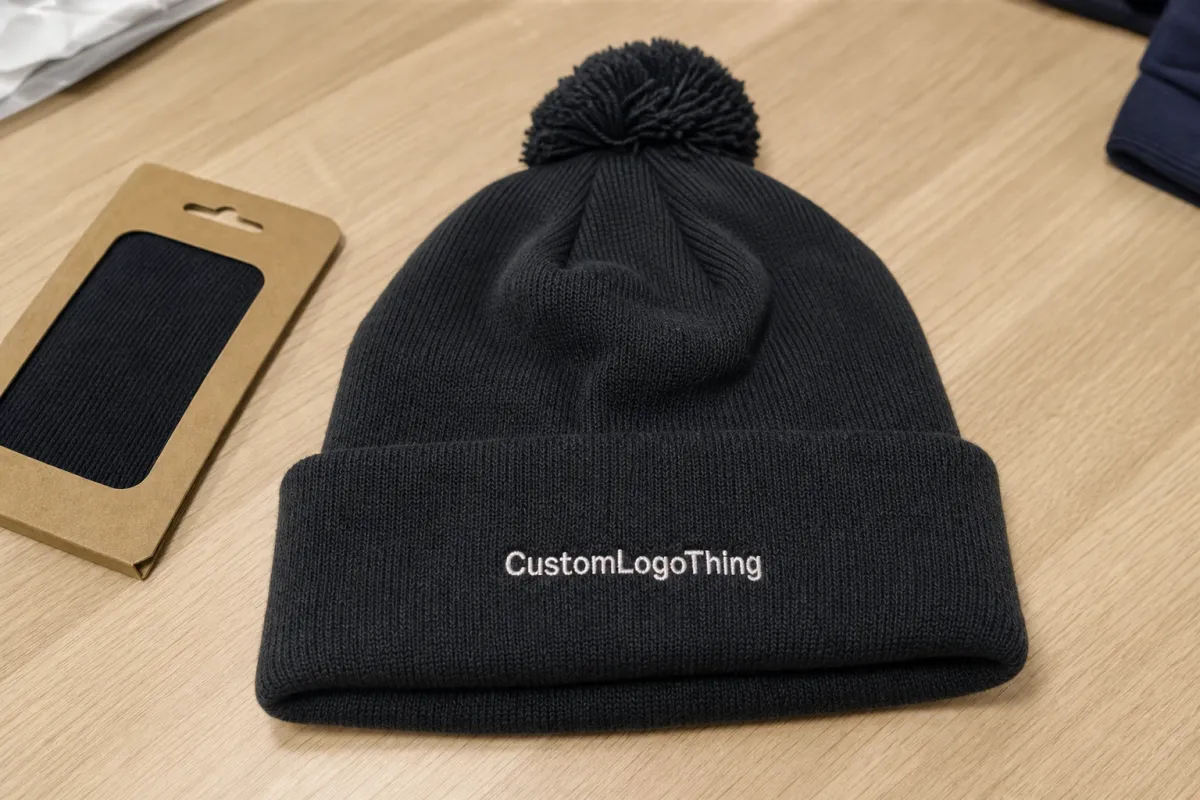
The sample is not a formality. It is the factory's first proof that the design can be repeated with control, not just knitted once for show. A clean-looking beanie can still hide weak points: scratchy yarn, a crown that loses shape, embroidery that puckers, or a pom that sheds fibers before it even reaches a shelf.
Pom pom styles have one extra weakness that plain beanies do not: the attachment point. A good body knit can be undone by a bad pom mount, loose stitching, or glue where stitching should have been used. A pom that is slightly too heavy can pull the beanie sideways. A pom that is too light can look underfilled and cheap. Those issues are subtle in photos and obvious in hand.
Buyers should also view the sample on a head form or a real wearer, not only on a flat table. Adult unisex beanies commonly target a 56-60 cm head circumference; youth styles usually sit closer to 52-54 cm. If the fit only works when the hat is staged a certain way, it is not really approved. It is only photogenic.
A sample that looks tidy in a product shot can still fail in wear. Knit accessories expose construction flaws quickly, and pom pom beanies are especially unforgiving about weak trim work.
How the Sample Review Process and Timeline Should Work
Start with a tech pack or at least a precise spec sheet. The supplier needs measurements, yarn type, stitch density, pom diameter, label placement, and packaging notes before they begin. If those details are missing, the first sample usually reflects whatever the factory guessed was acceptable. That is not progress. It is a cleanup job with a delivery date.
A practical sample flow usually looks like this: first sample, feedback, revised sample, then a pre-production sample if fit, color, or construction changes were made. Stock yarn and a standard woven label may take 7-12 business days for the first round. Custom-dyed yarn, embroidery, private packaging, or a specialty pom attachment can stretch that to 2-4 weeks. Revisions are often faster, around 5-10 business days, if the materials stay the same.
Build the timeline backward from your launch date. Put the sample ship date, feedback deadline, revision cutoff, and final approval date in writing. That sounds basic because it is. The projects that go wrong usually do not fail from one dramatic issue. They fail from a series of small delays, unclear responses, and one rushed approval made under pressure.
What slows the sample down
Some delays are predictable:
- Custom yarn - dye matching adds lead time, especially for heather, melange, and deep saturated shades.
- Nonstandard pom construction - oversized poms, mixed-color poms, and removable hardware all require extra back-and-forth.
- Branding changes - embroidery, woven labels, and heat-transfer details often need an additional review.
- Retail packaging - hangtags, belly bands, polybags, and insert cards create another approval layer.
If a supplier will not give a written timeline, expect drift. Not always a disaster, but enough to create pressure later. And pressure is the enemy of clean approvals. People begin saying a sample is "close enough" because the schedule has become louder than the product.
Pom Pom Beanies Sample Checklist: Specs to Verify
A strong Pom Pom Beanies sample checklist should make the review objective. "Looks good" is not a spec. Neither is "close enough." The point is to compare the sample against measurable targets before anyone approves a bulk run.
Start with dimensions. Measure the beanie flat and compare it against the approved drawing. Confirm crown height, cuff depth, body width, and total length. Many adult Pom Pom Beanies fall around 20-23 cm in flat body height, but that range should never override your own target. Tolerances of +/- 0.5 cm are common on key dimensions, though tighter control is possible only if the supplier can repeat it consistently.
Then inspect the pom itself. Check diameter, fullness, softness, symmetry, and shedding. A good pom feels dense without feeling hard. It should sit centered and not drag the beanie to one side. Depending on the design, pom size often lands around 8-12 cm, but consistency matters more than the exact number. One weak pom can make a whole shipment feel off.
Examine the trim and branding closely. Label placement matters because a label that sits too high or too deep in the cuff changes the whole visual line. Embroidery should have clean edges, no puckering, and no stray threads. Inside the hat, loose ends should be secured neatly. If the interior looks rough, there is usually more than one issue hiding there.
Color needs a real check, not a visual guess. Review the sample in daylight and under indoor lighting. Yarn shades can shift more than buyers expect, especially with melange, charcoal, deep red, and dark green tones. A beanie that looks balanced near a window can look muddy under store lights. If color is business-critical, request a lab dip, yarn code, or Pantone reference before bulk knitting starts.
Material choice also affects performance. Most custom Pom Pom Beanies are made from 100% acrylic, acrylic/wool blends, or recycled polyester, usually in a double-layer knit. Acrylic gives predictable cost and shape. Wool adds warmth and can feel more premium, but it may raise price and care concerns. Recycled polyester often helps with sustainability claims, though handfeel and loft vary by source. The cheaper knit is not always the worse one; the wrong knit is the problem.
Stitch density deserves more attention than it gets. A tighter knit generally supports embroidery and labels better and helps the hat hold shape. A looser knit can feel softer, but it may collapse faster and show more distortion around seams or logos. That tradeoff is worth deciding before approval, not after the first shipment arrives.
Fit testing is not optional. Stretch the cuff, fold it back, wear the beanie for a minute, remove it, and watch what happens. Does the crown recover or stay bagged out? Does the pom remain upright? Does the cuff roll cleanly, or does it twist and buckle? That short wear test reveals more than a carefully staged photo ever will.
- Measurements - crown height, cuff depth, body width, and total length match the spec.
- Pom - size, fullness, softness, and center position are consistent.
- Attachment - stitched or snapped pom is secure and does not distort the knit.
- Color - checked under daylight and indoor light.
- Branding - label, embroidery, and inside finishing are clean.
- Fit - the sample works on a head form, not just on a desk.
Step-by-Step Approval Workflow for Buyers
If you want fewer surprises, approve like a buyer who has seen a few bad runs. Here is a workflow that keeps the review practical:
- Set pass/fail criteria first. Lock the measurement targets, color standard, pom size, label position, and packaging requirements before the sample ships.
- Inspect slowly. Open the sample, photograph every angle, and take flat measurements before handling it too much.
- Compare against the spec pack. Use the approved drawing, reference photos, and notes. Do not rely on memory or the factory's verbal explanation.
- Prioritize corrections. Separate must-fix issues from nice-to-have changes. A loose pom mount is not the same as a label that sits 2 mm off.
- Approve in writing. Save the final approval, keep the dated photos, and retain the physical sample or an agreed reference sample if possible.
That record matters later. If the bulk order lands and the supplier says it matches the sample, you need to know which sample they mean. The dated version, signed notes, and photos are the only reliable reference. Without them, disputes become memory contests, and those are expensive in both time and patience.
If a change affects fit, color, or trim construction, ask for another sample. Trusting the old version after a material swap is a common way to approve a problem twice.
Cost, Pricing, and MOQ Traps to Watch
Sample pricing catches buyers off guard more often than it should. A basic custom knit pom pom beanie sample often falls around $35-$120, depending on whether the factory uses stock yarn, custom colors, embroidery, or a special pom attachment. Some suppliers credit the fee against bulk production. Some do not. Ask before the sample is made, not after the invoice lands.
MOQ changes the math quickly. Lower quantities usually raise unit cost, especially when the design includes private labels or custom packaging. As a rough benchmark, a small custom run may land around $4.50-$8.00 per unit, while larger runs can move closer to $2.80-$5.20 per unit, depending on material, stitch complexity, and branding. Those ranges are not universal. They are useful because they help you spot pricing that is either inflated or unrealistically low.
Request a quote that separates each moving part: sample fee, bulk unit cost, shipping, duties, revision cost, packaging, and any setup charge tied to the pom or label application. If those pieces are blurred into one line, the quote is hard to trust. Hidden costs tend to hide in exactly those blur lines.
| Option | Typical Use | Sample Cost Range | Bulk Impact | Risk Level |
|---|---|---|---|---|
| Stock yarn, basic woven label | Simple promotional runs | $35-$60 | Lowest setup pressure | Lower |
| Custom yarn color, standard pom | Brand-colored retail styles | $60-$95 | Moderate material and revision cost | Medium |
| Custom pom, embroidery, private packaging | Retail-ready premium orders | $90-$120+ | More setup, more revision risk | Higher |
If the beanies will ship in retail packaging, check the packed version as well as the hat itself. Transit testing matters because a perfect beanie can still arrive crushed, flattened, or marked by poor pack-out. Standards groups such as ISTA exist for a reason. If your packaging or sourcing policy requires fiber certification, FSC can matter for paper components like hangtags or insert cards. Practical packaging is not decoration. It is part of the product.
Common Sample Mistakes That Cause Bulk Problems
Some mistakes repeat because they are easy to make. The first is approving from photos alone. Knit texture can look dense on a screen and feel thin in hand. A pom can appear full in an image and shed the moment it is handled. If the sample is physical, judge it physically.
The second mistake is ignoring dye lot variation. A sample may match perfectly while the bulk yarn shifts a shade lighter or darker during production. That happens often with marled yarns, charcoal tones, and saturated colors. If color matters to the brand, keep the approved reference and ask for a yarn standard or lab dip confirmation before production.
Wear testing gets skipped because it seems too simple. Stretch the hat, fold it, pull the cuff down and back, and shake the pom lightly. Weak seams, twisting poms, and loose label stitching usually show up within a minute. That minute is cheaper than an entire carton of avoidable returns.
Packaging is another common blind spot. A beanie can be excellent and still look poor if the fold line is wrong, the barcode is misplaced, or the polybag crushes the pom into a flat shape. If the product ships through retail, fulfillment, or a club store program, the packed-out appearance matters as much as the hat itself.
The last mistake is vague feedback. "Make it nicer" does not help a factory fix anything. Measurable notes do. Say the pom is 1 cm too small. Say the cuff should sit lower. Say the label needs to move 8 mm left. Clear instructions shorten the next round and reduce the chance of repeating the same defect.
- Do not approve from screen photos alone.
- Do not ignore dye lot shifts.
- Do not skip a quick wear test.
- Do not overlook retail pack-out details.
- Do not give non-measurable feedback.
Expert Tips and Next Steps Before Production
Make the approval process easier to repeat than to argue about. A one-page pass/fail sheet is enough in many cases if it covers measurements, color, pom specs, label placement, inside finishing, and packaging. Keep it short, but do not make it vague. Short paperwork is useful only when it still tells the factory exactly what was approved.
Ask for two photos from the supplier even if you already have the physical sample: one straight-on front view and one close-up of the pom attachment and label area. Those images become useful later if the bulk order starts drifting. Also keep every revision dated. Approval means more when there is a trail showing what changed and why.
If any yarn, trim, or color changes after approval, request a new sample. Material substitutions can shift handfeel, stretch, shade, and recovery in ways that are not obvious on a quote sheet. A hat that once felt balanced can turn sloppy after a single substitution. That is not a minor detail; that is the product.
Packaging discipline pays off on commercial orders. If the beanie will ship folded in a polybag with a hangtag, inspect the packed presentation before production starts. If the hangtag is paper and the buyer cares about sourcing claims, the spec needs to reflect that. If cartons are part of the order, test the packed version, not just the garment. That is basic due diligence, not extra caution.
Use the pom pom Beanies Sample Checklist one final time, approve only after every critical item passes, and send the sign-off in writing before bulk production begins. That protects margin, reduces rework, and keeps a simple knit accessory from turning into a preventable headache.
What should I include in a pom pom beanies sample checklist?
Include measurements, yarn type, stitch density, pom size, label placement, inside finishing, and packaging specs. Add pass/fail notes for fit, color accuracy, and seam quality so the review stays objective. Keep one reference photo or signed sample file so the factory knows what final approval means.
How many samples do I need before ordering pom pom beanies in bulk?
At minimum, review one physical sample and one revised sample if changes are needed. If you are changing color, label, pom construction, or packaging, ask for a pre-production sample before bulk approval. More versions are worth it when the order is large enough that a mistake would be expensive.
How long does the pom pom beanies sample process usually take?
Timing depends on whether the design uses stock materials or custom yarn, labels, and packaging. Allow extra time for feedback, revisions, and shipping between sample rounds. If the supplier cannot give you a clear timeline, expect the project to drift.
What affects pom pom beanie sample cost the most?
Custom yarn, unique pom construction, embroidery, and private labels usually push the price up. Shipping and revision costs can matter as much as the sample itself. Ask for a quote that breaks out sample fee, bulk unit cost, and any setup charges.
What should I do if the sample looks good but the bulk order does not match?
Compare the bulk order against the signed sample record, not against memory. Use your photos, measurements, and written approval to document the mismatch. Ask the supplier for a fix, replacement, or credit, depending on the agreement and defect severity.


