Wine Club Trucker Caps Unit Cost Review for Bulk Orders
For a winery team, a wine club trucker caps Unit Cost Review should start with the finished job, not with a random blank cap price. The cap needs to work for club shipments, staff uniforms, tasting-room merch, and event giveaways without drifting into premium apparel pricing.
Trucker caps stay economical because the format is simple: a structured front, mesh back panels, one primary decoration location, and an adjustable closure. That simplicity matters more than squeezing a few cents off the blank. The biggest cost creep usually comes from artwork revisions, split colorways, and packaging changes.
Why unit cost stays lower than many winery buyers expect
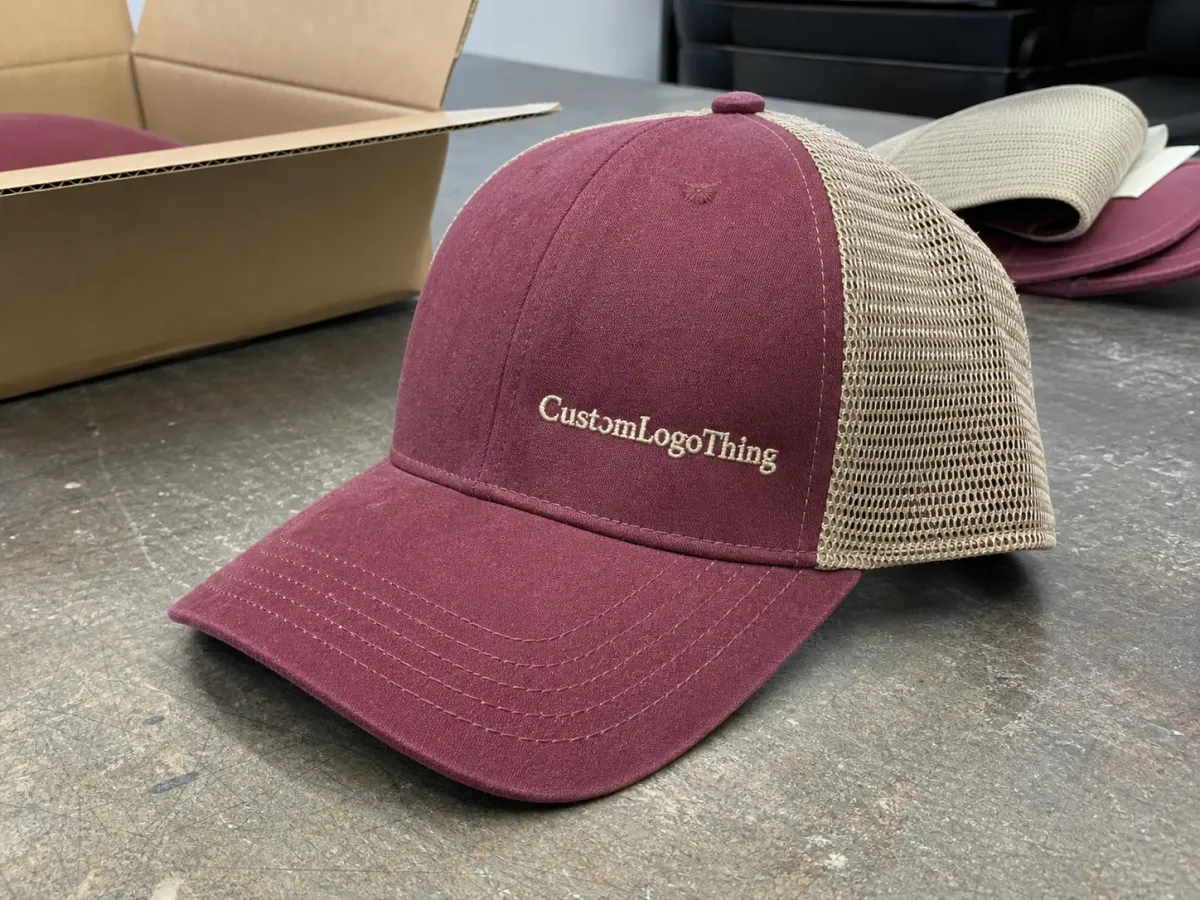
Trucker caps are one of the few branded items that can look retail-ready without a complex build. For winery programs, they sit in a useful middle zone: casual enough for harvest work and tastings, but still polished enough for club gifts and merch tables. The mesh back adds breathability, and the snapback closure avoids size runs.
The biggest savings come from standardization. If the style, decoration method, and logo placement are decided before quoting, the supplier can price the order with fewer assumptions. A clean spec sheet almost always produces a better number than a vague request for “something nice.” It also reduces proof revisions and rework.
Bulk apparel gets cheaper per unit when it becomes easier to produce. In cap orders, that usually means:
- one cap silhouette across the run
- one logo location unless there is a clear reason not to
- one or two cap colors, not a mix of many shades
- final artwork before proofing starts
That approach also helps on reorders. If the club grows and the program needs another run later, the second order should feel like a repeat job instead of a new sourcing project.
Cap build and decoration choices that change the final look
The classic trucker profile works because it is flexible. Most versions use a structured foam or cotton front, polyester mesh side and back panels, a curved or pre-curved visor, and a plastic snap closure. That is enough structure to hold branding well without making the cap feel overbuilt.
Decoration choice changes the tone of the product right away. Embroidery gives a clean, durable finish and is usually the simplest option for bold logos. Woven patches handle finer linework. Leather patches push the look toward rustic or vineyard-forward. PVC patches add dimension and feel more modern. Printed labels are useful when the design is small or intentionally understated.
The logo should drive the decoration method, not the other way around. A dense embroidered mark can look heavy if the art uses delicate letterforms. A leather patch can flatten a detailed crest. Thin serif text and tiny secondary lines are especially vulnerable. If the logo depends on precision, a patch may protect it better than direct stitching. If the art is simple and bold, embroidery usually gives the best value.
Color contrast matters too. A dark front with a light patch reads clearly in photos and across a room. Tonal decoration feels softer and more lifestyle-driven, but it can disappear on social media or a merch shelf. The right choice depends on whether the cap should feel premium, rustic, sporty, or retail-ready.
Front structure also changes how the branding lands. A 6-panel structured trucker usually holds a logo more predictably, while a 5-panel build creates a flatter front that works especially well for patches. Unstructured fronts feel casual, but they are less reliable when the brand needs the logo to stay crisp and centered. For most wine club programs, a structured front is the safer buy.
Material specs, fit details, and imprint limits to lock in early
Before production starts, the buyer should lock down the cap spec carefully. Crown height, panel count, mesh weight, visor shape, sweatband feel, and closure type all affect how the finished cap looks and wears. Two caps can look similar in a photo and still feel very different in hand if one uses a stiffer front or thinner mesh.
Fit is easy to underestimate. Winery programs often need one cap to work for staff, members, and guests with different head shapes. Snapbacks solve most of that problem, but not all of it. The cap still has to feel secure when adjusted and should not buckle at the front. A weak closure or shallow crown can turn an otherwise solid cap into something people wear once and stop using.
Imprint limits matter just as much. A logo that looks clean on screen can become hard to reproduce on a cap front if the strokes are too thin or the mark is too wide for the panel. Thread density, minimum line thickness, patch edge clearance, and usable front width all affect the result. The art file is not just a design file; it is a production file.
A practical buyer should ask for these items before approving a quote:
- final vector artwork when available
- brand color references, ideally Pantone matches
- exact decoration placement and size
- thread, print, or patch color preferences
- bagging, folding, carton, or insert requirements
If the order includes paper inserts or hang tags, FSC-certified stock is a sensible request for buyers who care about responsible paper sourcing; the FSC system is the standard reference point. For ship-ready cartons or tougher transit paths, buyers sometimes align expectations with ISTA test methods so the order is judged on more than appearance alone.
The approval checkpoint is simple: confirm the cap blank, decoration method, placement, color callouts, and packaging method before the work starts. Most avoidable delays come from assuming one of those pieces is obvious.
Wine club trucker caps unit cost review: pricing, MOQ, and bulk cost drivers
This is the part that tells the truth. A proper wine club trucker caps Unit Cost Review separates blank cap cost, decoration setup, labor, packaging, freight, and any special handling for inserts or kitting. Looking only at the headline unit price hides what the order actually costs. A lower blank price can still produce a worse finished number if it creates extra setup or shipping complications.
MOQ changes by decoration method, and the minimum is often a better signal than the final price. Direct embroidery usually supports lower entry quantities because it is straightforward to set up and repeat. Woven or molded patches often ask for higher minimums because they introduce a second production step. Leather and PVC patches can be more distinctive, but tooling, prep, or application time often pushes the economics upward.
| Decoration method | Typical MOQ tendency | Typical unit cost effect | Best use case |
|---|---|---|---|
| Direct embroidery | Often the most accessible for smaller bulk runs | Usually efficient for simple logos with limited thread colors | Wordmarks, short club names, simple icons |
| Woven patch | Moderate minimums, especially for custom shapes | Usually higher than embroidery because the patch must be made and applied | Fine-detail logos, crest-style marks, textured branding |
| Leather patch | Moderate minimums with added patch prep | Can raise unit cost, but often improves perceived retail value | Rustic, heritage, vineyard-forward branding |
| PVC patch | Higher setup sensitivity for custom tooling | Usually sits toward the higher end of the decoration range | Dimensional logos, bold modern marks, outdoor use |
For reference, a simple embroidered trucker cap often lands around $2.35-$4.10 per piece at mid-sized bulk quantities. More detailed patch builds may sit closer to $3.10-$5.50 per piece, depending on the cap grade, artwork complexity, quantity tier, and color count. Those are working ranges, not promises. Freight, packaging, and rush timing can move the final number more than the logo method itself.
The biggest price drivers are usually predictable:
- quantity tier and whether it crosses a pricing break
- number of thread colors or patch colors
- front-panel coverage and logo size
- mixed cap body colors inside one order
- extra packaging, inserts, or kitting
A cap that is cheaper on paper can cost more overall if it forces a second setup or separate shipment. A slightly more expensive blank can lower total cost if it shortens production, reduces rejection risk, or keeps everything in one run. The right question is not “What is the cheapest cap?” It is “What combination of blank, decoration, and fulfillment gives the cleanest finished price?”
Production steps and lead time from proof approval to delivery
The smoothest orders follow a predictable path: quote request, proof review, approval, blank sourcing, decoration setup, production, inspection, carton packing, and shipment. The sequence is ordinary. The timing is not, because every last-minute change adds friction. A color adjustment after proof approval can delay a run, and so can a revised placement or a new patch shape.
The proof stage should be detailed enough that nobody is guessing. A proper proof shows cap color, logo placement, decoration method, thread or print color, and packaging details. If there are staff versions and club-member versions, each one should be identified clearly. This is one of the easiest places to prevent avoidable errors, especially when the order needs to match a tasting-room launch or mailer schedule.
After approval, the workflow usually moves through blank sourcing, setup, stitching or patch application, finishing, quality control, carton packing, and freight booking. QC should not be a vague promise. Good inspection catches stitch density problems, crooked placement, loose patch edges, uneven panel alignment, and snapback closures that feel flimsy or misaligned.
Lead time depends on the decoration method, stock availability, and quantity. A straightforward bulk trucker cap order often lands in a 12-15 business day production window after proof approval if the blank is available and the artwork is final. Custom patch work can take longer because the patch itself must be produced before application begins. Rush orders are possible in some cases, but they work best only when the cap style is in stock and the artwork is already clean.
Holiday demand, complex freight lanes, and multiple product versions can stretch the calendar further. If the order is tied to a wine club drop date, build in a buffer. The most expensive delay is the one that shows up after the shipment is already late.
What makes a packaging partner a safer fit for winery headwear
The safer partner is not automatically the one with the lowest first quote. It is the one that quotes consistently, proofs clearly, and produces the same result again without forcing the buyer to rebuild the project from scratch. Reorders matter in winery programs because club demand is rarely one-and-done.
Color control deserves more attention than it usually gets. Winery brands often live inside a narrow visual system: label art, seasonal releases, tasting-room decor, and club-tier colors. A cap that drifts too far from that system can feel detached from the brand even if the quality is fine. A good supplier knows how to stay close enough to the original palette that the cap feels intentional on a merch table, in a photo, or in a subscription box.
Clear answers also matter. A reliable partner can tell you what changes affect MOQ, what changes affect schedule, and what changes require a fresh proof. That kind of clarity keeps a review honest and helps prevent surprise add-ons later.
For winery buyers, the value is practical: fewer surprises, cleaner forecasting, better control over setup charges, easier reorders, and a more reliable baseline for future cap programs.
Next steps to lock specs, quote, and reorder cleanly
Start with the minimum information a supplier needs to quote correctly: quantity, cap color, decoration method, logo file, target ship date, and any packaging or insert requirements. If you have a previous sample, send that too. A sample often reveals more than a long email thread because it shows the actual hand feel, color depth, and placement logic.
Then decide who the caps are for. Staff, club members, and retail resale are not identical use cases. Staff caps may prioritize durability and fit. Club gifts often need a clean branded look that travels well in a shipment. Retail pieces may justify a more distinctive patch or upgraded blank because they are competing with other merch on the shelf.
Before approval, make sure all decision-makers are looking at the same proof. The easiest way to lose time is to approve one version and then discover that another person wants a larger logo or darker cap after production has already been scheduled. Once the blanks are moving, changes cost more.
For recurring drops, create a reorder record now. Keep the same cap style, decoration method, artwork version, and approval path. Future pricing becomes easier to compare, and the supplier can quote against a stable baseline instead of chasing a moving target.
Use this wine club trucker caps Unit Cost Review as a working decision sheet. Once the spec is fixed, the quote becomes far easier to interpret.
How can I lower trucker cap unit cost for a wine club order?
Keep the cap body, logo placement, and decoration method consistent across the run. Reduce thread colors or patch complexity, and place the full quantity in one order tier so the supplier can quote a cleaner bulk price.
What MOQ should I expect for custom trucker caps?
MOQ depends on the decoration method. Simple embroidery usually allows lower entry quantities, while custom patch styles can push the minimum higher because they add setup time and another production step.
Is embroidery or a patch better for cost and durability?
Embroidery is usually efficient for simple logos and short text. Patches are often a better fit for detailed artwork or a more textured look. Both can wear well if the decoration is matched to the logo and the cap front.
How long does a bulk trucker cap order usually take after proof approval?
A straightforward order often fits into a 12-15 business day production window after approval if stock is available. Custom patch work, artwork changes, or tight freight deadlines can extend that schedule.
What do you need from me to quote wine club trucker caps accurately?
Send the quantity, cap color, decoration method, logo file, target delivery date, and any packaging requirements. Pantone colors or a previous sample help sharpen the quote and keep the Unit Cost Review aligned with the actual build.


