Most buyers treat the beanie as the product and the label as a minor finishing touch. In production, that order is usually backwards. A label sits right at the point where sight, touch, and brand memory meet, so a small mistake can change how the entire item feels. A clean woven label can make a simple knit look considered. A scratchy, distorted, or badly placed one can make the whole piece feel rushed.
A strong Woven Label Beanies material guide starts with that reality. Woven labels are not printed stickers or decorative afterthoughts; the design is built from threads woven into the structure itself. That gives better edge control, better wash life, and a more retail-ready appearance than basic print in many beanie applications. The tradeoff is that thread choice, weave density, backing, and attachment style all affect how the label behaves on a stretch knit. Ignore those variables and the label may curl, pucker, or blur at the exact moment it should be doing the opposite.
For bulk buyers, the job is simple to describe and annoying to execute: choose a label that holds detail, stays comfortable, and survives wear without stiffening the beanie. That is the standard used throughout this Woven Label Beanies material guide.
Woven Label Beanies Material Guide: Why Tiny Labels Matter
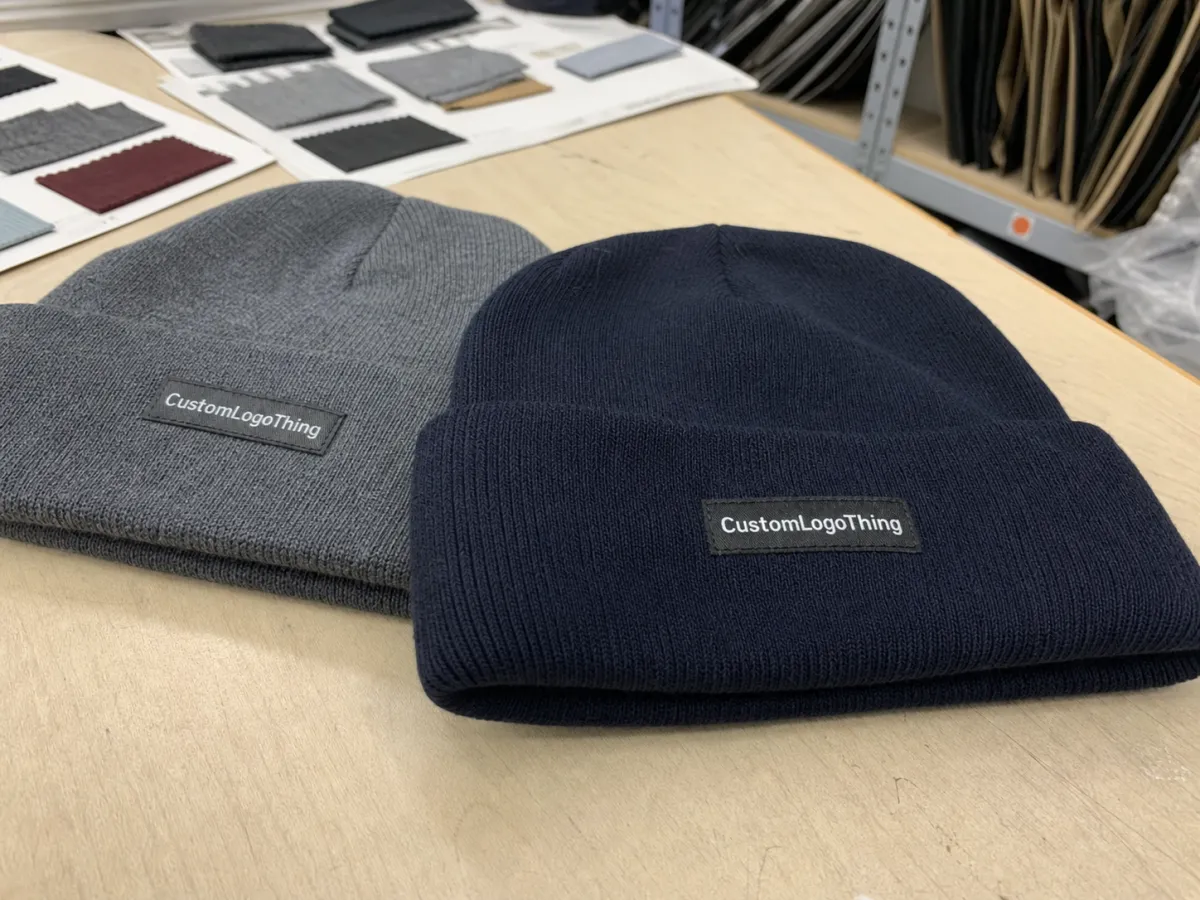
On a beanie, the label carries more weight than its size suggests. It has to brand the piece, support the price point, and survive stretching, folding, stuffing into bags, and repeated contact with skin and hair. That is a harder brief than it looks. A beanie can be warm and well-made, but if the label scratches or twists after the first wear, customers often remember that problem first.
Woven labels differ from printed labels in a basic way: colored threads form the artwork during weaving instead of sitting on top of the surface as ink. The result is usually sharper for small logos and more durable for high-handling products. Embroidery can be attractive on larger patches, but at tiny sizes it often loses the clarity that woven construction can preserve. That matters on beanies because the brand mark is usually compact and viewed from arm’s length, not from across a store window.
Three technical choices drive most of the outcome:
- Thread type controls sheen, softness, and how crisp the design reads.
- Weave density determines how much of the artwork survives at small scale.
- Backing and attachment decide whether the label lies flat or fights the knit.
There is a practical rule here: the best label is not the one with the most detail. It is the one that still reads clearly after the beanie has been worn, packed, and washed. That is why spec review for Custom Labels & Tags should focus on the actual garment, not only on a mockup file.
“A beanie can survive cold weather, shipping, and repeated wear. A label that scratches or curls survives none of those tests in the customer’s memory.”
That is the real job of a Woven Label Beanies material guide: not to flatter the artwork, but to pressure-test it against production reality.
How Woven Labels Sit on Knit Cuffs and Seams
Woven labels arrive flat. Once they are folded, stitched, or patch-mounted onto a beanie, they behave very differently. A center-fold label on a rib cuff and a straight-cut patch on a slouch beanie may share the same art file, but they will not look or wear the same. Placement changes visibility, comfort, and how much the knit stretches around the edges.
Cuff-front placement is the most common because it gives immediate brand visibility and works well for retail. Side-seam placement reads quieter and often suits minimal branding. Inside placement is cleaner for a low-profile look, but it does less for shelf presence. For beanies sold online, the first photograph often decides whether the label was worth the extra effort. That is one reason placement should be planned early, not after the sample comes back.
Common constructions include:
- Center-fold for wrapping over an edge or seam.
- End-fold for a neat top surface with hidden raw edges.
- Straight-cut when the label is fully stitched down or used as a patch.
- Patch-style for larger branding areas and more structure on heavier cuffs.
Structure matters because knit fabric behaves differently from woven apparel panels. A tight rib cuff can support the label and help it sit cleanly. A loose or very soft knit may ripple if the backing is too rigid or the stitch line is too close to the edge. That is how puckering starts. It looks minor on a sample board and obvious in hand.
Buyers should ask for placement photos on the actual blank beanie, not a generic template. The same label can look premium on a dense rib cuff and awkward on a slouch body. That is not a design failure. It is a material fit issue, which is much easier to correct before bulk than after.
Materials, Weave Density, and Backing Options to Compare
Most woven labels for beanies use polyester thread. There is a reason for that boring answer: polyester holds detail, keeps edges crisp, and tolerates wear better than many softer fibers. It is not the most romantic material, but it is dependable. In accessories manufacturing, dependable usually wins.
Cotton and cotton-blend threads create a softer, more matte look. Some brands prefer that because it feels less synthetic and more lifestyle-oriented. The tradeoff is clarity. Fine text, narrow lines, and intricate marks can soften more quickly under friction. On a beanie cuff that gets handled often, that can show up sooner than expected. For tiny logos, polyester remains the safer choice. For more natural-looking fashion pieces, a blend may work if the art is simplified and the weave is dense enough to support it.
Weave density deserves as much attention as thread type. A tighter weave gives better legibility, cleaner borders, and stronger small-type performance. But there is a ceiling. If the artwork includes too much line work, too many gradients, or compressed text, even a dense weave will flatten the design into a muddier result than the digital proof suggested. Thread is not a pixel grid. It has limits, and those limits show up fastest on small accessories.
Material and finish comparison
| Option | Typical use | Handfeel | Durability | Typical label add-on at 5,000 pcs |
|---|---|---|---|---|
| Polyester woven label | Retail beanies, repeat wear, outdoor basics | Clean and slightly crisp | High | $0.10-$0.22 per unit |
| Cotton-blend woven label | Natural-looking fashion beanies | Soft, matte, less structured | Medium | $0.12-$0.26 per unit |
| Patch-style woven label | Bold logo placement, premium streetwear | Heavier and more visible | High | $0.15-$0.30 per unit |
| Soft-backed sew-on label | Stretchy cuffs, comfort-first beanies | Less scratchy, more flexible | Medium-High | $0.11-$0.24 per unit |
Backing is the other half of the decision. Sew-on constructions tend to work best for knit beanies because they move with the cuff instead of resisting it. A rigid adhesive-backed solution can be attractive in theory, but flexible knit surfaces do not always cooperate. When the cuff stretches, any backing that is too stiff can cause distortion at the corners or an irritating edge against skin. A softer fold style or thinner base often performs better than forcing a stiff patch onto a soft knit.
That tradeoff is the core of most material conversations. Softer handfeel can reduce structure. More structure can improve visibility and keep the label stable through wear. A fashion-forward beanie may tolerate a slightly looser read if the touch is excellent. A retail beanie with a stronger brand mark usually benefits from clearer lines and firmer construction. There is no universal winner; there is only the version that matches the intended use.
Packaging can add to the story as well. Beanies shipped in kraft paper sleeves or FSC certified corrugated cardboard cartons feel more considered than random polybagging, especially for retail or direct-to-consumer programs. If a supplier offers recycled materials or post-consumer waste content, ask for documentation rather than a verbal claim. If the pack-out uses biodegradable packaging, verify what parts are actually compostable and what parts are simply recyclable. Sustainability language gets loose very quickly in sales decks.
Sampling and Production Timeline: From Art File to Shipment
The production sequence is straightforward, but each step can go sideways if the brief is vague. It usually starts with vector artwork, then a digital proof, then a sample or strike-off, and finally bulk production and packing. That sounds orderly because it is. Order matters. Missing information at the beginning tends to show up later as rework, delays, or an avoidable color mismatch.
Reasonable planning windows are:
- Digital proof: usually 1-3 business days.
- Sample or strike-off: often 3-10 business days, with longer waits if the art needs cleanup.
- Bulk production: commonly 12-18 business days after approval for standard runs.
- Freight: separate from production and often the part that shifts a launch date the most.
The delays are rarely mysterious. They are usually caused by fuzzy artwork, too many revision rounds, unclear fold instructions, or repeated changes to size and placement. If the supplier has to infer the spec, the clock starts stretching. That is especially true for small beanie labels because minor changes in width or density can affect readability more than buyers expect.
Sample review should happen on the actual blank beanie, not only on paper or screen. Check whether the label sits flat when the cuff is stretched, whether the edges curl after handling, whether the artwork is still legible at a normal viewing distance, and whether the color contrast survives the texture of the knit. A beanie can pass a proof and still fail in hand. The proof is a plan; the sample is reality.
Shipping tests deserve attention too. If the beanies go into retail cartons, master cartons, or display packs, inspect whether the pack-out protects shape under handling conditions similar to ISTA distribution methods. That is not excessive caution. It is basic damage prevention, and it saves money long after the first shipment leaves the dock.
Cost, MOQ, and Unit Price Drivers for Beanie Labels
Label pricing comes down to a handful of variables: size, color count, weave complexity, backing, and order quantity. The rest is noise. Buyers often overfocus on one unit price while ignoring the setup and freight structure around it. That is how a cheap-looking label becomes a surprisingly expensive landed product.
MOQ matters because lower minimums almost always carry a higher unit cost. Setup has to be recovered across fewer pieces. If a buyer only needs 300 labels, the economics will not look like a 5,000-piece run. There is no trick that changes that math. The best approach is to get pricing at several quantity breaks so the relationship between MOQ and per-unit cost is visible before the order is committed.
Practical cost drivers usually look like this:
- Simple two-color woven label: lower setup, cleaner production, better pricing.
- Three to five colors: still workable, but the weave takes more time and care.
- Fine-detail artwork: more proofing, more risk, and more chance of losing clarity at small size.
- Special folds or backing: extra labor, which can raise the unit price faster than expected.
Hidden costs are often the real budget problem. Artwork cleanup, digitizing, special stitching, sample freight, carton upgrades, and outbound freight all affect the landed number. A buyer can save a few cents on the label and lose far more on shipping or rework. That is especially true when the label spec is unstable and the factory has to remake samples. The cheapest line item is not always the cheapest outcome.
If a program includes broader packaging, ask whether the supplier can source recycled materials or FSC certified paper components. That should be treated as a spec question, not a marketing slogan. In practice, a slightly better carton or insert made from post-consumer waste content can be worth the marginal cost if it reduces transit damage and supports the brand position. If the packaging story does not matter, keep it simple. Simple often preserves margin better than a half-committed sustainability program.
Common Material Mistakes That Make Beanies Look Cheap
The quickest way to weaken a beanie label is to overcomplicate the artwork. Small text, hairline strokes, and too many colors can look fine on a screen and fail once woven. Thread is not a high-resolution medium. It rewards clarity and punishes clutter. A logo that looks elegant in a brand deck can become muddy when reduced to a 40 mm label.
Backing choice causes another round of problems. A stiff backing on a soft knit cuff can create puckering, edge lift, or a scratchy feel against the skin. Technically secure is not the same as commercially good. If the label stays attached but feels rough, that still counts as a fail in the customer’s hands. Beanies sit close to the head; comfort is part of the product, not a bonus.
Size can also go wrong in either direction. Too large and the label overwhelms the beanie. Too small and it disappears into the texture of the knit. Most retail beanies do best with a label that is visible without becoming loud. The branding should be readable quickly, but not so aggressive that the cuff turns into a billboard.
Contrast deserves a real test, not a guess. Thread color and beanie color need enough separation to stay legible, but not so much contrast that the result feels harsh or cheap. A charcoal cuff and a heather gray mockup are not the same thing. Neither are navy-on-black or cream-on-oatmeal. Those combinations often look acceptable in a rendering and disappointing in hand.
Then there is the testing gap. Skipping wear and wash checks is a common mistake because the sample looks acceptable on arrival. After a few stretches or a wash cycle, the problems become clear: curling, fraying, distortion, or a scratchy edge that was not obvious before. A quick hand-feel check, a stretch test on the cuff, and a basic wash trial are cheap compared with a bad return rate or a box of inventory that never quite feels finished.
One final issue is packaging mismatch. A well-made beanie can still feel underwhelming if it is shoved into flimsy plastic and crushed in transit. A neater pack-out, especially in corrugated cardboard with kraft paper inserts or wraps, can improve the first impression without changing the product itself. Small details stack. On accessories, they stack fast.
Expert Tips and Next Steps Before You Approve Production
Before requesting quotes, send vector art, Pantone targets, beanie photos, and exact placement instructions. That reduces back-and-forth more effectively than almost any other step. A vague brief tends to generate vague answers. Production teams can only work with what is specified, not what is implied.
Ask for a sample that uses the real construction, not a close substitute. A sample from the wrong fold or backing can mislead more than it helps. A straight-cut patch will not tell you much about an end-fold label on a rib cuff. It is the wrong test for the job.
Spec documentation should be locked before approval. The most useful items are:
- Approved size and final placement.
- Material and weave density.
- Backing and fold style.
- Color count and target references.
- Packaging notes for cartons, inserts, or retail bagging.
If the same brand is producing hats, scarves, or other accessories, keep the label system consistent across the line. That consistency does more branding work than buyers often realize. It also simplifies reorders. When the label structure is standardized, future programs move faster because the supplier already knows the approved material stack and stitch logic. Consistency is not flashy, but it saves time and protects margins.
Ask for landed cost, not just the unit quote. That means label, setup, sample cost, packing, and freight should all be visible in the same view. If the supplier offers eco-conscious pack-outs, compare the full structure rather than isolating the label line. Sometimes a better carton or insert made from post-consumer waste content is worth the extra spend because it reduces damage. Sometimes it is not. The answer depends on channel, transit distance, and target price. That judgment matters more than a generic “green” option.
The clearest buying sequence is still the simplest one: choose the beanie style, select the label material, request a sample, compare cost and timeline, and only then approve bulk. That is the practical version of a Woven Label Beanies material guide. Not glamorous. Just a reliable way to avoid paying for avoidable mistakes.
Before sign-off, check one last time that the Woven Label Beanies material guide you followed matches the real blank, the real finish, and the real pack-out. If those three align, the label does its job quietly. That is the point. Good labeling should feel invisible in the best possible way: present, durable, and exactly where it belongs.
FAQ
What material works best for woven label beanies?
Polyester is usually the safest choice because it keeps detail crisp and stands up well to repeated handling. Cotton blends can work when the brand wants a softer, more natural look, but they are less forgiving with tiny type and fine line work.
Are woven label beanies better than printed labels?
In most retail settings, yes. Woven labels tend to look more premium and hold up better because the design is part of the weave rather than a surface layer. Printed labels can still work for short runs or budget programs, but they usually wear down sooner on high-contact beanies.
How long does woven label beanie production usually take?
Proofing often takes 1-3 business days, sampling around 3-10 business days, and bulk production about 12-18 business days after approval for standard runs. Freight is separate, so a fast factory schedule can still miss a launch if shipping is not planned early.
What MOQ should I expect for woven label beanies?
MOQ varies by supplier and construction, but lower minimums generally raise the unit price. It helps to ask for pricing at multiple quantity breaks so the cost curve is visible before deciding whether the run size makes sense.
Can woven labels work on rib knit or slouch beanies?
Yes, but the backing and placement matter more on stretchy knits. A rib cuff usually supports the label better than a loose slouch body, while a softer backing or cleaner fold style can help reduce puckering and edge distortion.


