Pet Treat Paper Shopping Bags Material Guide: What It Covers
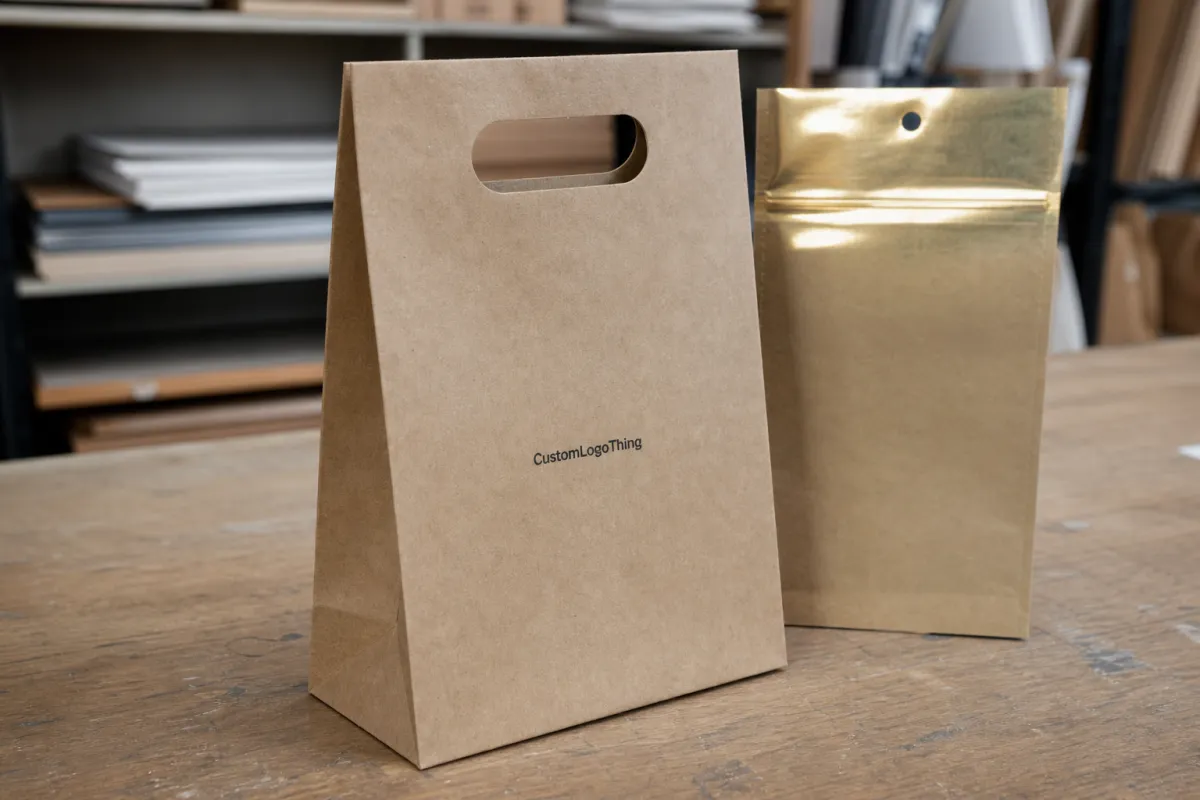
A bag can look polished in a mockup and still split at the gusset after a few handoffs. I have seen that happen more than once. The front panel stays clean, the logo prints beautifully, and then the failure shows up in the fold, the seal, or the handle attachment long before the ink starts to fade. That is the trap buyers fall into when they search for a pet treat Paper Shopping Bags material guide and only focus on appearance.
This pet treat Paper Shopping Bags material guide is really a buying framework. It links paper weight, fiber mix, coating, and print method to the treat inside the bag: dry biscuits, crumbly training snacks, oily chews, or mixed packs with inserts. The logic sounds neat on paper, but two bags with identical outside dimensions can behave very differently once fill weight, gusset depth, and finish enter the mix. Packaging has a way of humbling tidy assumptions.
From a buyer’s angle, these bags sit in a middle zone between retail packaging and light food-adjacent packaging. That middle ground matters. You are not only buying for shelf appeal. You are buying for grease resistance, controlled porosity, handle strength, and a clean look after customers touch the bag three or four times. A pet treat Paper Shopping Bags material guide has to cover all of that because pet treats are usually handled at checkout, tossed into baskets, then carried home in a car or a damp tote.
Four material families show up in most sourcing conversations: kraft paper, recycled stock, coated paper, and laminated paper. Kraft gives a natural, practical look. Recycled stock can support a credible sustainability story, especially when it includes post-consumer waste content. Coated and laminated options improve stain resistance and sharpen print, but they change the feel in hand and can push cost up faster than many buyers expect. A useful pet treat Paper Shopping Bags material guide should not rank those options by looks alone. It should rank them by the treat profile, the sales channel, and the production realities behind the quote.
A good paper bag spec is not the fanciest one. It is the one that still looks intentional after the bag has been filled, carried, set down, and handled several times.
That is why this pet treat Paper Shopping Bags material guide starts with fit, not aesthetics. If the bag does its job, the brand still looks sharp after a counter display, a customer handoff, and the walk to the parking lot. If it is overbuilt, you pay for performance you never use. If it is underbuilt, the first crease or stain becomes the brand story, and that story is rarely flattering.
How Pet Treat Paper Shopping Bags Material Guide Choices Work
The mechanics are straightforward once you separate them. Paper structure, porosity, and surface treatment shape how a bag feels, how sharply it prints, and how much abuse it can take. In a pet treat Paper Shopping Bags material guide, those three variables matter because pet treats create a particular mix of risks: light grease, fine dust, frequent handling, and a fair amount of shelf visibility.
Porosity is a quiet variable with an outsized effect. A more open sheet can breathe better and fold with less cracking, but it may also absorb stains faster. A tighter surface improves print holdout and slows moisture penetration, yet it can make the bag feel less natural and change how glue behaves during converting. That is why the same material can look excellent on a sample sheet and behave differently in a production run. The paper face is only part of the story; bond lines, fold memory, and glue bond strength matter just as much.
Heavier board grades usually improve stiffness and standing strength, which helps if the bag needs to sit upright on a shelf or at a POS counter. The tradeoff is real. More stiffness can make folds less crisp, raise freight weight, and increase unit cost. Lighter papers can feel more refined in the hand, but they may collapse faster after repeated carrying. A smart Pet Treat Paper Shopping Bags material guide compares those behaviors against the actual fill weight instead of assuming heavier is automatically better.
Surface treatment changes the visual tone quickly. Uncoated paper gives a warm, natural, slightly matte appearance that works well for handmade treats, simple ingredient stories, and minimalist brands. Coated surfaces resist fingerprints and light moisture better, while also making color pop more strongly under store lighting. That can help if the packaging uses photographic art or bold block colors. It can also make the design feel less earthy, which matters if the brand sells on transparency and natural positioning.
There is another practical layer that buyers often miss: the way converting equipment handles the stock. Folding accuracy, adhesive grab, handle reinforcement, and top-edge rigidity all shift with paper structure. A material that looks good in a static swatch can still create weak gusset behavior or slight skew in the final bag. A pet treat paper shopping bags material guide should therefore be read as a production document, not just a sourcing note. If the paper fails in converting, the shelf story does not matter.
One more point matters in practice: the same paper behaves differently depending on whether the treats are dry, oily, or crumbly. Dry biscuits are forgiving. Oily chews are not. Crumbly snacks create dust that can expose every seam and weak patch in the stock. That is why a pet treat paper shopping bags material guide always needs a real fill test, not an empty bag inspection.
For shipping or retail transit, it also helps to separate the bag’s job from the carton’s job. Corrugated cardboard protects the master case. The paper shopping bag protects presentation and short-term handling. Mixing those responsibilities is a classic buying mistake, because a bag should not be asked to behave like a shipping carton.
Key Material Factors That Change Performance and Feel
Paper weight, often measured as GSM, is the first number many buyers ask for, and for good reason. It signals hand feel, load support, and how confidently the bag will stand on a counter. In a pet treat paper shopping bags material guide, GSM is not a vanity metric; it is a clue about stiffness, durability, and the bag’s ability to keep its shape after being filled and carried. For small dry treats, lighter stock can work well. For heavier assortment packs or bags with rope handles, more substantial stock usually makes sense.
Barrier needs come next. Pet treats rarely need the full treatment of a high-barrier food pouch, but they often need selective protection. Grease resistance helps prevent visible oil marks. Moisture resistance matters if the bag will sit near a doorway, ride in a car, or be handled after a rainy walk. Aroma control can matter for stronger-smelling treats, and dust resistance keeps the bag cleaner on the shelf. A useful pet treat paper shopping bags material guide does not overengineer these needs; it matches the barrier to the product profile.
Sourcing claims matter too. Buyers increasingly ask for FSC certified paper, PEFC sourcing, recycled materials, and post-consumer waste content. Those claims can be meaningful, but they should be checked carefully. Recycled content can vary in brightness and strength from one mill lot to another. That does not make recycled stock a bad choice. It means the spec should define acceptable tolerances for appearance and performance. If the bag must support a premium print finish, the recycled mix needs to be tested early.
Print compatibility is another practical filter. Some stocks take ink cleanly and give crisp logo edges. Others absorb too much, causing softer edges or muted color. Matte papers often support a natural look, while gloss or coated surfaces make colors more vivid and improve contrast. If the logo depends on fine type, gradients, or a detailed pattern, the wrong paper can quietly undermine the whole design. A seasoned pet treat paper shopping bags material guide should tell the buyer to check print proofs under store lighting, not only on a design file.
Structural details belong in the material decision as well. Side gussets influence capacity and expansion. Square bottoms improve stand-up behavior. Handle style changes both comfort and perceived value. Flat paper handles are usually more economical. Twisted handles feel sturdier and often read as a step up. Rope handles can signal gift-like presentation, but they may not be necessary for every treat bag. The right pet treat paper shopping bags material guide treats those features as part of the material system, not decorative afterthoughts.
| Material option | Typical feel | Barrier level | Best fit | Relative cost signal |
|---|---|---|---|---|
| Natural kraft paper | Warm, matte, honest | Low to moderate | Dry treats, earthy branding | Low to mid |
| Recycled paper stock | Textured, slightly variable | Low to moderate | Sustainability-led brands | Low to mid |
| Coated paper | Smoother, sharper print | Moderate | Retail displays, branded graphics | Mid |
| Laminated paper | Premium, more polished | Moderate to high | Gift sets, heavier handling | Mid to high |
That table is a starting point, not a final answer. A 160 gsm kraft bag with a reinforced base can outperform a thinner coated bag if the product is light and dry. The reverse can also be true. In a real pet treat paper shopping bags material guide, the bag spec has to be read as a system: paper, coating, fold geometry, glue pattern, handle, and fill profile working together.
Pet Treat Paper Shopping Bags Material Guide: Cost, MOQ, and Pricing
Cost is where buyer assumptions often fall apart. Two bags that look nearly identical can differ enough to change margin, especially once artwork, coating, and handle choice enter the conversation. A pet treat paper shopping bags material guide should therefore start with the main cost drivers: substrate, coating, print coverage, finishing, handle style, and any special barrier treatment.
For smaller production runs, a basic natural kraft bag with a single-color print and flat handles might land around $0.18-$0.28 per unit for 5,000 pieces, depending on size, print area, and freight. If you move to a white bleached stock, add more colors, or specify a soft-touch finish, the same order can move into the $0.24-$0.40 per unit range or higher. That is not a quote. It is a reality check. The market rewards simplicity, and it charges for every extra step.
MOQ matters because setup costs need to be spread across the run. Plates, dies, color matching, and finishing all introduce fixed labor and machine time. When the order is small, those fixed costs are visible in every unit. As quantity rises, unit cost drops because the setup is diluted. That is why a lower-looking quote can become the more expensive option if the spec is not matched line for line. A disciplined pet treat paper shopping bags material guide asks buyers to compare only when the size, GSM, coating, handle, and print coverage are identical.
Here is a more practical way to think about pricing in a pet treat paper shopping bags material guide: a slight change in stock can move the quote more than a change in artwork color count. Switching from natural kraft to bleached white stock, for example, may affect the look, the yield, and the consistency of the final print. Adding a laminated surface can increase not only material cost but also process time and spoilage risk. Those are the hidden costs that disappear in fast quote comparisons.
Freight, storage, samples, artwork revisions, and rush charges are easy to overlook because they often sit outside the headline unit price. Yet they can decide whether a project works. A buyer may save two cents on paper and then lose that savings in rework, air freight, or a second sample round. A practical pet treat paper shopping bags material guide keeps those secondary costs in view from the start.
Material choice also interacts with the sustainability narrative. Some buyers want biodegradable packaging language, but that claim should be used carefully. Coatings, inks, and laminated layers can change end-of-life behavior. A paper bag can still be a smart choice, but it is not automatic proof of easy recycling or compostability. If the story depends on recycling, the buyer should verify local acceptance rules and avoid vague promises. That is especially true with recycled materials, because post-consumer waste content and recyclability are related, but they are not the same claim.
For comparison, the sustainability choice can be very different from the cost choice. A lower-cost kraft bag may make sense for a dry treat line with high turnover, while an FSC-based coated bag may make more sense for a premium shelf set or a retail environment where appearance matters more. That kind of tradeoff is exactly why the pet treat paper shopping bags material guide belongs at the spec stage, not after the quote comes back.
If you are comparing suppliers, ask for a clean spec sheet before anything else. It should list GSM, coating type, handle style, print coverage, MOQ, and Lead Time. If those details are missing, the quote is not comparable. It is just a rough number.
Production Steps, Process, and Lead Time for Paper Bags
Production follows a predictable path, but only if the spec is locked early. A pet treat paper shopping bags material guide should map the sequence this way: spec confirmation, dieline creation, sample approval, printing, converting, quality control, packing, and shipment. Each step can influence the next one. If artwork changes after the dieline is approved, the schedule shifts. If the coating needs a different drying window, converting may need to wait. If the handle style changes, tooling may need adjustment.
Artwork approval usually takes longer than people expect. Color matching is a real variable, especially if the brand has a precise logo blue, a warm natural kraft tone, or a large photograph on the bag face. The factory may produce a proof quickly, but final sign-off often takes a few review rounds. That is normal. A pet treat paper shopping bags material guide should assume this and build time around it rather than pretending approvals happen instantly.
Simple paper bags can often move through production in roughly 12-15 business days from proof approval if the material is standard and the print is straightforward. Add special coatings, foil, embossing, or custom handles, and the timeline can stretch closer to 18-25 business days, sometimes longer if material availability is tight. That range depends on factory workload, tooling, and the number of finishing steps. A smart pet treat paper shopping bags material guide does not promise speed without checking the real spec.
There is a useful connection here to testing standards. If the bags will travel through multiple distribution points, align the packaging sample with the kind of handling it will actually receive. The testing discipline used in organizations like ISTA can help buyers think more clearly about shipping stress, even when the item is a retail bag rather than a shipper. Likewise, if sustainability claims need third-party verification, the chain-of-custody framework from FSC is worth reviewing before artwork locks in.
Buffer time matters. Sample feedback, proof corrections, and freight movement can easily add several days. Ocean freight is slower than air, but even short-distance transport can be delayed by consolidation or customs paperwork. The best pet treat paper shopping bags material guide is not just a material reference; it is also a schedule control tool. The earlier the spec gets fixed, the easier it is to hit launch day without last-minute compromises.
From an operations point of view, the cleanest order is the one with fewer moving parts. One paper grade, one coating decision, one handle style, one print plan. Every extra variable creates another chance for delay or inconsistency. That is why buyers often get better results by reducing complexity instead of stacking features on top of each other.
Common Mistakes When Choosing Paper Bag Materials
The biggest mistake is choosing on appearance alone. A natural kraft bag can look perfect in a mockup and still fail once oily treats sit inside it for a few hours. A pet treat paper shopping bags material guide should prevent that mismatch by forcing the buyer to test the bag under real conditions, not only under studio lighting.
Another mistake is over-specifying barrier performance. Some buyers ask for a heavy coating or a laminated surface because it sounds safer. Sometimes that is justified. Often it is not. If the treats are dry and the bag will be used quickly, a simpler coated paper may do the job at a lower cost and with less material waste. Buying the wrong level of protection is expensive in two directions: first in unit price, then in unnecessary complexity. A useful pet treat paper shopping bags material guide keeps that tradeoff visible.
Comparing bags by size alone is also misleading. Two bags can share the same width and height while differing in GSM, coating, handle reinforcement, and print method. That means the cheaper quote may actually be the lighter spec. The better comparison is a spec sheet, not a dimension sheet. If the bag is meant to carry premium treats, a thin stock can create a weak brand impression even if the artwork looks polished on screen.
Sustainability checking is another area where buyers get tripped up. A vague recycled-content claim is not enough. Neither is assuming that all paper bags are easy to recycle everywhere. Local recycling rules vary, and coatings or adhesives can affect acceptance. Recycled materials are useful, but the claim needs context. If the bag includes a film layer or heavy treatment, the end-of-life story may change. That is one reason a pet treat paper shopping bags material guide should ask for exact composition, not broad marketing language.
It is also a mistake to ignore the actual product inside the bag. Empty samples rarely reveal the full picture. Real treats add weight, pressure, dust, and residue. They can change how the bottom panel sits and how the handles feel after the bag has been carried for a few minutes. I would test with the real product every time. The bag may pass an empty inspection and still fail when filled.
Finally, do not ask the paper bag to do the job of corrugated cardboard. A retail paper shopping bag is for presentation, handling, and short transport. Corrugated cardboard is for impact protection, stacking, and shipment. Mixing those jobs creates avoidable failures, especially in chains where master cases and front-of-house packaging are specified by different teams.
The safest buying habit is simple: test the bag with the real treat, under real handling, before you approve the order.
That single habit catches more problems than any glossy sales sample. It also keeps the pet treat paper shopping bags material guide grounded in performance instead of wishful thinking.
Expert Tips and Next Steps Before You Order
The quickest way to make a better decision is to compare three samples side by side: one budget spec, one target spec, and one premium spec. That gives you a real feel for what extra GSM, coating, or finish actually buys. In a pet treat paper shopping bags material guide, this three-sample method is worth more than a long email thread, because it turns abstract pricing into a tactile comparison.
Ask every supplier for the same clean spec sheet before comparing quotes. It should list GSM, coating type, handle style, print coverage, MOQ, lead time, and any special finishing. Without that, the numbers are not apples-to-apples. A vendor quoting uncoated kraft with flat handles is not competing directly with a vendor quoting coated white stock with rope handles. A disciplined pet treat paper shopping bags material guide should make that obvious before the purchasing team gets tempted by the lowest number.
Sample testing should be specific. Check crease cracking after folding, stain resistance after 24 hours, handle pull strength, and how the bag looks after being handled on a store floor. Look at print clarity under warm retail lighting, not only under office LEDs. Place the actual treats inside the sample and leave it sitting for a day. That is a better test than an empty hand feel. The bag should still look neat after a short retail cycle, because that is where most brands lose the visual battle.
For packaging teams balancing cost and brand image, it is useful to remember that a stronger spec is not always the right spec. Sometimes a slightly lighter kraft paper bag with a clean single-color print performs better than a heavier laminated option that feels overworked. That is the kind of judgment a good pet treat paper shopping bags material guide should support. The goal is not to buy the most material. The goal is to buy the most suitable material.
My practical order sequence would be this: shortlist two or three specs, request samples, confirm pricing against one locked specification, then verify production timing before artwork approval. That order reduces surprises. It also makes it easier to defend the decision internally, because the tradeoffs are visible. If sustainability matters, confirm whether the stock is FSC certified, whether recycled content includes post-consumer waste, and whether the end-of-life story matches local recycling reality.
One last filter: think about the customer’s path after the purchase. If the bag will ride home in a car, sit near a warm window, or be carried in damp weather, the surface finish becomes more important than the mockup suggests. That is where a pet treat paper shopping bags material guide earns its keep. It turns a vague packaging idea into a workable spec, a clear quote, and a bag that still looks good after handling.
For buyers at Custom Logo Things, the cleanest next step is to turn the pet treat paper shopping bags material guide into a spec request with exact size, GSM, coating, handle type, print coverage, and target quantity. Once those pieces are fixed, pricing becomes easier to trust, lead times become easier to plan, and the final bag has a much better chance of doing what it is supposed to do: protect the treats, support the brand, and hold up in the hands of real customers.
Which paper weight is best in a pet treat paper shopping bags material guide?
Use lighter GSM for small, dry treats and heavier GSM for larger packs or Bags with Handles. A pet treat paper shopping bags material guide should also check the fill test, because load behavior depends on gussets, folds, and how the treats sit inside the bag. If the bag must stand upright on shelves, stiffness matters as much as weight.
Are coated or uncoated pet treat paper shopping bags better for oily treats?
Coated paper usually performs better when treats leave grease marks or when the bag will be handled often. Uncoated paper gives a more natural look, but it may need a liner or a dry product profile to stay clean. A pet treat paper shopping bags material guide should choose based on the actual treat formula, not only on brand style.
How does material choice affect MOQ and unit cost for pet treat bags?
Special coatings, custom finishes, and multiple print colors usually push MOQ upward and increase setup cost. Standard kraft stock and simpler artwork tend to keep pricing more efficient at smaller volumes. In a pet treat paper shopping bags material guide, unit cost typically falls as quantity rises because setup charges are spread across more bags.
What should I test in a sample from a pet treat paper shopping bags material guide?
Check crease cracking, stain resistance, handle pull, and whether the bag still feels sturdy after being filled. Look at print clarity under store lighting and after the bag has been handled for a while. Use the actual product inside the sample so you see realistic performance. That is the most reliable test in a pet treat paper shopping bags material guide.
How long does production usually take for custom paper treat bags?
Lead time depends on artwork approval, sample sign-off, printing complexity, and finishing choices. Simple specs usually move faster than bags with special coatings, extra colors, or decorative effects. Add buffer time for proofing and freight so the launch date stays realistic. A solid pet treat paper shopping bags material guide should treat timing as part of the spec, not an afterthought.


